• KGS/USD = 0.01143 -0%
  • KZT/USD = 0.00198 -0%
  • TJS/USD = 0.10899 0.93%
  • UZS/USD = 0.00008 0%
  • TMT/USD = 0.28490 -0.28%
  • KGS/USD = 0.01143 -0%
  • KZT/USD = 0.00198 -0%
  • TJS/USD = 0.10899 0.93%
  • UZS/USD = 0.00008 0%
  • TMT/USD = 0.28490 -0.28%
  • KGS/USD = 0.01143 -0%
  • KZT/USD = 0.00198 -0%
  • TJS/USD = 0.10899 0.93%
  • UZS/USD = 0.00008 0%
  • TMT/USD = 0.28490 -0.28%
  • KGS/USD = 0.01143 -0%
  • KZT/USD = 0.00198 -0%
  • TJS/USD = 0.10899 0.93%
  • UZS/USD = 0.00008 0%
  • TMT/USD = 0.28490 -0.28%
  • KGS/USD = 0.01143 -0%
  • KZT/USD = 0.00198 -0%
  • TJS/USD = 0.10899 0.93%
  • UZS/USD = 0.00008 0%
  • TMT/USD = 0.28490 -0.28%
  • KGS/USD = 0.01143 -0%
  • KZT/USD = 0.00198 -0%
  • TJS/USD = 0.10899 0.93%
  • UZS/USD = 0.00008 0%
  • TMT/USD = 0.28490 -0.28%
  • KGS/USD = 0.01143 -0%
  • KZT/USD = 0.00198 -0%
  • TJS/USD = 0.10899 0.93%
  • UZS/USD = 0.00008 0%
  • TMT/USD = 0.28490 -0.28%
  • KGS/USD = 0.01143 -0%
  • KZT/USD = 0.00198 -0%
  • TJS/USD = 0.10899 0.93%
  • UZS/USD = 0.00008 0%
  • TMT/USD = 0.28490 -0.28%
06 December 2025

Viewing results 1 - 6 of 14

Air Astana Signs Memorandum for Delivery of 50 Airbus A320neo Aircraft

Kazakhstan’s national carrier Air Astana has signed a memorandum of understanding with Airbus for the delivery of up to 50 A320neo family aircraft. The agreement includes 25 firm orders and 25 options, according to a company press release. The proposed purchase will comprise a mix of A320neo and A321neo models, with initial deliveries expected in 2031. Most of the aircraft will be A321LRs, long-range models on which Air Astana was among the first to introduce a premium cabin layout for long-haul routes to Europe and Asia. This new memorandum builds on an earlier agreement announced by the airline this month and remains subject to shareholder approval. Air Astana CEO Peter Foster, who is set to step down in March 2026, noted that expanding the A320neo fleet will help the airline enhance operational efficiency and maintain high service standards. He added that these aircraft “have demonstrated excellent operational performance over many years” in the company’s fleet. Air Astana introduced the A320ceo into its fleet in 2006 for domestic and regional routes across Central Asia and the Caucasus. The first A320neo joined the fleet in November 2016, followed by the A321LR in September 2019. The A321LRs are deployed on long-haul routes to Europe and Asia. The Air Astana group currently operates 62 aircraft, 59 of which belong to the A320 family. These are utilized by both Air Astana and its low-cost subsidiary FlyArystan. Earlier this year Air Astana also signed a contract with Boeing for the delivery of up to 15 Boeing 787-9 Dreamliners. That order brings the total Dreamliner portfolio to 18 aircraft, with deliveries scheduled between 2032 and 2035. The total catalog value of the fleet stands at approximately $7 billion. The arrival of the first Dreamliners is tied to the planned launch of a direct route between Astana and New York.

Alatau to Become First City in Kazakhstan with Air Taxi System

Alatau, a newly established city in southern Kazakhstan near the country’s largest metropolis, Almaty, is set to become the first in the nation to launch an air taxi system. Kazakhstan’s Ministry of Artificial Intelligence and Digital Development recently signed a memorandum of understanding with U.S. based Joby Aero, Inc. for the purchase of electric vertical take-off and landing (eVTOL) aircraft valued at approximately $300 million. The aircraft will form the basis of a new urban air mobility system. The agreement also includes Alatau Advance Air Group Ltd., a local operator and integrator of air mobility technologies, and Vyacheslav Kim, chairman of the board of directors at Kaspi.kz and a key investor in the Alatau City development project. Plans for the construction of Alatau City were unveiled in late 2024, when four villages near Almaty were merged to create a new urban agglomeration. The city aims to attract $7.2 billion in investment and grow to a population of 2 million. It will also be part of a special economic zone that includes more than 170 planned projects worth a combined $24.4 billion. Authorities hope to position Alatau as a leading destination for investors. Joby Aero, Inc., a global leader in eVTOL aviation and the developer of certified electric air taxis, will supply aircraft capable of vertical take-off and landing. These aircraft will anchor Kazakhstan’s first urban air mobility initiative. The agreement also includes the creation of a testing site in southern Kazakhstan for certification and demonstration flights, along with plans to integrate air taxis into the transport systems of both Alatau and Almaty. Joby’s electric aircraft can travel up to 160 kilometers on a single charge and reach speeds of up to 322 km/h. The distance between Almaty and Alatau is approximately 34 kilometers. “Kazakhstan is taking a step into the future of innovative transport. The purchase of electric eVTOL aircraft marks an important milestone in developing smart cities and integrating cutting-edge technologies,” said Zhaslan Madiyev, Minister of Artificial Intelligence and Digital Development. “This move will shape Alatau as a city built on the technologies of tomorrow.” As previously reported by The Times of Central Asia, Kazakh authorities plan to launch commercial air taxi operations as early as next year.

Uzbekistan Denies Reports on Return of Afghan Military Helicopters

Speculation has resurfaced regarding the fate of Afghan military aircraft flown to Central Asia during the collapse of the previous Afghan government in August 2021. On September 10, Taliban spokesman Zabihullah Mujahid told The Kabul Times that Uzbekistan had agreed to return helicopters that Afghan pilots had flown across the border as Kabul fell. He claimed the transfer of 57 helicopters was imminent, describing it as a step toward rebuilding Afghanistan’s air force and strengthening ties between the two countries. According to Mujahid, the aircraft had remained in Uzbekistan under the terms of quiet negotiations between Tashkent and Kabul. The U.S. Department of Defense previously confirmed that 46 planes and helicopters were flown to Uzbekistan and another 18 to Tajikistan in 2021. The aircraft included Mi-17 and UH-60 helicopters, along with PC-12, C-208, AC-208, and A-29 fixed-wing aircraft. However, Uzbekistan’s Ministry of Foreign Affairs quickly denied the Taliban’s claims. On September 11, ministry spokesperson Ahror Burkhanov told Gazeta.uz that reports of an agreement to return the helicopters “do not correspond to reality.” He dismissed the information as “fake news” and emphasized that Uzbekistan’s position on the issue remains unchanged. The Taliban has repeatedly demanded the return of the aircraft from both Uzbekistan and Tajikistan, but neither Tashkent nor Dushanbe has responded to these requests publicly. U.S. Ambassador to Uzbekistan Jonathan Henick previously stated that Washington and Tashkent reached an understanding in 2021 regarding the aircraft. He added that part of the military equipment remains in Uzbekistan, and that the two governments are cooperating on the matter through a joint program. Prior to the Taliban’s return to power in August 2021, Afghanistan’s air fleet included 164 military aircraft. Today, only 81 are believed to remain. As the government collapsed, many Afghan Air Force pilots fled with their aircraft to neighboring countries, including Uzbekistan and Tajikistan.

What Drives Kazakhstan’s Threefold Growth in High-Tech Exports

Kazakhstan has sharply increased its presence in the global market for high-tech goods in recent years. According to analysts at Finprom.kz, the country’s high-tech exports nearly tripled, rising from $2.5 billion in 2021 to $7.3 billion in 2024. Geography and Growth Dynamics This surge was driven less by a physical increase in exports, up 9.7%, and more by rising global prices and the growth of re-exports. Since 2022, amid shifting geopolitical dynamics, Kazakhstan has emerged as a key player in re-export chains for complex technical equipment. The Bureau of National Statistics reports that nearly 77% of high-tech export value in 2024 ($5.6 billion) was attributed to companies registered in Astana and Almaty. However, this reflects business registration patterns rather than actual production. For example, a Kazakh-Chinese joint venture in Ust-Kamenogorsk manufactures fuel assemblies for nuclear reactors, yet its exports are registered as originating from Almaty. Uranium: The Strategic Core Uranium and its compounds remain Kazakhstan’s dominant high-tech export, comprising 62.7% of the total in 2024, or $4.6 billion. Over the past three years, the value of uranium exports rose 2.6 times, while the physical volume increased by just 16.7%. The key driver was a sharp spike in global uranium prices: in the first half of 2024 alone, the spot price rose by 73%, while long-term contract prices also trended upward. Aviation and Leasing Structures Aircraft ranked second in terms of profitability. In 2024, exports of airplanes and helicopters exceeded $940 million, 30 times higher than in 2021. Ireland was the largest reported buyer. However, this spike reflects aviation leasing arrangements rather than direct aircraft sales. As noted in a document submitted by Prime Minister Olzhas Bektenov to the Mazhilis, Kazakhstan's parliament, Kazakhstan’s national carrier Air Astana operates aircraft registered in Ireland, leading to leasing-related flows being counted as exports. Smartphones, Electronics, and Digital Equipment Smartphones emerged as a fast-growing category, with exports increasing 54-fold to $433 million. Key markets included Central Asian neighbors, Mongolia, and the Czech Republic. Much of the growth occurred in 2022, driven by shifting supply chains amid international sanctions. While the volume of exported computers and digital equipment rose, their total value declined. Notably, exports of digital data processing units fell from $136.6 million in 2021 to $11.6 million in 2024. This discrepancy highlights the predominance of re-exports. In 2024, Kazakhstan produced just 33,000 computing units but exported 744,100. Similarly, it manufactured 7,500 electromechanical devices while exporting nearly 200,000. Broader Export Structure According to QazTrade, the share of high value-added products in Kazakhstan’s exports reached 13.5% or $11.1 billion in 2024, marking a 16.1% year-on-year increase. However, the country’s export structure remains resource-heavy: raw materials account for 63.3% of total exports, followed by low value-added goods at 15.5%, with high-tech processed goods in third place.

Third Canadian-Manufactured Aircraft for Asman Airlines Arrives in Kyrgyzstan

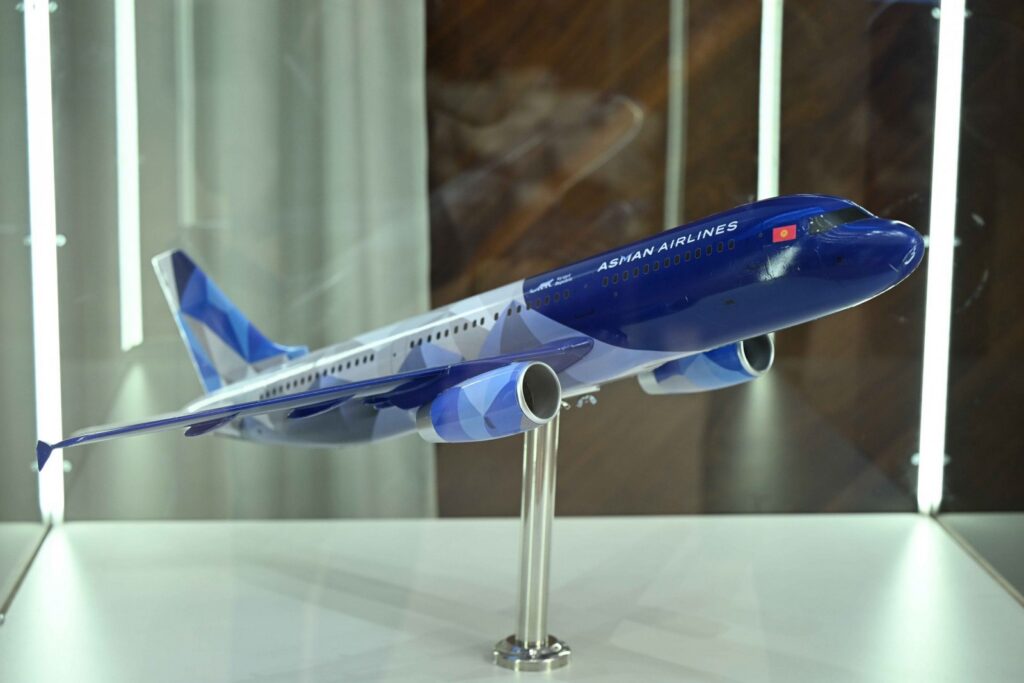
On September 2, the third Dash 8 Q400 aircraft for Kyrgyzstan’s state-owned Asman Airlines arrived at Manas International Airport in Bishkek, according to JSC Airports of Kyrgyzstan. The Dash 8 Q400, manufactured in Canada, is a short-haul turboprop aircraft designed to carry up to 80 passengers over distances of up to 2,000 kilometers. Its specifications make it well-suited for domestic flights in Kyrgyzstan, where mountainous terrain and underdeveloped road infrastructure pose challenges to ground transportation. Asman Airlines has recently restored domestic air connections between Bishkek and remote regional centers, including Talas, Karakol, Kerben, and Kazarman. The arrival of the third short-haul aircraft will allow the airline to expand its route network and improve accessibility and affordability of air travel for residents across the country. The first Dash 8 Q400 entered service in September 2024, followed by a second aircraft in November of the same year. The addition of the third aircraft further enhances Asman Airlines’ ability to meet growing demand for domestic travel. Looking ahead, the airline is considering the acquisition of larger aircraft such as the Airbus A320/A321 and Boeing 737, which would enable the launch of international flights. Kyrgyzstan is currently experiencing growth in both domestic and international passenger traffic. Speaking at the reopening ceremony of Kazarman Airport in the southern Jalal-Abad Region in August, President Sadyr Japarov noted that since 2021, passenger traffic has increased by 46%, while the number of flights has risen by 31%. The expansion of Kyrgyzstan’s air fleet is part of a broader national strategy to modernize the country’s aviation infrastructure. Construction of a new terminal complex at Osh International Airport began in February 2025, while Karakol International Airport and Talas Airport have already reopened. Renovation projects are also underway at Issyk-Kul International Airport and Naryn Airport.

Kazakhstan Boosts Air Transport Sector with New Fleet and Airport Revamps

Kazakhstan is set to double its civil aircraft fleet over the next five years, increasing the number of aircraft from 103 to 216 by 2030. According to the Ministry of Transport, in 2025 the country's fleet will add six new Airbus A320s and one Boeing 737 MAX 8. In January 2025, FlyArystan and Air Astana received new aircraft as part of this expansion. The government’s long-term plan aims to boost the number of aircraft operated by Kazakh airlines to 216 by the end of the decade. “This year, 36 new international routes have been launched, and eight foreign airlines have entered the market. There are currently 61 domestic routes with 850 flights per week,” said Deputy Minister of Transport Maksat Kaliakparov. As part of domestic connectivity efforts, 21 subsidized routes are now operating across nine regions, with approximately $12 million allocated for these services in 2025. The government’s priority is to improve air access to tourist destinations such as Usharal, Urdar, Kokshetau, and Turkestan. Airport Infrastructure Development Major investments are also being channeled into the country’s largest airports in Astana, Almaty, Shymkent, and Aktobe, all of which are being developed into multimodal transport hubs. In Astana, a $1.1 billion modernization project for Nursultan Nazarbayev International Airport began in 2025. Plans include the construction of a second runway, a third passenger and cargo terminal, and a multifunctional complex known as the Aerotropolis. The new facility will feature an industrial and logistics zone, business centers, hotels, and retail space. In Almaty, the airport is undergoing modernization in line with a General Development Plan extending to 2050. The initial phase includes reconstructing the domestic terminal, building a taxiway, upgrading the runway and fueling infrastructure, and establishing a cargo apron and maintenance hangar. Future phases envision a hotel and a multi-level parking facility. During the construction phase, more than 1,800 jobs are expected to be created, with an additional 550 jobs during operations. Shymkent opened a new 40,000 square-meter terminal in December 2024, boosting its annual passenger capacity from 800,000 to 6 million. Plans are underway to construct a new 3,500-meter runway and develop a multimodal hub connecting the airport with the Ontustik Special Economic Zone. In Aktobe, a multifunctional logistics center is being implemented at the airport. As part of this effort, the fuel filling complex is being upgraded, and storage capacity will more than double, facilitating an increase in flight operations. Authorities are also considering the construction of a second runway, which would allow the existing runway to undergo major repairs without disrupting service. “In addition, the government has decided to expand the boundaries of special economic zones at the country's largest airports. This will attract investors, develop industry and logistics, and turn Kazakhstan's air hubs into growth points for the national economy,” the government said in a statement. Foreign Investment and Regional Expansion As previously reported by The Times of Central Asia, the German company Skyhansa intends to construct a new cargo and passenger airport in Kazakhstan’s Zhetysu region. The project...