• KGS/USD = 0.01144 0%
  • KZT/USD = 0.00216 0%
  • TJS/USD = 0.10682 -0.56%
  • UZS/USD = 0.00008 0%
  • TMT/USD = 0.28571 0%
  • KGS/USD = 0.01144 0%
  • KZT/USD = 0.00216 0%
  • TJS/USD = 0.10682 -0.56%
  • UZS/USD = 0.00008 0%
  • TMT/USD = 0.28571 0%
  • KGS/USD = 0.01144 0%
  • KZT/USD = 0.00216 0%
  • TJS/USD = 0.10682 -0.56%
  • UZS/USD = 0.00008 0%
  • TMT/USD = 0.28571 0%
  • KGS/USD = 0.01144 0%
  • KZT/USD = 0.00216 0%
  • TJS/USD = 0.10682 -0.56%
  • UZS/USD = 0.00008 0%
  • TMT/USD = 0.28571 0%
  • KGS/USD = 0.01144 0%
  • KZT/USD = 0.00216 0%
  • TJS/USD = 0.10682 -0.56%
  • UZS/USD = 0.00008 0%
  • TMT/USD = 0.28571 0%
  • KGS/USD = 0.01144 0%
  • KZT/USD = 0.00216 0%
  • TJS/USD = 0.10682 -0.56%
  • UZS/USD = 0.00008 0%
  • TMT/USD = 0.28571 0%
  • KGS/USD = 0.01144 0%
  • KZT/USD = 0.00216 0%
  • TJS/USD = 0.10682 -0.56%
  • UZS/USD = 0.00008 0%
  • TMT/USD = 0.28571 0%
  • KGS/USD = 0.01144 0%
  • KZT/USD = 0.00216 0%
  • TJS/USD = 0.10682 -0.56%
  • UZS/USD = 0.00008 0%
  • TMT/USD = 0.28571 0%

Viewing results 1 - 6 of 79

ADB Growth Forecast Points to Strong Expansion in Tajikistan

Asian Development Bank (ADB) forecasts that Tajikistan’s economy will maintain strong growth over the next two years, driven primarily by industrial expansion and the services sector. In its latest Asian Development Outlook (April 2026), the bank projects that gross domestic product will grow by 7.3% in 2026 and 6.8% in 2027. This follows an estimated 8.4% expansion in 2025, indicating a slight moderation but continued robust performance. ADB attributes the outlook to improving industrial competitiveness and rising value-added production, which are expected to support long-term economic development and job creation. “Tajikistan’s strong growth opens up opportunities to accelerate job creation,” said Ko Sakamoto, ADB country director for Tajikistan. “By developing competitive, value-adding industries from food processing and textiles to mineral products, the country can translate growth into more and better jobs.” At the same time, inflation is projected to rise to 4.0% in 2026 and 4.5% in 2027. According to ADB, this increase will be driven by stronger consumer lending, remittance inflows, higher public sector wages, supply chain pressures, and adjustments to utility tariffs. The bank noted that the outlook remains subject to revision given the uncertain regional environment. Despite recent gains, ADB cautioned that Tajikistan’s economic structure remains vulnerable. While industrial output has grown, the country continues to depend heavily on a narrow range of products. Exports are dominated by raw materials and low- to mid-level processed goods, with higher value-added manufactured products accounting for less than 10% of total merchandise exports. To address these challenges, the report recommends a broader, ecosystem-based industrial policy. This would involve support for specific sectors, along with improvements in infrastructure, workforce skills, access to finance, and the overall business environment. ADB’s earlier assessments highlight mixed socioeconomic trends. While poverty has declined significantly from 30.9% in 2020 to 19.9% in 2024, inequality and structural constraints continue to pose challenges to long-term development.

Saryagash Bypass Road to Improve Kazakhstan–Uzbekistan Transport Links

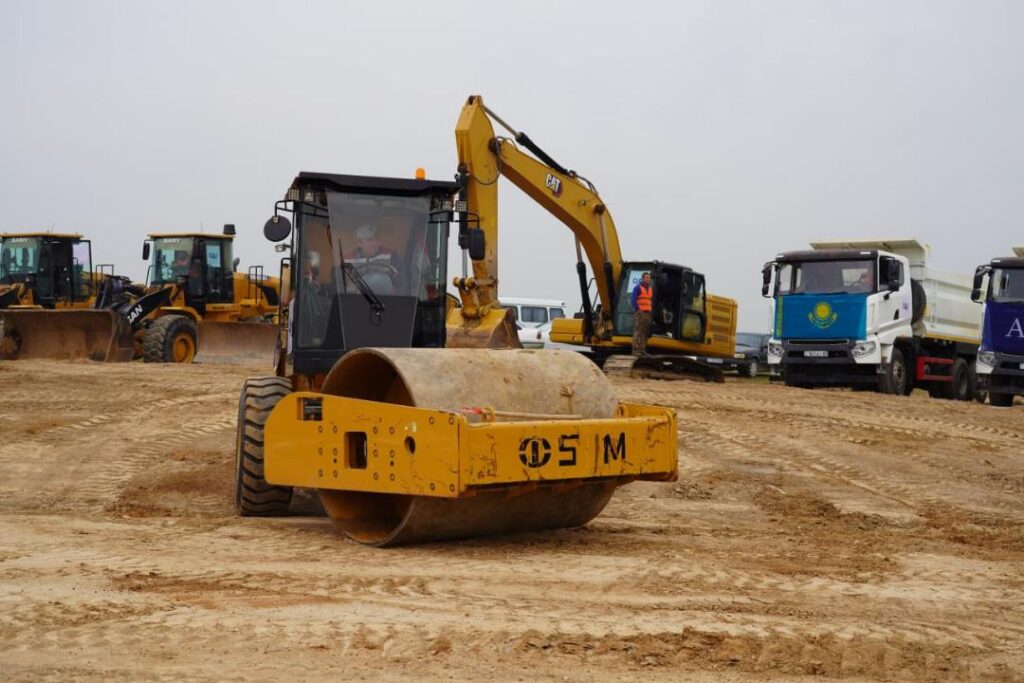
Kazakhstan has begun construction of a new highway bypassing the city of Saryagash in the Turkistan region. The project is expected to improve transport links in southern Kazakhstan and support transit along international routes. Saryagash is located in southern Kazakhstan near the Kazakh-Uzbek border, approximately 20 km from Tashkent, the capital of Uzbekistan. The Saryagash Bypass Road is designed to redirect transit traffic away from urban areas, reduce congestion within the city, shorten travel times, and facilitate faster passenger and cargo movement toward Uzbekistan. The project involves the construction of a 102.6 km modern four-lane highway, aimed at supporting cross-border trade and reinforcing the Turkistan region’s role as a key transport hub on international corridors. In September 2025, the Asian Development Bank (ADB) approved a sovereign-guaranteed loan of $400 million to KazAvtoZhol National Company for the construction of the bypass road. “The Saryagash Bypass Road will strengthen Kazakhstan’s trade and transport links within the region and with external markets in East Asia and Western Europe, helping unlock the country’s potential as a key transit hub,” said Utsav Kumar, ADB Country Director for Kazakhstan. “The project will contribute to the economic development of the Turkistan region by improving access to larger markets, reducing congestion, creating jobs, and promoting tourism.” The highway will improve links between Central Asia Regional Economic Cooperation (CAREC) Corridors 3 and 6, key trade routes connecting Kazakhstan with neighboring countries. The CAREC Program, supported by the Asian Development Bank, brings together regional countries and development partners to promote economic growth and sustainable development. In addition to the bypass project, road network modernization is ongoing in the Turkistan region, according to the Ministry of Transport. Five road repair projects with a combined length of 99.2 km are currently underway, including the reconstruction of interchanges and bridges on key routes connecting Kazakhstan with neighboring states. These initiatives are expected to increase transit capacity and improve cross-border transport flows.

Tajikistan’s Reliance on External Funding for State Investment Projects Is Growing

Tajikistan continues to implement a large-scale state investment programme. International financial institutions play a key role in financing these projects, however, while the government's own contribution remains limited. According to data from the State Committee on Investment and State Property Management, 82 state investment projects are currently under way in the country The total value of ongoing initiatives is estimated at approximately $4.67 billion. Of these, 55 projects are being implemented on a grant basis, five through loans, and another 22 have mixed financing. About $3 billion has already been allocated for procurement, works, and services related to the implementation of these projects. However, more than 70% of the funding is provided by just three international institutions. The World Bank remains the largest donor, contributing $1.725 billion (36.9%). It is followed by the Asian Development Bank with $914.7 million (19.5%) and the European Bank for Reconstruction and Development (EBRD) with $658.1 million (14.1%). Other investors include the Islamic Development Bank ($207.9 million), the Chinese government ($194.9 million), the Asian Infrastructure Investment Bank ($142.5 million), the German Development Bank ($129.3 million), and the European Investment Bank ($114.8 million). Against the backdrop of extensive external financing, Tajikistan’s own contribution remains small. The state is investing approximately $151.2 million, accounting for only 3.2% of the total. This means that the implementation of key infrastructure and social projects largely depends on international donors and lenders. At the same time, in 2025 Tajikistan managed to significantly increase capital inflows. Foreign investment reached approximately $7 billion, rising by nearly $2 billion (35.1%) compared with the previous year. The authorities hope to sustain this momentum by improving the investment climate, including through legislative updates. A key step was the adoption on May 14, 2025, of a new version of the law “On Investments and the Promotion of Investment Activity,” aimed at increasing the country’s attractiveness to international partners. The current development model allows Tajikistan to implement large-scale projects that would be difficult to carry out relying solely on domestic resources. However, this financing structure also increases dependence on external sources, making the economy more sensitive to the conditions set by international institutions and the global financial environment.

Asian Development Bank to Invest $5.5 Billion in 15 Projects in Kazakhstan by 2029

Kazakhstan's government and the Asian Development Bank (ADB) have signed a memorandum of understanding to implement 15 major projects worth approximately $5.5 billion in the period 2026-2029. The initiatives, focused on infrastructure, digitalization, and sustainable development, aim to strengthen the country’s transit capacity and investment appeal. According to an official statement, the memorandum lays the groundwork for large-scale projects in regional connectivity, disaster resilience, water resource management, modernization of housing and utilities infrastructure, and housing market development. ADB will also continue financing private-sector initiatives, including projects in agriculture, transport, and logistics. Priority areas include transport and logistics infrastructure, emergency response systems, digital technology development, and green finance. The parties also highlighted potential cooperation in artificial intelligence, the construction of data centers, the expansion of fiber-optic backbone networks, and the digitalization of transport corridors and customs procedures. One of the first concrete steps under the agreement is a project between KazAutoZhol JSC and the ADB to construct a 102-kilometer bypass road around the town of Saryagash in the Turkestan region. The new road is expected to enhance road safety, accelerate freight and passenger transport, and strengthen trade links between Kazakhstan and Uzbekistan. The parties also reviewed progress on a public-private partnership project to build a 300-bed university hospital in Karaganda. The planned medical cluster will combine professional training and scientific research, with subsequent integration of innovations into practical healthcare. ADB President Masato Kanda noted Kazakhstan’s progress in structural reforms, including measures to enhance financial sector stability, and reaffirmed the bank’s interest in supporting the country’s digital transformation. Earlier, ADB initiated a project to develop a shorter road route from Almaty to Lake Issyk-Kul in Kyrgyzstan. The new route is expected to reduce travel time by nearly half, strengthening tourism and trade connectivity between the two countries.

Tourism Master Plan for Almaty-Bishkek Economic Corridor Updated with Green Focus

On February 12, Bishkek hosted a presentation of the green update to the tourism master plan for the Almaty-Bishkek Economic Corridor (ABEC) between Kazakhstan and Kyrgyzstan, a document prepared with the support of the Asian Development Bank (ADB). The event brought together representatives of Kyrgyz government agencies, officials from the Issyk-Kul and Chui regions bordering Kazakhstan, as well as members of tourism associations and international development partners. The ABEC tourism master plan was initially approved in 2019. According to Kyrgyzstan’s Ministry of Economy and Commerce, the updated version emphasizes three key areas. The first is green tourism, including the development of eco-tourism routes, sustainable accommodation facilities, hiking and cycling trails, and measures to reduce pressure on mountain ecosystems, lakes, and national parks. The second priority is sustainable development. This includes improving resource efficiency, introducing renewable energy sources, promoting green logistics, and reducing the carbon footprint of tourism-related activities. The third focus area is regional integration and connectivity. Planned measures include digitalizing border-crossing procedures, developing sustainable transport solutions, strengthening cross-border coordination, and creating more convenient tourist routes along the corridor. The updated master plan aims to attract investment and mobilize financial resources from the ADB, national governments, the private sector, and development partners to implement priority projects along the ABEC corridor. A central infrastructure component of the ABEC initiative is the proposed construction of an alternative highway linking Almaty, Kazakhstan’s largest city, with Lake Issyk-Kul, Kyrgyzstan’s leading tourist destination. Lake Issyk-Kul remains a major attraction for visitors from across the region and is particularly popular among Almaty residents seeking weekend or summer trips. Although the two locations are separated by only about 80 kilometers in a straight line, mountain ranges make direct travel difficult. The existing route passes through Bishkek, extending the journey to more than 460 kilometers and turning what could be a short trip into an approximately eight-hour drive to Cholpon-Ata, the largest resort town on the lake’s northern shore. The Times of Central Asia previously reported on long-standing plans to establish a more direct road between Almaty and Issyk-Kul. In 2007, Kazakhstan and Kyrgyzstan signed a memorandum of understanding for a route bypassing Bishkek, running through Uzynagash and Kemin and connecting directly to Cholpon-Ata. The project, however, stalled at an early stage. If completed, it would reduce the travel distance to approximately 260 kilometers and significantly shorten travel time. The project is currently at the stage of preparing a feasibility study.

Asian Development Bank Awards $1 Million Grant to Support Floating Solar Energy in Tajikistan

The Asian Development Bank (ADB) has approved a $1 million grant to support the development of floating solar photovoltaic (PV) systems in Tajikistan, an emerging technology for the mountainous Central Asian country. According to Ko Sakamoto, ADB’s Country Director in Tajikistan, the initiative leverages the nation’s abundant solar and water resources. “This innovative initiative aims to make the most of what Tajikistan has to offer: sun and water,” he said. The project is designed to establish the foundation for a year-round, reliable, and environmentally sustainable energy supply. With 93% of its territory covered by mountains, Tajikistan faces limited availability of flat land, most of which is allocated for agriculture or housing. These conditions make the construction of ground-mounted solar power facilities prohibitively expensive. However, the country’s extensive network of reservoirs, with high solar exposure and pre-existing infrastructure, offers a viable alternative. Floating solar systems are being explored as a cost-effective and land-efficient solution to expand renewable energy output without displacing essential land uses. Under the ADB grant, technical experts will assess up to five reservoirs to evaluate their suitability for floating PV installation. The results will inform a detailed feasibility study for the construction of a large-scale floating solar plant at one selected site. The grant will also fund the modernization of the financial management system of Barki Tojik, the state-owned energy company. This component aims to improve the company's operational efficiency and financial transparency. Tajikistan has recently accelerated its shift toward clean energy. As previously reported by The Times of Central Asia, the country has launched its most ambitious solar energy initiative to date: the construction of two photovoltaic plants with a combined capacity of 500 megawatts. The scale of this project marks a strategic pivot toward energy diversification and sustainability.