• KGS/USD = 0.01144 0%
  • KZT/USD = 0.00212 0%
  • TJS/USD = 0.10609 0.28%
  • UZS/USD = 0.00008 0%
  • TMT/USD = 0.28530 0%
  • KGS/USD = 0.01144 0%
  • KZT/USD = 0.00212 0%
  • TJS/USD = 0.10609 0.28%
  • UZS/USD = 0.00008 0%
  • TMT/USD = 0.28530 0%
  • KGS/USD = 0.01144 0%
  • KZT/USD = 0.00212 0%
  • TJS/USD = 0.10609 0.28%
  • UZS/USD = 0.00008 0%
  • TMT/USD = 0.28530 0%
  • KGS/USD = 0.01144 0%
  • KZT/USD = 0.00212 0%
  • TJS/USD = 0.10609 0.28%
  • UZS/USD = 0.00008 0%
  • TMT/USD = 0.28530 0%
  • KGS/USD = 0.01144 0%
  • KZT/USD = 0.00212 0%
  • TJS/USD = 0.10609 0.28%
  • UZS/USD = 0.00008 0%
  • TMT/USD = 0.28530 0%
  • KGS/USD = 0.01144 0%
  • KZT/USD = 0.00212 0%
  • TJS/USD = 0.10609 0.28%
  • UZS/USD = 0.00008 0%
  • TMT/USD = 0.28530 0%
  • KGS/USD = 0.01144 0%
  • KZT/USD = 0.00212 0%
  • TJS/USD = 0.10609 0.28%
  • UZS/USD = 0.00008 0%
  • TMT/USD = 0.28530 0%
  • KGS/USD = 0.01144 0%
  • KZT/USD = 0.00212 0%
  • TJS/USD = 0.10609 0.28%
  • UZS/USD = 0.00008 0%
  • TMT/USD = 0.28530 0%

Viewing results 1 - 6 of 18

Kazakhstan and Azerbaijan Are Reinforcing the Middle Corridor’s South Caucasus Link

On April 7 Kazakhstan’s Foreign Minister Yermek Kosherbayev visited Tbilisi to hold talks with Georgian Foreign Minister Maka Bochorishvili and sign a 2026–2027 foreign-ministry cooperation program. He called Georgia “a key link” in the Europe–Asia transport architecture and said the common task was to raise corridor capacity, improve service predictability, and ensure tariff transparency. The materialization of the bilateral cooperation is already evident from last June’s opening of the Poti multimodal terminal by a joint Kazakhstani-Georgian company. The real meaning of Kosherbayev's discussions in Tbilisi lies in their context. On April 2 in Baku, Prime Minister Olzhas Bektenov said Kazakhstan plans an intergovernmental agreement with Azerbaijan this year to strengthen the status of the Middle Corridor (also known as the Trans-Caspian International Transport Corridor, TITR), and he proposed moving quickly on the Digital Monitoring Center under the Organization of Turkic States (OTS). On April 6 in Tbilisi, Azerbaijani President Ilham Aliyev called the Azerbaijan–Georgia segment the corridor’s “main transport artery.” Then on April 8 in Baku, Aliyev received Kosherbayev together with Kazakhstan’s transport minister. The official readout ranged from the Middle Corridor to joint investment, green-energy, and fiber-optic projects. Kosherbayev’s April 7 stop in Tbilisi thus belongs to a short Kazakhstan-led diplomatic run across the corridor’s western nodes. Kazakhstan and Azerbaijan Tighten the Corridor Kazakhstan’s early-April engagement in the South Caucasus rests on its eastward-looking framework with China. Two China–Kazakhstan documents were already in evidence in October 2023: a Memorandum of Understanding (MoU) on deepening the development of the China-Europe Railway Trans-Caspian route, and an intergovernmental agreement on developing that route. China’s National Development and Reform Commission (NDRC) subsequently clarified that the agreement focused on stronger transit organization, fewer administrative barriers, and improved logistics and transport operations. In July 2024, Kazakhstan’s President Kassym-Jomart Tokayev and his Chinese counterpart Xi Jinping jointly attended the opening of the Trans-Caspian direct fast transport service; NDRC then recorded a work mechanism with Kazakhstan’s transport ministry to carry that cooperation forward. On January 1, the first Trans-Caspian train of 2026 departed Xi’an for Baku carrying 45 containers of photovoltaic equipment. Chinese reports assert that the route had accumulated 466 runs by the end of November 2025, moved onto a weekly six-outbound and three-inbound timetable, and cut travel times from the roughly 20-day average recorded in 2025 to a standard 15 days, with the fastest runs taking 11 days. On April 3, it was also reported that there were 85 Xi’an Trans-Caspian trains in the first quarter of 2026, up 150% year-on-year, while the Kazakhstan–Xi’an terminal in Almaty handled more than 6,000 containers in that quarter alone, a 60% increase from a year earlier. A separate quasi-official Chinese trade-services portal reported that Trans-Caspian trains had reached daily service and that 371 such trains had run in January–October 2025, up 33%. China’s NDRC also said in late 2025 that Aktau and Baku should be strengthened as hub nodes in this corridor system. Azerbaijan is the indispensable partner without which the route’s western logic does not function. Bektenov’s...

Kyrgyzstan Tests Alternative Transport Route to Russia That Bypasses Kazakhstan

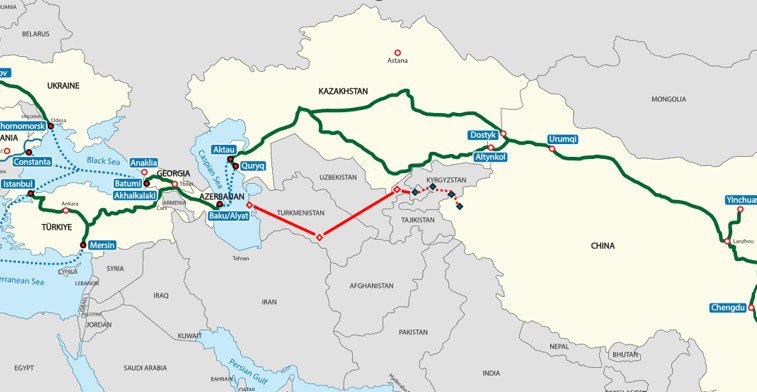
Kyrgyzstan and Russia are advancing plans for an alternative transport route that would bypass Kazakhstan. The proposed Southern Transport Corridor would connect the Russian port of Astrakhan across the Caspian Sea to the Turkmenbashi port in Turkmenistan and then continue overland through Turkmenistan and Uzbekistan to Kyrgyzstan. The first test cargo shipments along this corridor have already been completed, according to Russian media reports citing Kyrgyzstan’s First Deputy Prime Minister Daniyar Amangeldiyev. Amangeldiyev said Kyrgyzstan views the development of this southern route via the Caspian Sea as a promising alternative for trade between the two countries. “We’re working in this direction. We have a strategic partnership in this area and a shared vision. We are currently in negotiations,” he told Russia’s TASS news agency on April 3 on the sidelines of the CIS International Economic Forum in Moscow. Discussions on establishing the new transport corridor date back to October 2024, during the visit of then–prime minister of Kyrgyzstan Akylbek Japarov to Moscow. For Kyrgyzstan, the Southern Transport Corridor offers a way to reduce dependence on transit through Kazakhstan. At present, most cargo traffic between Russia and Kyrgyzstan passes through the territory of Kazakhstan. Trucks from Kyrgyzstan often face delays of several days at the border, creating significant obstacles for cargo transport, particularly for perishable agricultural goods. The new corridor is expected to help alleviate these bottlenecks and provide an alternative route linking Kyrgyzstan with the European part of Russia. Kazakhstan would continue to serve as the primary transit route for trade with Russia’s Siberian, Ural, and Far Eastern regions.

Saryagash Bypass Road to Improve Kazakhstan–Uzbekistan Transport Links

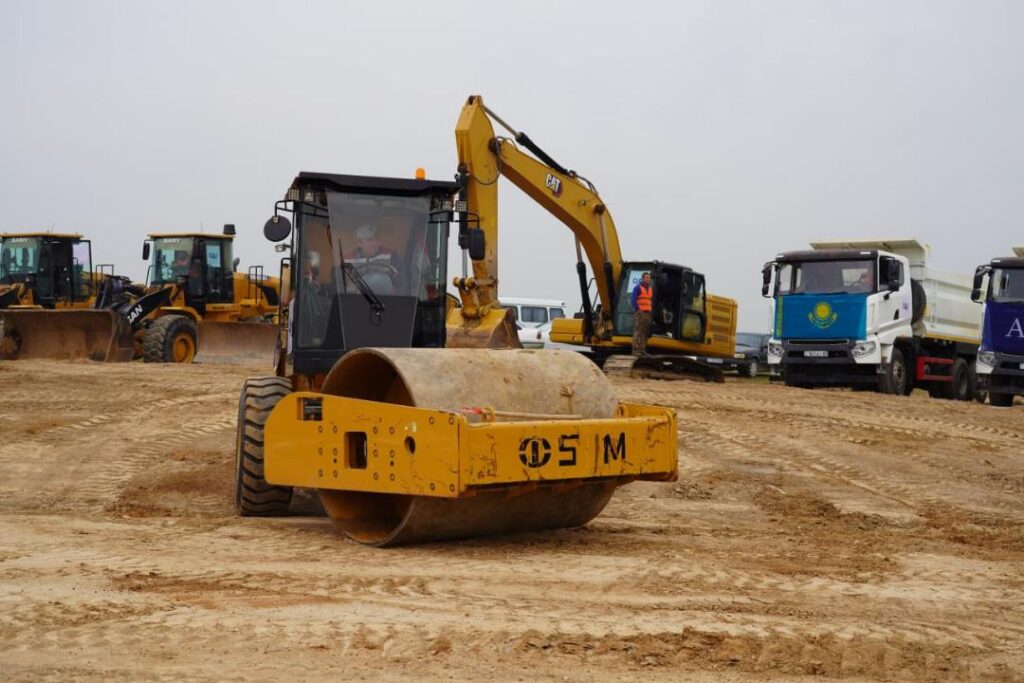
Kazakhstan has begun construction of a new highway bypassing the city of Saryagash in the Turkistan region. The project is expected to improve transport links in southern Kazakhstan and support transit along international routes. Saryagash is located in southern Kazakhstan near the Kazakh-Uzbek border, approximately 20 km from Tashkent, the capital of Uzbekistan. The Saryagash Bypass Road is designed to redirect transit traffic away from urban areas, reduce congestion within the city, shorten travel times, and facilitate faster passenger and cargo movement toward Uzbekistan. The project involves the construction of a 102.6 km modern four-lane highway, aimed at supporting cross-border trade and reinforcing the Turkistan region’s role as a key transport hub on international corridors. In September 2025, the Asian Development Bank (ADB) approved a sovereign-guaranteed loan of $400 million to KazAvtoZhol National Company for the construction of the bypass road. “The Saryagash Bypass Road will strengthen Kazakhstan’s trade and transport links within the region and with external markets in East Asia and Western Europe, helping unlock the country’s potential as a key transit hub,” said Utsav Kumar, ADB Country Director for Kazakhstan. “The project will contribute to the economic development of the Turkistan region by improving access to larger markets, reducing congestion, creating jobs, and promoting tourism.” The highway will improve links between Central Asia Regional Economic Cooperation (CAREC) Corridors 3 and 6, key trade routes connecting Kazakhstan with neighboring countries. The CAREC Program, supported by the Asian Development Bank, brings together regional countries and development partners to promote economic growth and sustainable development. In addition to the bypass project, road network modernization is ongoing in the Turkistan region, according to the Ministry of Transport. Five road repair projects with a combined length of 99.2 km are currently underway, including the reconstruction of interchanges and bridges on key routes connecting Kazakhstan with neighboring states. These initiatives are expected to increase transit capacity and improve cross-border transport flows.

China-Kyrgyzstan-Uzbekistan Railway Enters Active Construction Phase

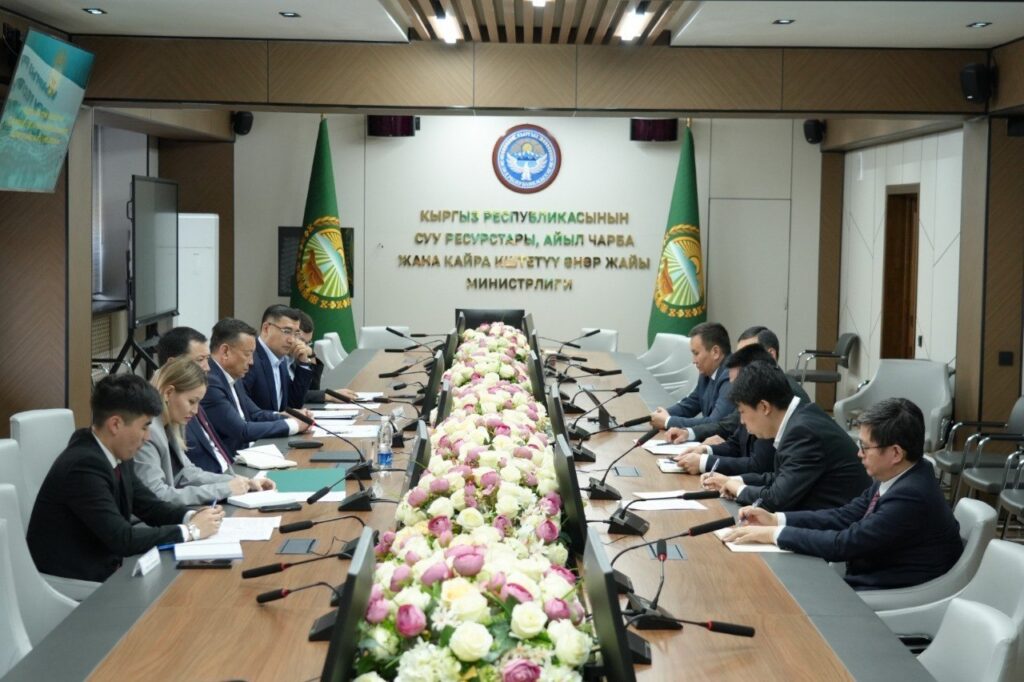
Construction of the China-Kyrgyzstan-Uzbekistan railway has entered an active phase, following a meeting between the Kyrgyz government and representatives of the company implementing the project. According to the project company, preparation of the main design materials has been completed, while refinement and approval of the technical documentation are ongoing. At the same time, large-scale work has begun at construction sites. More than 5,000 people and approximately 5,600 units of specialized equipment are currently involved in the project. Tunnel excavation, earthworks, and bridge construction are underway, with total earthworks exceeding 3.5 million cubic meters. Erlist Akunbekov, Deputy Chairman of the Cabinet of Ministers of Kyrgyzstan and the official overseeing the project, highlighted the importance of strict compliance with environmental standards and safety requirements. He added that the government would provide the necessary support and coordination to ensure timely completion. Kyrgyz authorities view the railway as a strategic infrastructure project. The new transport corridor is expected to provide the country with direct access to international markets and strengthen its role in regional logistics. One of the key challenges during the design phase was the difference in railway track gauge. China uses the 1,435 mm standard, while Kyrgyzstan and Uzbekistan use 1,520 mm. As a result, a compromise has been reached: part of the railway in Kyrgyzstan will be built to the Chinese standard, with a transshipment hub created to ensure connectivity. Economically, the project is expected to boost exports, primarily agricultural products, to China, the Middle East, and Europe. At present, a significant portion of cargo is transported by road through Uzbekistan and Turkmenistan, with onward routes to the Azov and Black Seas, as well as via China to Pakistan and India. The launch of rail services is expected to reduce logistics costs and improve the competitiveness of Kyrgyz products in foreign markets.

Can the New Multimodal Route Become a Sustainable Corridor for Central Asia?

The launch of the China-Kyrgyzstan-Uzbekistan-Turkmenistan-Caspian multimodal corridor has generated significant interest as another attempt to expand Eurasian transport connectivity. A pilot shipment in the fall of 2025 demonstrated the technical feasibility of the new route: cargo transported from Kashgar, China, passed through Kyrgyzstan and Uzbekistan, reached Turkmenistan, and was then delivered to Azerbaijan via the Caspian Sea, continuing along the Baku-Tbilisi-Kars railway toward Europe. Despite its evident geopolitical appeal, questions remain over the route’s long-term sustainability and commercial viability. The central question is whether this demonstration project can evolve into a regularly functioning transport corridor. A Third Alternative Between the Northern and Middle Corridors This multimodal route can be seen as a potential alternative to the two existing pathways: the northern route, China-Kazakhstan-Russia-Europe; and the Trans-Caspian International Transport Route (TITR), or Middle Corridor, which passes through Kazakhstan, the Caspian Sea, the South Caucasus, and Turkey. The growing geopolitical risks along the northern route since 2022, combined with capacity limitations on the Caspian segment of the TITR, have spurred interest in a third option, a so-called “southern belt” traversing Kyrgyzstan, Uzbekistan, and Turkmenistan. Each country along this route has its own strategic calculus. Uzbekistan is seeking to overcome its “double continental isolation” and elevate its role as Central Asia’s transit hub. Kyrgyzstan is aiming to monetize its geographic position between China and the Ferghana Valley. Turkmenistan is developing the port of Turkmenbashi as an alternative to the increasingly congested hubs of Aktau and Alat. China, meanwhile, continues to diversify its westward overland trade routes. The Uzbek Factor: Geoeconomics vs. Logistics From Tashkent's perspective, this corridor aligns with its long-term transport strategy. Analysts frequently cite Uzbekistan’s ambition to transition from a landlocked to a “land-linked” state with direct access to China, the Caspian Sea, and southern routes to the Indian Ocean. The new route offers Uzbekistan three strategic advantages: alternative access to China via Kyrgyzstan, enhanced status as a regional transit hub, and deeper transport cooperation with Turkmenistan, including potential joint development of the Turkmenbashi port. However, when shifting from geopolitical ambition to logistical execution, serious limitations emerge, many outside Uzbekistan’s control. Kyrgyzstan: A Bottleneck in the Chain Documents from the Central Asia Regional Economic Cooperation (CAREC) program highlight the continued challenges facing multimodal transport in the region, namely slow transit, poor modal integration, border delays, and outdated logistics technologies. Within this corridor, Kyrgyzstan remains the primary bottleneck. Approximately 82% of its foreign trade by weight is transported by road, making the route through this mountainous country highly seasonal, expensive, and unpredictable. According to the International Road Transport Union, Kyrgyzstan’s transport system faces severe constraints from alpine terrain, avalanches, and impassable mountain passes that render winter transport nearly impossible in many areas. It is therefore unsurprising that, following the pilot shipment, no major logistics operators committed to shifting regular cargo to this route. The Caspian Sea: Structural Constraints The Caspian Sea leg, anchored by Turkmenbashi port, presents another critical challenge. The limitations here are systemic rather than national. Key issues include insufficient...

Afghanistan Offered Opportunity to Regain Role as Central Asian Transit Hub

Erkin Tukumov, Special Representative of the President of Kazakhstan for Afghanistan, has called on Central Asian nations to intensify efforts to develop new transport corridors linking the region with Afghanistan and further to South Asia, including Pakistan and India. He made the remarks during the 2025 Astana Think Tank Forum at a session titled “Vision for Central Asia.” “Afghanistan has historically served as a transit hub, with the Great Silk Road and other trade corridors passing through its territory,” Tukumov stated. “Today, like the countries of Central Asia, Afghanistan is interested in developing stable and reliable transport routes that facilitate the movement of goods and provide access to South Asian markets. In the past, the region was primarily oriented toward the West, and later toward the East, particularly China. The southern direction remained largely overlooked for an obvious reason: Afghanistan endured nearly half a century of war.” Tukumov noted that the security situation is evolving, and although complete safety cannot yet be guaranteed, the level of risk has notably decreased. He emphasized that the Taliban now exercises effective control over the entirety of Afghan territory, which has contributed to an overall sense of stability. Trade and economic cooperation between Central Asian countries and Kabul, grounded in bilateral agreements, is also growing. “The next logical step is the establishment of new transport corridors connecting Central Asia with Afghanistan and South Asia. This objective can only be achieved through a coordinated regional effort,” he said. Javlon Vakhabov, Director of the International Institute for Central Asia (Uzbekistan), supported this view. He advocated for a unified regional approach to infrastructure development, including a strategic focus on the Afghan direction, and called for the creation of a sustainable coordination mechanism. “It is also necessary to convene an international forum titled ‘Central Asia - Afghanistan’ to foster expert dialogue, align policy efforts, share research, and develop joint strategies,” Vakhabov added. He further proposed involving Afghanistan in the regional water dialogue, particularly regarding the joint management of the Amu Darya, and establishing a multilateral framework to ensure equitable water use. Younes Zangyabadi, Executive Director of the Institute for Peace and Diplomacy (Canada-USA), referred to the “Group of Neighbors and Friends of Afghanistan” (6+2 format), a diplomatic initiative established in the late 20th century under UN auspices. The group included Iran, Pakistan, Tajikistan, Uzbekistan, Turkmenistan, China, Russia, and the US. Zangyabadi suggested that this format could be revived with Central Asian countries taking a leading role. “Central Asia is well-positioned to take the initiative in reviving this platform, which once brought together regional and global powers to discuss the future of Afghanistan in an inclusive manner,” he said. Valiullah Shahin, Director of the Center for Strategic Studies at the Afghan Ministry of Foreign Affairs, expressed Kabul’s readiness to participate in water negotiations and emphasized Afghanistan’s interest in boosting trade, economic ties, and regional security. He also voiced support for collaborative efforts focused on development and stability in Central Asia. Previously The Times of Central Asia reported that Kazakhstan...