• KGS/USD = 0.01144 0%
  • KZT/USD = 0.00206 0%
  • TJS/USD = 0.10812 0.37%
  • UZS/USD = 0.00008 0%
  • TMT/USD = 0.28571 0%
  • KGS/USD = 0.01144 0%
  • KZT/USD = 0.00206 0%
  • TJS/USD = 0.10812 0.37%
  • UZS/USD = 0.00008 0%
  • TMT/USD = 0.28571 0%
  • KGS/USD = 0.01144 0%
  • KZT/USD = 0.00206 0%
  • TJS/USD = 0.10812 0.37%
  • UZS/USD = 0.00008 0%
  • TMT/USD = 0.28571 0%
  • KGS/USD = 0.01144 0%
  • KZT/USD = 0.00206 0%
  • TJS/USD = 0.10812 0.37%
  • UZS/USD = 0.00008 0%
  • TMT/USD = 0.28571 0%
  • KGS/USD = 0.01144 0%
  • KZT/USD = 0.00206 0%
  • TJS/USD = 0.10812 0.37%
  • UZS/USD = 0.00008 0%
  • TMT/USD = 0.28571 0%
  • KGS/USD = 0.01144 0%
  • KZT/USD = 0.00206 0%
  • TJS/USD = 0.10812 0.37%
  • UZS/USD = 0.00008 0%
  • TMT/USD = 0.28571 0%
  • KGS/USD = 0.01144 0%
  • KZT/USD = 0.00206 0%
  • TJS/USD = 0.10812 0.37%
  • UZS/USD = 0.00008 0%
  • TMT/USD = 0.28571 0%
  • KGS/USD = 0.01144 0%
  • KZT/USD = 0.00206 0%
  • TJS/USD = 0.10812 0.37%
  • UZS/USD = 0.00008 0%
  • TMT/USD = 0.28571 0%

Viewing results 1 - 6 of 134

Insider’s View: Uzbekistan–U.S. – A New Era of Environmentally Friendly and Energy-Efficient Investment

Today, environmentally friendly and energy-efficient projects are no longer just a fashionable trend but a factor of global competitiveness. Uzbekistan, once regarded as a country with a resource-based energy system and limited opportunities for the adoption of modern technologies, is now becoming a hub for “green” investment and innovation. A strategic partnership with the United States plays a special role in this process, encompassing key areas ranging from energy and ecology to finance, education, and culture. Clean and innovative projects are becoming the hallmark of Uzbek-American relations, shaping a new model of cooperation in the 21st century. Green Energy and Strategic Partnership Uzbekistan is moving confidently toward a “green” future. While in 2018 renewable energy sources accounted for less than one percent of electricity generation, from January to July 2025, renewables already provided 20.3% of the country’s total electricity. More than 11 billion kWh of “green” energy were produced, including 6.4 billion kWh from solar power plants and 3.6 billion kWh from wind farms. This volume saved 3.6 billion cubic meters of natural gas and prevented over 2.2 million tons of harmful emissions. Every day, renewables now generate about 26.7 million kWh – enough to cover the needs of 7.28 million households for half a year, or 3.64 million homes for an entire year. Currently, 10 solar and 4 wind plants with a combined capacity of more than 4.5 GW operate across 10 regions of the country. A key focus of Uzbek-American cooperation has become “green” energy. In 2025, Allied Green Ammonia (AGA), together with the U.S. company Plug Power, announced a major project for the production of sustainable aviation fuel, green diesel, and urea. The plan includes the supply of electrolyzers with a capacity of up to 2 GW for the future complex. A final investment decision is expected by the end of 2025, and the project has already been recognized as one of the flagship initiatives for Central Asia. Air Products – A Flagship of American Presence Air Products, a global leader in industrial gases and hydrogen energy, occupies a special place in Uzbek-American cooperation. In the Kashkadarya region, the company participates in a large-scale gas-to-liquids (GTL) project worth around $1 billion. The complex is designed to produce about 1.5 million tons of synthetic fuels per year, including diesel, jet kerosene, and naphtha. Its structure includes air separation units, autothermal reformers, and hydrogen production facilities. This project has become a landmark example of how U.S. technologies are transforming Uzbekistan’s energy sector. In addition to GTL, Air Products is actively developing industrial gas production in Uzbekistan. The company participates in oxygen, nitrogen, and hydrogen production projects, introduces the latest PSA units, as well as freezing and storage technologies that reduce food losses and enhance economic resilience. Furthermore, the company has implemented a “green financing” system that links investments to sustainability principles. These projects not only strengthen the country’s industrial potential but also pave the way for positioning Uzbekistan as a regional hub for “green” energy. The company’s future plans...

Uzbekistan and United States Leaders Discuss Expanding Strategic Partnership

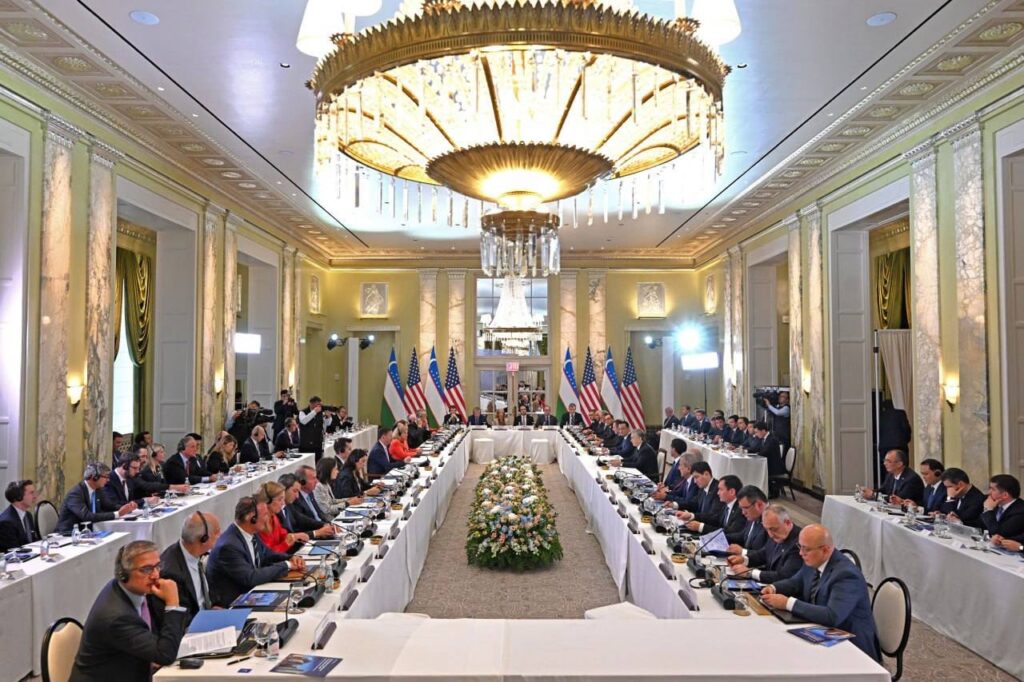
According to the office of President Shavkat Mirziyoyev, the Uzbek and U.S. presidents held a telephone conversation on Friday, focusing on ways to deepen their countries’ strategic partnership across economic, security, and cultural fields. The details of the call were provided by the Uzbek president’s office. Strengthening Economic Ties The presidential office reported that both leaders emphasized opportunities to expand trade and investment. Bilateral trade grew by 15% in 2024, and the two sides signaled interest in building on that momentum. Prospective projects span civil aviation, mineral resources, energy, agriculture, digital technologies, finance, and education. Later this month, meetings are expected between Uzbek representatives and leading U.S. companies to explore long-term cooperation. Security and Regional Cooperation According to the statement, security issues also featured prominently in the conversation. The two presidents noted ongoing joint work against terrorism, extremism, and illegal migration. They also exchanged views on regional cooperation in Central Asia, highlighting the role of the “C5+1” dialogue format that brings together the United States and five Central Asian countries. Cultural and Humanitarian Exchanges The Uzbek president’s office noted that the discussion touched on expanding cultural and educational links. Branches of U.S. universities are operating in Tashkent, providing new opportunities for academic exchange. Looking ahead, the leaders noted with satisfaction that Uzbekistan’s national football team will participate for the first time in the 2026 World Cup, which the United States will be the main host of. A Growing Partnership Since Mirziyoyev assumed the presidency in 2016, Uzbekistan has pursued a more open foreign policy and a program of internal reforms aimed at modernizing the economy and improving governance. These changes have created new opportunities for cooperation with Washington. The United States, for its part, has supported regional initiatives through the C5+1 framework, while also seeking closer ties with Tashkent in areas such as counterterrorism, economic development, and education. American universities and companies have increased their presence in Uzbekistan, and cultural exchanges have expanded steadily in recent years. Next Steps The president’s office stated that President Mirziyoyev invited President Trump to pay an official visit to Uzbekistan. Both leaders agreed to maintain high-level contacts and continue advancing joint projects and programs. According to the Uzbek president’s office, the conversation was held in a constructive and friendly atmosphere, underscoring a shared interest in further strengthening Uzbek-American relations.

Tokyo Steps Up: Iwaya’s Central Asia Tour Signals Japan’s Long-Term Commitment

Japanese Foreign Minister Takeshi Iwaya made a landmark trip to Central Asia from August 24–28, 2025, holding talks in Kazakhstan and Uzbekistan. Tokyo framed the visit as a bid to deepen bilateral ties and revive the Central Asia plus Japan leaders’ summits. The visit fulfilled commitments made by then-Prime Minister Kishida, who had planned a similar tour in 2024 before cancelling at the last minute due to a domestic earthquake alert. Strategic Engagement Iwaya’s visit reflects Tokyo’s long-standing, multifaceted approach to Central Asia. Analysts emphasized to The Times of Central Asia that Japan is pursuing “trust-building diplomacy” in the region, focusing on human capital, infrastructure, and governance rather than quick geopolitical wins. Tokyo inaugurated the Central Asia plus Japan Dialogue format in 2004, making it the first outside power to group all five Central Asian republics within a single framework. As Professor Timur Dadabaev of Tsukuba University told The Times of Central Asia, Tokyo is seen “not as a competing hegemon, but as a partner that invests in the region’s human capital, infrastructure, and governance in ways that reinforce independence.” This approach contrasts with what has been characterized as the transactional models of other powers. On August 25, Iwaya met with Kazakhstan’s Deputy Prime Minister and Foreign Minister Murat Nurtleu in Astana, marking his first official visit to the country. The talks underscored both sides’ commitment to strengthening ties as strategic partners and in upholding a “free and open international order based on the rule of law.” The ministers welcomed active exchanges and pledged to expand cooperation in trade, investment, mineral resources, disaster prevention, and nuclear non-proliferation. They also announced plans to accelerate preparations for the long-delayed Central Asia plus Japan summit. [caption id="attachment_35524" align="aligncenter" width="1000"] Japanese Foreign Minister Iwaya with Kazakh Foreign Minister Nurtleu in Astana after their meeting on August 25, 2025; image Japan MOFA[/caption] In Tashkent, Iwaya echoed this message, calling Uzbekistan “an important strategic partner,” and highlighting the first-ever foreign ministers’ strategic dialogue held there. Japanese officials also stressed their policy does not aim to pressure Central Asian partners on sensitive issues. Characterizing Japan as a “catalyst to promote interconnectivity and inter-regional cooperation,” Foreign Ministry spokesman Toshihiro Kitamura stated that Tokyo does not see a zero-sum “competition between Japan and other countries. We would like to see Central Asian countries work together with other parts of the world.” In Tashkent, Kitamura explicitly noted that while Japan condemns Russia’s invasion of Ukraine, it will not pressure Uzbekistan or others to take the same stance. “The relationship between Russia and the Central Asian countries is a very delicate issue. Each country should take into account the relations it establishes with other countries. Even if it is with Russia, such relations do not affect the relations of other countries with Japan,” Kitamura stated. Bilateral Agreements In Kazakhstan, Iwaya held high-level talks with President Kassym-Jomart Tokayev and Foreign Minister Nurtleu. Tokayev welcomed Japan as a “reliable and close partner in Asia” and said ties are “developing dynamically.” The sides agreed to...

Tokayev in Bishkek: Deals, Diplomacy, and a Golden Bridge

Kazakh President Kassym-Jomart Tokayev arrived in Kyrgyzstan on 21 August for an official visit that rolls into a full day of talks in Bishkek on 22 August, including a session of the Supreme Interstate Council. The Kyrgyz capital implemented rolling traffic restrictions around motorcade routes, a sign of how tightly choreographed the program is. The visit’s centerpiece is a Tokayev–Japarov meeting in both narrow and expanded formats, alongside a packed slate of bilateral events that underscore deepening political, economic, and cultural ties between the neighbors. Tokayev’s schedule blends state protocol with public-facing diplomacy. Alongside presiding over the seventh meeting of the Supreme Interstate Council, the two leaders are set to unveil the “Golden Bridge of Friendship” monument in Bishkek’s Yntymak Park - an attempt to give symbolic form to a relationship both sides have labored to institutionalize over the past two years. The program is also set to include the inauguration of the Consulate General of Kazakhstan in Osh, the launch of a branch of L.N. Gumilyov Eurasian National University in Kyrgyzstan’s south, the third Kyrgyz-Kazakh Youth Forum, and Days of Kazakhstan Cinema - events designed to anchor cooperation beyond chancelleries and boardrooms. This public show of diplomacy is being matched by concrete steps. The new Consulate General in Osh is intended to smooth consular services, support cross-border business, and expand cultural ties in a region where Kazakh–Kyrgyz trade and travel flows are accelerating. Central government, city, and regional officials joined Kazakh diplomats at the ribbon-cutting, underscoring the practical, day-to-day value for citizens who live and work across the southern corridor. Optics aside, the substance is in the talks. Astana and Bishkek have spent the last 18 months upgrading their legal architecture. In April 2024, the presidents signed a Treaty on Deepening and Expanding Allied Relations, moving the relationship beyond the basic language of partnership and into a framework that touches upon security, transport, energy, agriculture, and cultural cooperation. Kazakhstan’s Parliament later approved, and the president signed implementing legislation, putting the allied-relations commitments on a firmer legal footing domestically. This trip is widely viewed in both capitals as a chance to translate that framework into specific projects - some of which are already in motion. Trade and connectivity top the economic agenda. Bilateral trade hit roughly $1.7 billion in 2024, and both governments have repeatedly floated a target of $3 billion within the decade. The composition of flows is familiar: Kazakhstan ships metals, grain, fuels, and construction materials, while Kyrgyzstan supplies gold, coal, light-industry goods, and services. Reaching the next rung, however, will require more predictable border procedures, harmonized standards, and dedicated logistics capacity - areas where ministerial roadmaps are already in circulation. Energy and water cooperation is the other pillar. Kyrgyzstan’s Kambarata-1 hydropower project - envisioned as a 1,860 MW plant on the Naryn River - has become a regional test case for practical integration. Since mid-2024, Kyrgyzstan, Kazakhstan, and Uzbekistan have built a joint track with the World Bank and other partners to complete feasibility work, structure financing,...

Tokayev to Visit Kyrgyzstan for High-Level Talks on Aug. 21–22

Kazakhstan’s President Kassym-Jomart Tokayev is due in Kyrgyzstan for an official visit at the invitation of President Sadyr Japarov, with the main program set in Bishkek. An announcement, carried by state media, confirmed the trip and outlined that talks would take place on deepening political and economic ties. Local authorities have introduced traffic restrictions for Aug. 21–22, indicating a two-day schedule including protocol events and bilateral meetings. The leaders are expected to review cooperation across trade, transit, and energy, and to convene the Supreme Interstate Council, the highest bilateral forum, to sign documents prepared by their foreign ministries in recent weeks. Diplomatic sources say deliverables could include measures to ease border procedures and timelines for joint infrastructure projects. A Busier, More Formalized Partnership Kazakhstan and Kyrgyzstan have intensified engagement through 2024–2025 with frequent ministerial contacts, new investment pledges, and coordination on water-energy policy. In early August, the countries’ foreign ministers initiated a 2025–2027 cooperation plan for presidential approval at the upcoming summit. Energy is central: the governments, together with Uzbekistan and international partners, have advanced groundwork on the Kambarata-1 hydropower plant, a flagship project intended to expand clean generation and regulate seasonal flows in the Syr Darya basin. Economically, both states are members of the Eurasian Economic Union, giving their businesses a shared customs space and labor mobility framework — a recurring theme when leaders meet to resolve practical bottlenecks in border trade and logistics. Business groups on both sides are also pushing for upgrades to road and rail crossings and for the expanded use of digital customs tools. Tokayev’s program is expected to include a formal meeting with President Japarov, a session of the Supreme Interstate Council, and a signing ceremony. While detailed communiqués typically follow the talks, officials in Bishkek and Astana have signaled that this visit aims to translate recent preparatory work into specific targets on trade, transport, and energy, setting the tone for the next phase of Kazakh–Kyrgyz relations.

Kyrgyzstan’s Issyk-Kul and China’s Qinghai Become Sister Lakes

Kyrgyzstan and China’s Qinghai Province have signed a memorandum of intent to establish “twin” or sister-lake relations between Lake Issyk-Kul and Qinghai Lake, the Kyrgyz Ministry of Natural Resources, Environment and Technical Supervision announced. The two lakes share many natural similarities. Issyk-Kul, Kyrgyzstan’s largest lake, measures 182 km in length and up to 60 km in width. Saline and surrounded by mountain ranges, it is the country’s leading tourist destination. Qinghai Lake, located in northwest China’s Qinghai province, is the country’s largest lake, renowned for its scenic beauty and diverse birdlife. It stretches 105 km in length and 63 km in width, covering over 4,500 square kilometers. Situated at 3,200 meters above sea level, it has an average depth of 21 meters, with cold, salty waters. Under the memorandum, Kyrgyz and Chinese representatives will organize mutual visits, seminars, scientific events, and other activities to foster cooperation and share expertise on lake management. The plan also includes developing an eco-tourism route called “Sister Lakes.” The initiative forms part of broader Kyrgyz-Chinese environmental and social cooperation under the Belt and Road Initiative. It also envisions joint use of natural resources, development of infrastructure projects, and coordinated monitoring of water quality and environmental conditions.