• KGS/USD = 0.01144 0%
  • KZT/USD = 0.00205 0%
  • TJS/USD = 0.10784 0%
  • UZS/USD = 0.00008 0%
  • TMT/USD = 0.28490 0%
  • KGS/USD = 0.01144 0%
  • KZT/USD = 0.00205 0%
  • TJS/USD = 0.10784 0%
  • UZS/USD = 0.00008 0%
  • TMT/USD = 0.28490 0%
  • KGS/USD = 0.01144 0%
  • KZT/USD = 0.00205 0%
  • TJS/USD = 0.10784 0%
  • UZS/USD = 0.00008 0%
  • TMT/USD = 0.28490 0%
  • KGS/USD = 0.01144 0%
  • KZT/USD = 0.00205 0%
  • TJS/USD = 0.10784 0%
  • UZS/USD = 0.00008 0%
  • TMT/USD = 0.28490 0%
  • KGS/USD = 0.01144 0%
  • KZT/USD = 0.00205 0%
  • TJS/USD = 0.10784 0%
  • UZS/USD = 0.00008 0%
  • TMT/USD = 0.28490 0%
  • KGS/USD = 0.01144 0%
  • KZT/USD = 0.00205 0%
  • TJS/USD = 0.10784 0%
  • UZS/USD = 0.00008 0%
  • TMT/USD = 0.28490 0%
  • KGS/USD = 0.01144 0%
  • KZT/USD = 0.00205 0%
  • TJS/USD = 0.10784 0%
  • UZS/USD = 0.00008 0%
  • TMT/USD = 0.28490 0%
  • KGS/USD = 0.01144 0%
  • KZT/USD = 0.00205 0%
  • TJS/USD = 0.10784 0%
  • UZS/USD = 0.00008 0%
  • TMT/USD = 0.28490 0%

Viewing results 1 - 6 of 20

Chinese Mining Firm Lists on AIX in Landmark Belt and Road IPO

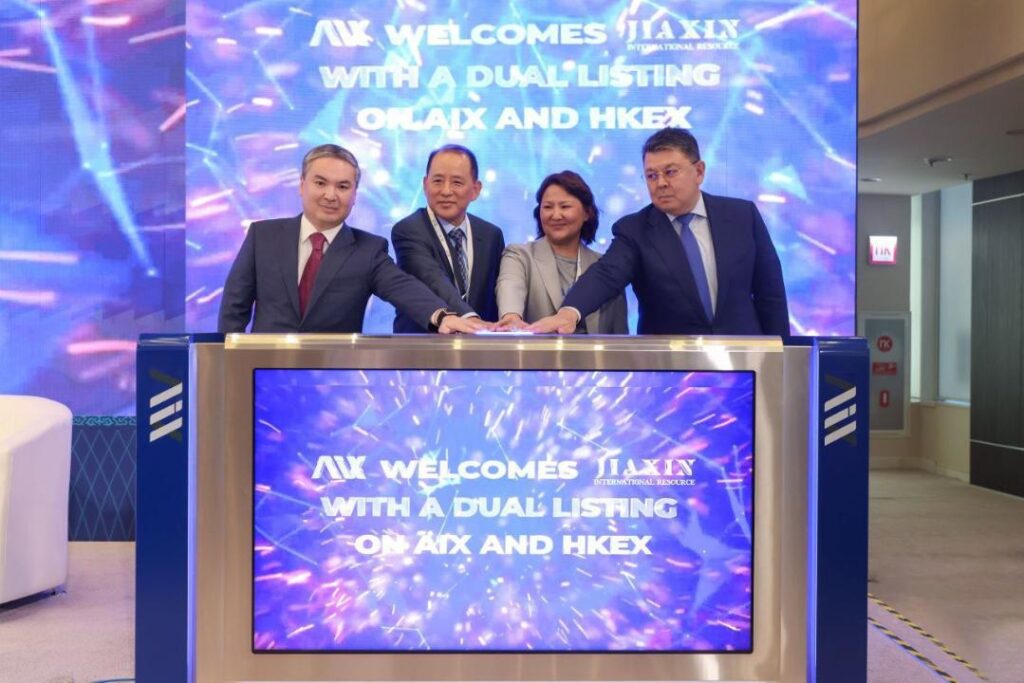
China’s Jiaxin International Resources Investment Limited, the world’s leading tungsten mining and production company, has successfully completed an offering of common shares on the Astana International Exchange (AIX) in Kazakhstan. The listing ceremony took place on September 5 during Astana Finance Days 2025, marking a milestone for Kazakhstan’s capital market. According to the Ministry of Industry and Construction, the transaction represents the first IPO in Central Asia denominated in Chinese yuan (CNY) and the first IPO on AIX’s dedicated Belt and Road Initiative segment. Strategic Importance of the Boguty Mine Jiaxin International is currently developing the Boguty tungsten deposit in Kazakhstan’s Almaty region. With reserves of approximately 107 million tons of ore, Boguty is ranked as the fourth-largest tungsten deposit in the world, positioning Kazakhstan as a critical player in the global supply chain for this strategic metal. At the listing ceremony, Minister of Industry and Construction Ersayin Nagaspayev emphasized the strategic value of the transaction: “This event once again demonstrates the high level of investor confidence in the Astana International Financial Center. I am confident that the example of such a large and reputable company will significantly increase the investment attractiveness of Kazakhstan and attract new foreign participants.” AIX, established in 2017 under the Astana International Financial Center (AIFC), counts among its shareholders the AIFC, Shanghai Stock Exchange, Silk Road Fund, and NASDAQ which also provides its trading platform. Record-Breaking Demand Ordinary shares of Jiaxin International were admitted to listing on August 28 on both AIX and the Hong Kong Stock Exchange (HKEX). The final offer price was set at CNY 9.93. Global demand exceeded $34 billion, with the IPO more than 220 times oversubscribed compared to the targeted amount. Confidence in Kazakhstan’s Market Assel Mukazhanova, CEO of AIX, highlighted the significance of the deal: “It has been about 10 years since Jiaxin first entered the Kazakh market with a tungsten investment project, and today we are proud to celebrate the inclusion of its shares into the AIX Official List. This achievement not only demonstrates the trust placed in our market but also sets a strong precedent for other issuers to follow.” For Jiaxin International, the dual listing underscores the growing economic ties between China and Kazakhstan. Liu Liqiang, Chairman of Jiaxin International Resources Investment Limited, stated: “This milestone not only marks a significant chapter in the company’s growth journey, but also reflects our solid step forward in deepening China-Kazakhstan economic cooperation in the context of High-Quality Belt and Road Cooperation.”

China’s Luban Workshops in Kazakhstan: Skills-Building or Strategic Leverage?

At the recent Shanghai Cooperation Organization summit in Tianjin, China inaugurated two new vocational centers in Kazakhstan under the Luban Workshop initiative. The move highlights the growing emphasis on technical education and skills development across the region. Kazakhstan’s first Luban Workshop was launched in 2023 at Serikbayev East Kazakhstan Technical University, creating a platform to advance engineering and technical training. The program has since expanded with a second workshop at the Gumilyov Eurasian National University in Astana and a third at the Academy of Logistics and Transport in Almaty. This China-led program aims to share China’s educational expertise and technical resources with partner countries, with a particular focus on cultivating a new generation of skilled workers in developing economies. The workshops are not only a vehicle for workforce training but also a symbol of the Belt and Road Initiative’s people-to-people exchange dimension. By encouraging social and educational connections, China is seeking to complement government-to-government cooperation with deeper societal ties. The choice of Tianjin for the ceremony is not a coincidence. The Luban Workshop concept originated in this city and has been actively promoted by the Tianjin municipal government. Equally notable is Kazakhstan’s central role in the program’s expansion. The Kazakh government has expressed consistent support for Chinese-led educational partnerships, underlining the importance of vocational training to its national development agenda. During his visit to a Luban Workshop in Kazakhstan in February 2024, President Kassym-Jomart Tokayev praised the initiative, saying, “I am deeply appreciative of the contributions made by Chinese universities. They have executed exemplary work. I hope to see more workshops like this in Kazakhstan.” The expansion of China’s Luban Workshop initiative offers distinct benefits for both China and Kazakhstan. For China, the workshops help shift perceptions of its educational initiatives. Unlike the Confucius Institutes, which focus on cultural and language promotion, the Luban Workshops emphasize practical, in-demand skills in fields such as manufacturing and technology. This approach allows China to project a more pragmatic and development-oriented image, fostering goodwill in a way that is less vulnerable to geopolitical criticism. A second key benefit lies in the realm of soft power. By delivering tangible skills and opportunities, Luban Workshops can positively influence public attitudes toward China in Central Asia. In Kazakhstan, such initiatives not only support technical education but also help frame Chinese investments as beneficial for local communities. Over time, this contributes to strengthening government-to-government ties and broader people-to-people connections, enhancing China’s long-term influence in the region. For Kazakhstan, the Luban Workshops provide benefits by helping to build a pool of technically skilled human capital. This directly supports the country’s industrial goals and broader economic development agenda. A more qualified workforce also enables local citizens to participate more actively in Chinese-backed projects in Kazakhstan, thereby boosting local employment. One of the recurring criticisms of China’s overseas investment projects has been the limited transfer of knowledge and skills. In many cases, local workers are confined to low-skilled, manual roles, while Chinese nationals occupy managerial and technical positions. The Luban Workshops...

Uzbekistan’s Pharma Pivot: Strategic Gains or Growing Dependence on China

Since 2016, Uzbekistan has steadily deepened its partnership with China across multiple sectors. Energy, infrastructure, agriculture, and the digital economy have long been the pillars of this cooperation. Yet recent discussions showed that the pharmaceutical sector will be another critical area for cooperation in the long term. Much like renewable energy and critical minerals, the pharmaceutical sector is now viewed in Tashkent as a strategic domain where Chinese expertise and investment could accelerate development and add value to the domestic economy. The Compelling Logic of Partnership China's strength lies in its ability to produce high-quality, affordable medicines and distribute them globally at scale. For Uzbekistan - whose growing population and rising demand for advanced healthcare have placed pressure on its system - this makes China a natural partner. At present, the Uzbek pharmaceutical market remains heavily import-dependent: by the end of 2024, imported drugs accounted for 87% of retail sales in monetary terms and 63% in physical volume. This reliance not only exposes vulnerabilities but also highlights the untapped potential for local production. Recognizing this, Tashkent has moved to create favorable conditions for investment. The country has established specialized pharmaceutical Special Economic Zones (SEZ) such as Parkent-Pharm and Andijan-Pharm. These SEZs offer investors an attractive package of incentives, from exemptions on customs duties and VAT for raw materials and equipment, to a 20% preference in government procurement for local products. Such regulatory incentives, combined with a growing domestic market, have already begun to draw interest from Chinese pharmaceutical firms. Strategic Priorities Recently, Uzbekistan has signed a series of memorandums of understanding with Chinese firms such as Zhendong Health Industry, Guojo Medical Technology, and Langtian Pharma Group, signaling a stronger bilateral focus on the pharmaceutical sector. These agreements align closely with Uzbekistan’s strategic goal of building a robust domestic pharmaceutical industry with an emphasis on access to capital and technology, localization, and human capital development. One of Uzbekistan’s key priorities is securing access to capital and expertise. Without investment and collaboration with experienced companies, the state cannot establish modern laboratories and production facilities. In this regard, the Uzbek company, Ozwell, has signed an MoU with Zhendong Health Industry Group to jointly implement a modern pharmaceutical laboratory. The partnership involves a total investment of $9.5 million, with $4.5 million allocated toward creating a world-class laboratory facility and $5 million designated for establishing and scaling up a production complex. This agreement reflects Tashkent’s desire to tap into Chinese technical knowledge and experience, while simultaneously building domestic capacity and developing local talent in the long term. Another critical priority is the localization of drug production. By reducing dependency on imports, Uzbekistan is aiming to strengthen supply chain resilience, meet domestic demand, and create new opportunities for regional exports. In this regard, the MoU established with Langtian Pharma Group and Guojo Medical Technology is designed to investigate opportunities for domestic production while promoting technological collaboration and knowledge transfer within the pharmaceutical industry. The final priority is the development of human capital. In this regard, Uzbekistan...

Jewelry Factory Opens in Tajikistan with Chinese Investment

A new jewelry factory operated by China-Tajikistan Mining Industry Company LLC officially opened in Dushanbe on April 10. The inauguration ceremony was attended by President Emomali Rahmon of Tajikistan. Construction of the facility began in 2023. The complex now includes modern production facilities and a two-story gold sales center. Utilizing the latest Chinese technology, the factory is capable of processing up to one ton of gold and 30 tons of silver annually. It will also produce a variety of goods, including jewelry, home decorations, and household items. On the same day, President Rahmon laid the foundation stones for two additional jewelry factories, also backed by Chinese investment. One will be operated by TBEA Dushanbe Mining Industry Company LLC, and the other by Pakrut Company LLC. Both are slated for completion within a year and will be located in Dushanbe. China currently controls over 75% of Tajikistan’s gold production. While Chinese investment has helped develop Tajikistan’s mining infrastructure, it has also raised concerns. Critics point to potential environmental risks and labor rights issues associated with the expanding influence of Chinese firms in the sector.