• KGS/USD = 0.01143 -0%
  • KZT/USD = 0.00198 -0%
  • TJS/USD = 0.10899 0.65%
  • UZS/USD = 0.00008 -0%
  • TMT/USD = 0.28490 -0.28%
  • KGS/USD = 0.01143 -0%
  • KZT/USD = 0.00198 -0%
  • TJS/USD = 0.10899 0.65%
  • UZS/USD = 0.00008 -0%
  • TMT/USD = 0.28490 -0.28%
  • KGS/USD = 0.01143 -0%
  • KZT/USD = 0.00198 -0%
  • TJS/USD = 0.10899 0.65%
  • UZS/USD = 0.00008 -0%
  • TMT/USD = 0.28490 -0.28%
  • KGS/USD = 0.01143 -0%
  • KZT/USD = 0.00198 -0%
  • TJS/USD = 0.10899 0.65%
  • UZS/USD = 0.00008 -0%
  • TMT/USD = 0.28490 -0.28%
  • KGS/USD = 0.01143 -0%
  • KZT/USD = 0.00198 -0%
  • TJS/USD = 0.10899 0.65%
  • UZS/USD = 0.00008 -0%
  • TMT/USD = 0.28490 -0.28%
  • KGS/USD = 0.01143 -0%
  • KZT/USD = 0.00198 -0%
  • TJS/USD = 0.10899 0.65%
  • UZS/USD = 0.00008 -0%
  • TMT/USD = 0.28490 -0.28%
  • KGS/USD = 0.01143 -0%
  • KZT/USD = 0.00198 -0%
  • TJS/USD = 0.10899 0.65%
  • UZS/USD = 0.00008 -0%
  • TMT/USD = 0.28490 -0.28%
  • KGS/USD = 0.01143 -0%
  • KZT/USD = 0.00198 -0%
  • TJS/USD = 0.10899 0.65%
  • UZS/USD = 0.00008 -0%
  • TMT/USD = 0.28490 -0.28%
07 December 2025

Viewing results 1 - 6 of 79

The First Kazakh Comic and Its Cultural Significance

In the early 20th century, educated Kazakh thinkers were known as Alash intellectuals. Disillusioned by the Russian Empire’s growing control over the Kazakh people, they sought to establish an independent Kazakh state and protect their nation from imperial oppression. Their political and cultural struggle laid the foundation for modern Kazakhstan’s independence. The Alash Orda, a successor to the 19th-century Kazakh enlightenment movement, evolved into a more politically assertive and nationalist organization representing Kazakhs in southern Central Asia. Formed in March 1917 by prominent figures including Alikhan Bokeikhanuly, Akhmet Baitursynuly, Mirzhakyp Dulatuly, and Khalel Dosmukhameduly, the group participated in the Pan-Muslim Congress in Moscow that May. However, the congress, largely driven by Tatar leaders, failed to address Kazakh concerns, further alienating them. As a result, the Kazakhs withdrew from future congresses and focused on developing their own political structures. The Alash movement ultimately became the leading force guiding the Kazakh people during this turbulent era. [caption id="attachment_34521" align="aligncenter" width="347"] Zhusipbek Aimauytov with his daughter; image: alash.semeylib.kz[/caption] Zhusipbek Aimauytov, one of the prominent members of the Alash movement, authored important literary works such as Kartkózha, Akbilek, and Kúnékéýdiń jazyq dalasy. He was also a statesman and cultural figure who fell victim to Soviet repression, accused of nationalist sympathies. Arrested in 1929, he was sentenced to death in absentia in 1931. Despite his short life, Aimauytov left a lasting mark on Kazakh culture and literature. His writings consistently emphasized that national progress requires sacrifice, effort, and resistance against ignorance and injustice. [caption id="attachment_34523" align="aligncenter" width="826"] Cover page of Aimauytov`s comic book published in 1929[/caption] One of Aimauytov’s lesser-known yet significant contributions was the first Kazakh comic book, Ugly Headwear, which was written for children. Published in 1929 by the Kazidat publishing house, the work is composed in verse and meant to both entertain and educate young readers. The story explores timeless themes such as social injustice, class conflict, and moral reasoning. The tale begins with a poor villager and his family — a frail wife and three strong sons. They own little: one brown horse and a single cow. When the village head visits and demands taxes, he takes the family’s only cow by force and beats the father. This dramatic opening immediately draws the reader in and sets the tone for the rest of the story, which critiques the social conditions of the time. The motif of the marginalized challenging the dominant recurs across many world literatures. Known for addressing political and societal issues in his work, Aimauytov continues this in Ugly Headwear. The village leaders, religious figures, and even the wealthy refuse to help the poor man, claiming taxes are mandated by the Tsar and must be paid. Eventually, the desperate man turns to the Russian district chief, only to be humiliated and chased away. In a symbolic scene, the man’s hat — the “ugly headwear” — becomes the central object of the story. It is lost, found by a dog, taken to a barn, and later discovered by someone who...

Exile and Empire: Dostoevsky’s Years in Semey, Kazakhstan

Semey, Kazakhstan – In the windswept, seemingly infinite steppe of eastern Kazakhstan stands a city with a dual, haunting legacy. It is a place where one of the world's literary giants plumbed the depths of the human soul, and where, a century later, humanity sought to master the power to extinguish itself. This is Semey, formerly Semipalatinsk, a city whose soil is steeped in the memory of both Fyodor Dostoevsky's exile and the Soviet Union's atomic ambition. For Fyodor Dostoevsky, one of Russia’s most celebrated writers, Semey was not a destination of choice but of punishment. Arrested in 1849 for his involvement with the Petrashevsky Circle — a group of intellectuals who read and discussed banned political texts — Dostoevsky was sentenced to death, only to be spared at the last moment in a mock execution ordered by Tsar Nicholas I. His sentence was commuted to four years of hard labour in the Omsk fortress, followed by compulsory military service in Semipalatinsk. Arriving in 1854, Dostoevsky spent nearly five years in Semipalatinsk, a provincial outpost on the Russian Empire’s edge, where exiles, soldiers, and bureaucrats mingled with Kazakh nomads and merchants. Though his official role was that of a soldier in the Siberian Line Battalion, his time here marked a critical period of transformation — politically, spiritually, and literarily. Semey offered isolation, but also introspection. Deprived of literary contact, Dostoevsky was forced inward. His exposure to suffering — in prison, in exile, and his struggles with epilepsy — sharpened the moral and psychological vision that would later define Crime and Punishment, The Idiot, and The Brothers Karamazov. In letters from this time, he describes long walks through the barren steppe and his growing fascination with the Kazakh people, whose customs and resilience left a lasting impression. During his years in Semey, Dostoevsky also began to reengage with the intellectual world. Thanks to the leniency of local officials, he was able to read, write, and eventually re-enter literary circles. It was here he completed Uncle’s Dream and The Village of Stepanchikovo, and began work on Notes from the Dead House, a fictionalised account of his time in prison that marked a decisive shift from romanticism to the raw psychological realism for which he became renowned. Despite its remoteness, Semey in the 1850s was not without its cultural encounters. Dostoevsky formed a lasting friendship with Chokan Valikhanov, a Kazakh nobleman, ethnographer, and military officer, whose liberal views and deep knowledge of Central Asian culture helped broaden Dostoevsky’s perspective on the empire’s outer subjects. Their conversations influenced Dostoevsky’s thinking on race, empire, and the spiritual dignity of non-Russian peoples — ideas that subtly permeate his later works. In 1853, aged 18, Valikhanov graduated from the Cadet Corps and was commissioned as a cornet in the Army Cavalry. He was then assigned as an officer to the 6th Regiment of the Siberian Cossack Army. Later, through the Main Administration of the Region, he was appointed as an officer of special assignments. In 1858–1859, he...

Bridging Empires: A Japanese Historian on Kazakh-Qing Relations

Last year, I came across Professor Jin Noda’s research from the Tokyo University of Foreign Studies: The Kazakh Khanates Between the Russian and Qing Empires: Central Eurasia International Relations during the 18th–19th Centuries. As it explores Kazakh history, particularly letters written by Khan Ablai and other sultans to the Qing emperor, I reached out to Professor Noda to ask a few questions. TCA: What inspired you to write this book? Noda: I thought there was a great divide between studies of Central Asia from the Russian side and those from the Qing Chinese side. To bridge this gap, I decided to research Kazakh history using both Russian and Chinese sources. TCA: You published letters from 1779 related to Ablai Khan. What is their social significance? Jin Noda: While the “social significance” isn’t entirely clear to me, the letters are important for Kazakhs as evidence of relations with the Qing Dynasty. They also reflect Ablai’s authority — sending letters to the Qing emperor signified his direct contact with the imperial court. TCA: Were these letters originals? What challenges did you face studying them? Jin Noda: I accessed microfilmed versions at the First Historical Archive in Beijing. The poor image quality made them difficult to read, and some texts were unreadable. TCA: How much did you rely on Chinese sources, and how reliable are they? Jin Noda: For my PhD and the book, I used many Manchu documents. While they have their biases, they also offer valuable new information on the Kazakhs. I cross-referenced them with Russian sources from the same era. TCA: Are there many historical records about Kazakhs in Japan? How should they be studied? Jin Noda: Some records exist, particularly from the Japanese military’s interest in Xinjiang after the Russo-Japanese War. For Kazakhs under Russian rule, one rare case is the Kazakh politician Marsekov contacting the Japanese government during the revolution. His letter’s translation is preserved in a Japanese archive and was recently studied by Prof. Uyama and Mr. Ono. TCA: Apart from Sultan Gubaidolla’s well-known letter, did you find other sources related to him? Jin Noda: I collected Russian archival documents on his activity around 1824 in Almay and Omsk. He is known for his role in protesting Russian colonisation. TCA: As a foreign researcher, how do you assess Kazakh-Qing political relations? Jin Noda: Traditionally, Chinese discourse portrayed the Kazakhs as distant vassals. However, Qing sources place them closer to the empire, like the Mongols or the Torghuts. I believe the Kazakh khans understood the strategic advantage in their relations with the Qing. These ties held unique importance for both sides. TCA: You’ve also used Manchu archives. What did they reveal? Jin Noda: Manchu documents are rich sources — essentially direct reports from Xinjiang officials to the emperor. While they reflect the officials’ own motivations, they offer a vivid picture of the Kazakhs’ contact with the Qing. TCA: Have you received proposals to translate your book into Kazakh? Jin Noda: I’ve recently received a proposal to translate it...

Ancient Khuttal in Tajikistan Added to UNESCO World Heritage List

On July 12, Tajikistan celebrated a major cultural milestone: at the 47th session of the UNESCO World Heritage Committee in Paris, the ancient monuments of Khuttal were officially inscribed on the UNESCO World Heritage List. This marks the fifth site in Tajikistan to receive such international recognition. A Historical Crossroads of Culture and Architecture The newly recognized World Heritage site encompasses 11 archaeological and architectural monuments across the districts of Vose, Danghara, Jaloliddin Balkhi, Farkhor, and Khovaling in Tajikistan’s Khatlon region. Among these are Kalai Khulbuk, Adzhina-Teppa, Khishtepa, Shakhratepa, Manzarteppa, the Mausoleum of Mavlon Tojiddin, and the ancient fortresses of Zoli Zard and Kofirkala. The Kalai Khulbuk complex, once the residence of Khuttal’s rulers, is of particular historical importance. The medieval state of Khuttal flourished from the 7th to the 16th century in southern Tajikistan and played a key role in cross-border trade along the Great Silk Road. According to UNESCO, the monuments “illustrate the diversity of the region's culture and its significant role in the exchange of cultural values.” At its peak, Khuttal included up to 12 cities. Its capital, Khulbuk, featured advanced infrastructure in the 9th-12th centuries, including a palace, citadel, and urban systems well ahead of their time. As Tajik archaeologist Tatyana Filimonova has noted, “the urban culture of Hulbuk was several centuries ahead of Europe,” citing innovations such as centralized heating, sewage systems, and water supply. The listed monuments span various historical periods and artistic traditions from the 7th-century Buddhist monastery Ajina-Teppa, where a 13-meter-long reclining Buddha statue was discovered, to the intricately carved gancha and frescoes of the Hulbuk Palace. Other highlights include Zoli Zard, believed to be the legendary fortress of the Persian hero Rustam, and Manzarteppa, where archaeological excavations continue to yield pottery fragments and cultural artifacts. A Collaborative Effort in Preservation and Recognition The nomination of Khuttal began in 2023, spearheaded by the Ministry of Foreign Affairs and the Ministry of Culture of Tajikistan, in collaboration with the Institute of History of the National Academy of Sciences, the International Institute for Central Asian Studies, and the CAAL project at University College London. UNESCO commended the scientific rigor and collaborative approach of the submission. Restoration efforts have been ongoing since the early 2000s. Kalai Khulbuk was opened to visitors in 2006, and Ajina-Teppa underwent restoration with UNESCO support in 2008. These sites, along with Kofirkala, Zoli Zard, and Manzarteppa, remain active locations for archaeological and conservation work under the State Program for the Protection of Cultural Heritage. The inscription of Ancient Khuttal on the World Heritage List not only affirms its global significance but also paves the way for increased cultural tourism, international research cooperation, and long-term development of Tajikistan’s rich historical legacy.

Unique Artifact from Kushan Era Unearthed in Tajikistan

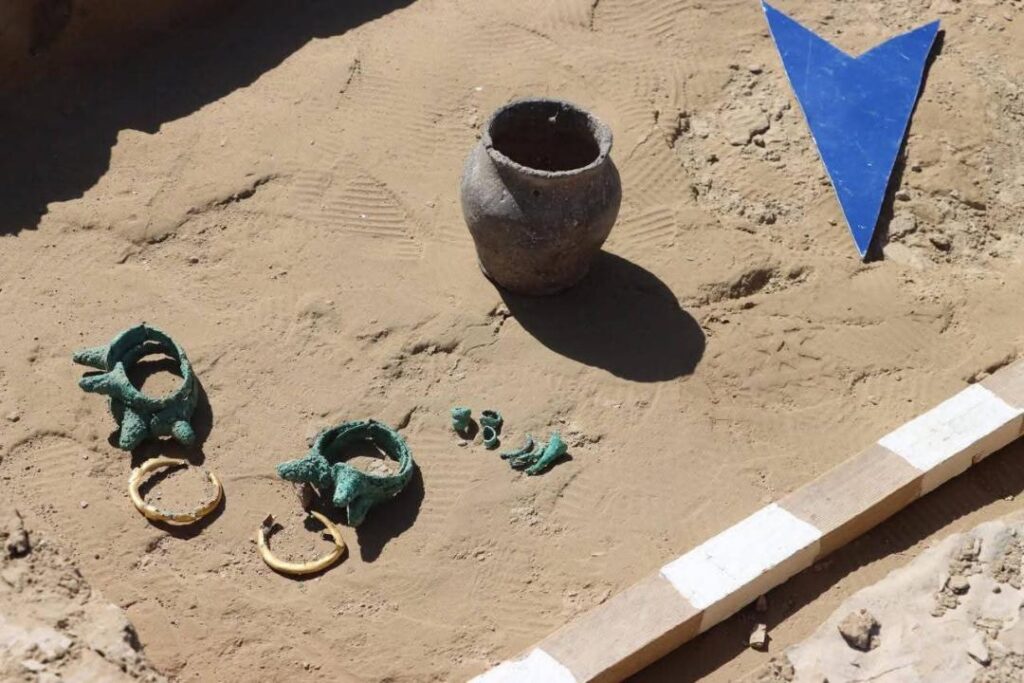
Archaeologists from the National Museum of Tajikistan have unearthed a rare and significant artifact, a clay vessel bearing a complete inscription in the Bactrian language, dating to the Kushan era. The discovery was made at the Khalkhajar archaeological site near the village of Sarband, according to the museum’s announcement. A Jug with a Story Excavations at Khalkhajar began on May 20 under the direction of Mirali Zamon Karimdodzoda, head of the museum’s archaeology and numismatics department. The team uncovered the remains of ancient architectural structures, including clay and brick walls with traces of whitewash and well-preserved sections of interior spaces. Most of the artifacts unearthed date back to the Kushan Empire’s peak between the 1st and 3rd centuries AD. Among the most notable finds is a two-handled clay jug, recovered in fragments and meticulously restored. What makes the vessel exceptional is its intact inscription in Bactrian, written in a distinct broken script, an exceedingly rare occurrence in Tajikistan. Deciphering the Inscription To analyze the text, the museum enlisted the expertise of internationally renowned scholars: Professor Nicholas Sims-Williams, a specialist in ancient Iranian languages, and numismatist Joe Cribb. Based on their interpretation, the inscription reads: “eiado gō(l)z[o ]sido finzo sagkino ol(o) mo(.)” Translation: “This water jug belongs to the woman Sagkina.” This simple phrase is of considerable linguistic and cultural significance. It offers a rare glimpse into everyday life and personal property practices in the Kushan period, shedding light on literacy, gender, and identity in ancient Central Asia. Cultural and Historical Significance The name “Sagkina” provides valuable material for onomastic studies and enriches understanding of female naming conventions in the region during the Kushan era. The presence of such inscriptions suggests a relatively advanced level of literacy and a societal norm of marking personal belongings, an important insight into domestic life and social organization at the time. Experts note that finds of this nature are vital for tracing the evolution of writing systems in Eastern Iran and for better understanding the intersection of language and material culture in ancient societies. Echoes of Empire The Kushan Empire was one of the most expansive and influential states in ancient Central Asia, encompassing areas of present-day Afghanistan, Pakistan, India, southern Uzbekistan, and parts of Tajikistan. The Bactrian language, written in a modified Greek script, served as a key medium for administration and trade, and today remains essential to reconstructing the region’s historical narrative. Archaeological efforts at Khalkhajar are ongoing. All discoveries are being catalogued for future public exhibition at the National Museum of Tajikistan, where the inscribed jug will take pride of place as a symbol of the region’s rich cultural heritage.

How The New York Times Came to Publish an Obituary for Kazakh writer Mukhtar Auezov

While browsing old issues of The New York Times, we wondered: “Is there anything here about the Kazakhs or Kazakhstan?” One edition stood out, the June 28, 1961 issue. On page 35, alongside obituaries for several prominent figures, was one for our great writer, Mukhtar Auezov. [caption id="attachment_33412" align="aligncenter" width="378"] “Winner of Lenin Prize in 1959 for 2-Volume Work Dies Mukhtar O. Auezov, the Kazakh poet and philosopher whose two-novel work, ‘Abai’ and ‘The Road of Abai,’ earned a Lenin Prize two years ago, died yesterday in Alma-Ata.”[/caption] The article went on to note that Mukhtar Auezov was born and raised in the Shyngystau region (known today as the Abai District), and later wrote a major work about the life of Abai. It also mentioned that he studied at Leningrad University and authored numerous literary works. In 1960, Auezov visited several U.S. states as part of a Soviet writers’ delegation. Upon returning home, he expressed in interviews his admiration for the towering skyscrapers of New York City. What pleased us even more was that The New York Times included a photograph of Auezov alongside the obituary. This shows that even in the 1960s, American literary circles recognized and took notice of a Kazakh writer. In other words, Auezov left a lasting impression on the American public. Other articles about him may have appeared in the U.S. press, but so far this obituary is the only one we have been able to find. Mukhtar Omarkhanuli Auezov holds the distinction of being the first known Kazakh writer to set foot on American soil. His official visit was well covered by the U.S. press and known to the American public at the time. This likely explains why such a major publication honored him with a dedicated obituary, informing readers around the world of his passing. The gesture reflects a significant level of respect and recognition. Mukhtar Auezov indeed visited the United States from February 17 to March 17, 1960, as part of a delegation of Soviet writers. This trip was part of the “Agreement Between the United States of America and the Union of Soviet Socialist Republics on Exchanges in the Cultural, Technical, and Educational Fields.” According to the agreement, four American writers visited the USSR in 1959, and in return, a Soviet delegation traveled to the U.S. in February/March 1960. To give readers a closer look at his journey, we are sharing excerpts from Mukhtar Auezov’s diary, where he reflects on the trip. The entries were later published in a bilingual edition, Mukhtar Auezov: Impressions of America, in 2021, in both Kazakh and English. Below are a few details from Auezov’s impressions of the U.S.: That day we toured Washington, D.C. It’s a very beautiful city. No two houses look alike. Even the cars are all different, though there are many, they never repeat. We visited the old part of the city, the area known as ‘Georgetown.’ All the houses here are old, yet highly stylish, elegant two-story homes. There is one...