• KGS/USD = 0.01144 0%
  • KZT/USD = 0.00212 0%
  • TJS/USD = 0.10761 -0.09%
  • UZS/USD = 0.00008 0%
  • TMT/USD = 0.28571 0%
  • KGS/USD = 0.01144 0%
  • KZT/USD = 0.00212 0%
  • TJS/USD = 0.10761 -0.09%
  • UZS/USD = 0.00008 0%
  • TMT/USD = 0.28571 0%
  • KGS/USD = 0.01144 0%
  • KZT/USD = 0.00212 0%
  • TJS/USD = 0.10761 -0.09%
  • UZS/USD = 0.00008 0%
  • TMT/USD = 0.28571 0%
  • KGS/USD = 0.01144 0%
  • KZT/USD = 0.00212 0%
  • TJS/USD = 0.10761 -0.09%
  • UZS/USD = 0.00008 0%
  • TMT/USD = 0.28571 0%
  • KGS/USD = 0.01144 0%
  • KZT/USD = 0.00212 0%
  • TJS/USD = 0.10761 -0.09%
  • UZS/USD = 0.00008 0%
  • TMT/USD = 0.28571 0%
  • KGS/USD = 0.01144 0%
  • KZT/USD = 0.00212 0%
  • TJS/USD = 0.10761 -0.09%
  • UZS/USD = 0.00008 0%
  • TMT/USD = 0.28571 0%
  • KGS/USD = 0.01144 0%
  • KZT/USD = 0.00212 0%
  • TJS/USD = 0.10761 -0.09%
  • UZS/USD = 0.00008 0%
  • TMT/USD = 0.28571 0%
  • KGS/USD = 0.01144 0%
  • KZT/USD = 0.00212 0%
  • TJS/USD = 0.10761 -0.09%
  • UZS/USD = 0.00008 0%
  • TMT/USD = 0.28571 0%

Viewing results 1 - 6 of 13

Mirziyoyev Announces Uzbekistan’s 2027-2029 Leadership of Aral Sea Fund

On April 22, Uzbekistan’s President, Shavkat Mirziyoyev, took part in a meeting of the Council of the Heads of Founder States of the International Fund for Saving the Aral Sea, where regional leaders discussed growing water challenges and environmental risks in Central Asia. The meeting reviewed the results of Kazakhstan’s chairmanship of IFAS for 2023-2026 and focused on improving environmental, water management, and socio-economic conditions in the Aral Sea basin. In his remarks, Mirziyoyev warned that water shortages in the region are expected to intensify. “According to expert estimates, the water deficit in the Aral Sea basin could almost double to 20 billion cubic meters per year by as early as 2040,” he said, adding that this could pose risks to drinking water supply, agriculture, energy production, and regional stability. He also noted that water use efficiency in Central Asia remains low. In agriculture, nearly three cubic meters of water are used to generate $1 of added value, compared to roughly half that level globally. [caption id="attachment_47681" align="aligncenter" width="2560"] @Akorda[/caption] Mirziyoyev outlined steps taken in Uzbekistan to address these challenges. Water-saving technologies have been introduced on 60% of irrigated land, while 40% of irrigation canals have been concreted. Modernization of pumping stations has reduced energy consumption in the sector by nearly 30%. A unified digital database covering more than 600,000 water users and over 4 million hectares of irrigated land is also being developed. As a result, Uzbekistan has achieved annual water savings exceeding 10 billion cubic meters, with plans to increase this figure to 15 billion cubic meters by 2030. The Uzbek president emphasized the importance of strengthening IFAS and transforming it into a key platform for regional integration. Uzbekistan is set to assume the chairmanship of the fund for 2027-2029. Among the proposals discussed were improving the effectiveness of IFAS programs, introducing performance indicators to monitor progress, and expanding cooperation with international partners. Mirziyoyev also called for aligning the fund’s work with broader regional initiatives agreed at Consultative Meetings of Central Asian leaders. He highlighted the need for greater cooperation on climate adaptation, glacier preservation, and combating desertification, and proposed launching a regional program titled “Water of the Future” to train farmers and businesses in water-saving technologies. The president also stressed the importance of engaging Afghanistan in regional water and environmental cooperation and called for developing a long-term legal framework for water distribution in the basin. Kazakhstan’s President, Kassym-Jomart Tokayev, likewise called on Central Asian countries to strengthen coordination on water resources and environmental policy amid growing climate risks. According to Tokayev, the situation in the Aral Sea basin remains strained: despite some progress, environmental threats are intensifying faster than mitigation efforts. He pointed to rising temperatures, declining precipitation, and increasingly frequent dust storms that spread salt and chemical pollutants over vast distances, affecting ecosystems and public health. The president emphasized that the International Fund for Saving the Aral Sea remains a key regional platform for coordinating efforts in water, energy, and environmental management. He noted that, with...

Insider’s View: Tashkent’s Water Diplomacy – From National Reforms to Regional Synergy in Central Asia

On April 22, a summit of the International Fund for Saving the Aral Sea (IFAS), one of the region's prominent organizations, takes place in Astana. The meeting of the Heads of the Founding States is especially significant because it marks the transition of the Fund's chairmanship to Uzbekistan for the 2027-2029 period. This will be our country's third mandate, following leadership terms in 1997-1999 and 2013-2016. Tashkent was at the forefront of the creation of IFAS. Yet returning to this leadership role after a decade comes in a fundamentally transformed regional landscape. Today, Uzbekistan brings not only substantial experience but also a broad portfolio of initiatives that have received international recognition. The Transformation of Uzbekistan's Water Sector for Sustainable Development Facing intensifying climate pressures alongside strong economic and demographic growth, Uzbekistan has made the restructuring of water resource management a core priority of state policy. The scale of the challenge is clear in the data. Over the last 15 years, per capita water availability in the republic has fallen by more than half, from 3,000 to 1,400 cubic meters per year. According to the Ministry of Water Resources, the annual volume of water resources has dropped to 51-53 billion cubic meters, a 21% decline from 1991 levels of 64 billion cubic meters. A major challenge remains the country's high dependence on external sources, as approximately 80% of surface water, or 41 billion cubic meters, originates outside the country. While the water shortage did not exceed 3 billion cubic meters prior to 2015, expert forecasts indicate that the deficit could reach 7 billion cubic meters by 2030 and 15 billion cubic meters by 2050. Recognizing the scale of these risks, Uzbekistan, under the leadership of Shavkat Mirziyoyev, is pursuing broad technological modernization of the water sector. In less than a decade, the area using water-saving technologies has grown from 28,000 hectares to more than 2.6 million hectares, now covering more than 60% of all irrigated land. At the same time, large-scale work continues across the country on canal concreting and the reconstruction of flume networks. By 2030, these systemic measures are projected to yield annual savings of up to 15 billion cubic meters of water. At the same time, the sector is undergoing digitalization. Currently, 11 information platforms are being deployed to manage the water cadastre, monitor pumping stations, and track land reclamation status. Over the past four years, the management of 100 major water facilities has been fully automated, the Smart Water system has been introduced at 13,000 water intake points, and more than 1,700 pumping stations have been equipped with real-time online monitoring devices. At the same time, the national economic model is also adapting. According to the Center for Economic Research and Reforms, the share of agriculture in GDP has declined from 32% in 2017 to 19% by 2024. Notably, against this backdrop, total agricultural production has increased by 17%. This divergence points to a transition toward more efficient resource use and higher productivity. Regional Synergy and Water...

Planting Trees to Heal Old Wounds: Can a Desert Forest Save the Aral’s Last Residents?

In the Aralkum Desert, afforestation campaigns have multiplied since the early 2000s. They are meant to slow the sandstorms, temper a rapidly warming climate, and protect the health of those still living in the shadow of the Aral Sea. But the promised results have not appeared yet. The road from Aralsk to Aiteke Bi cuts through a palette of ochre and dust. Trucks drift forward in pale clouds, dragging the desert behind them like a long train. In these villages scattered along the former shoreline of the Aral Sea, the wind never leaves. It is abrasive, restless, and a witness to a vanished water body that once cooled the hottest corner of Kazakhstan. Respiratory diseases now run through family histories, and doctors say they can recognize lungs shaped by ecological collapse. At the polyclinic in Aiteke Bi, patients describe the same symptoms with weary precision: breath shortening too quickly, coughs that never fully recede, a fatigue that never seems to lift. Nuralay, 52, says the storms “get into the house, into the throat, into everything.” She admits she cannot remember a season without irritation in her chest. For Dr. Kuanyshqar Assilov, who has watched the pattern deepen for years, the cause is unmistakable: decades of airborne salts, pesticide residues, and industrial chemicals lifted from the dried seabed of the Aral Sea. [caption id="attachment_39897" align="aligncenter" width="1378"] In Aralsk, sand covers everything[/caption] Marat Narbaev, executive director of the International Fund to Save the Aral Sea (IFAS), recounts the disaster’s origins with a mixture of resignation and habit. He traces it back to the 1960s, when Soviet planners diverted the Amu Darya and Syr Darya to feed cotton monocultures. “The cotton was used to make clothing for soldiers and ammunition,” he says. Today, he argues, the basin faces two pressures: “climate change and demographic growth. Fifty million inhabitants… soon seventy.” In this landscape, the promise of restoring the region through afforestation has acquired symbolic weight. Saxaul trees - hardy, grey-green, capable of surviving in brackish soils - are planted by the millions on the exposed seabed. Officially, they are meant to stabilize sand, calm storms, and cool the surface. Unofficially, they carry the hope that life here might once be breathable again. Survivalist tree? On paper, the saxaul is a biological survivalist: roots plunging more than 30 feet deep, the ability to stabilize dunes, lower surface salinity, and grow dense enough within a few years to slow the wind. In Aralkum, a village east of Aralsk, residents praise the planting that lines a dozen houses. “It really worked, the storms became more bearable,” a man says. Then he shrugs: more trees should have been planted. “We asked for the other side of the village, but there’s no funding left.” Nowadays, half of the trees have died, and the rest lie buried beneath the dunes. [caption id="attachment_39896" align="aligncenter" width="1378"] In Aralkum village, half of the surviving trees barely emerge from the sand[/caption] Sometimes, past plantations have almost zero trees left. According to a 2021...

Kazakhstan Urges Regional Cooperation to Save the Aral Sea

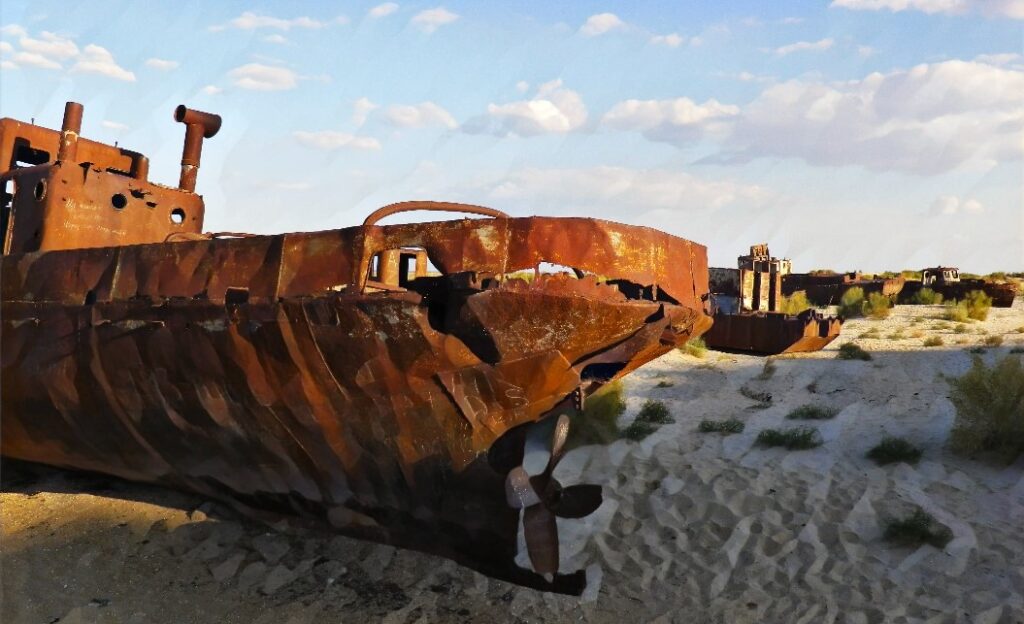
Kazakhstan has intensified its efforts to restore its portion of the former Aral Sea, calling on neighboring Central Asian states to increase their participation in regional environmental cooperation. Once the world’s fourth-largest lake, the Aral Sea has become a symbol of ecological catastrophe. Experts warn that international efforts remain inadequate. How the Sea Died Straddling the border between Kazakhstan and Uzbekistan, the Aral Sea began to shrink in the 1960s when large-scale irrigation projects diverted water from its two main tributaries, the Amu Darya and Syr Darya rivers, to support cotton production and agriculture. A growing regional population added further strain. By 1989, the sea had split into the Northern (Small) and Southern (Large) Aral Seas. In 2014, the eastern basin of the Southern Aral Sea dried up completely. Today, the Aralkum Desert occupies much of what was once open water. Kazakhstan has since focused on restoring the Northern Aral Sea. [caption id="attachment_37684" align="aligncenter" width="2560"] A ship stranded in the desert, Moynaq, Uzbekistan; image: TCA, Stephen M. Bland[/caption] The restoration of the Northern Aral Sea has already yielded visible environmental and social benefits. Rising water levels have lowered salinity, allowing several native fish species to return. Local fisheries, once thought lost, are now active again in communities such as Aralsk. According to the Ministry of Ecology, the annual fish catch in the North Aral has risen more than tenfold since the early 2000s, reviving local employment and boosting food security. Experts note that even small ecological gains have had a profound psychological impact on residents who once witnessed the sea’s disappearance. Call for Renewed Efforts On October 15, Kazakhstan called for expanded international cooperation to protect both the Aral and Caspian Seas. First Deputy Minister of Foreign Affairs, Yerzhan Ashikbayev, speaking at the International Astana Think Tank Forum-2025, emphasized Kazakhstan’s contribution to the global climate agenda. He noted that a regional climate summit, set to be held in Astana in 2026, would provide a platform for coordinated strategies and joint decision-making among Central Asian nations. “Astana also calls for increased international participation in solving environmental problems and preserving the water resources of the Aral and Caspian Seas,” Ashikbayev said. Earlier, on October 10, Prime Minister Olzhas Bektenov met with senior officials from Tajikistan, Uzbekistan, and Turkmenistan during the second meeting of the Board of the International Fund for Saving the Aral Sea (IFAS), chaired by Kazakhstan. The event highlighted the need for a united regional approach, noting that restoration of the Aral Sea can be achieved through collective action. Bektenov acknowledged the challenges of the recent growing season, but said regional cooperation had helped maintain a stable water regime in the basin. “Each country has its own national interests, and we are obliged to defend them and will always do so. But I am convinced that our common strategic, long-term priority is good neighborly relations. In solving everyday short-term tasks, we must not undermine long-term priorities. I think that we will take joint measures to ensure that issues are always...

Central Asia’s Water Crisis

Over 80% of Central Asia’s available water is spent on irrigation, 40% of which is lost during delivery and directly in the fields. Over the coming years, the problem of water shortage will inevitably worsen and with the commission of the Qosh Tepa Canal in Afghanistan, will become chronic from 2028. The stark warning was issued by Evgeny Vinokurov, Eurasian Development Bank’s (EDB) Deputy Chairman of the Board and Chief Economist during the  “Water, Energy and Food in Central Asia: Partnerships and Projects for Sustainable Development” session at the EDB 2024 Annual Meeting and Business Forum on 27–28 June in Almaty. The challenges of the Central Asian water and energy complex are too great to be tackled independently by the region’s countries. Historically, Central Asia’s five states have been closely linked by the region’s two largest transboundary rivers, the Amu Darya and the Syr Darya which flow into the Aral Sea basin, home to 80% of the population. Hence, the need for close a intersectoral relationship (nexus) concerning water, energy and food and deep regional cooperation for the effective use of shared water and energy resources to overcome the crisis. At the session, Askhat Orazbai, Chairman of the Executive Committee of the International Fund for Saving the Aral Sea, stressed the central role played by IFAS in building essential regional dialogue. The Fund is the only regional organization with membership of all five Central Asian states and according to its mandate, was designed to address the region’s complex water-energy nexus. For over 30 years, the Fund has been the key platform for decisions on water resources management at the highest level. Currently being reformed, the Fund’s full potential will soon be fully unlocked. The session emphasized the urgent need for increased funding to deal with challenges posed by water scarcity. Modernization of the existing irrigation infrastructure is extremely capital-intensive but budgetary funds are inadequate and private investors have shown no interest in the sector. The contribution of multilateral development banks is therefore critical and encouragingly, over recent years, most of the region’s  MDBs have given special priority to water projects. The EDB's Chief Economist Vinokurov pointed out that conservation is key to solving the problem of water scarcity. Highlighting the importance of digital accounting and the introduction of effective irrigation technologies, Vinokurov suggested creating a regional cluster of irrigation equipment. Considering that the region spends from $150 million to $300 million annually on the above, the EDB plans to actively support this sector's development. Michael Detlefsen, a UNIDO representative, expressed confidence in the future formation of a regional cluster of irrigation equipment in Central Asia. Over the last two years, the region has seen increased activity from manufacturers from Turkey, China, Israel, and the United States on the organization of local assembly lines. In this regard, the UNIDO representative stressed the importance of working together with the EDB to form such a cluster.