
• KGS/USD = 0.01144 0%
  • KZT/USD = 0.00212 0%
  • TJS/USD = 0.10841 -0.46%
  • UZS/USD = 0.00008 0%
  • TMT/USD = 0.28490 0%
  • KGS/USD = 0.01144 0%
  • KZT/USD = 0.00212 0%
  • TJS/USD = 0.10841 -0.46%
  • UZS/USD = 0.00008 0%
  • TMT/USD = 0.28490 0%
  • KGS/USD = 0.01144 0%
  • KZT/USD = 0.00212 0%
  • TJS/USD = 0.10841 -0.46%
  • UZS/USD = 0.00008 0%
  • TMT/USD = 0.28490 0%
  • KGS/USD = 0.01144 0%
  • KZT/USD = 0.00212 0%
  • TJS/USD = 0.10841 -0.46%
  • UZS/USD = 0.00008 0%
  • TMT/USD = 0.28490 0%
  • KGS/USD = 0.01144 0%
  • KZT/USD = 0.00212 0%
  • TJS/USD = 0.10841 -0.46%
  • UZS/USD = 0.00008 0%
  • TMT/USD = 0.28490 0%
  • KGS/USD = 0.01144 0%
  • KZT/USD = 0.00212 0%
  • TJS/USD = 0.10841 -0.46%
  • UZS/USD = 0.00008 0%
  • TMT/USD = 0.28490 0%
  • KGS/USD = 0.01144 0%
  • KZT/USD = 0.00212 0%
  • TJS/USD = 0.10841 -0.46%
  • UZS/USD = 0.00008 0%
  • TMT/USD = 0.28490 0%
  • KGS/USD = 0.01144 0%
  • KZT/USD = 0.00212 0%
  • TJS/USD = 0.10841 -0.46%
  • UZS/USD = 0.00008 0%
  • TMT/USD = 0.28490 0%

Viewing results 1 - 6 of 3

Uzbekistan Pushes to Turn $43 Billion in Investment Deals into Economic Growth

President Shavkat Mirziyoyev has instructed officials to accelerate the implementation of investment agreements signed during the 5th Tashkent International Investment Forum, stressing that every deal must deliver tangible economic results rather than remain on paper. Speaking at a government meeting on June 25, Mirziyoyev said the forum resulted in 177 agreements worth $43 billion with foreign partners. He added that each agreement should be transformed into concrete projects that create jobs and generate higher added value. “Every agreement must become a project, a workplace, and a source of high added value,” the president said. Officials were ordered to prepare decisions addressing 120 proposals submitted by foreign investors during the forum. Mirziyoyev also called on ministers and regional governors to rethink their approach to investment, placing greater emphasis on quality and efficiency. According to the president, half of all investment attracted to Uzbekistan over the past five years has gone to just four regions, but economic returns differ sharply. In Fergana, he said, every UZS 1 million invested generates an additional UZS 273,000 ($22.78) in gross regional product. In Samarkand, the figure is UZS 262,000. In Bukhara, it is UZS 117,000 ($9.76), roughly half the return in stronger-performing regions. The meeting also focused on the growing demand for construction materials driven by Uzbekistan’s ambitious development plans. Earlier this year, the government adopted a long-term housing program aiming to double the number of new homes built annually to 280,000 by 2040 and increase the number of “New Uzbekistan” residential districts from 61 to 120. In addition, Uzbekistan is commissioning 20 to 25 million square meters of commercial buildings every year, creating annual demand for at least $10 billion worth of construction materials. During the investment forum, the government also presented $27 billion in new infrastructure projects to international investors. These include a nuclear power plant in Jizzakh, a fourth copper processing plant in Tashkent Region, New Tashkent Airport with an annual capacity of 20 million passengers, a 55,000-seat stadium in New Tashkent, and a 282-kilometer highway linking Tashkent and Samarkand. Mirziyoyev said these large-scale projects require construction materials that meet strict international standards and instructed officials to establish a new system linking domestic manufacturers with major investment projects. The president also ordered the government to prepare proposals ensuring equal conditions for imported and locally produced construction materials. While foreign investors have requested value-added tax exemptions for imported materials used in major projects, domestic manufacturers argue that the same incentives should apply to local products, saying they are ready to compete on quality and standards. The meeting also addressed financial difficulties in the construction materials sector. According to officials, 457 companies have accumulated 3.5 trillion soums ($292,101,250) in overdue loans because their products remain too expensive or fail to meet current market demand. To help revive the sector, Mirziyoyev ordered officials to develop recovery plans for each company and allocate $50 million to modernize production facilities, reduce manufacturing costs, and support the production of more competitive goods.

Data, Minerals, and the New Tashkent: Uzbekistan Pitches Its Next Growth Phase at Investment Forum

Uzbekistan used the opening of this year’s Tashkent International Investment Forum to make a broader pitch than investment alone: the country is presenting itself as a platform for data-driven governance, value-added mineral processing, and large-scale urban development. The fifth Tashkent International Investment Forum is being held in the Uzbek capital from June 16-18, bringing together government officials, international financial institutions, business leaders, and investors as Uzbekistan seeks to reinforce its position as one of Central Asia’s leading investment destinations. Held under the theme “Investment Resilience: New Frontiers, New Partnerships,” TIIF 2026 comes as Uzbekistan continues to promote reforms aimed at attracting capital, expanding industrial production, developing digital infrastructure, and moving higher up global value chains. Mirziyoyev Sets Out Investment Priorities Addressing the forum on June 17, President Shavkat Mirziyoyev presented Uzbekistan’s recent economic performance as evidence of growing investor confidence. He said the country had attracted more than $150 billion in foreign investment in recent years, including $123 billion over the past five years. According to the president, nearly 4,000 foreign guests from more than 100 countries are attending this year’s forum, reflecting its expanding international profile. The event brought together heads of state, prime ministers, representatives of international financial institutions, and business executives from around the world. Mirziyoyev said Uzbekistan remained committed to creating a favorable investment environment through reforms designed to protect investors’ rights and broaden economic opportunities. He said GDP grew by 7.7% in 2025, foreign investment reached $43 billion, international reserves exceeded $70 billion, and Uzbekistan rose 14 places in the Index of Economic Freedom, joining the group of economies classified as “moderately free.” He also emphasized the pace of economic growth. Four years ago, he said, Uzbekistan set a target of reaching a $100 billion economy by the end of 2026; now, he said, GDP is expected to exceed $180 billion this year. Mirziyoyev also announced plans to establish the Tashkent International Financial Center, a tax- and customs-free zone operating under a special legal regime based on English common law principles. He said the center would offer zero rates on profit tax, value-added tax, property tax, and customs duties, while guaranteeing free capital movement and payments in any currency. Delta Y: A Data Infrastructure Startup Looks to Uzbekistan One of the companies drawing attention at the forum was Delta Y, a Lisbon-based data infrastructure startup seeking to help governments and cities turn fragmented information into practical decision-making tools. Founded in 2025, Delta Y describes itself as a “data infrastructure layer” for governments, institutions, and advisory firms. Its goal is to use data engineering and artificial intelligence to turn disconnected datasets into usable analysis. Co-founder Afonso Carvas said the idea emerged from his experience working with data teams in technology companies and from a broader question: whether governments and cities could gain access to the same quality of data infrastructure used by leading global companies. That question eventually led the company to Uzbekistan. Why Uzbekistan? Carvas said Delta Y first began looking at Uzbekistan after a...

Towards a New Tashkent

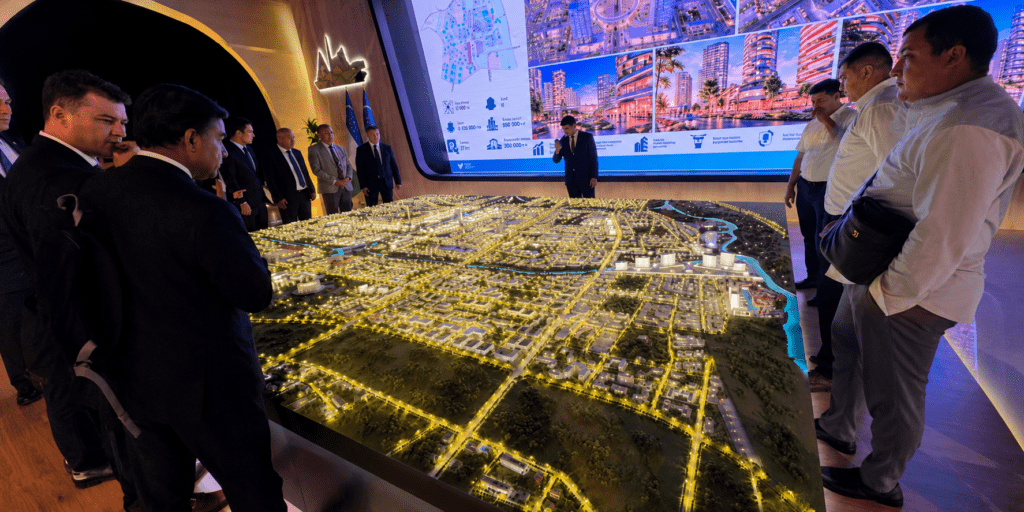
On April 3rd, Uzbekistan President Shavkat Mirziyoyev attended a ceremony to celebrate the start of construction of New Tashkent; a twin capital located on 20,000 hectares east of the existing city of Tashkent, between the Chirchiq and Karasu rivers. Speaking at the launch, President Mirziyoyev emphasized the historical significance of the ground-breaking project and its far-reaching impact on the future of Uzbekistan: “Today we are laying the foundation for the campuses of Yangi Uzbekistan University and Tashkent State Pedagogical University, the National Library, the National Theater, the International Research Center, the Museum of Literature, and the Alisher Navoi School of Creativity. It is no coincidence that the construction of a new city begins with the abodes of knowledge and spirituality. They will become the basis and model in the formation of an enlightened society.” The new city’s campus of Tashkent State Pedagogical University will provide teaching facilities for 20 thousand students, dormitories for 5 thousand, a kindergarten for 300 children, and a school for 616 pupils. It will also include a sports centre, a palace of culture, and an amphitheatre. Yangi Uzbekistan University, rated as one of the most prestigious universities in the country for engineering, management, information technology, agricultural technology, humanities, and natural sciences, will be complemented by a second campus in New Tashkent. Once in operation, the new facilities will accommodate 10 thousand students, a library, sports complex, and an Olympic-sized swimming pool. Ambitious plans for the second city also include a new National Library of Uzbekistan with the capacity to house over 10 million books and accommodate over 1,400 users at any given time. Concluding his speech, the president underlined his belief that New Tashkent was set to become a centre for excellence in science, education, and culture not only for Uzbekistan but also for the entire region. It was earlier reported that master plans for New Tashkent had been developed by the UK’s Cross Works design company.