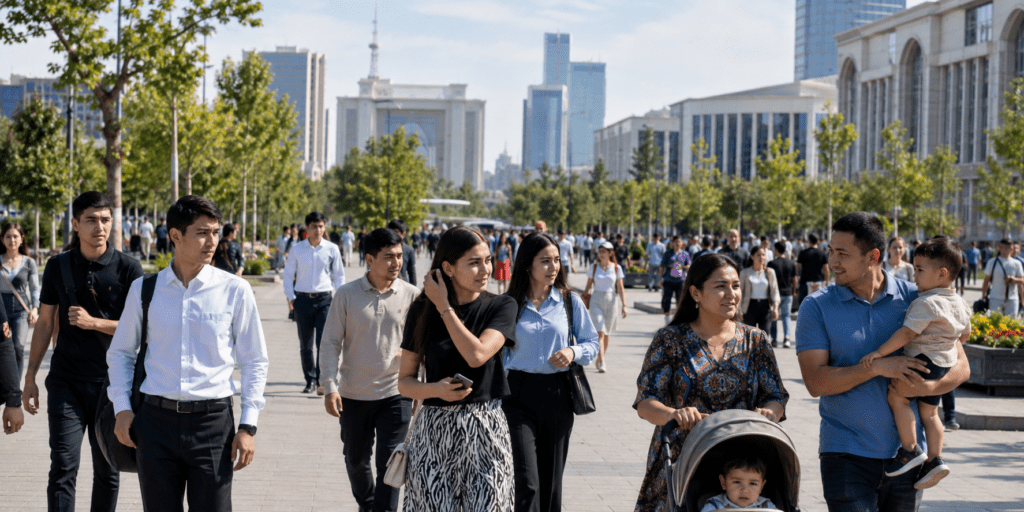
Uzbekistan Population Growth: 20 Years To Use a Window of Opportunity
Uzbekistan has a limited window of opportunity to turn its rapidly growing young population into a driver of long-term economic growth, according to a new study on demographic trends and human capital development in the country. The report, produced as part of a broader regional study on Central Asia, analyzes the prospects of young people up to the age of 24, as well as the impact that a range of investments in their well-being could have on national development through 2050. Approximately 60% of Uzbekistan’s population is under the age of 30. As this generation enters the workforce, the country is expected to gain the largest labor force in its history. Researchers argue that this creates the conditions for a “demographic dividend,” a period during which a high proportion of working-age citizens can accelerate economic growth and boost productivity. However, the report warns that such an outcome is far from guaranteed. Uzbekistan’s demographic opening is also a labor-market test. UNDP has estimated that around 700,000 young people enter the country’s job market each year, while warning that many graduates still lack practical, market-relevant skills. That makes education, vocational training, and job creation central to whether population growth becomes an economic advantage or a source of pressure. “Uzbekistan risks missing the opportunity for accelerated economic growth due to underdeveloped human capital,” the authors state. One indicator of the challenge is Uzbekistan’s score of 0.6 in the World Bank’s Human Capital Index. This suggests that children born in the country today are likely to realize only 60% of their potential future productivity compared with what would be possible with full access to quality education and good health outcomes. The UN has framed the issue in similar terms, saying targeted investments in early childhood, including health, nutrition, early learning, and social protection, could help close Uzbekistan’s human-capital gap and generate additional economic returns by 2050. Uzbekistan’s population is projected to grow from approximately 38 million people in 2025 to more than 40 million by 2030 and reach around 52 million by 2050. In 2024, the country was home to 11.3 million children under the age of 15, 23.9 million working-age adults, and 2.2 million people aged 65 and older. By 2050, the working-age population is expected to exceed 33 million, while the number of elderly citizens is projected to triple to more than 6 million. Researchers note that Uzbekistan is currently in what demographers describe as the “early-dividend” phase, during which fertility rates gradually decline while the share of working-age citizens continues to rise. The average number of children per woman has fallen from more than four in the early 1990s to approximately 3.45 in 2025 and is expected to decline further to 2.55 by mid-century. The report’s authors argue that the next two decades will be critical for Uzbekistan’s future economic trajectory. They recommend increased investment in education, healthcare, nutrition, child protection, social protection, water supply, sanitation infrastructure, and labor market development. According to the study, investments in human capital during the...