• KGS/USD = 0.01144 0%
  • KZT/USD = 0.00205 0%
  • TJS/USD = 0.10784 0%
  • UZS/USD = 0.00008 0%
  • TMT/USD = 0.28490 0%
  • KGS/USD = 0.01144 0%
  • KZT/USD = 0.00205 0%
  • TJS/USD = 0.10784 0%
  • UZS/USD = 0.00008 0%
  • TMT/USD = 0.28490 0%
  • KGS/USD = 0.01144 0%
  • KZT/USD = 0.00205 0%
  • TJS/USD = 0.10784 0%
  • UZS/USD = 0.00008 0%
  • TMT/USD = 0.28490 0%
  • KGS/USD = 0.01144 0%
  • KZT/USD = 0.00205 0%
  • TJS/USD = 0.10784 0%
  • UZS/USD = 0.00008 0%
  • TMT/USD = 0.28490 0%
  • KGS/USD = 0.01144 0%
  • KZT/USD = 0.00205 0%
  • TJS/USD = 0.10784 0%
  • UZS/USD = 0.00008 0%
  • TMT/USD = 0.28490 0%
  • KGS/USD = 0.01144 0%
  • KZT/USD = 0.00205 0%
  • TJS/USD = 0.10784 0%
  • UZS/USD = 0.00008 0%
  • TMT/USD = 0.28490 0%
  • KGS/USD = 0.01144 0%
  • KZT/USD = 0.00205 0%
  • TJS/USD = 0.10784 0%
  • UZS/USD = 0.00008 0%
  • TMT/USD = 0.28490 0%
  • KGS/USD = 0.01144 0%
  • KZT/USD = 0.00205 0%
  • TJS/USD = 0.10784 0%
  • UZS/USD = 0.00008 0%
  • TMT/USD = 0.28490 0%

Viewing results 1 - 6 of 146

Kazakhstan’s Banking System and the Logic of Early Enforcement

Kazakhstan’s growth model depends on uninterrupted access to international finance. Because its largest energy and mining projects rely on foreign capital, hard-currency financing, and offshore banking channels, confidence in the integrity of its banking system is not just a regulatory issue; it is a macroeconomic constraint. This reliance is structural. Export revenues are concentrated in globally-priced commodities—especially oil (up to 60% of total exports in recent years), and uranium (40%+ of global output)—linking fiscal stability directly to hard-currency liquidity and correspondent banking access. In that context, correspondent banking is a systemic requirement underpinning international payments and trade. Because international banks incorporate sanctions exposure and AML/CFT risk into their assessments, adverse risk perceptions can trigger de-risking behavior that raises costs and slows flows. Astana is now courting U.S. and European investment in multibillion-dollar initiatives, including the Trans-Caspian/Middle Corridor and projects related to rare earth and critical minerals supply chains. This further increases Kazakhstan’s exposure to Western compliance standards and regulatory scrutiny. With a growth model heavily driven by foreign capital, Kazakhstan understands that perceived weaknesses in banking system compliance would not halt investment outright, but would translate into higher funding costs and reduced appetite in international capital markets. Sanctions Exposure After 2022: Structural, Not Tactical Russia’s full-scale invasion of Ukraine in February 2022 sharply increased Kazakhstan’s exposure to global sanctions enforcement. Geography, membership in the Eurasian Economic Union, and dense trade and infrastructure ties with Russia made Kazakhstan a focal point for concerns over re-exports and sanctions leakage. At the same time, its border with China—an important source of dual-use goods—has added another layer of scrutiny, even as reporting later showed that China-origin cargo bound for Russia was, in documented cases, routed without physically entering Kazakhstan, despite being linked to it in trade flows. Western sanctions reshaped logistics faster than enforcement capacity could adapt. Restrictions on shipping, insurance, and financial services increased reliance on overland transit routes through Central Asia, drawing attention to Kazakhstan, even where violations were difficult to substantiate. Western investigations later showed that EU-origin dual-use goods continued to reach Russia through intermediary channels, underscoring enforcement gaps beyond Kazakhstan itself. For Kazakhstan, however, heightened scrutiny translated directly into financial risk, regardless of intent. In the logic of global compliance, perception can be as consequential as proof. Early Intervention as Risk Management Since 2022, Kazakhstan’s response has evolved from declaratory neutrality to early, containment-oriented enforcement. This shift has been driven less by foreign-policy alignment than by a calculation that even isolated violations can carry disproportionate financial consequences. President Kassym-Jomart Tokayev has repeatedly emphasized that sanctions violations carry direct economic consequences for Kazakhstan, warning in public remarks that non-compliance could expose the country to secondary sanctions affecting trade, finance, and investment flows. By framing compliance as a matter of macroeconomic risk management rather than geopolitical positioning, the government signaled that enforcement would prioritize financial stability over short-term commercial convenience. That logic has translated into practice. When Western sanctions were imposed on Sberbank in 2022, Kazakhstan approved the sale and restructuring of...

Kazakhstan Boosts Oil Output Despite Export Infrastructure Challenges

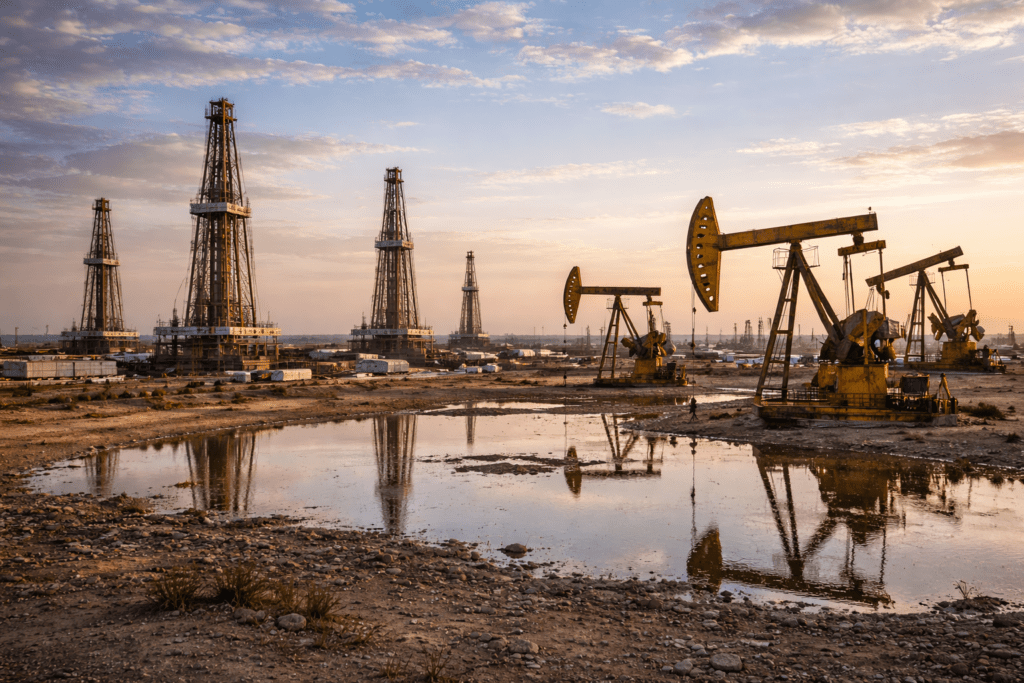
Kazakhstan increased its production of oil and gas condensate by 14% in January-November 2025 compared to the same period last year, and exceeded its annual export plan ahead of schedule, despite ongoing disruptions in the Caspian Pipeline Consortium (CPC). The figures were announced by Deputy Minister of Energy Sungat Yessimkhanov. By the end of 2024, Kazakhstan had produced 87.7 million tons of oil and gas condensate, 97.1% of its target of 90.5 million tons. Total oil exports for the year reached 63.2 million tons. In the first 11 months of 2025, production rose to 91.9 million tons, marking a 14.1% year-on-year increase. The full-year target for 2025 is 96.2 million tons. Over the same period, exports amounted to 73.4 million tons, already surpassing the annual target of 70.5 million tons and representing a 16.1% increase from the previous year. This growth came despite serious challenges to Kazakhstan’s main export route. The CPC, which carries the bulk of Kazakh crude to international markets, experienced disruptions following a drone attack on its infrastructure. The incident raised fresh concerns about the vulnerability of critical export corridors. In the gas sector, Kazakhstan produced 62.8 billion cubic meters of natural gas in January-November 2025, a 16.7% increase from the same period in 2024. The annual gas production target for 2025 has already been met. Liquefied petroleum gas (LPG) production rose to 2.8 million tons, up 1.8%. Gas transit volumes through Kazakhstan reached 64.5 billion cubic meters, up 0.9%. During the same period, domestic production of petroleum products reached 14 million tons. The full-year target is 14.5 million tons, on track to match the 2024 total, when 17.9 million tons of crude were processed domestically. Production of oil and gas chemical products increased by 12.2%, reaching 567,600 tons. The target for 2025 is set at 590,000 tons. As previously reported by The Times of Central Asia, Kazakh authorities are actively seeking foreign investment for the construction of a fourth major oil refinery with a projected capacity of up to 10 million tons per year. Overall, Astana plans to attract between $15 billion and $19 billion in investment for the development of the oil refining sector by 2040.

Organization of Turkic States Discusses Key Eurasian Energy Projects

At the 5th meeting of ministers responsible for energy within the Organization of Turkic States (OTS), held on December 10 in Istanbul, OTS Secretary General Kubanychbek Omuraliev outlined major joint energy initiatives underway among member states. Founded in 2009, the OTS comprises Azerbaijan, Kazakhstan, Kyrgyzstan, Turkey, Uzbekistan, and Turkmenistan. Hungary and Northern Cyprus participate as observer states. Omuraliev touched upon the following projects: Major oil and gas routes such as the Baku-Tbilisi-Ceyhan (BTC) oil pipeline, Baku-Tbilisi-Erzurum (BTE) gas pipeline, South Caucasus Pipeline, Trans-Anatolian Natural Gas Pipeline (TANAP), Trans Adriatic Pipeline (TAP), and the Iğdır-Nakhchivan gas pipeline; A strategic partnership between Azerbaijan, Kazakhstan, and Uzbekistan to develop and transmit green energy; The Azerbaijan-Georgia-Turkey-Bulgaria Green Energy Corridor, which extends the Central Asia-Azerbaijan corridor and opens new avenues for energy exports to Europe; Construction of the Kambarata-1 Hydropower Plant in Kyrgyzstan, a project jointly developed with Kazakhstan and Uzbekistan; and A planned Black Sea submarine cable to transmit renewable energy. Omuraliev emphasized that enhanced intra-OTS cooperation bolsters both the economic potential of member states and regional energy security. Ministers at the meeting noted the significant fossil fuel and clean energy resources held by OTS members and observers, describing the region as a strategic energy bridge between Asia and Europe. They stressed that advancing practical cooperation is essential amid growing global energy demand and the accelerating energy transition. Participants agreed to move forward with joint projects under the OTS framework, including the establishment of a Regional Center for Technologies and Green Initiatives. As previously reported by The Times of Central Asia, on December 5, the Board of Governors of the Turkic Investment Fund announced in Bishkek that the fund will begin operations in the first quarter of 2026. The Turkic Investment Fund is the first dedicated financial institution jointly established by OTS member states. Headquartered in Istanbul, its mandate is to promote economic cooperation, boost intra-regional trade, and support sustainable development by financing major joint initiatives across the region.

China’s Power Play in Central Asia’s Energy Sector

China is steadily expanding its influence in Central Asia’s oil and gas sector through multi-billion-dollar investments, long-term supply agreements, and a growing network of strategic partnerships. From Kazakhstan to Turkmenistan, Beijing’s state-backed companies are securing key upstream and midstream assets, financing new petrochemical and pipeline projects, and positioning themselves as indispensable players in the region’s resource development. This expansion is driven not only by China’s rising energy demand, but also by Beijing’s ambition to establish durable overland energy corridors that reduce reliance on maritime routes vulnerable to disruption. Central Asia’s existing and planned pipelines provide China with rare direct access to oil and gas fields across its western frontier, making the region a focal point of its broader energy-security strategy and a cornerstone of Beijing’s efforts to diversify supply while deepening political and economic footholds across Eurasia. Kazakhstan Eyes Chinese Investment Amid Lukoil Sanctions Kazakhstan may seek to transfer Russian company Lukoil’s stake in the offshore Kalamkas-Khazar oil and gas project to a new partner, with some industry channels, including the Telegram channel Energy Monitor, speculating about possible Chinese interest. Lukoil, which has been targeted by Western sanctions, is reportedly planning to exit Kalamkas-Khazar Operating LLP, a joint venture with KazMunayGas (KMG). Each company currently holds a 50% stake. Some commentators have suggested that a Chinese investor could step in, but no replacement has been officially confirmed. Seconded engineers from KMG Engineering are expected to be withdrawn from the project as of January 1, 2026, with several Kalamkas-Khazar staff members temporarily reassigned to other KMG subsidiaries until a new partner is confirmed. The project is considered highly promising, with earlier estimates citing reserves of 81 million tons of oil and 22 billion cubic meters of gas. New exploration has identified additional oil-bearing structures. A final investment decision (FID) worth more than $6.5 billion was originally expected by the end of 2025. However, U.S. sanctions against Lukoil have delayed progress. Located 120 km from the Kashagan field in the North Caspian Basin, the Kalamkas-Khazar block comprises the Kalamkas-More and Khazar fields. The site is situated in Kazakhstan’s Mangistau Region, 60 km from the Buzachi Peninsula. KazMunayGas Chairman Askhat Khasenov previously confirmed that production was expected to begin in 2028-2029, with peak output reaching four million tons annually. Lukoil was sanctioned by the UK on October 15, followed by the U.S., complicating ongoing negotiations. Despite this, major projects where Lukoil holds minority stakes, such as Tengiz, Karachaganak, and the Caspian Pipeline Consortium, have not been impacted. A Lukoil withdrawal would create a rare opening for China to secure its first significant offshore position in the North Caspian, a zone historically dominated by Western majors and Russian firms. Such an entry would represent a notable shift in Kazakhstan’s offshore partnership landscape. Beijing's Billion-Dollar Energy Deals in Kazakhstan In September 2025, President Kassym-Jomart Tokayev announced a series of energy deals with China valued at $1.5 billion. During his official visit to China, more than 70 commercial agreements totaling approximately $15 billion were signed, several...

KMG Pushes Back on Reports of European Asset Sale Amid Romania Refinery Losses

KazMunaiGaz (KMG) says it has no concrete plans to sell any of its European assets, though pressure is building to at least sell off some of the Kazakh company’s shares in oil refineries in Romania. Reports on November 21 said KMG was looking to privatize up to 50% of its shares in its subsidiary KMG International’s (KMGI) European operations in Europe. The reports were based on a list of recommendations from Kazakhstan’s Agency for the Protection and Development of Competition (APDC), which proposed, as part of the 2026-2027 strategy, that KMGI should have a two-stage tender to sell up to 50% of its stakes. On November 26, KMG denied making any decisions about KMGI businesses in Europe, adding that the APDC’s list of recommendations “includes assets from different sectors, but this in itself does not automatically trigger a sale.” Rompetrol KMGI has 28 companies operating in seven countries, four of them European, but the focus of reports was on the two oil refineries KMGI owns in Romania. KMGI purchased 75% of the shares in the Romanian oil company Rompetrol in 2007, and in 2009 bought the remaining 25% of shares in the company. That sale included the Petromidia oil refinery, with a capacity of some five million tons annually, and the smaller Vega refinery, with a capacity of some 350,000 tons that Rompetrol owns. KMGI also took ownership of the oil terminal near Constanta on the Black Sea coast, some 20 kilometers from the Petromidia refinery. The terminal imports mainly Kazakh oil. KMGI invested billions of dollars in upgrades and modernization of the refineries and the terminal, and finally, in 2017, operations of subsidiary Rompetrol Rafinare (54.63% KMGI and 44.7% Romanian state through the energy Ministry) showed a profit - $80 million. By 2022, profits had slightly increased to $90.3 million, but in December that year, the Romanian authorities changed tax regulations, and in 2023, Rompetrol Rafinare registered a net loss of some $270.5 million, and in 2024, a loss of $78 million. In the first six months of 2025, the company lost $53 million and paid some $771 million in taxes to the Romanian government. Rompetrol Rafinare has complained to the Romanian government that the tax burden is preventing the company from investing in new projects and has brought a legal challenge to the solidarity tax in court. In such a situation, it seems unlikely KMG would easily find a party interested in buying up to 50% of KMGI’s Romanian operation, unless the price was very low. Opponents of the proposed arrangement point to the $7 billion in investment KMG has made over nearly 20 years into upgrading the Romanian refineries as a reason to be patient for a while longer. KMGI KMG has subsidiaries operating in Switzerland, Bulgaria, Turkey, Moldova, and Georgia, as well as in Romania and Kazakhstan. At the start of 2025, there were reports that KMG was considering the acquisition of an oil refinery in Bulgaria from Russia’s LUKoil, so it appeared the Kazakh company...

Kazakhstan vs Eni: How a Swiss Lawsuit Could Reshape the $160 Billion Kashagan Dispute

The legal landscape surrounding Kazakhstan’s energy sector has taken an unexpected turn. What began as a closed commercial arbitration dispute has now entered the public sphere in Switzerland’s courts. This marks a significant escalation in Astana’s confrontation with international oil and gas majors. According to Bloomberg, PSA LLP, a structure representing Kazakhstan’s interests in production-sharing agreements (PSAs), has significantly broadened its claims. The lawsuit now directly targets alleged schemes involving units and executives of the Italian company Eni. Kazakhstan alleges that during the early development of Kashagan infrastructure, including the Bolashak processing plant and pipeline systems, corruption and fraud may have occurred. Arbitration claims against the NCOC consortium, which includes Shell, ExxonMobil, TotalEnergies, and Eni, exceed $150 billion. Within this context, the Swiss case has become the most sensitive element. The Swiss case itself is much smaller – $15 million plus interest – and is being used to gather evidence and strengthen the larger arbitration case. While the financial stakes are high, the proceedings reflect a deeper political shift. Kazakhstan is moving away from the 1990s model of offering investors exceptional privileges. Under President Kassym-Jomart Tokayev’s “Fair Kazakhstan” policy, the state is aiming to secure more balanced and equitable cooperation with foreign partners. Distinctiveness of Swiss Proceedings The Swiss case is distinctive due to the nature of its allegations. The plaintiffs claim that during the tenure of Agip KCO (an Eni subsidiary) as project operator, contracts were awarded amid corrupt practices. Allegations include inflated prices and kickbacks to contractors. Targeting Eni is deliberate. The company led the project during its most troubled phase from 2001 to 2008. Kashagan’s budget swelled during this period, with repeated delays. Following a 2013 gas leak, production was halted for nearly three years. Kazakh officials have long linked Kashagan’s massive cost overruns and technical failures to poor procurement and mismanagement, and the current legal offensive zeroes in on alleged corrupt tenders. Cost estimates rose from a few tens of billions of dollars to around $60 billion, and by 2007, projections for total project costs had reached about $136 billion. Why Switzerland? The selection of the Swiss jurisdiction is strategic. Switzerland’s laws on corruption and financial crimes allow for the prosecution of both corporations and individual executives. Moreover, many entities connected to Kashagan’s operations are registered there. Another factor is the PSA’s stabilization clause, which forbids altering the contract’s terms. However, under international legal norms, if corruption is proven in the contract’s formation, such protections can be voided. This opens the door for Kazakhstan to challenge key financial terms of the agreement. Resource Nationalism 2.0: Legal Strategy Meets Political Logic Astana’s current posture can be described as a form of “new-generation resource nationalism.” Rather than using administrative leverage, the state is deploying legal tools to address grievances. This is driven in part by Kazakhstan’s fiscal needs, ranging from infrastructure upgrades to social spending. Amid these pressures, the vast expenditures reported by Kashagan operators have drawn public skepticism. Kazakhstan’s claims aim to re-evaluate the cost recovery model...