• KGS/USD = 0.01144 0%
  • KZT/USD = 0.00211 0%
  • TJS/USD = 0.10803 0%
  • UZS/USD = 0.00008 0%
  • TMT/USD = 0.28571 0%
  • KGS/USD = 0.01144 0%
  • KZT/USD = 0.00211 0%
  • TJS/USD = 0.10803 0%
  • UZS/USD = 0.00008 0%
  • TMT/USD = 0.28571 0%
  • KGS/USD = 0.01144 0%
  • KZT/USD = 0.00211 0%
  • TJS/USD = 0.10803 0%
  • UZS/USD = 0.00008 0%
  • TMT/USD = 0.28571 0%
  • KGS/USD = 0.01144 0%
  • KZT/USD = 0.00211 0%
  • TJS/USD = 0.10803 0%
  • UZS/USD = 0.00008 0%
  • TMT/USD = 0.28571 0%
  • KGS/USD = 0.01144 0%
  • KZT/USD = 0.00211 0%
  • TJS/USD = 0.10803 0%
  • UZS/USD = 0.00008 0%
  • TMT/USD = 0.28571 0%
  • KGS/USD = 0.01144 0%
  • KZT/USD = 0.00211 0%
  • TJS/USD = 0.10803 0%
  • UZS/USD = 0.00008 0%
  • TMT/USD = 0.28571 0%
  • KGS/USD = 0.01144 0%
  • KZT/USD = 0.00211 0%
  • TJS/USD = 0.10803 0%
  • UZS/USD = 0.00008 0%
  • TMT/USD = 0.28571 0%
  • KGS/USD = 0.01144 0%
  • KZT/USD = 0.00211 0%
  • TJS/USD = 0.10803 0%
  • UZS/USD = 0.00008 0%
  • TMT/USD = 0.28571 0%

Viewing results 1 - 6 of 127

Tajikistan: Leaders introduced to president-to-be?

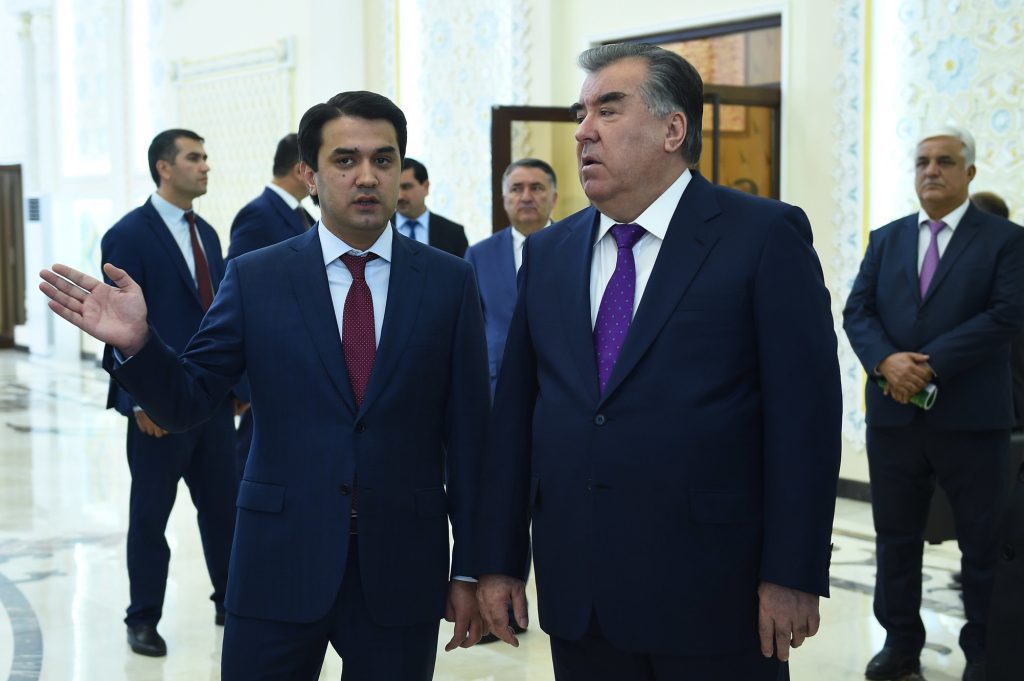
DUSHANBE (TCA) — The most recent developments suggest that Tajikistan has opted for a father-to-son power succession scheme. We are republishing this article on the issue, originally published by Eurasianet: In a gesture profound in symbolism, Rustam Emomali, the mayor of Tajikistan’s capital and son of the president, last week met with the heads of state visiting Dushanbe to attend a Commonwealth of Independent States summit. In Tajikistan, greeting arriving presidents is typically the purview of the prime minister, making this a noteworthy departure from convention. Thirty-year-old Emomali was captured in photographs as he met in Dushanbe international airport with Russian President Vladimir Putin, Kazakhstan’s Nursultan Nazarbayev, Alexander Lukashenko of Belarus, and others. The received wisdom is that this marks an important stage in a widely mooted succession strategy as incumbent leader Emomali Rahmon, who turns 66 on October 5, introduces his son to the leaders of some of Tajikistan’s main international partners. Speculation from Akhbor, an often well-informed news website based in Prague, is that Rahmon may even be bracing to announce the holding of elections in 2019 in mid-November. This announcement could be made after the first two turbines of the all-important and politically existential Roghun hydropower dam are put into operation, the website said. The next presidential election, which takes place every seven years, is in theory scheduled for 2020, but that year is also due to see parliamentary elections. The thinking is that the presidential vote may be brought forward to avoid two major political dates falling in the same year. Akhbor’s reasoning is that Rahmon intends to make the start of operations at Roghun the crowning development of his more than 25 years of rule. The dam, which is slated to cost at least $3.9 billion to complete, has been elevated to the status of a be-all and end-all project — an undertaking to pull the country out struggling indigence. The commissioning of two turbines is only the beginning, however. The end product will, if ever finished, comprise six turbines and produce enough power to generate hundreds of millions in electricity export revenue. Another factor mentioned by rumor-mongers is Rahmon’s supposedly shaky health. But such speculation is a perennial feature of succession forecasters in Central Asia and there is no evidence that Rahmon is indeed ailing in any meaningful fashion. The notion of an imminent transition at the top is supported by the decision to hold a referendum in 2016 that amended the constitution to reduce the minimum age of eligibility for presidential office from 35 to 30 years. At a cursory glance, this appeared tailor-made to allow for Emomali to take the job. He turns 31 in December. Even if Rahmon were to formally surrender his title as head of state, he would retain significant — arguably still paramount — rank by virtue of his lifelong Leader of the Nation status. The president was bestowed with this title by lawmakers in 2015. The bespoke post allows Rahmon to address the nation and state officials...
Uzbekistan’s president rebrands his administration, but keeps stalwarts

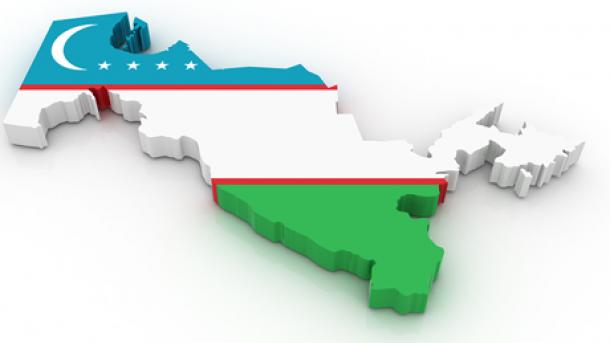
TASHKENT (TCA) — Along with political and economic reforms, Uzbekistan’s President has made some changes in his administration in an effort to redistribute executive powers and make the country’s governance more effective. We are republishing this article on the issue, written by Umida Hashimova, originally published by The Jamestown Foundation’s Eurasia Daily Monitor: The president of Uzbekistan, Shavkat Mirziyoyev, issued a decree, on August 27, changing the official name of the 27-year-old “Presidential Executive Office” (Devon in Uzbek and Apparat Russian) to the “Presidential Administration.” Along with the new name, the Administration saw some personnel changes and possibly limitation of powers of certain advisors. Overall, these reforms are largely superficial as the Presidential Administration inherited not only the same departments and functions from the Executive Office, but maintains all the major stalwarts of the previous government structure. President Mirziyoyev’s office was not the only government body to be renamed. The heads of nine departments within the administration will now be called “Presidential Advisors,” dropping the word “State,” which had heretofore preceded their titles. Presidential advisors will reportedly now monitor and control the activities of the eight deputy prime ministers and work in concert with them (Gazeta.uz, August 27). A government official commented that, under the new arrangement, “the personal responsibility of presidential advisors will increase” (Gazeta.uz, August 27). Yet, in actuality, the organization might mean advisors will have to share their authority with relevant ministries and, more importantly, their power will be limited to the deputy prime minister level. Under Mirziyoyev’s predecessor, Islam Karimov, presidential state advisors had long arms of power, while ministries and state enterprises were merely bodies subservient to the advisors (BBC News—Uzbek service, August 28). The reorganization may narrow the distance between ministers and the president, thus allowing the government greater access to the head of state. This is all logical in the context of Mirziyoyev’s attempts to decentralize governmental powers while increasing the accountability of various government bodies. The presidential decree also precipitated some reshuffles of his team. Notably, Khayriddin Sultonov stepped down from the administration’s Mass Media, Cultural and Educational Affairs Department—a post he had held since 2000 (Facebook.com, August 27). Sultonov, however, remains in the administration as President Mirziyoyev’s speech writer. One of two longest serving officials remaining from the late Karimov’s Executive Office, Sultonov had joined the presidential administration in 1993, at the age of 37, where he led the analytical center. As of 2000, his tight supervision of Uzbekistan’s media outlets earned him the title of the country’s “chief censor” (Ozodlik, August 22, 2017). On the other hand, Mirziyoyev’s Administration will continue to be headed by the little-known Zaynilobiddin Nizomiddinov. The exact date he had joined Mirziyoyev’s team is not clear. But he and his three deputies are all young men in their 30s. The head of the Administration is a powerful position: the law gives Nizomiddinov and his deputies control over information flows to the president by way of compiling and analyzing anything addressed to the head of state (Lex.uz,...

Kyrgyzstan: Political tussle overshadows Nomad Games

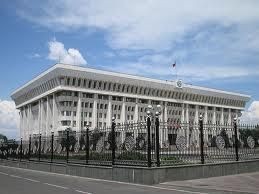
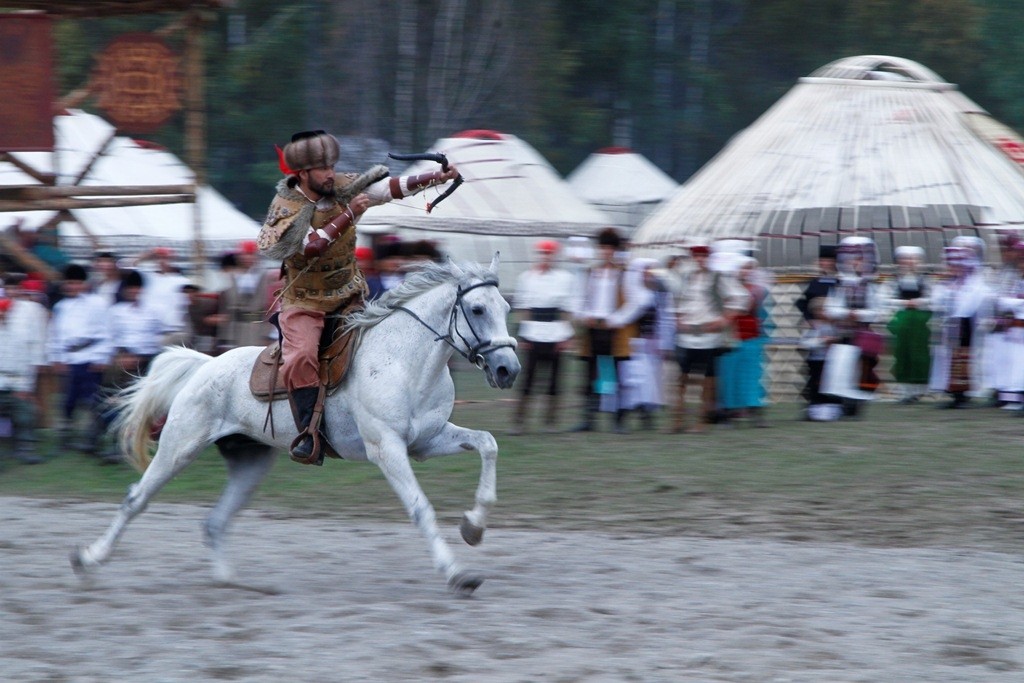
BISHKEK (TCA) — As Kyrgyzstan makes final preparations for hosting the World Nomad Games, the event is also expected to shed more light on the ongoing tensions among Kyrgyzstan’s political elite. We are republishing this article on the issue, originally published by Eurasianet: Continue reading

Kyrgyzstan: ex-President’s party criticizes ‘short-sighted’ government policies

BISHKEK (TCA) — Kyrgyzstan's Social Democratic Party (SDPK) has blasted government policies as "short-sighted," indicating a growing tension between former President Almazbek Atambayev and the country’s current leader, Sooronbai Jeenbekov, RFE/RL's Kyrgyz Service reported. Continue reading

Kyrgyzstan: Bishkek court ruling fuels high-level feud in the country

BISHKEK (TCA) — A court in Kyrgyzstan has reinstated a senior customs official who was fired on Almazbek Atambayev's last full day in office, drawing an angry reaction from the former president, RFE/RL reports. Continue reading

Kazakhstan: Nazarbayev becomes Security Council’s chairman for life

ASTANA (TCA) — Kazakhstan President Nursultan Nazarbayev has become the head of the Central Asian country’s Security Council for life. State-run media published a presidential decree on July 12 that brought the new law into force, RFE/RL reported. Continue reading