• KGS/USD = 0.01144 0%
  • KZT/USD = 0.00205 0%
  • TJS/USD = 0.10685 -0.37%
  • UZS/USD = 0.00008 0%
  • TMT/USD = 0.28490 0%
  • KGS/USD = 0.01144 0%
  • KZT/USD = 0.00205 0%
  • TJS/USD = 0.10685 -0.37%
  • UZS/USD = 0.00008 0%
  • TMT/USD = 0.28490 0%
  • KGS/USD = 0.01144 0%
  • KZT/USD = 0.00205 0%
  • TJS/USD = 0.10685 -0.37%
  • UZS/USD = 0.00008 0%
  • TMT/USD = 0.28490 0%
  • KGS/USD = 0.01144 0%
  • KZT/USD = 0.00205 0%
  • TJS/USD = 0.10685 -0.37%
  • UZS/USD = 0.00008 0%
  • TMT/USD = 0.28490 0%
  • KGS/USD = 0.01144 0%
  • KZT/USD = 0.00205 0%
  • TJS/USD = 0.10685 -0.37%
  • UZS/USD = 0.00008 0%
  • TMT/USD = 0.28490 0%
  • KGS/USD = 0.01144 0%
  • KZT/USD = 0.00205 0%
  • TJS/USD = 0.10685 -0.37%
  • UZS/USD = 0.00008 0%
  • TMT/USD = 0.28490 0%
  • KGS/USD = 0.01144 0%
  • KZT/USD = 0.00205 0%
  • TJS/USD = 0.10685 -0.37%
  • UZS/USD = 0.00008 0%
  • TMT/USD = 0.28490 0%
  • KGS/USD = 0.01144 0%
  • KZT/USD = 0.00205 0%
  • TJS/USD = 0.10685 -0.37%
  • UZS/USD = 0.00008 0%
  • TMT/USD = 0.28490 0%

Viewing results 1 - 6 of 30

Breaking into Project Vault: A U.S. Role for Central Asia’s Strategic Minerals

The Trump Administration has decided to go head-to-head with Beijing to secure an independent supply chain for critical minerals and insulate U.S. industries from supply shocks. Among many initiatives, the United States launched Project Vault on February 2 to establish a U.S. Strategic Critical Minerals Reserve. The public-private stockpile is expected to secure essential minerals and metals for U.S. national security purposes and high-technology industries. The effort formalizes the U.S. strategy to diversify critical mineral supply chains away from rival China and, in the process, harness broader global capacity. As part of this effort, mineral-rich Central Asia is already factoring heavily in U.S. foreign and economic policy thinking. Participating in the front row of the 2026 Critical Minerals Summit, Kazakhstan and Uzbekistan were invited to engage in Washington’s global effort to build resilient global supply chains. But Project Vault is a critical and separate component of the administration’s focus. Formally approved by the Export-Import Bank of the United States (EXIM) on February 2, Project Vault will be backed with up to $10 billion in long-term financing and an additional $2 billion in private sector participation. In sites across the country, the initiative will establish stores of critical minerals and rare earth elements essential for aerospace, defense, semiconductors, advanced manufacturing, renewables, and electric vehicles. The stockpile’s structure will be operated as a public-private partnership that enables manufacturers, trading firms, and private capital providers to jointly participate. Rare earths, copper, lithium, titanium, scandium, gallium, and germanium are all key minerals highlighted by the U.S. Department of the Interior that underpin modern technologies and demonstrate U.S. vulnerability to supply chain disruptions. Why a Strategic Mineral Reserve? The initiative is a direct response to perceived risks posed by China’s relative control of global critical mineral supply chains and markets, as well as Beijing’s use of trade restrictions, protectionism, and the weaponization of access to certain critical minerals. China controls a commanding share of the mining, refining, and processing of rare earths and related materials. Due to years of strategic planning and investment, Beijing has leveraged state subsidies and pricing controls to develop and secure between 80%-100% of rare earth processing capacities that have dominated international markets and disincentivized competitors for decades. Past export controls and export-license restrictions imposed by Beijing have underscored how critical mineral supply can become a tool of geopolitical leverage. China has at times restricted rare earth exports to Japan, Sweden and the United States in what is defined by many as supply-chain protectionism. Such actions can disrupt U.S. production for industries that rely on stable supplies to manufacture semiconductors, defense systems, and clean energy technologies. Project Vault is, therefore, conceived not merely as a reserve but as a mechanism to stabilize U.S. markets, to reduce reliance on China, and to signal a long-term commitment to diversified supply chains. Much like the U.S. Strategic Petroleum Reserve acts to cushion energy price shocks, the mineral reserve is expected to serve as a similar buffer. Operational and Financial Dimensions Project Vault’s financing model expects a...

Kazakhstan’s Foreign Minister Yermek Kosherbayev in Washington: Critical Minerals Cooperation

Foreign Minister Yermek Kosherbayev will travel to Washington, DC, to attend the Critical Minerals Ministerial on 3–4 February. A meeting with the Department of State and other rare earth element (REE) supplier countries will take place on 3 February. This will be Kosherbayev’s first official visit to the United States as foreign minister. A career diplomat, he assumed office on 26 September 2025. Prior to his appointment as foreign minister, he served as Kazakhstan’s ambassador to the Russian Federation, governor of the East Kazakhstan Region, and, earlier in 2025, as deputy prime minister, combining senior diplomatic experience with executive and regional governance roles. His visit will include engagement with Ambassador Yerzhan Kazykhan, appointed as the President’s first-ever Special Envoy to the United States on 13 January 2026, reflecting the priority Kazakhstan places on engagement with Washington. U.S.–Kazakhstan Strategic Convergence on Critical Minerals The visit follows a period of sustained diplomatic engagement beginning in November, marked by intensified trade and investment discussions. Since then, Presidents Kassym-Jomart Tokayev and Donald Trump have met twice in person and held one phone call, during which an invitation was extended for the G20 meeting scheduled for 14–15 December 2026. During this period, Kazakhstan also acceded to the Abraham Accords, a signature foreign policy initiative of the Trump administration. This diplomatic momentum has converged with U.S. strategic priorities on critical minerals. Rare earth elements (REEs) are a core component of the U.S. critical minerals strategy. While the United States maintains domestic REE production, it continues to pursue supply-chain diversification to enhance resilience. In this context, Kazakhstan’s identified REE deposits and resource potential—including elements not currently produced at scale in the United States—position it as a relevant partner in broader diversification efforts. This alignment has been formalized through a memorandum of understanding on cooperation in critical minerals, signed by President Tokayev. The agreement is intended to strengthen supply chains and deepen economic ties related to strategic raw materials and has been complemented by engagement from U.S. and Kazakh stakeholders, including Amont, interest from U.S. investors such as Cove Capital, and potential financing support from the Export-Import Bank of the United States, which has issued a letter of interest for up to $900 million. These signals reflect growing momentum at an early stage. Letters of interest and initial investor engagement lay the groundwork for defining commercial structures, offtake agreements, and development timelines, with progress ultimately driven by effective project sequencing and alignment between public support and private-sector risk appetite. Kazakhstan’s growing cooperation with the United States on critical minerals takes place within a well-established multi-vector foreign policy framework. Astana’s approach prioritizes stability and pragmatic engagement across a broad set of economic partners. Within this context, additional compliance and due-diligence requirements to support resilient supply chains are likely to remain part of project development, representing a manageable—but non-trivial—consideration for stakeholders. Kazakhstan’s Full-Value-Chain Advantage in Rare Earths Unlike many prospective rare earth element suppliers to the United States, Kazakhstan is not a greenfield destination limited to upstream extraction. The country...

Central Asia, Vanadium, and the U.S. National Security Strategy

Dated November 2025 and released publicly in early December, the U.S. National Security Strategy links overseas trade and investment, but overlooks Central Asia as a target region for critical minerals. This oversight merits reconsideration in the NSS’s next iteration, given the region’s known natural resource base, openness to foreign investment, proficiency in mining operations, low processing costs, and manageable geopolitical risks. As governments and businesses review supply-chain resilience for critical minerals, vanadium – not one of the 17 rare earth metals – has increasingly become a strategically relevant rather than optional or cyclical commodity. It is widely used in high-strength steel, grid-scale energy storage functions such as redox flow batteries, and infrastructure with defense and industrial applications. A recent letter from the U.S. Congress highlights a critical shortfall of vanadium in the United States: with 14,000 metric tons consumed in 2024, only 3,800 tons were produced domestically. Imports, mainly from Brazil and South Africa, are at risk due to shifting market conditions, meaning the U.S. needs a more structured and focused industrial-like approach to counter unnecessary import dependencies and geopolitical stresses. U.S. supply is secured solely through imports and recycling, given that the mining of vanadium-bearing mineral precursors is minimal to non-existent in the United States. With mining dominated by China and Russia, and with South African production in decline, today’s need to secure primary materials and supply chains means the U.S. must invest overseas until domestic mining is viable. What is needed is vertical integration from mine to final product – vanadium pentoxide (V205), vanadium trioxide (V2O3), and vanadium sulfate (VOSO₄ / V₂(SO₄)₃) for batteries. In an October Development Finance Corporation media release, DFC CEO Ben Black said that “Securing critical minerals is a paramount matter of U.S. strategic interest and economic prosperity.” That’s clearly beyond dispute. Central Asia and Vanadium Central Asia as a region fits within the U.S.’s broader geostrategic goals and geographic diversification plans aimed at building solid asset-based partnerships that go beyond raw material extraction and precarious trading arrangements. Last November's gathering of Central Asia’s five presidents at the White House finally placed the region firmly on the global map. U.S. Assistant Secretary of State for South and Central Asian Affairs Paul Kapur has also been clear: “Under President Trump’s and Secretary Rubio’s leadership, we’re elevating the C5+1 partnership as a priority — a strategic priority and an economic priority.” Here, amongst critical minerals, vanadium surely emerges as a priority commodity, given the near absence of U.S. domestic mining. Kazakhstan leads Central Asia in vanadium mining and production, hosting the region’s most productive deposits. Established operations, strong infrastructure, cost advantages, supportive laws, tax incentives, and a free FX regime make the country highly attractive to investors. Kazakhstan has three vanadium assets—Balasausqandiq in advanced production and Lisakovsk and Kurumsak in exploration—making them attractive targets for miners or funds with long horizons and low-cost capital. Kyrgyzstan has scattered, under-explored vanadium deposits, including in the Jetim Mountain Range. Uzbekistan is expanding exploration, but the value is yet to...

Kazakhstan Deepens Its Critical Minerals Push

Kazakhstan is pushing a new phase of geological exploration, and the early results suggest that the country’s critical minerals profile is deepening. The Ministry of Industry and Construction says the area of mapped and studied subsoil will rise from about 2.1 to 2.2 million square kilometers by 2026. Exploration work completed in 2024 across eleven sites has produced new resource forecasts in Abai, East Kazakhstan, Karaganda, and Kostanay. The distribution matters as much as the tonnages: rare earths and other strategic metals appear across multiple regions, while gold prospects stand out in Kostanay. Five deposits have been added to the national register, alongside newly booked reserves of gold, copper, manganese, and phosphorites. Kazakhstan’s mineral importance was already widely recognized; this round of findings measurably strengthens that judgment. Four Regions Drive a Wider Metal Mix The most recent round of results from the national survey program is notable for the geographic spread and metals mix. The 2024 work across eleven sites also produced new forecasts of precious, rare, and strategic metals in Abai, East Kazakhstan, Karaganda, and Kostanay, according to the Ministry of Industry and Construction. In the Abai Region, geologists have outlined forecast resources of about 3,200 tonnes of beryllium, 1,100 tonnes of yttrium, and 200 tonnes of niobium. The mix points to advanced-manufacturing relevance, not a single-commodity profile. East Kazakhstan adds a second, larger beryllium signal, with newly identified deposits estimated at roughly 20,600 tonnes of beryllium and 600 tonnes of tungsten. That pairing reinforces an emerging pattern in which the northeast and east of the country are presenting not just rare-earth potential but a broader suite of strategic inputs. The largest rare-earth figures in this announcement sit in the Karaganda Region. Early estimates there indicate roughly 935,400 tonnes of lanthanoids, alongside prospective resources of copper, yttrium, gallium, and molybdenum. This is consistent with the earlier 2025 reporting that has repeatedly placed central Kazakhstan at the center of the country’s renewed rare-earth narrative. Kostanay Region stands out on the precious metals side. Forecast gold resources there are reported at about 17,500 tonnes, with prospective copper resources also identified. The December update also marks formal follow-through: five new deposits have been added to the national register, with newly booked reserves that include 98 tonnes of gold, 36,000 tonnes of copper, 11 million tons of manganese, and more than 1.3 million tonnes of phosphorites. Taken together, these regionally distributed findings give added empirical weight to a view already present in earlier coverage: Kazakhstan’s mineral importance was established; the survey now suggests a widening and deepening strategic profile rather than a single episodic discovery. Kazakhstan Treats Geological Knowledge as Policy The December 8 update also fits a pattern visible through 2025: the state is treating geological knowledge as a policy tool. Earlier this year, the Geology Committee described plans to expand subsurface study coverage by early 2026, while late-2025 government reporting reiterated the 2.2 million square kilometer objective as a presidential instruction tied to industrial priorities. What separates the current cycle from...

Washington Shifts C5+1 From Diplomacy to Deals

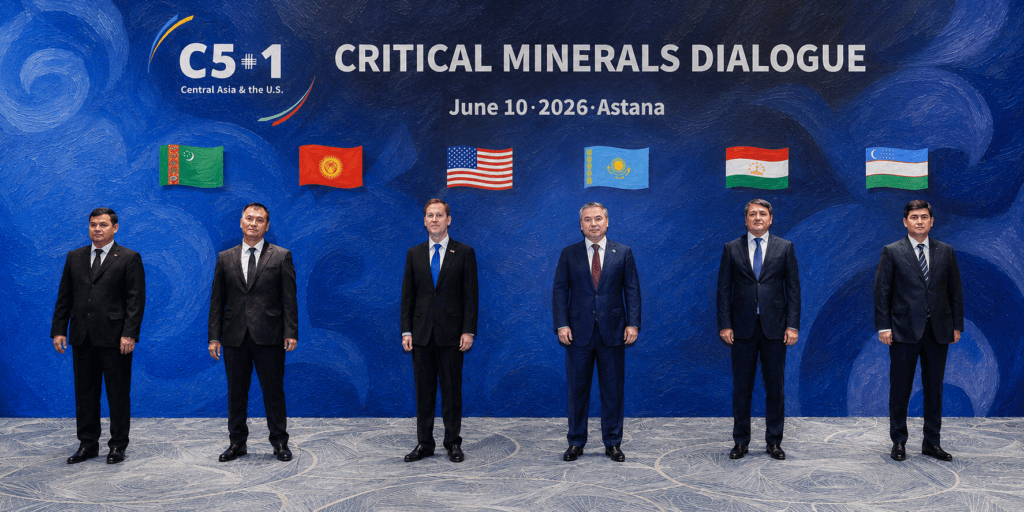
On November 6, 2025, Washington hosted the C5+1 summit, bringing U.S. President Donald Trump together with the leaders of Kazakhstan, Kyrgyzstan, Tajikistan, Turkmenistan, and Uzbekistan. The tone shifted from broad diplomacy to deliverable transactions, with officials emphasizing cooperation on critical raw materials. The timing signified a broader shift in supply chains away from China and Russia, and the discussion moved from general diplomacy to transactions that can be tracked and delivered. The private-sector track also accelerated. The B5+1 (“B” for “business”) platform is meant to carry follow-through on minerals, processing, logistics, and services. It complements state-to-state commitments by putting contract-ready work streams and policy dialogue in the same frame. Verification is simple: match U.S. and host-government readouts with company filings and ministry communiqués issued after the summit. Subsequent notices should specify instruments, values, financing, timelines, and the units responsible. What Was Signed Versus What Was Signaled The summit mixed firm orders with preliminary commitments. Uzbekistan Airways converted eight options for the Boeing 787-9 (covered by FAA Type Certificate Data Sheet T00021SE) into a firm order, bringing its total to twenty-two Dreamliners. That flows into the manufacturer’s backlog and starts financing and ground-side preparation. Tajikistan’s Somon Air announced up to four 787-9s and ten 737 MAX; that signals intent, with binding contracts and financing to follow. Engine families for the 787-9 are Rolls-Royce Trent 1000 TEN and GE Genx-1B, setting maintenance and training paths. Air Astana said it had selected up to fifteen 787-9s. Slot allocation and financing are next, along with sale-and-leaseback or operating-lease decisions. A parallel commercial package aimed to show that U.S.–Central Asia ties can move on a near-term clock, framed publicly through the Department of Commerce’s announced “C5+1 Deal Zone,” earmarked at “over $25 billion.” Rare earths and related inputs sat at the center of the talks. Aviation and other signings were presented as tangible outcomes. The substance rests with the underlying company agreements and national approvals, although the packaging usefully aggregates a single narrative for public consumption. Minerals were cast as the strategic core, even though many projects remain in the early stages. Public readouts emphasized supply-chain resilience and competition with China and Russia. For shipments into the European Union, the bottleneck remains the processing limits set by the EU Critical Raw Materials Act. Customs classification uses the Harmonized System (HS), a universal tariff code maintained by the World Customs Organization (WCO): tungsten falls under HS 8101, while rare-earth metals and their compounds are under HS 2805 and HS 2846. Bankability likewise depends on recognized industry disclosure rules for reporting mineral resources, which require standardized geology, sampling, and reserve estimates before serious financing proceeds. Wire services likewise underscored rare earths and closer cooperation along the value chain. Country Outcomes Kazakhstan. The most tangible non-aviation item was a tungsten venture at Northern Katpar and Upper Kairakty, with an indicated project scope of around $1.1 billion. A Letter of Interest (LOI) from the U.S. Export–Import Bank (EXIM) suggests a figure near $900 million on a 70/30 structure with...

Washington Steps Up Focus on Central Asia Amid Strategic Competition with China

The United States has intensified its interest in Central Asia following China’s decision to restrict exports of rare earth elements. Amid the broader U.S.–China trade rivalry, Washington is seeking to diversify its sources of strategic raw materials and strengthen economic ties with countries in the region. Analysts note that Central Asia is increasingly viewed as a key part of Washington’s strategy to reduce dependence on Chinese supply chains. However, they point to several obstacles, including high logistics costs, underdeveloped export infrastructure, and what they describe as a high-risk investment environment that limits the commercial viability of many projects. Kazakhstan and Uzbekistan: Pillars of U.S. Engagement Among the countries of the region, Kazakhstan and Uzbekistan offer the greatest potential for rare earth element extraction and present favorable conditions for U.S. cooperation. Kazakhstan is strengthening its partnerships with Western investors in the mining sector, while Uzbekistan has implemented market reforms and opened its economy to foreign capital in recent years. Kazakh President Kassym-Jomart Tokayev, currently visiting the U.S., has reiterated his government’s interest in attracting American investment and technology, including through the C5+1 regional format. After his visit to Washington, he is scheduled to travel to Moscow for a meeting with Russian President Vladimir Putin on November 12, reflecting Kazakhstan’s longstanding policy of balancing relations among major powers. Kyrgyzstan Banks on the Digital Economy Lacking major oil and gas reserves, Kyrgyzstan is pursuing a different path by developing partnerships with the U.S. in financial technology and digital assets. During talks with U.S. President Donald Trump in Washington, Kyrgyz President Sadyr Japarov said the country’s most valuable asset is its educated youth, who are increasingly active in the IT sector. Japarov outlined several initiatives, including the introduction of digital financial instruments such as the national stablecoin KGST. He also noted the importance of the U.S. Genius Act, which regulates stablecoin circulation, calling it one of the most progressive in the world. In response, the U.S. expressed its readiness to expand cooperation in digital transformation and fintech development. Tajikistan Prioritizes Energy and Security Tajik President Emomali Rahmon participated in the C5+1 summit in Washington and held separate talks with President Trump. The discussions focused on energy, investment, and regional security. Rahmon said that peace and stability are essential for sustainable development and reaffirmed Tajikistan’s readiness to expand cooperation with the U.S. in green energy and regional electricity transmission projects. At present, more than 70 U.S.-affiliated companies operate in Tajikistan. American investment in mineral extraction and processing is viewed as a promising area for future collaboration. The two sides also discussed joint efforts to combat transnational threats, including terrorism, extremism, and drug trafficking. Turkmenistan Maintains Its Neutral Stance In contrast to the active diplomatic engagements of its neighbors, Turkmenistan continues to adhere to its traditional policy of neutrality. Ashgabat has so far refrained from joining initiatives that could be perceived as aligning with geopolitical blocs. Nonetheless, the U.S. remains interested in Turkmenistan’s energy potential, particularly regarding prospects for diversifying gas exports to Europe through the...