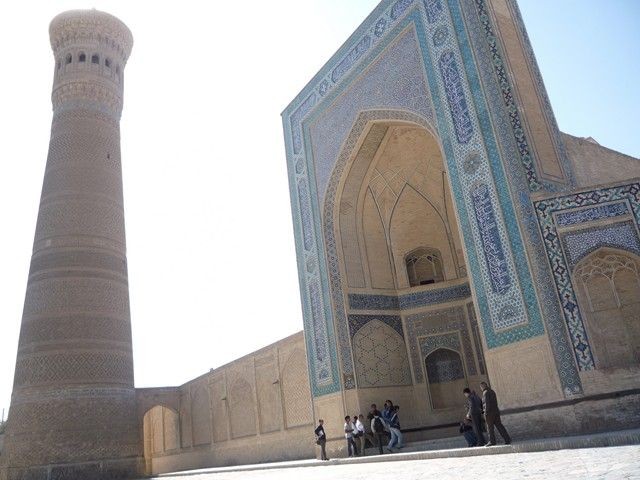
TASHKENT (TCA) — Authorities in Uzbekistan have softened their attitude to Islam in an effort to prevent religious extremism, but the state still strictly controls the religious sphere. We are republishing the following article on the issue, originally published by Eurasianet: The staircase that leads to the row of cells in Bukhara’s Mir-i Arab madrasa is steep and narrow. Ascending necessitates a bow that feels suitably reverent. Akbarali Mamadaliyev, 24, has been treading those steps for three years now. His hujra, or cell, is an almost cruelly cramped space, just 2.5 by 2 meters. There is no bed. Just a low ottoman where to sit and sleep, and small bookcase. On the ottoman lies a copy of Mamadaliyev’s most treasured book, the Koran. He has committed more than half of the 300 or so pages to memory. This feat has earned Mamadaliyev a photo on the honors board. Getting into this type of religious school is becoming a much sought-after ambition among young people in Uzbekistan committed to spreading knowledge of the faith. Mir-i Arab, which was one of very few Islamic education institutions permitted by Soviet authorities, remains an especially prestigious establishment. “I was always drawn to Bukhara, to Mir-i Arab. In 2015, I couldn’t get in, I didn’t have [good enough marks]. But the following year, happiness smiled on me – I became a student here,” Mamadaliyev told Eurasianet. Mamadaliyev comes from a devout household in a city, Namangan, with a reputation for Islamic piety. His family jealously guarded their Koran even in Soviet times, when possession of the book drew suspicion. He seriously began performing namaz – the five daily prayers – when he was 15. It was then that he understood that he wanted to become an Islamic scholar. The path to Islamic studies for people like Mamadaliyev has become easier as Uzbekistan’s government has in the last couple of years tempered its bitter suspicion of the pious and instead lent tentative support to religious education as a way of steering the young away from extremist notions. There are at present 11 specifically Islamic educational institutions in Uzbekistan. Of those, 10 are madrasas, where pupils can get onto the first rung of Islamic scholarship. After four years, they may seek to qualify as imams or become Arabic language teachers. Admission is still a highly exclusive affair though. Before 2017, Mir-i Arab accepted up to 24 students; last year it was 56. A year’s tuition costs almost $800. The Imam al-Bukhari Tashkent Islamic Institute is the only strictly religious college of higher learning to offer bachelor’s and master’s degrees. This new emphasis on religious education is in line with the change of tack adopted by President Shavkat Mirziyoyev, who is, in contrast to his late predecessor Islam Karimov, proving more accommodating toward believers. In an important symbolic breakthrough, following a decade-long silence, it is again possible to hear the azan, the call to prayer, ring out loudly in neighborhoods in Tashkent. And tens of thousands of people...