• KGS/USD = 0.01144 0%
  • KZT/USD = 0.00205 0%
  • TJS/USD = 0.10835 0%
  • UZS/USD = 0.00008 0%
  • TMT/USD = 0.28571 0.28%
  • KGS/USD = 0.01144 0%
  • KZT/USD = 0.00205 0%
  • TJS/USD = 0.10835 0%
  • UZS/USD = 0.00008 0%
  • TMT/USD = 0.28571 0.28%
  • KGS/USD = 0.01144 0%
  • KZT/USD = 0.00205 0%
  • TJS/USD = 0.10835 0%
  • UZS/USD = 0.00008 0%
  • TMT/USD = 0.28571 0.28%
  • KGS/USD = 0.01144 0%
  • KZT/USD = 0.00205 0%
  • TJS/USD = 0.10835 0%
  • UZS/USD = 0.00008 0%
  • TMT/USD = 0.28571 0.28%
  • KGS/USD = 0.01144 0%
  • KZT/USD = 0.00205 0%
  • TJS/USD = 0.10835 0%
  • UZS/USD = 0.00008 0%
  • TMT/USD = 0.28571 0.28%
  • KGS/USD = 0.01144 0%
  • KZT/USD = 0.00205 0%
  • TJS/USD = 0.10835 0%
  • UZS/USD = 0.00008 0%
  • TMT/USD = 0.28571 0.28%
  • KGS/USD = 0.01144 0%
  • KZT/USD = 0.00205 0%
  • TJS/USD = 0.10835 0%
  • UZS/USD = 0.00008 0%
  • TMT/USD = 0.28571 0.28%
  • KGS/USD = 0.01144 0%
  • KZT/USD = 0.00205 0%
  • TJS/USD = 0.10835 0%
  • UZS/USD = 0.00008 0%
  • TMT/USD = 0.28571 0.28%

Viewing results 1 - 6 of 75

Uzbekistan and EU Sign Landmark Enhanced Partnership Agreement in Brussels

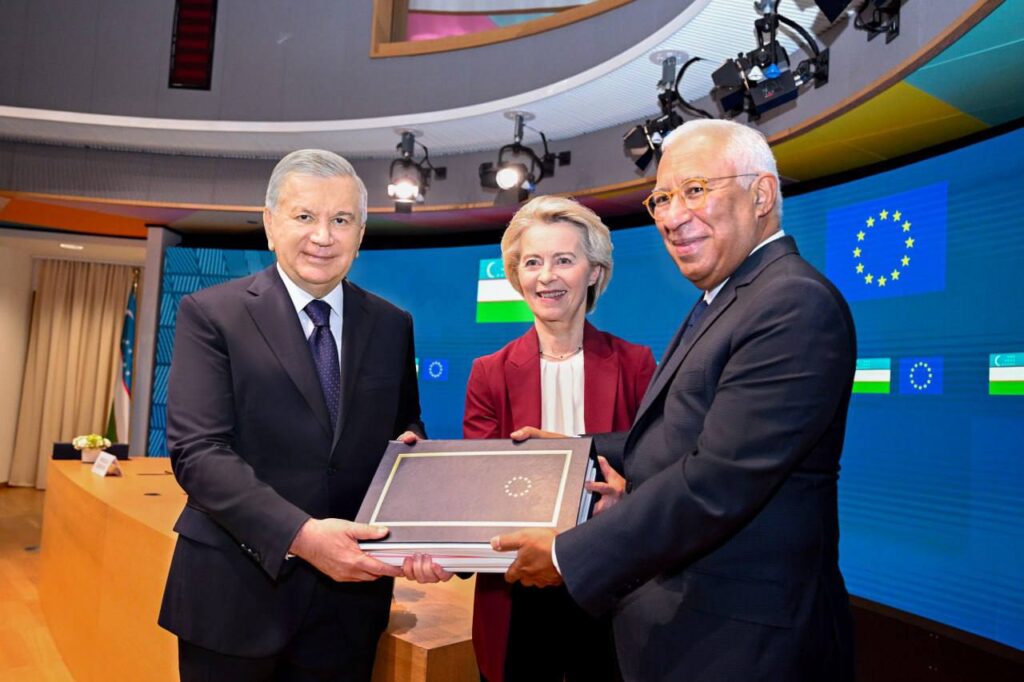
President Shavkat Mirziyoyev of Uzbekistan paid an official visit to Brussels on October 23-24 at the invitation of European Council President Antonio Costa and European Commission President Ursula von der Leyen, where a landmark agreement was signed to deepen Uzbekistan-EU cooperation across multiple sectors. During the visit, Mirziyoyev attended the signing ceremony of the Enhanced Partnership and Cooperation Agreement (EPCA), which replaces the 1996 Partnership and Cooperation Agreement. The new accord significantly broadens the scope of bilateral ties, covering areas such as trade, investment, digital technologies, environmental protection, and climate resilience. Negotiations began in February 2019 and concluded in July 2022. The EPCA includes nine sections, 356 articles, and 14 annexes, forming a comprehensive legal framework for political dialogue and long-term economic collaboration. It aims to bolster cooperation in trade, innovation, sustainable development, education, and cultural exchange between Uzbekistan and EU member states. In Brussels, Mirziyoyev also participated in a roundtable with executives from leading European companies and financial institutions, including Vandewiele, Linde, Lasselsberger Group, Meridiam, SUEZ, the European Investment Bank, Commerzbank, and KfW. The parties agreed to pursue new joint projects worth over €10 billion in sectors such as energy, chemicals, critical minerals, logistics, textiles, and pharmaceuticals. These initiatives build on an existing portfolio of EU-led projects in Uzbekistan, currently valued at more than €40 billion. Over the past seven years, trade between Uzbekistan and the European Union has doubled, while the number of joint ventures with European investment has surpassed one thousand. Mirziyoyev highlighted that the partnership is grounded in mutual trust and shared priorities, particularly in human capital development, renewable energy, digital transformation, and sustainable infrastructure. The President outlined four priority areas for expanding cooperation: joint production of high-value goods through deeper processing of strategic raw materials; collaboration in the green economy; development of logistics and transport corridors linking Europe and Asia; and partnerships in digital technologies, including artificial intelligence and cybersecurity. On the sidelines of the visit, Mirziyoyev met with King Philippe of Belgium at Laeken Palace. The two leaders discussed trade, investment, and cultural ties, with the King congratulating Uzbekistan on the signing of the historic EPCA. Relations between Uzbekistan and Belgium continue to grow, with rising trade volumes and expanding business cooperation. Belgian firms are active in Uzbekistan’s textile, logistics, and service sectors, while cultural ties have also deepened. Notable milestones include the unveiling of a bust of Ibn Sina in Kortrijk and sister-city partnerships such as Tashkent-Kortrijk and Samarkand-Liège. Mirziyoyev extended an official invitation to King Philippe to visit Uzbekistan, underscoring a shared commitment to strengthening bilateral ties in the years ahead.

Azerbaijan and Kazakhstan Deepen Strategic Partnership Through Middle Corridor

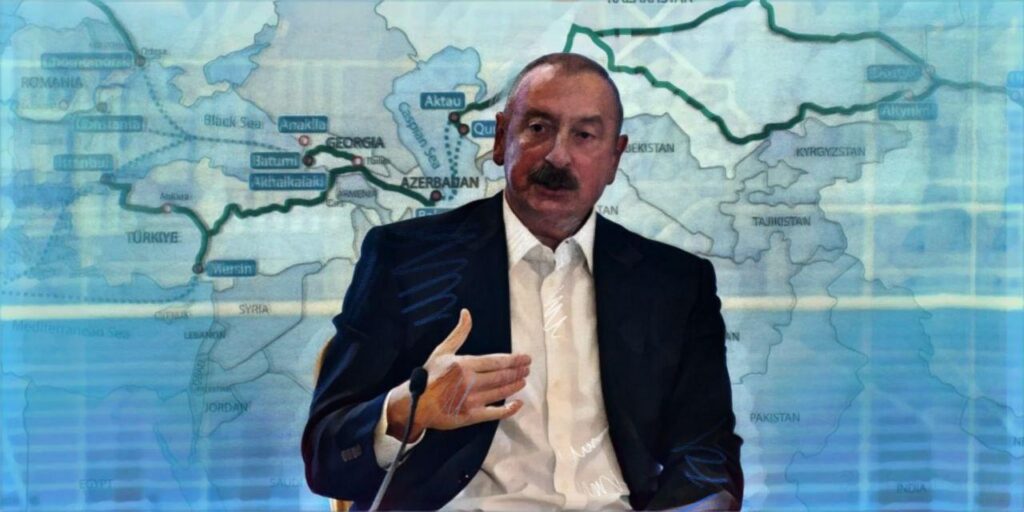
Azerbaijani President Ilham Aliyev’s recent state visit to Astana has marked a significant turning point in relations between Azerbaijan and Kazakhstan. President Kassym-Jomart Tokayev and President Aliyev underscored the rapid expansion of cooperation across transport, investment, and technology sectors. Political and cultural ties are also deepening, bolstering what both sides have described as a “brotherly” relationship. Economic Ties Strengthened by Infrastructure and Energy Projects Tokayev highlighted the strategic importance of the Trans-Caspian International Transport Route (Middle Corridor), noting a 62% increase in freight traffic in 2024 to 4.5 million tons, with a further 2% rise recorded so far in 2025. Kazakhstan is currently building a container hub in Aktau, while a new cargo terminal in the port of Alat, developed with foreign partners, including China, offers further growth potential. The two leaders also discussed establishing a Trans-Caspian ferry system to expand exports, with a long-term goal of boosting cargo traffic to 10 million tons. Tokayev further emphasized Kazakhstan’s use of the Baku-Tbilisi-Ceyhan pipeline for oil exports. In 2024, nearly 1.5 million tons of Kazakh oil transited through Azerbaijan, with plans to increase volumes significantly. He also cited efforts to deliver Kazakh uranium to foreign markets via Azerbaijan. Joint IT projects are also advancing, including plans to lay a fiber-optic communication line under the Caspian Sea. Tokayev commended the joint declaration on peace signed by Armenia and Azerbaijan in Washington under U.S. mediation, calling it a "historic" milestone in regional reconciliation efforts. Earlier on Monday, Aliyev had announced a significant policy shift, stating that Baku is lifting all restrictions on the transit of goods to Armenia. Middle Corridor as a Strategic Geopolitical Tool The Middle Corridor, connecting China and Europe through Kazakhstan, the Caspian Sea, and Azerbaijan, was a major focus of Aliyev's state visit. Amina Kosbaeva of the Institute for Eurasian Integration noted that the corridor - which carried about 2.7 million tons in 2023 and 4.5 million tons in 2024, as traffic shifted away from traditional routes via Russia - is evolving into a strategic asset that enhances regional autonomy and global connectivity. Kosbaeva highlighted that both countries have built a sustainable cooperation model grounded in cultural commonalities and mutual trust. She identified agriculture, petrochemicals, and machine-building as key sectors where new supply chains could emerge, boosting trade and resilience to global market fluctuations. Kosbaeva added that future cooperation is likely to grow within the framework of the Organization of Turkic States (OTS), which held its 12th Summit in Gabala, Azerbaijan, on October 6–7, 2025. further institutionalizing bilateral ties as a driving force within the Turkic world. “The history of the Turkic peoples goes back to common roots,” Tokayev said at the summit, expressing support for the idea of a broader “Turkic-speaking States +” platform to expand cooperation. Business Relations Rooted in Political Alignment Kazakh political analyst Gaziz Abishev noted that Astana and Baku often align on geopolitical issues. “The relationship between the two countries proves that rigid multilateral blocs are not necessary for close alliances. Unconditional mutual sympathy at all levels, leaders,...

Aliyev, Tokayev Pledge Deeper Cooperation as Azerbaijan Lifts Armenia Transit Ban

Azerbaijan’s President Ilham Aliyev began a state visit to Kazakhstan on Monday with a series of high-level meetings and a significant policy shift: Baku is lifting all restrictions on the transit of goods to Armenia. The move, announced during joint talks with Kazakh President Kassym-Jomart Tokayev in Astana, is one of the most concrete regional gestures since the end of the Second Karabakh War. The visit began with an official welcoming ceremony at Akorda Presidential Palace in Astana, where Presidents Kassym-Jomart Tokayev and Ilham Aliyev reviewed an honor guard before holding bilateral talks and chairing the second meeting of the Kazakhstan–Azerbaijan Supreme Intergovernmental Council. Speaking at a joint press briefing after the meeting, Aliyev confirmed that, “All restrictions on the transit of goods from Azerbaijan to Armenia and from third countries to Armenia through Azerbaijan have been lifted.” While no formal agreement was signed on Monday, the announcement is being viewed as a confidence-building measure at a moment of cautious diplomacy in the South Caucasus. Tokayev welcomed the development and stressed the importance of expanding cooperation between Kazakhstan and Azerbaijan in key sectors such as transport and energy. Ties on a Strategic Track Aliyev’s visit comes as Kazakhstan and Azerbaijan are expanding cooperation in multiple areas, including rail, ports, digital infrastructure, and energy. Monday’s talks produced several new accords and project announcements, including commitments to expand freight flows along the Trans-Caspian International Transport Route (Middle Corridor) - a logistics network connecting China to Europe via Central Asia, the Caspian Sea, and the South Caucasus. Since Russia’s 2022 invasion of Ukraine upended established overland trade routes, the corridor’s importance has surged, with Astana and Baku positioning themselves as key actors in a reconfigured Eurasian logistics network that bypasses Russian territory. In his welcoming address, Tokayev framed Aliyev’s state visit as of “critically important significance for the further development of our strategic partnership.” Tokayev described the relationship as “allied in nature,” calling Azerbaijan “a regional power that has strengthened its authority on the international stage.” He emphasized that developing multifaceted cooperation “remains a priority” and highlighted trade, economic, and political partnership as key goals. “Azerbaijan is a special country for Kazakhstan, a fraternal state,” Tokayev stated. “We are united by common historical roots, a rich spiritual and cultural heritage, and, ultimately, a shared mentality and outlook on developments. On this unshakable foundation, we are successfully developing our multifaceted cooperation.” Aliyev, in turn, praised Kazakhstan’s ongoing political and economic reforms, saying his country “fully supports [Tokayev’s] course of modernization” and is aiming to “strengthen cooperation in all areas” In a related development, Azerbaijan’s state energy firm SOCAR and Kazakhstan’s sovereign wealth fund Samruk-Kazyna are expected to deepen their collaboration in upstream energy projects and petrochemical exports, though no new energy deals were signed on Monday. Transit Opening to Armenia: Why Now? Aliyev’s announcement on transit restrictions - made in Astana, not Baku - was notable not just for its content, but its timing and setting. Since the end of the 2020 Second Karabakh...

Uzbekistan Jordan Relations Advance with Landmark State Visit

King Abdullah II of Jordan paid a state visit to Uzbekistan on August 25-26 at the invitation of President Shavkat Mirziyoyev. The visit, his first since the establishment of diplomatic relations, marked a milestone in bilateral ties and culminated in the signing of 15 agreements spanning politics, trade, investment, education, and culture. A Historic Visit with Symbolic and Strategic Weight Mirziyoyev welcomed King Abdullah with full ceremonial honors in Samarkand, including flag displays, a guard of honor, and performances of national songs and dances. The leaders visited prominent cultural sites, including the Shah-i-Zinda complex, Amir Temur’s mausoleum, and Registan Square, where the Jordanian monarch received an overview of Uzbekistan’s rich historical heritage. King Abdullah also visited the tomb of Qutham ibn al-ʿAbbas, a revered early Islamic preacher in Samarkand. The Jordanian delegation toured the “Eternal City” cultural park, which showcases Uzbekistan’s traditional crafts, architecture, and customs. Expanding Economic and Diplomatic Cooperation The official program commenced on August 26 at the Congress Center in Samarkand. Following the ceremonial welcome, the leaders visited an exhibition of Uzbekistan’s export-oriented products. The showcase featured a range of goods from key industries such as pharmaceuticals, chemicals, mining, textiles, agriculture, IT, and jewelry. King Abdullah praised Uzbekistan’s industrial development and called for increased business-to-business collaboration. During bilateral talks, the two sides agreed to elevate their relationship to a comprehensive partnership. Discussions focused on expanding political dialogue, boosting trade and investment, and strengthening cooperation in science, education, tourism, and culture. To formalize the partnership, the two countries agreed to establish a joint intergovernmental commission and a business council by the end of the year, and to convene an Uzbek-Jordanian business forum. They also outlined plans for cooperation in smart agriculture, geology, healthcare, and the textile industry. Broad-Based Agreements and International Alignment Fifteen agreements and memoranda were signed during the visit, including: An extradition treaty A bilateral investment promotion agreement A visa waiver agreement Cooperation protocols in higher education, scientific research, agriculture, veterinary medicine, tourism, and standardization The two leaders also reiterated their commitment to close coordination within international organizations, including the United Nations and the Organization of Islamic Cooperation. Honoring Partnership and Future Prospects In recognition of his role in strengthening bilateral ties, Mirziyoyev was awarded Jordan’s highest state honor, the Order of Al Nahda (“Renaissance”), presented personally by King Abdullah II. “I accept this award with great honor, as a recognition of our joint efforts to expand multifaceted cooperation and a sign of friendship and respect for the people of Uzbekistan, who are laying the foundations for the Third Renaissance in our country,” Mirziyoyev said. The visit concluded with a joint statement and mutual invitations for future high-level exchanges, reaffirming both countries’ shared ambition to elevate Uzbekistan-Jordan relations to a new strategic level.

Jordan’s King Abdullah II Departs for Uzbekistan and Kazakhstan

At the invitation of President Shavkat Mirziyoyev, King Abdullah II departed earlier today for a state visit to Uzbekistan spanning 25–26 August, with the main events to be held in Samarkand. The King will then continue to Kazakhstan for an official visit on 26–27 August. In Samarkand, King Abdullah II and President Mirziyoyev are expected to review political dialogue, trade and investment, agriculture and food security, education, tourism, and transport connectivity. Uzbek media report that several cooperation documents are slated for signature, underscoring Samarkand’s growing role as a diplomatic venue for Central Asia. In Astana, the King will meet President Kassym-Jomart Tokayev and attend events designed to expand commercial ties. The authorities in Astana have announced traffic curbs tied to the visit, a signal that a tightly choreographed official program is imminent. Kazakh media have framed the stop as part of a broader effort to deepen links with Middle Eastern partners at a time when Kazakhstan is diversifying export routes and courting investment from the Levant and Gulf. According to the official website of the President of the Republic of Kazakhstan, “high-level negotiations will be held aimed at further strengthening Kazakh-Jordanian cooperation in the trade, economic, cultural and humanitarian spheres.” The two visits fit into Jordan’s long-running outreach to Central Asia. Diplomatic relations with the region’s states date back to the 1990s, and Amman has increasingly paired political dialogue with practical economic initiatives. For Uzbekistan, officials have been looking to scale up a cordial relationship into more structured cooperation, and the Samarkand setting gives both sides a stage to announce concrete timelines for working groups or ministerial roadmaps. For Kazakhstan, Jordan is positioning itself as a mid-market gateway to the Levant and the Gulf, complementing Astana’s drive to build partnerships that can open new consumer markets, source medical-pharma products, and expand educational and tourism flows. Beyond Uzbekistan and Kazakhstan, Jordan’s engagement with Central Asia has emphasized areas where Amman brings specific comparative advantages. Jordan’s experience in water management and desert agriculture aligns with Central Asian priorities on climate resilience and efficient irrigation; its halal and medical-pharma sectors appeal to governments seeking to diversify imports; and its universities offer English- and Arabic-language programs that can deepen people-to-people links. Following the visits, observers will look for intergovernmental agreements that move beyond generalities, whether in health and pharmaceuticals, food supply chains, tourism promotion, or student exchanges. Aviation and cargo-handling announcements would be early evidence of a more durable commercial bridge, while references to streamlined customs procedures or mutual recognition in standards could make a material difference for small and mid-sized exporters on both sides. As Central Asia is recalibrating connectivity amid sanctions frictions and supply-chain shocks, Middle Eastern partners are seeking new sources of food, energy inputs, and investable projects with predictable regulatory environments. The two-country tour could, therefore, touch upon both sides' requirements, with Jordan’s looking to move its Central Asia policy from exploratory diplomacy to delivery.

Armenia’s PM to Visit Kazakhstan Amid Historic Peace Breakthrough and Economic Opportunities

Astana is preparing to host Armenian Prime Minister Nikol Pashinyan on an official visit scheduled for late 2025. On August 12, President Kassym-Jomart Tokayev had a call with Pashinyan, during which, according to an official statement, he praised the "outstanding qualities" of the Armenian Prime Minister, "as a politician with strong political will and a strategic vision of the national interests of his state." The forthcoming trip follows what U.S. Secretary of State Marco Rubio described as "the beginning of a peace deal" between Armenia and Azerbaijan, which was signed in Washington, D.C. on August 8, 2025, marking a pivotal moment in the South Caucasus after decades of conflict. At the White House, Pashinyan and Azerbaijani President Ilham Aliyev signed a framework pledging to respect each other’s territorial integrity, renounce the use of force, and dissolve the long-standing OSCE Minsk Group mediation format. The agreement also approved the creation of a major transit corridor — dubbed the Trump Route for International Peace and Prosperity (TRIPP) — linking Azerbaijan’s mainland to its exclave of Nakhchivan via Armenian territory. Kazakh President Kassym-Jomart Tokayev welcomed the accord as a “historic achievement” that not only ends a decades-long military standoff but also creates space for a deeper regional economic and diplomatic reset. In recent talks, Pashinyan briefed Tokayev on the details of the framework, the decision to dissolve the Minsk Group, and the TRIPP initiative. Both leaders emphasized the potential for new investment opportunities emerging from the stability the deal promises to bring and agreed to maintain an active political dialogue. For Kazakhstan, the visit reinforces its positioning as a neutral mediator between Eurasian powers, willing to offer diplomatic platforms for peace talks. In May 2024, Astana hosted ministerial-level Armenia–Azerbaijan negotiations in Almaty. With the TRIPP corridor set to enhance connectivity across the South Caucasus, Kazakhstan’s role in facilitating regional integration could expand beyond mediation into infrastructure, trade, and energy cooperation. Economically, the corridor offers Armenia new opportunities to become a transit hub between Central Asia and Europe, while Kazakhstan could benefit from more direct westward routes for its exports. Previous bilateral meetings have already laid the groundwork for business forums and joint initiatives in transport, technology, and investment, and the visit could provide the political momentum needed to bring these plans to fruition. Challenges remain, however. In Armenia, nationalist factions have criticized the peace deal, with border demarcation and the fallout from the Second Nagorno-Karabakh War remaining sensitive issues. Iran has also expressed opposition to the TRIPP corridor, citing concerns over shifting regional influence. Yet both Yerevan and Astana appear determined to use the current diplomatic window to solidify long-term cooperation. As the South Caucasus recalibrates, Pashinyan’s upcoming visit to Astana will test whether the political optimism generated in Washington can translate into tangible projects. For Kazakhstan, this presents an opportunity to deepen bilateral ties, demonstrate its growing influence as a stabilizing force, and secure a stake in the region’s new economic and geopolitical landscape.