• KGS/USD = 0.01144 0%
  • KZT/USD = 0.00205 0%
  • TJS/USD = 0.10835 0%
  • UZS/USD = 0.00008 0%
  • TMT/USD = 0.28571 0.28%
  • KGS/USD = 0.01144 0%
  • KZT/USD = 0.00205 0%
  • TJS/USD = 0.10835 0%
  • UZS/USD = 0.00008 0%
  • TMT/USD = 0.28571 0.28%
  • KGS/USD = 0.01144 0%
  • KZT/USD = 0.00205 0%
  • TJS/USD = 0.10835 0%
  • UZS/USD = 0.00008 0%
  • TMT/USD = 0.28571 0.28%
  • KGS/USD = 0.01144 0%
  • KZT/USD = 0.00205 0%
  • TJS/USD = 0.10835 0%
  • UZS/USD = 0.00008 0%
  • TMT/USD = 0.28571 0.28%
  • KGS/USD = 0.01144 0%
  • KZT/USD = 0.00205 0%
  • TJS/USD = 0.10835 0%
  • UZS/USD = 0.00008 0%
  • TMT/USD = 0.28571 0.28%
  • KGS/USD = 0.01144 0%
  • KZT/USD = 0.00205 0%
  • TJS/USD = 0.10835 0%
  • UZS/USD = 0.00008 0%
  • TMT/USD = 0.28571 0.28%
  • KGS/USD = 0.01144 0%
  • KZT/USD = 0.00205 0%
  • TJS/USD = 0.10835 0%
  • UZS/USD = 0.00008 0%
  • TMT/USD = 0.28571 0.28%
  • KGS/USD = 0.01144 0%
  • KZT/USD = 0.00205 0%
  • TJS/USD = 0.10835 0%
  • UZS/USD = 0.00008 0%
  • TMT/USD = 0.28571 0.28%

Viewing results 1 - 6 of 75

Uzbekistan and Turkey Set $5 Billion Trade Target at Strategic Council Meeting in Ankara

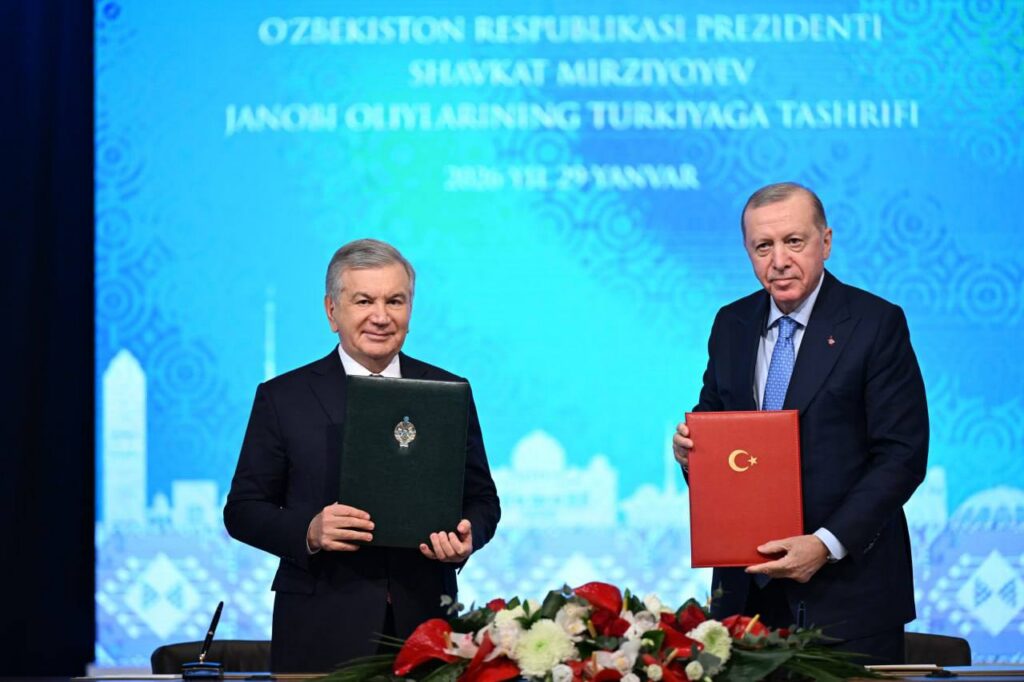
At the invitation of Turkish President Recep Tayyip Erdoğan, President of Uzbekistan Shavkat Mirziyoyev paid an official visit to Turkey on January 29, marking a new phase in the deepening partnership between the two nations. The visit was centered around the fourth meeting of the High-Level Strategic Cooperation Council, co-chaired by the two leaders in Ankara. Discussions focused on strengthening the comprehensive strategic partnership between Uzbekistan and Turkey, with an emphasis on political dialogue, trade and economic cooperation, transport connectivity, and cultural and humanitarian exchanges. The two presidents also exchanged views on regional and global developments, underscoring the growing coordination between Tashkent and Ankara on international platforms. Both sides highlighted the steady growth in bilateral trade, the rising number of joint ventures, and increased direct flights between the two countries. Regular cultural exchanges and growing people-to-people contacts were cited as further evidence of the strengthening relationship. Key areas for future cooperation include joint projects in industry, agriculture, and social protection, as well as enhanced collaboration in defense, security, and combating cybercrime. The timing of the Strategic Council meeting was described as symbolic, taking place on the eve of Ramadan and ahead of the 30th anniversary of the Treaty on Eternal Friendship and Cooperation between Uzbekistan and Turkey. The two sides expressed satisfaction with the growing political dialogue and the convergence of their positions on many international issues. The presidents reaffirmed their commitment to mutual support in international and regional organizations, including the United Nations, the Organization of Turkic States, the Organization of Islamic Cooperation, and the Economic Cooperation Organization. Inter-parliamentary cooperation has also intensified, particularly through parliamentary friendship groups. The leaders set an ambitious goal to increase bilateral trade turnover to $5 billion in the coming years. Expanding the list of goods covered under the Preferential Trade Agreement will be a key step toward achieving that target. Ahead of the visit, new priority areas for industrial cooperation were identified and will be implemented under a separate program. Significant potential was noted for interregional cooperation, with delegations from all regions of Uzbekistan expected to visit Türkiye by the end of the year to develop joint projects. Cooperation will also be deepened in agriculture, horticulture, healthcare, and medical tourism. The two countries agreed to intensify cultural and tourism ties through joint initiatives such as theater festivals, cultural weeks, historical film productions, and heritage restoration projects. In the education sector, the fourth Rectors’ Forum will be held in Bukhara this spring. Following the Strategic Council meeting, Mirziyoyev and Erdoğan signed a Joint Statement and adopted a framework for cooperation within the comprehensive strategic partnership. A wide-ranging package of bilateral agreements was also signed, covering healthcare, education, military medicine, economic and financial cooperation, mining, transport corridors, special economic zones, nuclear safety, migration, religious affairs, foreign ministry cooperation for 2026-2027, light industry, and cultural collaboration. At the conclusion of the visit, Mirziyoyev extended an official invitation to Erdoğan to visit Uzbekistan, reflecting the continued momentum and growing trust in bilateral relations.

Uzbekistan, Paraguay Deepen Ties During First-Ever Presidential Visit

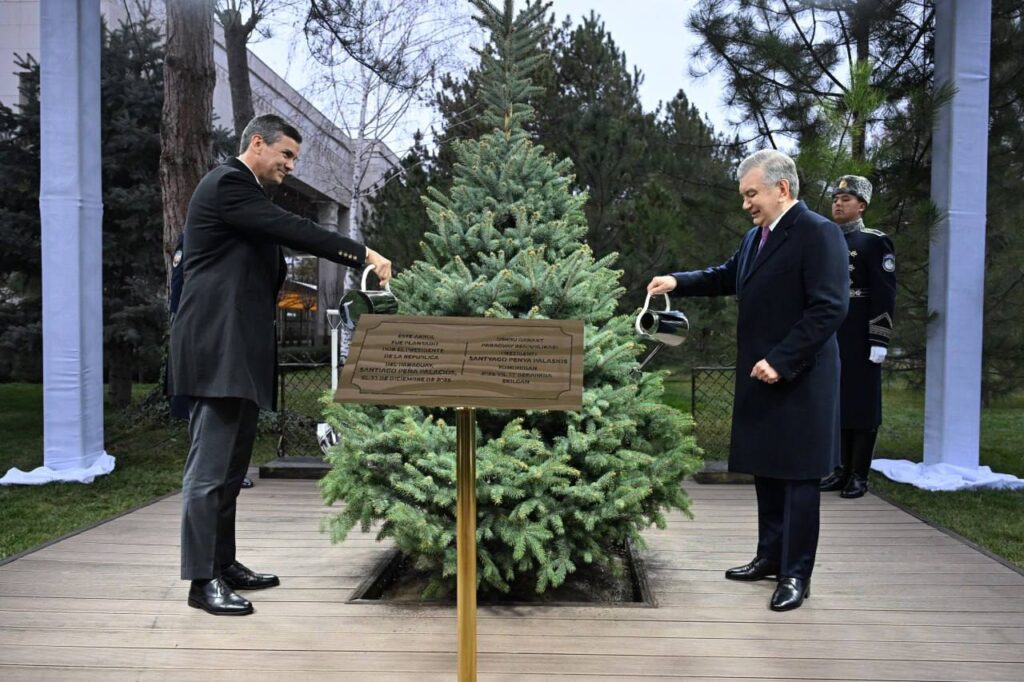
Uzbekistan and Paraguay have agreed to enhance political and economic cooperation following high-level talks in Tashkent, according to the presidential press service. The meeting between Uzbek President Shavkat Mirziyoyev and Paraguayan President Santiago Peña took place at the Kuksaroy residence, with participation from both countries’ official delegations. Mirziyoyev welcomed his counterpart and highlighted the historical significance of the visit, noting it as the first time a president from a Latin American country has traveled to Uzbekistan. The visit is expected to usher in a new era of bilateral relations. The two leaders discussed expanding cooperation across several sectors. Talks focused on increasing mutual trade, strengthening business contacts, and initiating joint projects in agriculture, food production, the chemical industry, digital technologies, tourism, and sports. Cultural, educational, and humanitarian collaboration were also emphasized as priority areas. The sides also exchanged views on international and regional developments. Following the talks, Mirziyoyev and Peña signed a joint statement reaffirming their commitment to strengthening political dialogue and expanding practical cooperation. Uzbek media reported that two additional documents were signed in the presence of the presidents: a protocol concluding bilateral market-access negotiations related to Uzbekistan’s accession to the World Trade Organization, and a memorandum between the foreign ministries to establish a mechanism for political consultations. The meeting concluded with a symbolic gesture. The two presidents planted a tree on the Alley of Honored Guests at the Kuksaroy residence, symbolizing their intention to open a new chapter in Uzbekistan-Paraguay relations.

Kazakhstan–Uzbekistan Partnership Signals a New Era in Central Asia

For many years, Kazakhstan and Uzbekistan were seen as regional rivals, with many analysts believing this long-standing competition impeded the realization of sustainable regional strategies. However, leadership changes and expanded cooperation frameworks in Central Asia have significantly shifted these dynamics. Today, countries in Central Asia are shaping policies at the intersection of Western, Chinese, and Russian interests, whilst looking even further afield. As Kazakhstan and Uzbekistan assert themselves more on the global stage, they are increasingly finding common ground. In part because of their geographic size and numbers, Kazakhstan and Uzbekistan are seen as the leading states in Central Asia. Kazakhstan has the largest territory by far, while Uzbekistan boasts the largest population, which stands in excess of 37 million. Both nations possess significant resources and development potential. While their current leadership has dismissed notions of rivalry, its roots stretched back for decades. Historical Competition Tensions between the two republics date to the Soviet era, when the rivalry was evident even to ordinary citizens. The influence of Dinmukhamed Kunaev, First Secretary of the Central Committee of the Communist Party of Kazakhstan, often clashed with that of his Uzbek counterpart, Sharaf Rashidov. Beyond personal rivalries between republican leaders, Soviet-era administrative borders were often drawn without regard for demographic realities or resource flows. Competition for Moscow’s attention and investment funding pushed union republics to emphasize different sectors - Kazakhstan’s development of virgin lands turned it into a major grain hub, while Uzbekistan long benefited from its cotton industry - creating distinct economic identities that later persisted into independence. These divergent economic structures shaped early regional competition and informed differing policy priorities in the 1990s and 2000s. Both republics had substantial industrial capacity, though analysts argue that Kazakhstan maintained an edge in economic growth. The Baikonur Cosmodrome, still operational today, was also a long-standing strategic asset within Kazakhstan’s borders. Following the collapse of the Soviet Union, this rivalry only intensified. Nursultan Nazarbayev and Islam Karimov, then presidents of Kazakhstan and Uzbekistan, were widely viewed as competing for regional leadership. While their economies were initially on par, Uzbekistan gradually turned inward, while Kazakhstan opened to foreign investment, particularly in the extractive sector. In the 2000s, despite successful border delimitation, disputes flared over boundaries, water, and natural resources. Some analysts contend that it was this lingering friction that hindered efforts to preserve the Aral Sea, once the world’s fourth-largest lake, which has now largely disappeared, at least in its southern section, causing dust storms so vast they are visible from space. In 2002, the border villages of Bagys and Khiyobon, inhabited by ethnic Kazakhs but situated in Uzbekistan, demanded to be recognized as part of Kazakhstan. These territories had been transferred to Uzbekistan in 1956. They were officially reincorporated into Kazakhstan only in 2021. Presidents Reject Rivalry Narrative Kazakh political scientist Gaziz Abishev maintains that there is no leadership struggle today between Kazakhstan and Uzbekistan. “An important point that was made is that there is no unhealthy rivalry between Kazakhstan and Uzbekistan, or between Kazakhs...

Between Trump and Putin: Tokayev Emerges as a Regional Diplomatic Powerbroker

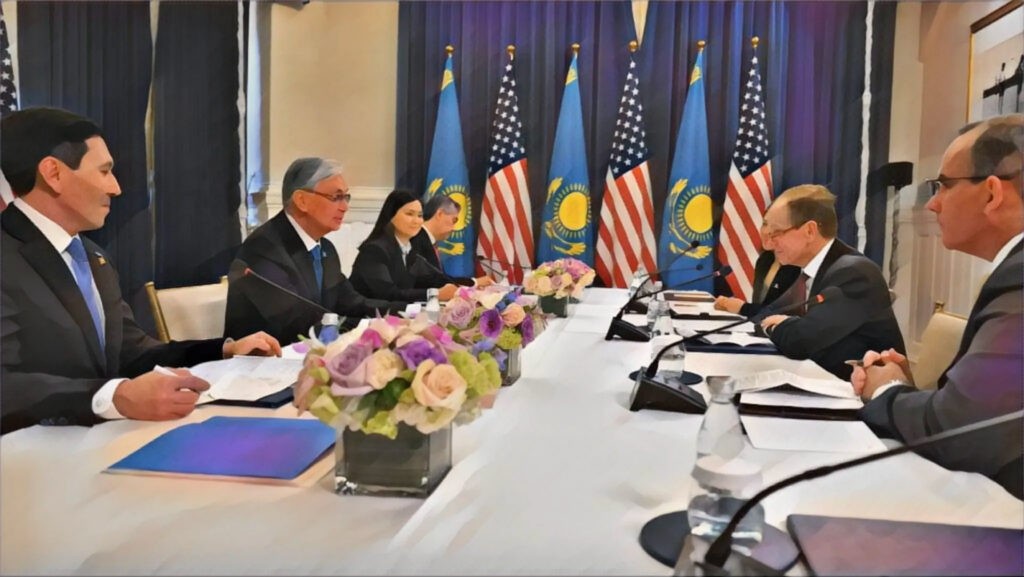
In a striking display of diplomatic balancing, Kazakhstan’s President Kassym-Jomart Tokayev ended 2025 with a high-profile state visit to Moscow, where he and Russian President Vladimir Putin signed a declaration elevating bilateral relations to a comprehensive strategic partnership and alliance. The visit came just days after Tokayev returned from Washington, where he participated in a summit with U.S. President Donald Trump, and the September meeting with Xi Jinping in Tianjin. Back-to-back high-level diplomatic engagements have underscored Tokayev’s rising stature as a regional statesman navigating the complex geopolitical landscape between Russia and the West, representing a somewhat diplomatic ‘hat trick’ for the Kazakh leader. Kazakhstan’s multi-vector foreign policy has long sought to maintain balanced relations with Russia, China, the United States, and Europe. This approach allows Astana to position itself as a neutral and pragmatic actor even during periods of geopolitical tension, and explains why Tokayev is one of the few leaders trusted by both Washington and Moscow. Amid speculation in global media about Kazakhstan’s accession to the Abraham Accords, Tokayev’s stop in Moscow has drawn attention not only for its symbolism but also for its possible behind-the-scenes diplomacy. Kazakhstan’s agreement to sign the Abraham Accords has generated considerable discussion within diplomatic circles. For Washington, Astana’s endorsement signals alignment with U.S. regional objectives in the Middle East, while for Russia, it raised questions about Kazakhstan’s strategic leanings, making Tokayev’s immediate trip to Moscow particularly important. No Central Asian state had previously moved to formally support a U.S.-brokered Middle Eastern diplomatic framework, making Kazakhstan’s position especially noteworthy. A Private Conversation at the Kremlin Russian political analyst Arkady Dubnov highlighted the significance of an informal, private meeting between Tokayev and Putin ahead of their official talks. “The presidents exchanged brief greetings, and then Putin invited his guest to his Kremlin apartment for a private conversation,” Dubnov noted. Tokayev later confirmed that the tête-à-tête lasted over two-and-a-half hours. Dubnov suggested that such discretion may point to confidential messages being relayed. He cited recent remarks by Finnish President Alexander Stubb, who visited Astana shortly before Tokayev’s Washington trip. Stubb reportedly said that Tokayev could serve as a conduit for communication between Trump and the Kremlin. Before this, only Chinese President Xi Jinping had been granted such extended privacy with Putin, Dubnov emphasized. Tokayev is one of the few leaders who has maintained uninterrupted working relationships with both Western capitals and Moscow throughout recent years. His neutral stance on the Ukraine conflict, refusal to recognize breakaway territories, and active participation in U.S.-backed initiatives - combined with Kazakhstan’s deep economic and security links with Russia - place Tokayev in a uniquely credible position. Neither side views him as fully aligned with the other, which increases his utility as a channel for sensitive political messaging. Kazakhstan as a Strategic Messenger? Kazakh political analyst Andrei Chebotarev also underscored the potential geopolitical significance of the Tokayev-Putin meeting. “Most likely, the Russian president was interested in the details of his Kazakh counterpart's recent visit to the U.S. and his talks with...

Tokayev in Moscow: Balancing Friendship and Strategy

Kazakh President Kassym-Jomart Tokayev begins a state visit to Russia in Moscow today, accompanied by a carefully calibrated message of diplomatic continuity. Ahead of his arrival, Tokayev published an article in Rossiyskaya Gazeta affirming Kazakhstan’s “eternal friendship” with Russia, a phrase that has become standard in bilateral rhetoric. While much of the piece reiterates familiar themes of cooperation in energy, trade, and culture, a few notable elements suggest deeper strategic positioning. From the outset, Tokayev appeared intent on striking a personal chord with Vladimir Putin. Mirroring the Russian president’s preference for historical framing, he wrote: “Our peoples have lived side by side for centuries, sharing joys and trials, and together creating a single cultural space in Eurasia. We are united by a common perception of traditional values, similar views on current issues of modern life, and joint work to ensure the well-being of our brotherly peoples.” The Kazakh leader also offered high praise for Putin’s leadership, describing bilateral ties as “mature and stable” and built on “deep trust, respect, and equality.” “All achievements in bilateral cooperation are inextricably linked to the energetic and productive efforts of President Vladimir Vladimirovich Putin,” Tokayev wrote. “In Kazakhstan, he enjoys unwavering respect as a statesman of global stature, and his name is on the lips of politicians and ordinary people in virtually every country in the world.” The visit’s key moment will be the signing of a Declaration elevating Kazakhstan-Russia ties to a “comprehensive strategic partnership and alliance”, a step Tokayev described as ushering in “a new era in bilateral relations.” More intriguing, however, was Tokayev’s commentary on Russia’s global standing, wherein Tokayev referenced recent high-level talks with Chinese President Xi Jinping, U.S. President Donald Trump, and leaders across Europe, Asia, and Africa. “Although many of them are at opposite ends of the geopolitical spectrum, they all recognize the exceptional role of Russia and its leader in resolving key issues in international relations. In other words, it is impossible to overcome the contradictions of the modern world without Moscow's participation,” he stated. While Tokayev has previously dismissed the idea of Kazakhstan acting as a mediator in the Russia-Ukraine conflict, his recent statements suggest Astana may be prepared to play a supporting role in future dialogue. “Kazakhstan is not a mediator in the military conflict between Russia and Ukraine and does not see itself as such,” he said last month. “In my opinion, both sides are capable of conducting dialogue on all contentious issues on a bilateral basis and at different levels. I have always believed and publicly stated that the ‘Ukrainian crisis’ is extremely complex and cannot be simplified.” Nonetheless, Tokayev offered practical insights into what a negotiation process would require, stressing the importance of expert-level preparation and dismissing the idea of hastily organized summits without a ceasefire or clear agenda as “unrealistic.” “If the leaders of Russia and Ukraine are willing to come to Kazakhstan, we will provide all the necessary services to ensure the success of the negotiations,” Tokayev added. He reaffirmed...

U.S. Secretary of State Marco Rubio Plans Visit to Central Asia in 2026

U.S. Secretary of State Marco Rubio announced on Wednesday his intention to visit all five Central Asian countries in 2026. Rubio made the statement during a meeting with the foreign ministers of Kazakhstan, Kyrgyzstan, Tajikistan, Turkmenistan, and Uzbekistan. The visit is part of a broader diplomatic initiative by U.S. President Donald Trump's administration to strengthen ties with the resource-rich region. Today, the presidents of the five Central Asian republics, Kassym-Jomart Tokayev (Kazakhstan), Sadyr Japarov (Kyrgyzstan), Emomali Rahmon (Tajikistan), Serdar Berdimuhamedov (Turkmenistan), and Shavkat Mirziyoyev (Uzbekistan), are scheduled to meet with President Trump in Washington. The summit is expected to focus on cooperation in the extraction of rare earth elements and other natural resources in Central Asia. Rubio emphasized the alignment of U.S. and Central Asian interests in promoting responsible and sustainable development of the extractive sector. “You are seeking to use the resources that God has blessed your countries with to create responsible development and diversify your economies,” he said at a reception hosted by the State Department. “I personally intend to visit in the coming year. All five [countries], so I know it would probably be a week-long trip. So we’ve got to work on that and make that happen together.” U.S. Deputy Secretary of State Christopher Landau stated that the invitation extended to Central Asian leaders is part of President Trump’s personal initiative to deepen engagement with the region. He highlighted broad opportunities for cooperation in business, investment, and strategic partnerships. Also speaking at the reception, Republican Senator James Risch said he intends to introduce legislation to repeal the Jackson-Vanik amendment, a Cold War-era law that restricts U.S. trade with non-market economies.