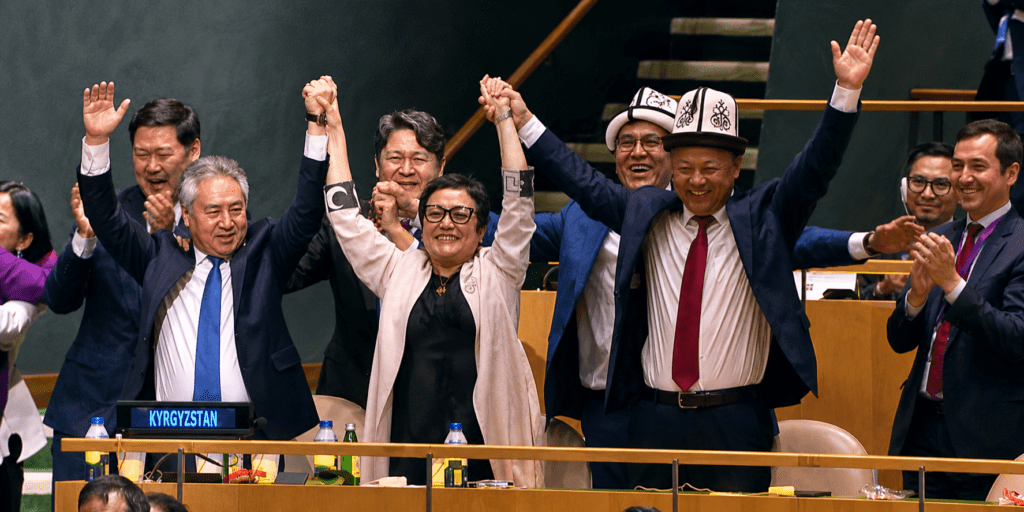
Kyrgyzstan Wins First-Ever Seat on UN Security Council
Kyrgyzstan has been elected to the United Nations Security Council for the 2027–2028 term, securing a non-permanent seat after a closely watched contest for the Asia-Pacific Group’s vacancy. The election marks the first time Kyrgyzstan will serve on the Security Council, the UN’s most powerful body for matters of international peace and security. It also returns Central Asian representation to the Council for the first time in nearly a decade, following Kazakhstan’s 2017–2018 term. Kyrgyzstan defeated the Philippines for the Asia-Pacific seat in the General Assembly vote, joining the incoming class of non-permanent members that will serve two-year terms from January 1, 2027, through December 31, 2028. The 2026 election filled five seats: one for Africa, one for Asia-Pacific, one for Latin America and the Caribbean, and two for the Western European and Others Group. The contest went to four rounds of voting before Kyrgyzstan secured the required two-thirds majority, defeating the Philippines by 142 votes to 49. Austria, Portugal, Trinidad and Tobago, and Zimbabwe were also elected to the Council. Kyrgyzstan will replace Pakistan when the new term begins. The Asia-Pacific race was the only contest involving Central Asia, but the wider election produced a surprise in the Western European and Others Group, where Germany failed to win one of the two available seats. Austria and Portugal were elected instead. For Bishkek, the result represents a major diplomatic breakthrough. Kyrgyz officials had framed the campaign as an opportunity to give greater voice to states that have never served on the Council, particularly landlocked and mountainous countries facing security, development, climate, and connectivity challenges. As of 2027, 59 UN member states will still have never served on the Security Council. President Sadyr Japarov had urged world leaders to support Kyrgyzstan’s bid, framing it as a chance to give small, developing, and landlocked states a stronger voice on the UN Security Council. Foreign Minister Jeenbek Kulubaev also framed the campaign in broader multilateral terms, arguing that smaller states need a greater role in responding to global security challenges. “No single state can address modern-day threats alone; that is why multilateral diplomacy is critical,” he said, speaking before the vote. The victory also carries broader regional significance. Central Asia sits at the intersection of several issues regularly discussed at the Security Council, including Afghanistan, counterterrorism, water security, transnational crime, and regional stability. Kyrgyzstan’s term is expected to give the region a more direct platform in Council deliberations. The seat will not give Kyrgyzstan veto power, which is held only by the five permanent members. But non-permanent members vote on resolutions, sanctions, peacekeeping mandates, and statements, and each member holds the rotating presidency of the Council for one month during its term. For Central Asia, the timing is significant. Afghanistan remains a recurring security concern, while terrorism, border security, narcotics trafficking, and climate-related instability all carry direct regional implications. Kyrgyzstan’s presence will give Bishkek a formal role in debates that often affect the region but are usually shaped by larger powers. The Security...