Viewing results 1 - 6 of 79
ASTANA (TCA) — Kazakhstan’s national atomic company Kazatomprom, the world leader in the extraction of natural uranium, on December 4 announced its intention to reduce planned uranium production by 20% in order to better align its output with demand. Continue reading
BISHKEK (TCA) — A high-level event in New York on September 21 in the presence of Kyrgyzstan President Almazbek Atambayev, EU Energy Commissioner Miguel Arias Cañete and the Estonian Minister of Foreign Affairs Sven Mikser under the headline “People and Planet: Central Asia calls for international solidarity” in the margins of the current UN General Assembly highlighted the danger for the environment and the health of the population, especially in the Ferghana valley where 14 million people live and which is spread across eastern Uzbekistan, southern Kyrgyzstan, and northern Tajikistan, the EBRD press office reported. Continue reading
BISHKEK (TCA) — The International Atomic Energy Agency (IAEA) and Russia’s State Atomic Energy Corporation ROSATOM on September 18 signed the Practical Arrangements regarding the cooperation in rehabilitation of uranium legacy facilities in Central Asian republics of Kyrgyzstan and Tajikistan, the Russian company said. Continue reading
ALMATY (TCA) — The U.S. Department of Energy’s National Nuclear Security Administration (DOE/NNSA), in partnership with the Institute of Nuclear Physics (INP) of Kazakhstan, repatriated the last remaining highly enriched uranium (HEU) from the institute’s VVR-K reactor and critical assembly in Almaty, Kazakhstan, on September 19. Continue reading
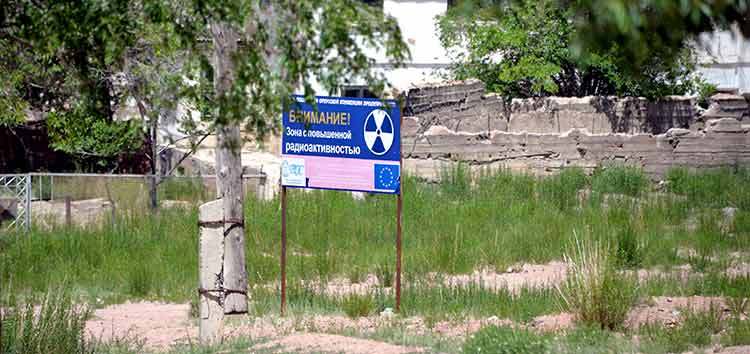
BISHKEK (TCA) — A Strategic Master Plan aimed to overcome the legacy of uranium mining in Central Asia was signed by Tajikistan, Uzbekistan, the IAEA, the EC, and the EBRD at the IAEA General Conference in Vienna on September 18, the EBRD reported on its website. Kyrgyzstan and Russia have confirmed their intention to join shortly. The Plan was developed by a group of experts established by the International Atomic Energy Agency (IAEA). It sets out a detailed blueprint for the environmental remediation of priority sites in Kyrgyzstan, Tajikistan, and Uzbekistan. These three countries are in the scope of the Environmental Remediation Account for Central Asia (ERA) established at the EBRD in 2015 at the initiative of the European Commission (EC). The fund will manage international donor support to deal with the challenges originating from legacy sites and affecting local populations and the environment. In order to ensure a coordinated, timely and cost-effective approach in accordance with international conventions and agreements, the Plan ranks remediation measures in terms of risks and priorities. It also develops an integrated approach for evaluating the remediation needs of each site. All of this flows into a programme detailing precisely the main tasks or activities, along with schedules, key milestones and costs. The total cost of all measures outlined in the Plan is estimated at €210 million. Of this amount, €56 million has already been made available by the EU, the Commonwealth of Independent States (CIS) and the World Bank. Work on the seven priority sites that will be covered by ERA is estimated to cost €85 million. While so far the European Commission is the sole contributor to ERA, with €16 million, a donor conference in 2018 will aim to close the funding gap. Balthasar Lindauer, EBRD Deputy Director, Nuclear Safety, said: “We welcome the agreement on the Strategic Master Plan. This key document will be our joint roadmap for addressing the urgent issue of the legacy of uranium mining in Central Asia. Today’s signing marks very important progress and also demonstrates the determination of all parties present today to address this challenge. We appeal to the international community to join this effort to create a safe and healthy environment for the people of Central Asia.” Central Asia served as an important source of uranium in the former Soviet Union. A large amount of radioactively contaminated material was placed in the waste dumps and tailing sites of mines. Most of these mines were closed by 1995 but very little remediation work was done. The accumulated radioactive material in the region is a threat to the environment and to the health of local populations.
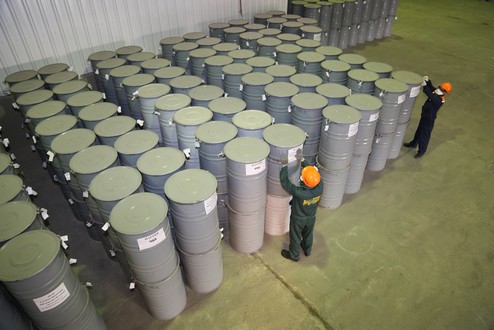
ASTANA (TCA) — International Atomic Energy Agency (IAEA) Director General Yukiya Amano and President of Kazakhstan Nursultan Nazarbayev on August 29 attended a ceremony in the Kazakh capital Astana to mark the official opening of the IAEA Low-Enriched Uranium (LEU) Bank Storage Facility at the Ulba Metallurgical Plant (UMP) in the eastern Kazakh city of Ust-Kamenogorsk. The IAEA LEU Bank will be established once the LEU, the basic ingredient to fabricate nuclear fuel, has been purchased and delivered to the Storage Facility, the IAEA said in a press release. “I am confident that the IAEA LEU Bank will make a valuable contribution to international efforts to ensure the availability of fuel for nuclear power plants,” IAEA Director General Amano told the event which was attended also by representatives of IAEA Member States and donors. The IAEA Board of Governors decided in December 2010 to establish the IAEA LEU Bank as an assurance of supply mechanism of last resort for Member States which experience a supply disruption due to exceptional circumstances, and which are unable to secure nuclear power fuel from the commercial market, State-to-State arrangements or by any other means. Owned and controlled by the IAEA, it will be a physical reserve of up to 90 metric tons of LEU suitable to make fuel for a typical light water reactor, available for eligible countries. Thanking President Nazarbayev and the Government and people of Kazakhstan for volunteering to host the IAEA LEU Bank, Amano added: “Kazakhstan has for many years been a steadfast partner of the IAEA in working to prevent nuclear proliferation and advancing peaceful uses of nuclear energy.” UMP began construction of the Storage Facility – an 880 square metre steel structure with robust security arrangements and enhanced safety features – in September 2016 and it was completed on schedule and on budget. Attending the inauguration at the site, IAEA LEU Bank Project Executive Mark Bassett said it was a special purpose-built facility. “The Storage Facility has been designed and built to provide a high level of safety and security for the LEU Bank,” he added. The establishment and operation of the IAEA LEU Bank are fully funded by voluntary contributions from IAEA Member States and other donors totalling US $150 million – sufficient to cover estimated costs for 20 years of operation. Director General Amano said he was grateful to all donors – including the United States, the European Union, Kuwait, the United Arab Emirates, Norway, the Republic of Kazakhstan and the Nuclear Threat Initiative – “whose generous financial contributions have made this project possible.” He also thanked China and the Russian Federation for their cooperation regarding agreements for the transit through their countries of LEU for the IAEA LEU Bank. Stressing that nuclear energy helps to address the twin challenges of securing sufficient energy for economic growth and mitigating the effects of climate change, Amano said around 30 countries are interested in introducing nuclear power. This is in addition to the same number of countries currently operating...