• KGS/USD = 0.01144 0%
  • KZT/USD = 0.00211 0%
  • TJS/USD = 0.10515 0.48%
  • UZS/USD = 0.00008 0%
  • TMT/USD = 0.28530 0%
  • KGS/USD = 0.01144 0%
  • KZT/USD = 0.00211 0%
  • TJS/USD = 0.10515 0.48%
  • UZS/USD = 0.00008 0%
  • TMT/USD = 0.28530 0%
  • KGS/USD = 0.01144 0%
  • KZT/USD = 0.00211 0%
  • TJS/USD = 0.10515 0.48%
  • UZS/USD = 0.00008 0%
  • TMT/USD = 0.28530 0%
  • KGS/USD = 0.01144 0%
  • KZT/USD = 0.00211 0%
  • TJS/USD = 0.10515 0.48%
  • UZS/USD = 0.00008 0%
  • TMT/USD = 0.28530 0%
  • KGS/USD = 0.01144 0%
  • KZT/USD = 0.00211 0%
  • TJS/USD = 0.10515 0.48%
  • UZS/USD = 0.00008 0%
  • TMT/USD = 0.28530 0%
  • KGS/USD = 0.01144 0%
  • KZT/USD = 0.00211 0%
  • TJS/USD = 0.10515 0.48%
  • UZS/USD = 0.00008 0%
  • TMT/USD = 0.28530 0%
  • KGS/USD = 0.01144 0%
  • KZT/USD = 0.00211 0%
  • TJS/USD = 0.10515 0.48%
  • UZS/USD = 0.00008 0%
  • TMT/USD = 0.28530 0%
  • KGS/USD = 0.01144 0%
  • KZT/USD = 0.00211 0%
  • TJS/USD = 0.10515 0.48%
  • UZS/USD = 0.00008 0%
  • TMT/USD = 0.28530 0%

Viewing results 493 - 498 of 3388

Congressional Panel Urges Trump to Host C5+1 Summit This Year

A U.S. congressional foreign affairs panel is asking U.S. President Donald Trump to host a meeting in Washington, D.C. with leaders from Central Asia by the end of 2025.   The proposal was made in an October 20 letter to Trump by Bill Huizenga, a Michigan Republican who chairs the House’s South and Central Asia Subcommittee, and Sydney Kamlager-Dove of California, the senior Democrat on the subcommittee.  The two representatives said that such a summit would mark the 10th anniversary of the C5+1 diplomatic forum and highlight the importance of Central Asia following Trump’s meetings with Uzbek President Shavkat Mirziyoyev and Kazakh President Kassym-Jomart Tokayev on the sidelines of the U.N. General Assembly last month. Multi-billion-dollar business deals were announced in connection with those meetings.  Established in 2015, the C5+1 formula refers to the United States and the five Central Asian countries of Kazakhstan, Kyrgyzstan, Tajikistan, Turkmenistan, and Uzbekistan. “A Leaders’ Summit with meaningful outcomes will strengthen regional cooperation and maximize the diplomatic potential of the 10th anniversary, setting the tone for strengthened U.S. engagement in the region for the rest of your presidency,” the representatives said in the letter to Trump. They said a meeting would advance U.S. priorities in Central Asia, “including security cooperation, economic ties, soft power, and good governance,” they said.  The letter noted U.S. interests such as the development of critical minerals, including tungsten, antimony, lithium, and rare earth elements; the full repeal of the Jackson-Vanik amendment, a Cold War-era law that imposes some restrictions on trade with several countries in Central Asia; and counterterrorism efforts against the regional branch of the Islamic State group.  “We also hope to see new agreements with the Central Asian countries to bolster people-to-people ties and expand U.S. soft power, such as additional American Peace Corps volunteers and the expansion of educational and cultural exchange programs, while addressing the accreditation issue surrounding U.S.-sponsored journalists and other U.S.-funded news broadcasters.  The Trump administration, however, has taken steps to cut most U.S. foreign aid programs, dismantling the U.S. Agency for International Development. USAID had been active in Central Asia. The administration has also cut aid for U.S.-funded domestic and international broadcasters. Analyst Temur Umarov wrote in the Carnegie Politika publication that Central Asia has found it relatively easy to work with the Trump administration.  “Business interests can be used to attract Washington’s attention, and there is no longer any need for demonstrative distancing from Russia or commitment to democratic reforms,” Umarov said.  He said that Uzbekistan and Kazakhstan have hoped to hold C5+1 anniversary events in their capitals, with top leaders in attendance. If that happens, Trump would be the first sitting U.S. president to visit any of the five Central Asian countries. 
Azerbaijan and Kazakhstan Deepen Strategic Partnership Through Middle Corridor

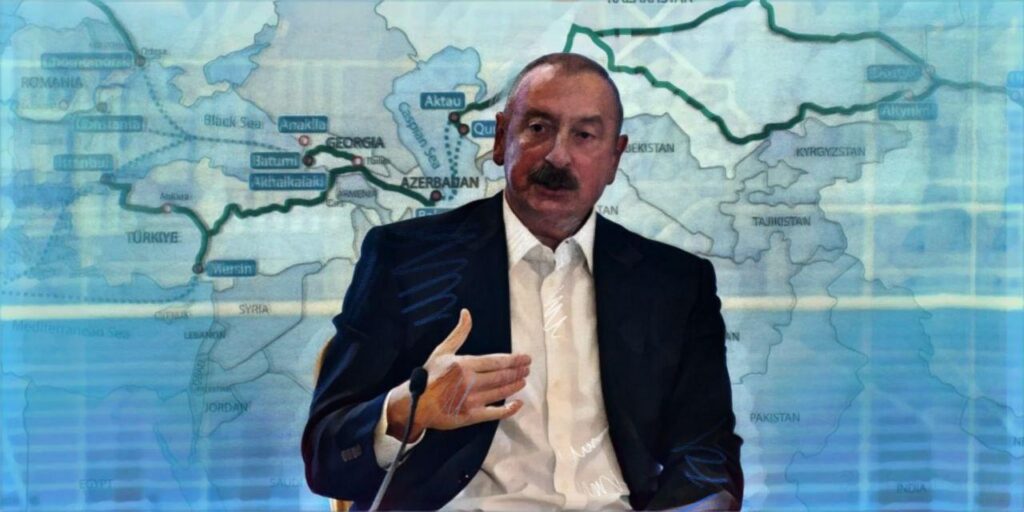
Azerbaijani President Ilham Aliyev’s recent state visit to Astana has marked a significant turning point in relations between Azerbaijan and Kazakhstan. President Kassym-Jomart Tokayev and President Aliyev underscored the rapid expansion of cooperation across transport, investment, and technology sectors. Political and cultural ties are also deepening, bolstering what both sides have described as a “brotherly” relationship. Economic Ties Strengthened by Infrastructure and Energy Projects Tokayev highlighted the strategic importance of the Trans-Caspian International Transport Route (Middle Corridor), noting a 62% increase in freight traffic in 2024 to 4.5 million tons, with a further 2% rise recorded so far in 2025. Kazakhstan is currently building a container hub in Aktau, while a new cargo terminal in the port of Alat, developed with foreign partners, including China, offers further growth potential. The two leaders also discussed establishing a Trans-Caspian ferry system to expand exports, with a long-term goal of boosting cargo traffic to 10 million tons. Tokayev further emphasized Kazakhstan’s use of the Baku-Tbilisi-Ceyhan pipeline for oil exports. In 2024, nearly 1.5 million tons of Kazakh oil transited through Azerbaijan, with plans to increase volumes significantly. He also cited efforts to deliver Kazakh uranium to foreign markets via Azerbaijan. Joint IT projects are also advancing, including plans to lay a fiber-optic communication line under the Caspian Sea. Tokayev commended the joint declaration on peace signed by Armenia and Azerbaijan in Washington under U.S. mediation, calling it a "historic" milestone in regional reconciliation efforts. Earlier on Monday, Aliyev had announced a significant policy shift, stating that Baku is lifting all restrictions on the transit of goods to Armenia. Middle Corridor as a Strategic Geopolitical Tool The Middle Corridor, connecting China and Europe through Kazakhstan, the Caspian Sea, and Azerbaijan, was a major focus of Aliyev's state visit. Amina Kosbaeva of the Institute for Eurasian Integration noted that the corridor - which carried about 2.7 million tons in 2023 and 4.5 million tons in 2024, as traffic shifted away from traditional routes via Russia - is evolving into a strategic asset that enhances regional autonomy and global connectivity. Kosbaeva highlighted that both countries have built a sustainable cooperation model grounded in cultural commonalities and mutual trust. She identified agriculture, petrochemicals, and machine-building as key sectors where new supply chains could emerge, boosting trade and resilience to global market fluctuations. Kosbaeva added that future cooperation is likely to grow within the framework of the Organization of Turkic States (OTS), which held its 12th Summit in Gabala, Azerbaijan, on October 6–7, 2025. further institutionalizing bilateral ties as a driving force within the Turkic world. “The history of the Turkic peoples goes back to common roots,” Tokayev said at the summit, expressing support for the idea of a broader “Turkic-speaking States +” platform to expand cooperation. Business Relations Rooted in Political Alignment Kazakh political analyst Gaziz Abishev noted that Astana and Baku often align on geopolitical issues. “The relationship between the two countries proves that rigid multilateral blocs are not necessary for close alliances. Unconditional mutual sympathy at all levels, leaders,...

Trade in Central Asia: China Deepens Influence, Europe Expands Presence, Region Seeks New Markets

Central Asia remains a theater of active economic competition, with countries in the region striving to diversify external partnerships and reduce dependence on traditional power centers, Russia and China. While both continue to dominate foreign trade, Kazakhstan, Uzbekistan, Kyrgyzstan, and Tajikistan are increasingly exploring new directions. The region’s evolving trade dynamics reflect each country's economic characteristics. Kazakhstan is driven by energy and metals exports, Uzbekistan by manufacturing and resource processing, while Kyrgyzstan and Tajikistan rely heavily on remittances and raw material exports. Amid global shifts and intensified competition for markets, Central Asian states are gradually shaping more multipolar trade strategies, opening up new routes and partnerships. Turkmenistan is excluded from this analysis due to the opacity of its national statistics. Kazakhstan As Central Asia’s largest economy, Kazakhstan relies heavily on natural resource extraction. Its main exports include oil, gas, metals, coal, grain, and agricultural products. Imports consist primarily of machinery, chemicals, vehicles, and consumer goods. Key export partners include Italy (21.6%), China (18.6%), Russia (10.2%), the Netherlands (7.4%), Turkey (4.7%), and Uzbekistan (4.3%). On the import side, China (29%) and Russia (28.8%) dominate, followed by Germany (4.8%), South Korea (3.7%), the United States (3.6%), and Turkey (2.5%). Kazakhstan has maintained a positive trade balance, buoyed by consistent demand for raw materials. In January-July 2025, the country’s foreign trade turnover totaled $78.18 billion, down 2.6% from the same period in 2024. Exports declined by 6.4% to $43.58 billion, while imports rose by 2.6% to $34.6 billion. Uzbekistan Uzbekistan's economy is focused on agriculture, textiles, natural resources, and manufacturing. Major exports include textiles, gold, gas, automobiles, cotton, and fruit. Imports are led by machinery, equipment, chemicals, and petroleum products. In the first half of 2025, foreign trade turnover reached $44.4 billion, up 19.9% year-on-year. Exports rose 34.9% to $20.1 billion, while imports increased 9.9% to $24.29 billion, leaving a trade deficit of $4.18 billion. Uzbekistan trades with 197 countries. Its largest trade partners are China (18.2%), Russia (16.1%), Kazakhstan (5.9%), Turkey (3.6%), and South Korea (2.2%). Export destinations include Russia (12.3%), China (5.5%), Kazakhstan (4.0%), Afghanistan (3.7%), Turkey (3.0%), France (2.6%), the UAE (1.8%), Kyrgyzstan (1.6%), Tajikistan (1.4%), and Pakistan (1.2%). Imports mainly come from China (28.7%), Russia (19.3%), Kazakhstan (7.6%), Turkey (4.1%), South Korea (3.9%), Germany (2.8%), and India (2.6%). Kyrgyzstan Kyrgyzstan, with limited natural resources, is heavily dependent on foreign trade. Its economy is rooted in agriculture, mining, and textiles. Key exports include gold and agricultural products, while imports are dominated by machinery, vehicles, petroleum products, and chemicals. From January to June 2025, foreign trade turnover fell 12.4% year-on-year to $6.99 billion. Exports made up only 15% of total trade, underscoring a continued trade deficit. Main partners remain Kazakhstan, Russia, and China. Tajikistan Tajikistan’s economy is centered on agriculture, hydropower, textiles, and mining. In January-August 2025, foreign trade turnover rose 16.8% year-on-year to $6.73 billion. Exports totaled $1.63 billion, while imports reached $5.1 billion, more than triple the export volume. Main exports are aluminum, textiles, agricultural goods, and minerals; imports...

Aliyev, Tokayev Pledge Deeper Cooperation as Azerbaijan Lifts Armenia Transit Ban

Azerbaijan’s President Ilham Aliyev began a state visit to Kazakhstan on Monday with a series of high-level meetings and a significant policy shift: Baku is lifting all restrictions on the transit of goods to Armenia. The move, announced during joint talks with Kazakh President Kassym-Jomart Tokayev in Astana, is one of the most concrete regional gestures since the end of the Second Karabakh War. The visit began with an official welcoming ceremony at Akorda Presidential Palace in Astana, where Presidents Kassym-Jomart Tokayev and Ilham Aliyev reviewed an honor guard before holding bilateral talks and chairing the second meeting of the Kazakhstan–Azerbaijan Supreme Intergovernmental Council. Speaking at a joint press briefing after the meeting, Aliyev confirmed that, “All restrictions on the transit of goods from Azerbaijan to Armenia and from third countries to Armenia through Azerbaijan have been lifted.” While no formal agreement was signed on Monday, the announcement is being viewed as a confidence-building measure at a moment of cautious diplomacy in the South Caucasus. Tokayev welcomed the development and stressed the importance of expanding cooperation between Kazakhstan and Azerbaijan in key sectors such as transport and energy. Ties on a Strategic Track Aliyev’s visit comes as Kazakhstan and Azerbaijan are expanding cooperation in multiple areas, including rail, ports, digital infrastructure, and energy. Monday’s talks produced several new accords and project announcements, including commitments to expand freight flows along the Trans-Caspian International Transport Route (Middle Corridor) - a logistics network connecting China to Europe via Central Asia, the Caspian Sea, and the South Caucasus. Since Russia’s 2022 invasion of Ukraine upended established overland trade routes, the corridor’s importance has surged, with Astana and Baku positioning themselves as key actors in a reconfigured Eurasian logistics network that bypasses Russian territory. In his welcoming address, Tokayev framed Aliyev’s state visit as of “critically important significance for the further development of our strategic partnership.” Tokayev described the relationship as “allied in nature,” calling Azerbaijan “a regional power that has strengthened its authority on the international stage.” He emphasized that developing multifaceted cooperation “remains a priority” and highlighted trade, economic, and political partnership as key goals. “Azerbaijan is a special country for Kazakhstan, a fraternal state,” Tokayev stated. “We are united by common historical roots, a rich spiritual and cultural heritage, and, ultimately, a shared mentality and outlook on developments. On this unshakable foundation, we are successfully developing our multifaceted cooperation.” Aliyev, in turn, praised Kazakhstan’s ongoing political and economic reforms, saying his country “fully supports [Tokayev’s] course of modernization” and is aiming to “strengthen cooperation in all areas” In a related development, Azerbaijan’s state energy firm SOCAR and Kazakhstan’s sovereign wealth fund Samruk-Kazyna are expected to deepen their collaboration in upstream energy projects and petrochemical exports, though no new energy deals were signed on Monday. Transit Opening to Armenia: Why Now? Aliyev’s announcement on transit restrictions - made in Astana, not Baku - was notable not just for its content, but its timing and setting. Since the end of the 2020 Second Karabakh...

The Industrial Map of Central Asia: Projects That Could Reshape the Region’s Economy

Over the next decade, the countries of Central Asia are preparing to launch a wave of industrial projects: copper mines, gas-chemical complexes, hydropower and nuclear plants, fertilizer factories, and others. The largest initiatives, valued at tens of billions of dollars, could significantly alter the balance of global markets. Uzbekistan: Betting on Metallurgy and Gas Chemistry Uzbekistan has been particularly active in launching new industrial projects. The largest initiative is the $15 billion expansion of the Almalyk Mining and Metallurgical Combine (AMMC), designed to increase copper cathode production from 148,000 to 400,000 tons annually by 2030. This more than two-fold increase is driven by strong global demand for copper. In May 2024, prices exceeded $11,000 per ton due to anticipated shortages linked to the energy transition and rising consumption in green technologies. Copper has become a key metal for electrification, and Uzbekistan’s copper megaproject fits squarely into this global trend, positioning the country as an emerging player in the market. Another strategic direction is the deep processing of natural gas into chemical products. In spring 2024, construction began on a $5 billion methanol-to-olefins gas-chemical complex in Bukhara. The plant, located in the Karakul Free Economic Zone, will process 1.3 billion m³ of gas and 430,000 tons of naphtha per year, producing up to 1.1 million tons of polymers. Completion is expected in 2027. The facility will create 2,000 direct jobs, and about 4,000 more in related industries such as construction materials, textiles, automotive, and electronics. Equipment suppliers include companies from the United States, Germany, and China, and the project is led by Uzbekistan’s largest oil and gas company, Sanoat Energetika Guruhi (Saneg). An even larger $10 billion MTO project is planned for completion by 2028, creating about 3,000 jobs and further expanding polymer production based on methanol. Uzbekistan is also investing in modernizing existing facilities. The $1.8 billion expansion of the Shurtan Gas Chemical Complex is under way, and preparations are being made for the privatization of the $3.4 billion Uzbekistan GTL plant launched in 2021. In renewables, a 250 MW solar power plant with Masdar is being built in Bukhara region with UAE partner Masdar, scheduled to come online by late 2025. Turkmenistan: Fuel, Energy, and the Chemical Industry Turkmenistan, which holds the world’s fourth-largest natural gas reserves, is focusing on export-oriented energy projects and the development of gas-chemical production. A key regional initiative is the TAPI pipeline (Turkmenistan–Afghanistan–Pakistan–India), valued at more than $7 billion. In 2024, work began on the Turkmen segment from Serhetabat on the Afghan border to Herat, forming the central section of the route. TAPI aims to deliver Turkmen gas to South Asian markets and enhance regional energy security. Despite geopolitical challenges, construction continues under the government’s “Arkadag Bright Path” energy development strategy. The country is also expanding its domestic processing capacity. In 2019, Turkmenistan launched the world’s first industrial gas-to-gasoline (GTG) plant in Ovadan Depe, a $1.7 billion facility that converts 1.8 billion m³ of gas into 600,000 tons of A-92 gasoline annually. The fuel...

Q-Pop Is Back. Is Kazakhstan Ready This Time?

Around 2015, Kazakhstan saw the rise of Q-pop, led by the boy band Ninety One. A decade on, the cultural tension remains: while youth artists enjoy greater visibility, many observers argue that freedom of expression is still shaped by a silent boundary — ‘you can make music, but not stir too much controversy. A little over a decade ago, five young men in earrings and pastel clothes released “Aıyptama!” (“Don’t blame me”) - a slick, catchy track in Kazakh, with a video that looked like it came straight out of Seoul. The group, Ninety One, was born out of a reality TV show modeled on the K-pop system. At the time, Kazakh-language pop had little presence on mainstream radio or TV, where Russian-language and Western hits dominated. Much of the Kazakh-language music most people heard came from weddings and folk performances rather than commercial pop charts. Occidental pop, rock and Russian-language hip hop ruled the charts. So, when Azamat Zenkaev (AZ), Dulat Mukhamedkaliev (Zaq), Daniyar Kulumshin (Bala), Batyrkhan Malikov (Alem), and Azamat Ashmakyn (Ace) debuted as a group, they looked and sounded like nothing the local music scene had ever seen. Their appearance sparked outrage. In Karaganda, a 2016 concert was canceled after protests. “We are against them because they dye their hair and wear earrings!” a demonstrator shouted, captured in the 2021 documentary Men Sen Emes (Sing Your Own Songs) by Katerina Suvorova. “No parent would want their son to look like a woman,” a conservative activist added. Even their producer, Yerbolat Bedelkhan, noted, “They shook up Kazakh show business with their unusual looks.” And yet, their rise was unstoppable. Despite boycotts and online abuse, Ninety One topped national charts. Each video release became an event. Over time, their success helped make gender-fluid aesthetics more visible in Kazakhstan’s pop scene — and made singing in Kazakh fashionable again among young audiences. But their aesthetics stood in sharp contrast to the state-promoted model of Kazakh masculinity. [caption id="attachment_37776" align="aligncenter" width="770"] Ninety One; image: JUZ Entertainment[/caption] Revival and Restriction: The State’s Masculine Ideal In 2017, then-President Nursultan Nazarbayev launched Rukhani Zhangyru – a sweeping state program for “spiritual renewal.” Its goal was to forge a unified Kazakh national identity after decades of Soviet domination, largely by reigniting traditional values. Streets were renamed after historical khans, a National Dombra Day was established, and the country began shifting from Cyrillic to the Latin alphabet. But the cultural revival came with a gender script. School textbooks were rewritten, according to a 2021 Rutgers University study, to cast masculinity as a blend of strength, rationality, and emotional restraint. The ideal Kazakh man - the Batyr - was reimagined as a stoic warrior of the steppes. In this context, Ninety One’s aesthetics didn’t fit in. “Many thought Q-pop artists didn’t act like ‘real Kazakhs’,” Merey Otan, a musician and PhD candidate at Nazarbayev University told The Times of Central Asia. “Wearing makeup, earrings, or bright clothes, expressing emotions or sexuality – these all clashed with a...