• KGS/USD = 0.01144 0%
  • KZT/USD = 0.00212 0%
  • TJS/USD = 0.10456 0.19%
  • UZS/USD = 0.00008 0%
  • TMT/USD = 0.28490 0%
  • KGS/USD = 0.01144 0%
  • KZT/USD = 0.00212 0%
  • TJS/USD = 0.10456 0.19%
  • UZS/USD = 0.00008 0%
  • TMT/USD = 0.28490 0%
  • KGS/USD = 0.01144 0%
  • KZT/USD = 0.00212 0%
  • TJS/USD = 0.10456 0.19%
  • UZS/USD = 0.00008 0%
  • TMT/USD = 0.28490 0%
  • KGS/USD = 0.01144 0%
  • KZT/USD = 0.00212 0%
  • TJS/USD = 0.10456 0.19%
  • UZS/USD = 0.00008 0%
  • TMT/USD = 0.28490 0%
  • KGS/USD = 0.01144 0%
  • KZT/USD = 0.00212 0%
  • TJS/USD = 0.10456 0.19%
  • UZS/USD = 0.00008 0%
  • TMT/USD = 0.28490 0%
  • KGS/USD = 0.01144 0%
  • KZT/USD = 0.00212 0%
  • TJS/USD = 0.10456 0.19%
  • UZS/USD = 0.00008 0%
  • TMT/USD = 0.28490 0%
  • KGS/USD = 0.01144 0%
  • KZT/USD = 0.00212 0%
  • TJS/USD = 0.10456 0.19%
  • UZS/USD = 0.00008 0%
  • TMT/USD = 0.28490 0%
  • KGS/USD = 0.01144 0%
  • KZT/USD = 0.00212 0%
  • TJS/USD = 0.10456 0.19%
  • UZS/USD = 0.00008 0%
  • TMT/USD = 0.28490 0%

Viewing results 559 - 564 of 3334

Trump and Tokayev Secure a Historic $4.2 Billion Locomotive Deal

Washington, D.C. – The United States and Kazakhstan have finalized the largest locomotive agreement in history, a $4.2 billion deal that underscores American industrial strength and deepens ties between the two nations. The announcement came following a call between President Donald Trump and Kazakhstan’s President Kassym-Jomart Tokayev, which officials say directly helped bring the deal across the finish line. The U.S. Department of Commerce confirmed that Pennsylvania-based Wabtec will supply about 300 Evolution Series locomotives, in kit form, to Kazakhstan’s state railway over the next decade. Commerce Secretary Howard Lutnick emphasized the scale of the export package, writing on X that the deal is “more than just a huge success story. It’s about American innovation leading the world, supporting thousands of jobs in TX & PA, and strengthening the U.S.–Kazakhstan partnership.” For Trump, the Pennsylvania tie is notable — the state is both home to Wabtec and a perennial battleground in presidential politics. What Trump and Tokayev said President Trump celebrated the breakthrough personally on Truth Social: “I just concluded a wonderful call with the Highly Respected President of Kazakhstan, Kassym-Jomart Kemeluly Tokayev. They have signed the largest Railroad Equipment Purchase in History, $4 Billion Dollars Worth of United States Locomotives and Rail Equipment”. He continued: “Congratulations to President Tokayev on his great purchase. This Country, and the World, was built on reliable, beautiful Railroads. Now they will be coming back, FAST!” Earlier in September, Trump had told reporters he had a “great conversation” with Tokayev — a remark that signaled improving ties between Washington and Astana ahead of the deal. On Sept. 22, the Commerce Department formally confirmed the $4.2 billion agreement. Commerce Secretary Howard Lutnick, in a separate statement on X, emphasized that the leaders’ engagement helped pave the way and argued the deal strengthens an enhanced strategic partnership while embedding American technology in Eurasian connectivity. President Tokayev, for his part, has emphasized transport and logistics as central to Kazakhstan’s role as a “link between Europe and Asia,” calling for expanded rail infrastructure and modern customs systems. In July, amid tariff tensions, he assured Trump in a letter that Kazakhstan was “ready for constructive dialogue” and was confident a compromise could be reached — a posture that laid groundwork for the closer economic cooperation reflected in this deal. Why It Matters: Unlocking Regional Corridors to the West The locomotives will reinforce capacity along the Trans-Caspian “Middle Corridor,” a trade route carrying goods from Central Asia through the South Caucasus and into Europe—an alternative to Russian and Iranian transit that governments have accelerated since 2022. A critical gap in that chain was addressed through U.S.-brokered diplomacy in August 2025, when President Trump hosted Armenian Prime Minister Nikol Pashinyan and Azerbaijani President Ilham Aliyev at the White House. The two leaders signed a peace declaration after decades of conflict and committed to reopening transport links, most notably a 42-kilometer passage through Armenia’s Syunik province, commonly called the Zangezur corridor or the Trump Route for International Peace and Prosperity (TRIPP). By...

Faith and Diplomacy: Kazakhstan Reconciles Religious Leaders

On September 17-18, 2025, Kazakhstan’s capital hosted the 8th Congress of Leaders of World and Traditional Religions. The event reinforced what has become increasingly evident: the Congress is evolving into a meaningful instrument of global dialogue, one President Kassym-Jomart Tokayev hopes to leverage in his broader efforts to reform the United Nations. Three years ago, the 7th Congress was notable for the visit of the late Pope Francis, who held a mass in Astana for residents and guests of the capital. This year’s edition welcomed another high-profile religious figure: Patriarch Kirill of Moscow and All Russia, head of the Russian Orthodox Church, who echoed the growing view that the Congress now carries global influence. “We have truly found a global interfaith platform, a group of people interested in working together for peace and prosperity,” Patriarch Kirill said. “Alongside other significant platforms, we can participate in solving, or at least studying, the problems confronting all of humanity. It is important that religious leaders of different faiths work hand in hand today as one family, which speaks to the closeness of our positions.” In his opening remarks, President Tokayev described the global situation as one of rising tension and deepening instability. “Hybrid wars being waged across various regions have no clear front lines, yet they result in significant casualties, refugee crises, and massive damage to the world economy,” he said. “The risk of nuclear conflict is greater now than at any point in recent decades.” In such a climate, Tokayev argued, the moral authority of religious leaders is more vital than ever. “We are placing our hopes on religious figures to help prevent global chaos, reminding politicians of common sense, goodwill, and moral responsibility.” He proposed further development of his earlier idea, a global “Movement for Peace” under the umbrella of the Congress. “Religious hierarchies could become the moral backbone of such a movement, issuing a neutral and apolitical call to end violence and seek peaceful solutions. Grounded in universal values like the sanctity of life, compassion, and mercy, it could unite not only believers, but also political leaders, NGOs, experts, and youth,” Tokayev said. Over the next two days, delegates from 60 countries, representing diverse cultures, civilizations, and faiths, gathered to discuss major global challenges. Their work culminated in the Declaration of the VIII Congress of Leaders of World and Traditional Religions, which was read at the closing session by George Jacob Kuttianickal, Prefect of the Dicastery for Interreligious Dialogue of the Holy See. The Declaration endorsed Tokayev’s peace initiative and emphasized the need to intensify international dialogue. It proposed a series of global and regional events to advance a culture of peace, as well as active promotion of the Congress’s goals within the UN and other international forums. “We call on the international community and the UN General Assembly to acknowledge the Congress’s 20-year contribution to dialogue and harmony among religions, and to strengthening peace and mutual understanding,” the Declaration stated. Delegates also reaffirmed Kazakhstan’s growing role as a respected...

Uzbekistan Halves Child Poverty in Four Years

Uzbekistan has achieved a significant reduction in child poverty over the past four years. According to UNICEF Representative Regina Maria Castillo, the child poverty rate dropped from 21.5% in 2021 to just 11.4% in 2024, effectively cutting the figure in half. Speaking at an international forum in Namangan, Castillo credited deliberate government policy for the 10-percentage-point decline. She emphasized that government-funded social benefits, including child allowances and pensions, played a critical role in lifting families out of poverty. Without these support mechanisms, she noted, child poverty could have sharply increased during the same period. Castillo also highlighted the importance of universal state-provided services, such as education, healthcare, and child protection, as essential pillars for developing human capital. She stressed that prioritizing child poverty reduction within broader socio-economic policy is vital, adding that UNICEF stands ready to support the Uzbek government through a multi-sectoral approach. Reducing poverty has become a central national priority in Uzbekistan. President Shavkat Mirziyoyev has set an ambitious target: to lower the national poverty rate to 6% by the end of 2025 and to eradicate absolute poverty entirely by 2030. These goals build on substantial progress already achieved. According to official figures, approximately 7.5 million people have been lifted out of poverty in recent years. The national poverty rate declined to 8.9% in 2024, down from around 23% a few years prior. The World Bank estimates that poverty in Uzbekistan has halved since 2015, a rate of decline faster than the regional average. At the Namangan forum, Mirziyoyev announced that as of mid-2025, the poverty level had dropped further to 6.8%, placing the country on track to meet its 6% year-end target. “Thanks to consistent reforms, 7.5 million people have been lifted out of poverty… The objective is to reduce this to 6% by year-end,” he said. “By 2030, Uzbekistan has every opportunity to completely eradicate absolute poverty and we will definitely achieve this.” Several key drivers underpin the country's progress. Rising household incomes account for roughly 60% of the recent poverty reduction, according to the World Bank. With the economy nearly doubling in size over the past eight years, economic growth has translated into higher wages and job creation, lifting many families above the poverty line. Another major contributor has been the expansion and modernization of social benefit programs. Increased spending on pensions and direct aid has protected millions from falling into extreme hardship. Notably, during the COVID-19 pandemic, Uzbekistan mobilized $8 billion for free medical supplies and direct payments, which prevented an estimated 5.2 million people from falling into the “poverty trap.” Looking ahead, sustaining these gains will hinge on job creation and human-capital improvements, sharper targeting in social protection, and stronger climate resilience - especially in rural regions. UNICEF’s 2024 situation analysis likewise flags regional disparities in child poverty and stresses better services for large, low-income households. The World Bank’s climate assessments, meanwhile, warn that rising temperatures and mounting water stress could push vulnerable rural families back into poverty without quicker adaptation in agriculture...

Insider’s View: Uzbekistan–U.S. – A New Era of Environmentally Friendly and Energy-Efficient Investment

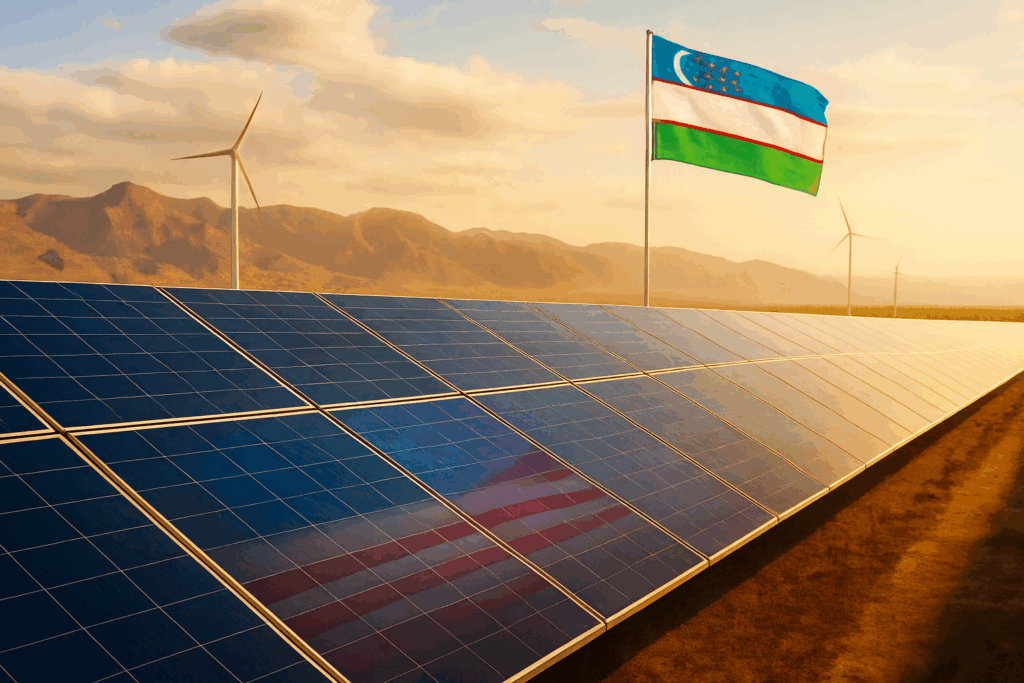
Today, environmentally friendly and energy-efficient projects are no longer just a fashionable trend but a factor of global competitiveness. Uzbekistan, once regarded as a country with a resource-based energy system and limited opportunities for the adoption of modern technologies, is now becoming a hub for “green” investment and innovation. A strategic partnership with the United States plays a special role in this process, encompassing key areas ranging from energy and ecology to finance, education, and culture. Clean and innovative projects are becoming the hallmark of Uzbek-American relations, shaping a new model of cooperation in the 21st century. Green Energy and Strategic Partnership Uzbekistan is moving confidently toward a “green” future. While in 2018 renewable energy sources accounted for less than one percent of electricity generation, from January to July 2025, renewables already provided 20.3% of the country’s total electricity. More than 11 billion kWh of “green” energy were produced, including 6.4 billion kWh from solar power plants and 3.6 billion kWh from wind farms. This volume saved 3.6 billion cubic meters of natural gas and prevented over 2.2 million tons of harmful emissions. Every day, renewables now generate about 26.7 million kWh – enough to cover the needs of 7.28 million households for half a year, or 3.64 million homes for an entire year. Currently, 10 solar and 4 wind plants with a combined capacity of more than 4.5 GW operate across 10 regions of the country. A key focus of Uzbek-American cooperation has become “green” energy. In 2025, Allied Green Ammonia (AGA), together with the U.S. company Plug Power, announced a major project for the production of sustainable aviation fuel, green diesel, and urea. The plan includes the supply of electrolyzers with a capacity of up to 2 GW for the future complex. A final investment decision is expected by the end of 2025, and the project has already been recognized as one of the flagship initiatives for Central Asia. Air Products – A Flagship of American Presence Air Products, a global leader in industrial gases and hydrogen energy, occupies a special place in Uzbek-American cooperation. In the Kashkadarya region, the company participates in a large-scale gas-to-liquids (GTL) project worth around $1 billion. The complex is designed to produce about 1.5 million tons of synthetic fuels per year, including diesel, jet kerosene, and naphtha. Its structure includes air separation units, autothermal reformers, and hydrogen production facilities. This project has become a landmark example of how U.S. technologies are transforming Uzbekistan’s energy sector. In addition to GTL, Air Products is actively developing industrial gas production in Uzbekistan. The company participates in oxygen, nitrogen, and hydrogen production projects, introduces the latest PSA units, as well as freezing and storage technologies that reduce food losses and enhance economic resilience. Furthermore, the company has implemented a “green financing” system that links investments to sustainability principles. These projects not only strengthen the country’s industrial potential but also pave the way for positioning Uzbekistan as a regional hub for “green” energy. The company’s future plans...

Tokayev at the UN Underscores Kazakhstan’s New Diplomacy

Kazakhstan’s international visibility is reaching a peak this late summer and early autumn of 2025. In August, UN Secretary-General António Guterres visited Astana, praising the country’s role as a stabilizing influence in Central Asia and a supporter of multilateral institutions. In a few days, President Kassym-Jomart Tokayev will address the UN General Assembly in New York, presenting Kazakhstan as a reliable partner in peacekeeping, sustainable development, and nonproliferation. This upcoming UN speech marks a departure from past appearances, signaling Astana’s intent not only to balance powers but also to set global agendas. Together, these events signify the country’s ascent as a state no longer defined solely by the art of survival between great powers, but one that now seeks to set agendas, convene adversaries, and project norms beyond its borders. This dual UN moment illustrates the broader transformation of Kazakhstan’s foreign policy over the past year: the shift from multi-vector balancing, an inheritance of the Nazarbayev era, toward a more assertive mode of multi-actor entrepreneurship. Framed through the UN stage, Kazakhstan’s diplomacy now aspires to translate regional initiatives into a global narrative. Rather than oscillating between Moscow, Beijing, Brussels, and Washington, Astana has begun to use its accumulated diplomatic capital to initiate, mediate, and institutionalize regional and global frameworks. From Balance to Initiative For three decades after independence, Kazakhstan’s “multi-vector” foreign policy served as a model of survival in a region shaped by the clash of external rivalries. The doctrine emphasized equidistance between Russia, China, and the West, with an overlay of pragmatic economic engagement. In practice, this often meant leveraging one relationship to offset pressure from another while securing steady inflows of trade and investment. Today, however, the war in Ukraine, the erosion of European security, and the sharper contest between Beijing and Washington have undermined the viability of simple balancing. In response, Tokayev’s government has shifted its approach, seeking to overlay a more agenda-setting dynamic on multi-vectorism by positioning Kazakhstan as a regional hub for diplomacy and connectivity. At the UN, this shift might be presented as Kazakhstan’s evolution from passive survival to a more proactive approach to international diplomacy. Astana’s task is to transform such declarations into a durable strategy. Central Asia and the South Caucasus The clearest evidence of Kazakhstan’s new role comes from Central Asia itself. Relations with Uzbekistan, once characterized by rivalry, have been recast as a cornerstone of functional regionalism. Over the past twelve months, Astana and Tashkent have concluded demarcation agreements, expanded electricity grid interconnections, and coordinated positions on water resource management. The consultative meetings of Central Asian leaders, which Kazakhstan has championed, now serve as regularized platforms for joint initiatives, from infrastructure to practical economic integration, with attempts to reduce Russian and Chinese influence. At the UN, this shift may be framed as Kazakhstan’s evolution from mere survival to actively pioneering new approaches in international diplomacy. For Kazakhstan, the partnership with Uzbekistan provides buffering against external pressure and multiplies regional influence. Astana has also made use of the UN Regional Centre...

Opinion: Almaty as a Model for the Future: Central Asia’s Role in the Global Agenda

Almaty is gradually becoming a hub for resolving issues of not only regional but also global significance. The recent opening of the UN Regional Center for Sustainable Development Goals (SDGs) for Central Asia and Afghanistan here was an event no less significant than the 80th anniversary session of the General Assembly in New York. This is no coincidence: the global agenda at the UN today is increasingly focused on the regional level. Central Asia is not a periphery, but a kind of “model for the future,” where climate, water resources, and security challenges are intertwined. For example, the Tian Shan glaciers have shrunk by more than 25% over the past decade and continue to melt faster than predicted, directly threatening the Amu Darya and Syr Darya rivers. These rivers are increasingly failing to reach the Aral Sea, and its dried-up bed is turning into a giant source of dust and salt. Air pollution levels in the region's cities, as measured by PM2.5, exceed World Health Organization guidelines by an average of 4–6 times. Extreme heat and drought are leading to the loss of agricultural land and the degradation of ecosystems, which affects not only regional but also global food security. Central Asia has already become a unique “testing ground for the future.” The region is testing mechanisms for cross-border cooperation. The CASA-1000 energy project connects Kyrgyzstan and Tajikistan with Afghanistan and Pakistan, creating a “green energy corridor.” Meanwhile, Afghanistan’s Qosh Tepa Canal is altering the balance of water usage on the Amu Darya, forcing neighboring countries to seek new models of agreement. The question is whether these nations can develop a system of joint water and energy management. The outcome will shape not only regional but also global processes. At the same time, the United Nations itself is grappling with a deficit of trust and effectiveness. The Security Council is paralyzed, while General Assembly resolutions often carry only advisory weight. In the face of nuclear risks, environmental upheavals, and the threat of epidemics, the global community is stalling. Even large-scale initiatives such as the Glasgow Financial Alliance for Net Zero (GFANZ) remain largely declarative rather than actually limiting “dirty” investments. Therefore, reform proposals are becoming increasingly vocal, in particular, to strengthen regional UN divisions that are capable of responding more quickly to crises and ensuring practical cooperation between countries. Another way to overcome the trust deficit could be to involve independent expert councils – scientists, NGOs, think tanks – more widely in the decision-making process, which would reduce the influence of political gridlock at the global level. Overall, Almaty can be seen as a model of a “UN in miniature” – a regional center capable of promptly addressing issues that may seem “too small” for New York, yet are critically important for the countries of the region. For instance, the SDG Center could initiate the creation of a regional water monitoring system with unified measurement standards and transparent data sharing. Such decentralization could form the basis for future UN reform....