• KGS/USD = 0.01143 0%
  • KZT/USD = 0.00205 0%
  • TJS/USD = 0.10433 0.1%
  • UZS/USD = 0.00008 0%
  • TMT/USD = 0.28577 0%
  • KGS/USD = 0.01143 0%
  • KZT/USD = 0.00205 0%
  • TJS/USD = 0.10433 0.1%
  • UZS/USD = 0.00008 0%
  • TMT/USD = 0.28577 0%
  • KGS/USD = 0.01143 0%
  • KZT/USD = 0.00205 0%
  • TJS/USD = 0.10433 0.1%
  • UZS/USD = 0.00008 0%
  • TMT/USD = 0.28577 0%
  • KGS/USD = 0.01143 0%
  • KZT/USD = 0.00205 0%
  • TJS/USD = 0.10433 0.1%
  • UZS/USD = 0.00008 0%
  • TMT/USD = 0.28577 0%
  • KGS/USD = 0.01143 0%
  • KZT/USD = 0.00205 0%
  • TJS/USD = 0.10433 0.1%
  • UZS/USD = 0.00008 0%
  • TMT/USD = 0.28577 0%
  • KGS/USD = 0.01143 0%
  • KZT/USD = 0.00205 0%
  • TJS/USD = 0.10433 0.1%
  • UZS/USD = 0.00008 0%
  • TMT/USD = 0.28577 0%
  • KGS/USD = 0.01143 0%
  • KZT/USD = 0.00205 0%
  • TJS/USD = 0.10433 0.1%
  • UZS/USD = 0.00008 0%
  • TMT/USD = 0.28577 0%
  • KGS/USD = 0.01143 0%
  • KZT/USD = 0.00205 0%
  • TJS/USD = 0.10433 0.1%
  • UZS/USD = 0.00008 0%
  • TMT/USD = 0.28577 0%

Viewing results 121 - 126 of 1444

Kazakh-Spanish Film La Tregua to Premiere on Netflix

Following its premiere at the San Sebastian International Film Festival this fall, where it received a special award, the Kazakh-Spanish film La Tregua (The Truce) has been released in cinemas in Spain and Kazakhstan. It is now set to become the first Spanish-language film featuring Kazakhstan to appear on Netflix. “Although critics say the film is not for popcorn viewing, given its focus on little-known and tragic chapters in the histories of Kazakhstan and Spain, its release has generated strong emotional responses in both countries,” said Yerlan Bekhozhin, a prominent Kazakh journalist and co-producer of the film, in an interview with The Times of Central Asia. “It speaks to the timeless struggle of human confrontation.” The film presents a Kazakh narrative about Spaniards caught on opposing sides of ideological conflict. “It is a story from the last century, yet it addresses the present day,” Bekhozhin said. “When we look at today’s world, it’s clear that people lack the ability to engage in dialogue. The main message of the film is: There is always a way to negotiate.” Netflix is expected to stream the film in 2026. Distribution discussions are also underway for theatrical releases in Mexico and other Spanish-speaking countries in Latin America. [caption id="attachment_41648" align="aligncenter" width="2560"] Still from La Tregua[/caption] From Karaganda to the Screen The story is rooted in the history of Karlag, the Karaganda labor camp that operated in Kazakhstan from 1937 to 1959. Victims of Stalinist repression from across the Soviet Union, including foreign nationals, were imprisoned there for dissent, free expression, or as victims of denunciations. The idea for the film came from Spanish producer César Benítez, inspired by an event from over 30 years ago. During the Soviet era, the identities of Spanish citizens imprisoned in Karlag were kept secret. After Kazakhstan gained independence, its government handed the list of repressed Spaniards to the King of Spain, a gesture that sparked widespread attention in Spain, allowing many families to finally discover the fate of their relatives. Years earlier, the Spanish documentary, The Forgotten in Karaganda, had drawn significant attention to the subject. Now, Benítez has transformed the story into a feature film. “The title The Truce is deeply relevant today, at a time when peace requires people to sit at the same table,” said Bekhozhin. [caption id="attachment_41650" align="aligncenter" width="2560"] Still from La Tregua[/caption] Kazakh Identity on a Global Stage Bekhozhin also emphasized the film’s role in portraying Kazakh identity. “Its global release will introduce the world to the law of the steppe, the law of hospitality,” he said. “Kazakhs have long demonstrated empathy forged under harsh conditions. It’s part of our national character to welcome others, regardless of nationality or faith.” One scene in the film shows a Kazakh family near the camp inviting Spanish prisoners into their home and setting a traditional dastarkhan, a generous table of lamb-based dishes. The prisoners are seated in the place of honor, or torge, in keeping with Kazakh custom. “In the film, the hostess explains that when...


Eco-Friendly Quraq-Korpe Christmas Tree Installed in Astana

An unconventional art installation has appeared in Astana’s new administrative center: an eco-friendly Christmas tree styled after quraq-korpe, the traditional Kazakh patchwork quilt. Created by local volunteers, the project is part of the city's broader initiative to incorporate national cultural heritage into contemporary public spaces. Quraq-korpe, made from multi-colored fabric scraps, symbolizes warmth, family, and hospitality. The New Year’s tree, hand-assembled from textile elements and installed on the left bank of the Ishim River, reflects these values in a striking urban art form. A similar eco-tree was first introduced in the capital in 2020 and proved popular with both residents and visitors. In response to public interest, the project was revived in 2025 with a fresh concept and deeper symbolic meaning, focusing on community involvement. [caption id="attachment_41616" align="aligncenter" width="1082"] Image: gov.kz[/caption] “The eco-tree project in the quraq-korpe style has returned to the city at the request of residents,” said organizer Rakhima Mukusheva. “This year’s version is inspired by the Year of Working Professions and the Year of the Horse, symbols of labor, movement, strength, and a living connection to tradition.” All the tree’s decorations were handmade by Astana residents of all ages. More than 50 volunteers across three generations, grandmothers, mothers, daughters, and grandchildren, contributed to the effort. Within two days, they crafted over 100 unique textile ornaments, which were placed in a symbolic “chest of goodness” as part of the installation. The tree will remain on display through January 20, inviting the public to experience it during the holiday season. [caption id="attachment_41618" align="aligncenter" width="1082"] Image: gov.kz[/caption] According to the Astana mayor’s office, the initiative supports Kazakhstan’s Year of Working Professions and highlights the value of labor, craftsmanship, and intergenerational professional traditions. It also showcases the potential of handicrafts as a foundation for cultural initiatives and the creative economy. Interest in Kazakhstan’s national culture continues to grow internationally. As previously reported by The Times of Central Asia, a cultural event called NoMad was recently held in New York to celebrate Kazakh identity. In Kazakhstan, Christmas is officially celebrated on January 7 by Orthodox Christians as a public holiday, while December 25 is observed privately by Catholic and Protestant communities.

Kazakhstan’s Bibisara Assaubayeva Wins Third World Blitz Chess Championship

Kazakh chess star Bibisara Assaubayeva has claimed her third women’s world blitz title, emerging victorious at the 2025 World Blitz Championship in Doha. The win secures her a direct place in the 2026 Candidates Tournament, set to take place in Cyprus in April. Assaubayeva reaffirmed her dominance in women’s chess by defeating Ukraine’s Anna Muzychuk 2.5-1.5 in the final. After three consecutive draws, she clinched the title in the decisive fourth game by capitalizing on a strategic advantage. The 21-year-old first rose to prominence in 2021, when she won the blitz title in Warsaw at just 17, becoming the youngest champion in the tournament’s history. She defended her crown in 2022 at the home championship in Almaty, solidifying her position among the elite in women’s chess. Her 2025 win in Doha marked the culmination of a strong performance throughout the 2024-2025 FIDE Women’s Tournament Cycle. “It’s an amazing feeling, as if all my New Year’s wishes have come true,” Assaubayeva told the tournament’s press service. She described this third title as the most emotional of her career due to the pressure and workload tied to the Candidates' qualification. Assaubayeva is the first Kazakhstani player to qualify for the Women’s Candidates Tournament, where she will face top contenders including India’s Divya Deshmukh, Humpy Koneru, and Vaishali Rameshbabu; China’s Zhu Jiner and Tan Zhongyi; and Russia’s Kateryna Lagno and Alexandra Goryachkina. The tournament will follow a double round-robin format in classical time control. The winner will earn the right to challenge China’s Ju Wenjun, who has held the women’s world championship title since 2018. In Kazakhstan, Assaubayeva’s achievement received high praise. President Kassym-Jomart Tokayev awarded her the Order of Barys, 2nd degree. In his official message, he noted that Assaubayeva “has gone down in the history of world chess as an outstanding master and the first representative of Kazakhstan to become a three-time world blitz champion.” As previously reported by The Times of Central Asia, Assaubayeva was awarded the title of International Grandmaster (GM FIDE) in July 2025, becoming one of the most decorated chess players in Kazakhstan’s post-independence history.

Beshbarmak, Pilaf, and Olivier Salad: What Will Be Served on New Year’s Eve Tables in Central Asia

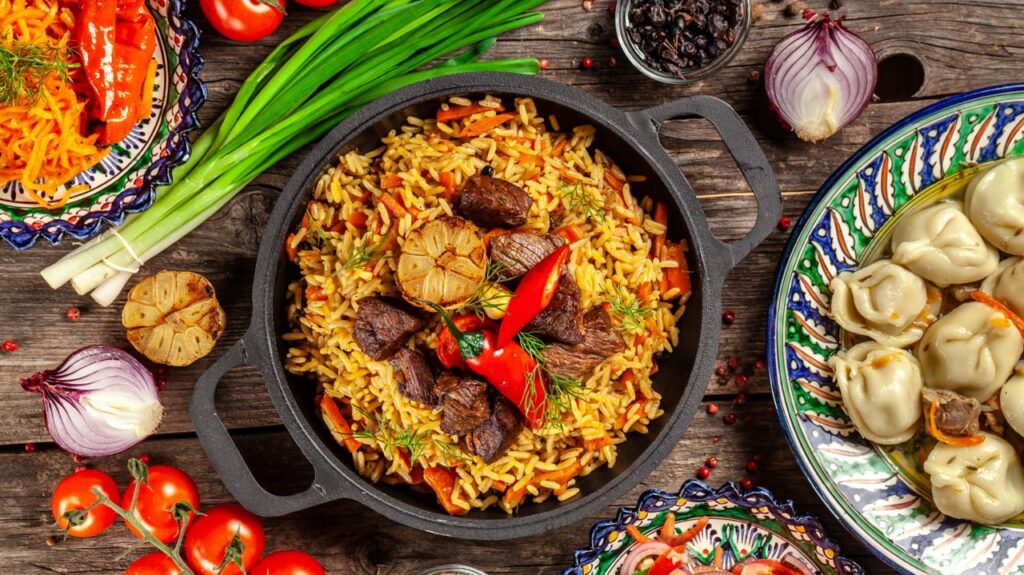
New Year remains one of the most significant holidays in Central Asia. While its scale and prominence have gradually declined due to rising religiosity, many residents still regard it as the foremost secular and ideology-free celebration of the year. Across the region, households prepare their most beloved dishes to ring in the occasion. No New Year Without Olivier Salad For many families, traditional fare is an essential part of New Year’s Eve. Olivier salad has long been a staple of the holiday table. Originally created in the 1860s by a French chef in Russia, the dish once featured ingredients such as hazel grouse and seafood. Over time, particularly during the Soviet era of shortages, the recipe evolved. Today, Olivier salad typically includes beef, chicken (or boiled sausage), potatoes, green peas, pickled cucumbers, and mayonnaise. It is usually prepared in large batches to ensure there is enough for all guests. Other popular salads include herring under a fur coat, vinaigrette, and “Tenderness”, hearty dishes that can leave guests too full for main courses. Even in modest households, red caviar often finds its way to the table, adding a touch of festivity and indulgence. Kazakhstan: Beshbarmak with a Twist In Kazakhstan, beshbarmak remains the centerpiece of the New Year’s feast, as it is for most major celebrations. Traditionally, the dish combines three cuts of horse meat, kazy, karta, and zhay, served with flat noodles and onions. However, some families are adapting their menus in line with the Chinese zodiac. As the Year of the Red Horse approaches, online advice has suggested avoiding horse meat out of respect for the symbolic animal. A vegan version of beshbarmak, featuring mushrooms and pumpkin, is gaining traction. Baked koktal fish is another showpiece dish, while kuydak (lamb with potatoes and onions) and khan syrbaz (a rich stew of lamb, vegetables, barley, and broth) are popular additions. Desserts often include traditional fermented milk products such as zhent, katyk, and irimshik, and the table is rarely without kumys, a fermented mare’s milk beverage. Uzbekistan: Pilaf Reigns Supreme In Uzbekistan, New Year is celebrated with great enthusiasm. According to folklore, Korbobo, a local version of Santa Claus, arrives on a donkey with his granddaughter Korgyz to distribute gifts to well-behaved children. Pilaf, or plov, is the dominant holiday dish. Made with rice, carrots, onions, meat, and spices, regional variations might include raisins or quince for added sweetness. Each area boasts its own version of the national favorite. Samsas, meat-filled pastries baked in a tandoor, are also served, as are manti, large, steamed dumplings filled with lamb, beef, or pumpkin. Other popular dishes include kazan-kabob (fried meat and potatoes). For dessert, chak-chak (fried dough with honey) and halva (made from sesame, semolina, or nuts) are perennial favorites. Kyrgyzstan: Boorsoki and Beshbarmak In Kyrgyzstan, beshbarmak, prepared with either horse meat or lamb, is also a central dish. Families commonly serve manti, baked chicken, and boorsoki (known in Kazakhstan as baursaki), fried dough balls that are a holiday staple. Other meat-based specialties...

NoMad Nights: Celebrating Kazakh Identity at New Year in New York

There’s no party like a New Year NoMad Kazakh Party. Staged slightly ahead of New Year’s Eve to align with the weekend, the glamorous event marked a welcome to the incoming 2026 as well as a celebration of Kazakh culture in New York City. The Sky Wise Lounge, a fashionable Asian fusion venue with regular live entertainment, is located in Brooklyn’s Sheepshead Bay. The neighborhood has a sizable Central Asian population rooted in the former Soviet diaspora and sustained by post-Soviet migration. Events like this one are part of an expanding series of multi-city gatherings across the United States hosted by ATB Promotions, led by Kazakhstani entrepreneur, Talgat Abdrakhmanov. A rotating group of about half a dozen DJs brings high-energy sets that fuse their own mixes with crowd-favorite Kazakhstani hits. [caption id="attachment_41575" align="aligncenter" width="455"] Talgat Abdrakhmanov (right) at NoMad Nights[/caption] Abdrakhmanov, originally from Karaganda, has achieved the American dream. Like other successful immigrants, he has built a business by adopting, adapting, and commercializing the enterprising customs of the U.S. After arriving in New York City in 2012, Abdrakhmanov worked his way up from a dishwasher and a waiter to a customer service representative. He later worked as an IT quality assurance analyst and in the competitive worlds of Wall Street and Silicon Valley. But it was not all work. While navigating employment and IT studies, Abdrakhmanov also embraced the play element of his American life, particularly nightlife and dance music, where he began to notice an unmet demand within his community. During this time, he developed an idea rooted in his own downtime preferences and a desire to cater to fellow immigrants from Kazakhstan. Initially, he organized small meetups with friends at restaurants and sports bars, as well as group outings to soccer games and boxing matches, including bouts featuring former Kazakhstani middleweight world champion Gennady Golovkin, widely known as GGG. “That was the initial spark that gave me an idea to make parties and events in the future,” Abdrakhmanov told The Times of Central Asia. “That’s how ATB Promotions came up.” The Kazakhstani community in the U.S. was receptive to Abdrakhmanov’s first networking foray, KazCommunity USA. “I started KazCommunity USA back in 2016, because I had held many jobs and gained a lot of experience, and people were often asking me for advice, where to find a job, where to find a place to live, how to do this, how to do that. Based on those questions, I decided to create chats and groups on Facebook, Telegram, and WhatsApp, so they exist across different social media platforms. “KazCommunity USA is really about the community. I never charged any money for it. It’s more like a nonprofit initiative that helps people find work, find a place to live, and connect with each other. That includes organizing meetups and events, some of which I later did through ATB Promotions. But KazCommunity itself is free and focused on helping people and building connections within the community.” Abdrakhmanov’s efforts to connect U.S.-based Kazakhstani...

Kazakhstan vs. Uzbekistan: A Footballing Derby with an Uncertain Outcome

The Uzbekistan national football team has qualified for the 2026 World Cup, which will take place across three North American countries: the U.S., Canada, and Mexico. Meanwhile, one of Kazakhstan’s leading clubs, FC Kairat Almaty, continues to gain experience competing in the UEFA Champions League. Football in Central Asia has become a mirror of the region’s growing economic and political ambitions, with Uzbekistan and Kazakhstan at the forefront. Their rivalry, which dates back to the Soviet era, has adapted to this new chapter. Kazakhstan and the Road to Europe Matches between Almaty's Kairat and Tashkent's Pakhtakor were once marquee events during the Soviet era, filling stadiums and energizing fans across the republics. Following the collapse of the USSR, however, the footballing paths of these two historical rivals began to diverge. Initially, both Kazakhstan and Uzbekistan joined the Asian Football Confederation (AFC), which includes countries from across Asia and parts of the Pacific, including former Oceania Football Confederation members such as Australia and Guam. Kazakhstan became a full member of the AFC in 1992, followed by Uzbekistan in 1994. However, Kazakhstan soon grew disillusioned with the level of competition within the AFC and began to explore other avenues. Its early attempts to join UEFA were rebuffed in the mid-1990s. Rakhat Aliyev, then head of the Football Union of Kazakhstan and son-in-law of former President Nursultan Nazarbayev, later described the process as being dismissed “without really getting to the heart of the matter.” Despite this, both Kazakhstan and Uzbekistan quickly showed they were a cut above most AFC members at the time. Kazakhstan won the inaugural Central Asian Cup in 1992, while Uzbekistan claimed gold at the 1994 Asian Games in Hiroshima, defeating China 4-2 in the final. Eventually, Kazakhstan succeeded in joining UEFA. Spearheaded by Aliyev, the Football Union of Kazakhstan (FSC) lobbied hard for admission, culminating in meetings with FIFA and UEFA presidents Lennart Johansson and Joseph Blatter in Moscow in late 2000 and early 2001. The AFC issued a statement on May 10, 2001, allowing Kazakhstan to make its own decision, and five days later Johansson confirmed that UEFA would welcome Kazakhstan as its 52nd member. "Joining UEFA has given all of us who work in football a powerful boost," Aliyev said at the time. "We will strive to use this momentum to raise the level of our national football." Uzbekistan and the Central Asian Football Association Unlike Kazakhstan, Uzbekistan chose to remain in the AFC, where it has steadily risen in prominence. In 2014, it became a founding member of the Central Asian Football Association (CAFA), a regional sub-group within the AFC. Officially operational since 2015, CAFA also includes Afghanistan, Iran, Kyrgyzstan, Tajikistan, and Turkmenistan. The organization is currently chaired by Rustam Emomali, son of Tajik President Emomali Rahmon. Uzbekistan is ranked second in the CAFA, behind Iran, and has consistently reached the quarterfinals of the AFC Asian Cup in 2004, 2007, 2015, and 2023. Much of this success is due to sustained investment in youth development, training...