• KGS/USD = 0.01143 0%
  • KZT/USD = 0.00208 0%
  • TJS/USD = 0.10438 -0.1%
  • UZS/USD = 0.00008 0%
  • TMT/USD = 0.28579 0%
  • KGS/USD = 0.01143 0%
  • KZT/USD = 0.00208 0%
  • TJS/USD = 0.10438 -0.1%
  • UZS/USD = 0.00008 0%
  • TMT/USD = 0.28579 0%
  • KGS/USD = 0.01143 0%
  • KZT/USD = 0.00208 0%
  • TJS/USD = 0.10438 -0.1%
  • UZS/USD = 0.00008 0%
  • TMT/USD = 0.28579 0%
  • KGS/USD = 0.01143 0%
  • KZT/USD = 0.00208 0%
  • TJS/USD = 0.10438 -0.1%
  • UZS/USD = 0.00008 0%
  • TMT/USD = 0.28579 0%
  • KGS/USD = 0.01143 0%
  • KZT/USD = 0.00208 0%
  • TJS/USD = 0.10438 -0.1%
  • UZS/USD = 0.00008 0%
  • TMT/USD = 0.28579 0%
  • KGS/USD = 0.01143 0%
  • KZT/USD = 0.00208 0%
  • TJS/USD = 0.10438 -0.1%
  • UZS/USD = 0.00008 0%
  • TMT/USD = 0.28579 0%
  • KGS/USD = 0.01143 0%
  • KZT/USD = 0.00208 0%
  • TJS/USD = 0.10438 -0.1%
  • UZS/USD = 0.00008 0%
  • TMT/USD = 0.28579 0%
  • KGS/USD = 0.01143 0%
  • KZT/USD = 0.00208 0%
  • TJS/USD = 0.10438 -0.1%
  • UZS/USD = 0.00008 0%
  • TMT/USD = 0.28579 0%

Viewing results 13 - 18 of 367

Kyrgyzstan to Introduce One-Year Temporary Licenses for New Drivers

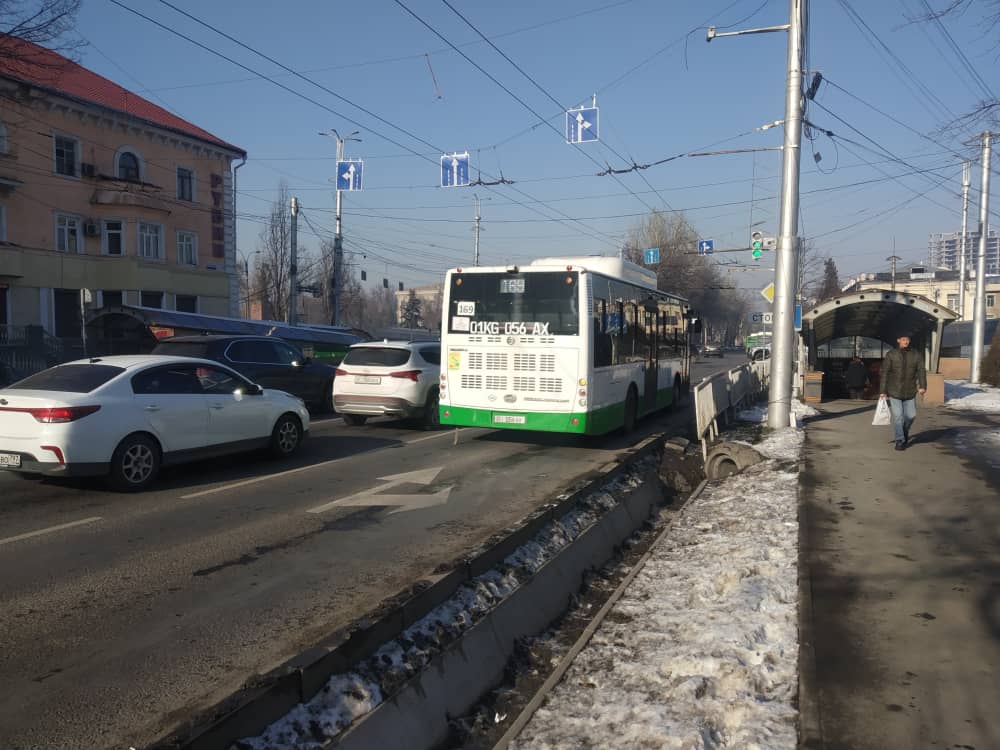
Kyrgyzstan plans to introduce a one-year temporary driver’s license for driving school graduates in an effort to ensure that new motorists develop sustainable skills for safe and responsible behavior on the road, according to a draft resolution of the Cabinet of Ministers of Kyrgyzstan currently undergoing public discussion. The training period at driving schools in Kyrgyzstan has recently been extended from 2.5 months to 10 months. Under the proposed resolution, students demonstrating excellent academic performance would be eligible to take exams after four months of training and receive a temporary driver’s license valid for one year and restricted to use within the country. According to the draft’s explanatory note, a temporary license would allow new drivers to assess their practical skills under real road conditions. If, during the one-year period, they do not commit serious traffic violations or cause traffic accidents, they would be issued a permanent driver’s license. If a driver holding a temporary license commits serious traffic violations or is found responsible for an accident within one year, the temporary license would be annulled, and the driver would be required to return to driving school to complete the remaining six months of the standard training program. The initiative is intended to improve discipline among new drivers and help reduce road accidents. The proposed measure is part of a broader set of reforms aimed at strengthening driver education and lowering accident rates. In a related move, Kyrgyz authorities have suspended all private driving schools until August 30, 2026. During this period, driver training will be limited to state-run institutions. The length of training has also been extended from 2.5 months to 10 months. Officials say the reforms are designed to eliminate corruption and ensure that drivers are properly prepared before receiving licenses. Additionally, Kyrgyzstan has introduced stricter traffic enforcement measures aimed at curbing repeat violations and improving road safety. Under the new rules, drivers who commit three serious traffic violations within a 12-month period are required to retake the traffic rules examination. The reform follows concerning national road safety data. In 2025 alone, Kyrgyzstan recorded 8,456 traffic accidents, resulting in 900 deaths and 12,169 injuries. Over the past decade, more than 75,000 accidents have claimed over 9,000 lives.
Kyrgyzstan Ready to Act as a ‘Gateway’ for Tajik Goods to EAEU and EU Markets

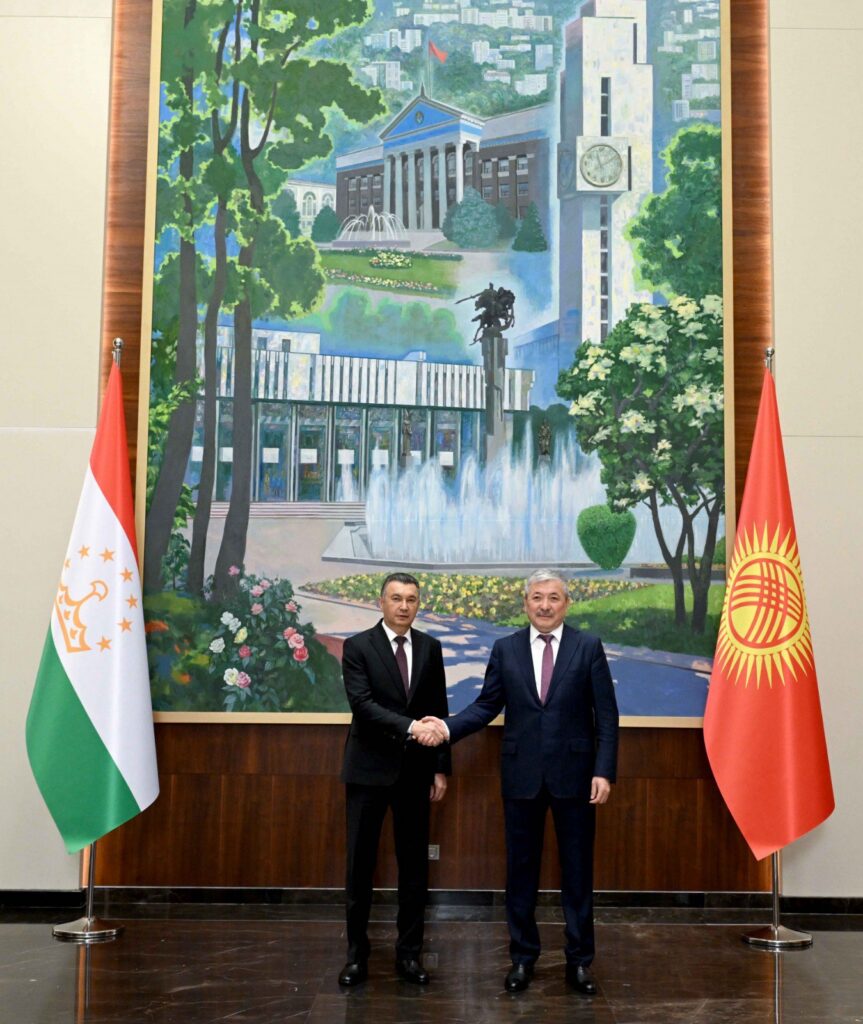
On February 13 in Bishkek, Chairman of the Cabinet of Ministers of Kyrgyzstan Adylbek Kasymaliev and Prime Minister of Tajikistan Kokhir Rasulzoda held the first meeting of the Kyrgyz-Tajik Intergovernmental Council. Opening the session, Kasymaliev said that 2025 marked a historic milestone in bilateral relations, citing the completion of the delimitation process of the Kyrgyz-Tajik border. He described the agreement as “a decisive factor in strengthening security and stability not only in our countries but also in the entire region.” Addressing trade and economic cooperation, Kasymaliev stated that Kyrgyzstan is ready to expand supplies of meat and dairy products, clothing and textiles, coal, glass, and sugar to Tajikistan. According to official figures, bilateral trade turnover reached $36 million in 2025, representing a nearly 24-fold increase compared to 2024. Both sides have set a target of increasing annual trade to $500 million. In the field of transport and logistics, Kasymaliev emphasized the need to improve border infrastructure and enhance the efficiency of checkpoints. Proposed measures include modernizing existing border crossings, expanding capacity, developing logistics and cargo terminals, and introducing digital solutions in customs and border administration. “Kyrgyzstan is ready to act as a trade gateway for Tajik goods to the markets of the Eurasian Economic Union (EAEU), as well as the European Union through the Generalised Scheme of Preferences Plus (GSP+),” Kasymaliev said. He also highlighted the strategic China-Kyrgyzstan-Uzbekistan railway project, which he said would significantly increase Kyrgyzstan’s transit potential and strengthen its role as a logistics hub in Eurasia. According to the Kyrgyz prime minister, the new transport corridor will create additional opportunities for Tajikistan. Kasymaliev further noted positive dynamics in tourism cooperation. In 2025, 86,000 tourists from Tajikistan visited Kyrgyzstan, a 12-fold increase compared to 2024. Kyrgyzstan reaffirmed its interest in developing joint tourism initiatives, including the possible introduction of a unified visa for third-country nationals traveling across Central Asia. Rasulzoda stated that Tajikistan places particular importance on good-neighborly relations and mutually beneficial cooperation with Kyrgyzstan, confirming readiness to further strengthen the partnership. As part of his visit to Bishkek, Rasulzoda toured a recently opened waste-to-energy plant constructed by a Chinese company. He described the facility as a promising example of modern waste recycling and expressed Tajikistan’s interest in implementing similar projects.

On the Eve of Valentine’s Day: Customs of Love and Marriage in Central Asia

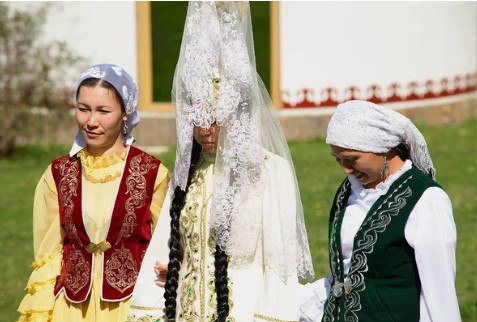
On the eve of Valentine’s Day, Central Asia is once again debating whether to celebrate the holiday or regard it as a symbol of foreign influence. Yet the region has its own rich and diverse customs related to love, matchmaking, and marriage. Accusations of Alien Influence and “Corruption” Valentine’s Day, like Halloween, spread to the former Soviet republics after the collapse of the USSR. In the first decades, young people embraced the new holidays. In recent years, however, critics have increasingly argued that commemorating a Catholic saint in a format centered on romantic love contradicts the traditions of the region’s peoples. For example, in Kazakhstan last year, deputies of the Mazhilis, the lower house of parliament, sharply criticized Valentine’s Day. Some deputies argued that it corrupts young people, promotes “free love,” and even carries “homosexual overtones.”  It is worth noting that Kazakhstan recently adopted legislation prohibiting so-called “propaganda of non-traditional sexual relations.” The Spiritual Administration of Muslims of Kazakhstan has also stated that Valentine’s Day promotes alien values and encourages promiscuity. Gratitude for Raising a Daughter Many matchmaking and marriage customs remain common across Central Asia, particularly the significant role of the bride’s and groom’s parents in ceremonies and celebrations. While traditions have evolved, many are still practiced in modern engagements and weddings. The well-known custom of paying bride price, kalym, has been preserved, though it has undergone significant change. Today, kalym varies depending on the wealth of the families. It may include apartments or cars, or it may amount to several hundred dollars. Importantly, kalym is now generally regarded as financial support for the young family and, as a rule, remains at the disposal of the bride and groom. Historically, in Kazakhstan and Kyrgyzstan, kalym was paid in livestock, and wedding celebrations could last more than a month.  One of the main Kazakh wedding rituals is the groom’s visit to the bride’s village or, in modern practice, her home. Before his first visit, the groom sends gifts to the bride’s family, known as Ilu,  an expression of gratitude for raising their daughter. In some regions of Kazakhstan, this ritual is called ana suty (“mother’s milk payment”). In the past, it included horses, camels, sheep, and riding equipment for the bride’s father. Today, it may consist of any valuable gift, and jewelry is often presented to the women in the bride’s family. The bride traditionally gives the groom a scarf as a symbol of her purity. Festivities then begin, with singing and dancing. Kazakh traditions often involve two weddings: one at the bride’s home and one at the groom’s. The bride’s farewell from her family home remains especially significant, reflecting her relatives’ wishes for her future life. Today, this ceremony is often held in a restaurant. The bride does not wear a white wedding dress at the farewell celebration but appears in an elegant outfit and a traditional headdress known as a saukele. During the farewell, the groom and his friends are subjected to playful pranks, for which they must...

Kyrgyzstan Moves to Expand Domestic and International Rail Tourism

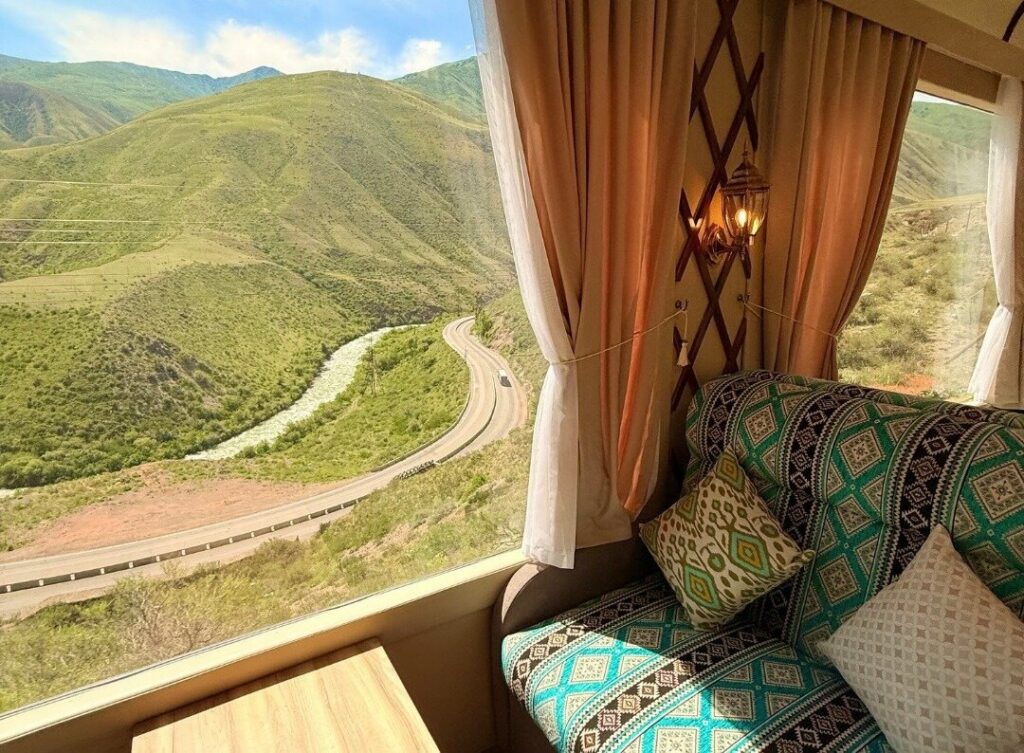
Rail transport is expected to play a greater role in Kyrgyzstan’s tourism strategy as authorities seek to promote railways as an affordable and comfortable travel option for both domestic and international visitors. On February 11, the national railway operator Kyrgyz Temir Jolu and the Tourism Development Support Fund of the Kyrgyz Republic signed a memorandum of cooperation aimed at the sustainable development of domestic and international tourism through rail infrastructure and passenger services. The agreement provides for joint promotional campaigns and coordinated railway tourism projects. According to Kyrgyz Temir Jolu Chief Executive Officer Azamat Sakiev, rail-based tourism has demonstrated steady growth since the launch of dedicated tourist trains in partnership with travel companies in 2021. He said the company is prioritizing domestic routes while working to restore demand for cross-border rail travel. New routes are planned for this year, alongside continued modernization of rolling stock. Refurbished railcars featuring traditional interior design have already entered service, aimed at strengthening the country’s tourism brand and enhancing the passenger experience. Following the upgrades, the company reports a noticeable increase in traveler interest. Kyrgyz Temir Jolu has introduced luxury and VIP compartment cars on the Bishkek-Balykchy line serving the Issyk-Kul region. Last year, the route was extended to the Balykchy Beach stop, providing passengers with direct access to the lakeshore during the summer tourist season. In 2025, the route carried 116,122 passengers, up 31% compared to 2024. Kyrgyzstan’s rail network remains limited, largely reflecting Soviet-era infrastructure. The main line runs from the Kazakh border through Bishkek to Balykchy. Despite these constraints, the country hosted 27 international tourist trains between 2022 and 2025, bringing visitors from Europe, Asia, and the United States, indicating growing global interest in rail-based travel to Kyrgyzstan. Rail tourism is also expanding at the regional level. Kazakhstan and Uzbekistan recently extended their joint Jibek Joly tourist train route to include Dushanbe, strengthening cross-border rail tourism links in Central Asia. Meanwhile, British operator Golden Eagle Luxury Trains has launched The Grand Silk Road, a 22-day luxury rail journey connecting major Silk Road destinations across the region.

New Rail Tour Launched Across Silk Road Routes in Central Asia

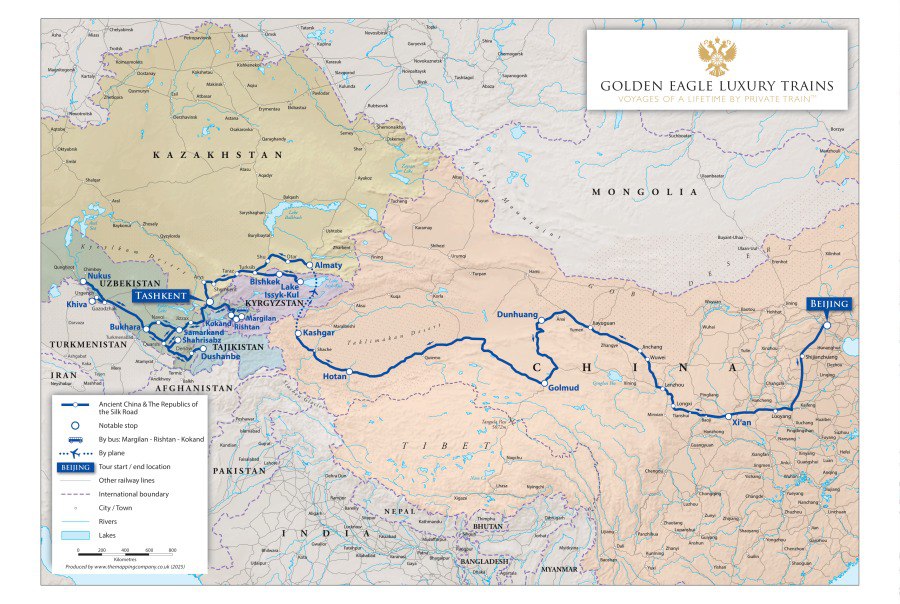
Rail tourism is gaining traction in Central Asia, offering travelers a slower yet more immersive way to experience the region’s historic Silk Road cities. Kazakhstan and Uzbekistan have recently expanded their joint Jibek Joly tourist train route to include Dushanbe, the capital of Tajikistan, an initiative that further strengthens regional railway tourism. A new high-end offering has now entered the market. British operator Golden Eagle Luxury Trains has launched The Grand Silk Road, a 22-day luxury rail journey traversing key cultural and historical landmarks along the ancient Silk Road corridor. Spanning approximately 3,862 kilometers, the route begins in Beijing and concludes in Tashkent. It passes through northwest China and four Central Asian countries: Kazakhstan, Kyrgyzstan, Tajikistan, and Uzbekistan. Notable stops include Almaty, Bishkek, Lake Issyk-Kul, Dushanbe, and Uzbekistan’s major heritage cities, Samarkand, Bukhara, Khiva, Kokand, and Nukus. The inaugural departure is scheduled for September 21 to October 12, 2026. The route is expected to increase high-end tourism to Central Asia. Due to the absence of a direct railway link between China and Kyrgyzstan, a segment of the journey, between Kashgar and Almaty, will be completed by air. Kyrgyzstan’s existing rail network connects to Kazakhstan, extending to Bishkek and Balykchi, near Lake Issyk-Kul. Meanwhile, China, Kyrgyzstan, and Uzbekistan are advancing the construction of a new cross-border railway that will directly link the three countries. Once operational, the line is expected to facilitate both freight transit and tourism, providing a critical new artery for regional connectivity.

Kyrgyzstan Tightens Traffic Enforcement, Mandates Retesting for Repeat Offenders

Kyrgyzstan has implemented stricter traffic enforcement measures aimed at curbing repeat violations and improving road safety. Under the new rules, drivers who commit three serious traffic violations within a 12-month period will be required to retake the traffic rules exam. Offenses triggering mandatory retesting include driving without license plates, failing to stop at the request of traffic police, exceeding the speed limit by more than 40 km/h, failing to yield to emergency vehicles, entering the oncoming lane while overtaking, damaging road infrastructure, causing injury, and permitting an intoxicated or unlicensed individual to drive. The initiative is part of a broader set of reforms designed to enhance driver education and reduce accident rates. In a related move, Kyrgyz authorities have suspended all private driving schools until August 30, 2026. During this period, driver training will be limited to state-run institutions. The length of training has also been extended from 2.5 months to 10 months. Officials say the reforms are intended to eliminate corruption and ensure that drivers are properly prepared before receiving licenses. President Sadyr Japarov has been a vocal proponent of the reforms. On February 3, he visited the State Center for Registration of Vehicles and Drivers to observe the new testing procedures. He criticized the former system, noting that over 90% of students at private driving schools previously passed licensing exams despite inadequate knowledge. Since the introduction of more rigorous exams, the pass rate has dropped to 18-20%, a figure authorities say better reflects actual preparedness. Japarov emphasized the human toll of traffic accidents, stating that over 75,000 accidents in the past decade have claimed more than 9,000 lives in Kyrgyzstan. The president also spoke candidly about personal losses caused by reckless driving. In 2019, his eldest son was killed when a vehicle illegally crossed a double line and struck his motorcycle. Years earlier, his brother and sister-in-law died in an accident caused by a drunk driver. “There are thousands of such stories,” Japarov said, underscoring the urgent need for stronger enforcement and reform in the country’s road safety system.