• KGS/USD = 0.01144 0%
  • KZT/USD = 0.00211 0%
  • TJS/USD = 0.10515 0.48%
  • UZS/USD = 0.00008 0%
  • TMT/USD = 0.28530 0%
  • KGS/USD = 0.01144 0%
  • KZT/USD = 0.00211 0%
  • TJS/USD = 0.10515 0.48%
  • UZS/USD = 0.00008 0%
  • TMT/USD = 0.28530 0%
  • KGS/USD = 0.01144 0%
  • KZT/USD = 0.00211 0%
  • TJS/USD = 0.10515 0.48%
  • UZS/USD = 0.00008 0%
  • TMT/USD = 0.28530 0%
  • KGS/USD = 0.01144 0%
  • KZT/USD = 0.00211 0%
  • TJS/USD = 0.10515 0.48%
  • UZS/USD = 0.00008 0%
  • TMT/USD = 0.28530 0%
  • KGS/USD = 0.01144 0%
  • KZT/USD = 0.00211 0%
  • TJS/USD = 0.10515 0.48%
  • UZS/USD = 0.00008 0%
  • TMT/USD = 0.28530 0%
  • KGS/USD = 0.01144 0%
  • KZT/USD = 0.00211 0%
  • TJS/USD = 0.10515 0.48%
  • UZS/USD = 0.00008 0%
  • TMT/USD = 0.28530 0%
  • KGS/USD = 0.01144 0%
  • KZT/USD = 0.00211 0%
  • TJS/USD = 0.10515 0.48%
  • UZS/USD = 0.00008 0%
  • TMT/USD = 0.28530 0%
  • KGS/USD = 0.01144 0%
  • KZT/USD = 0.00211 0%
  • TJS/USD = 0.10515 0.48%
  • UZS/USD = 0.00008 0%
  • TMT/USD = 0.28530 0%

Viewing results 7 - 12 of 275

Opinion: Tajikistan Narrows Online Extremism Liability — Debate Intensifies in Uzbekistan

Tajikistan’s Prosecutor General has reported a decrease in terrorist and extremist crimes. Officials attributed the decrease to the easing of penalties for “likes” and shares on the internet, which came into force in early May 2025, when the authorities stated that “liking” certain types of online materials and sharing them on social networks would no longer, in themselves, constitute a criminal offense. From 2018 onward, criminal liability was applied to the distribution, storage, or public endorsement of materials deemed extremist or prohibited. According to human rights groups, more than 1,500 Tajiks were imprisoned under the policy. Following recent changes, however, Prosecutor General Habibullo Vohidov said the number of terrorist and extremist crimes had decreased by more than 23%, by 314, compared to 2024. According to Reuters, the clarification applies to online materials deemed extremist or terrorist in nature; “likes” or shares of such content would no longer automatically trigger criminal liability. The recent changes implemented in Tajikistan have led to heated discussions among the public in Uzbekistan, where liability for online “likes”, posts, and comments continues. International organizations have for years characterized Uzbekistan’s enforcement of online speech provisions as a form of pressure on freedom of expression. In Uzbekistan, enforcement previously focused primarily on materials related to extremism and terrorism, but legal changes in 2021 introduced criminal liability for online “discrediting” of the president and state authorities. Local activist Rasul Kusherbayev wrote the following on his Telegram channel: “This issue is urgent for us, too. Law enforcement agencies, which lack the ‘nerve’ to punish officials who are illegally destroying the property of citizens, are not ashamed to hold citizens liable for a ‘like’”. Some observers argue that Uzbekistan’s legislation is more regulated compared to that in Tajikistan. While liability for prohibited content had been established in Tajikistan, the exact list of prohibited materials was not consistently disclosed. In Uzbekistan, however, this list has been regularly updated and publicly announced in recent years. Article 244.1 and the Prohibited List Draft decisions related to prohibited information have appeared in Uzbek legislation since the 1990s. Documents regarding information policy signed in March 1999 on the Lex.uz website speak about banned information. However, what was included in this list was not announced in open sources in Uzbekistan for years. The draft law on disclosing the list to the public was signed in 2014. Publicly available information about the evidentiary basis for earlier cases remains limited. The list of social network accounts and sites prohibited in Uzbekistan was last updated in January 2026. Around 1,600 channels, pages, and materials were included in the list. Specifically, it includes 249 pages and channels on Facebook, 790 on Telegram, 265 on Instagram, 167 on YouTube, 36 on the Odnoklassniki social network, and 53 on TikTok. Materials in audio, video, and text formats on websites and social networks were included. Although the list is publicly available, questions have arisen regarding its comprehensibility and clarity. Observers argue that the breadth of the list risks encompassing ordinary religious and political expression. Activists emphasize...
Opinion: Mirziyoyev in Washington – New Deals Expected Amidst Peace Diplomacy

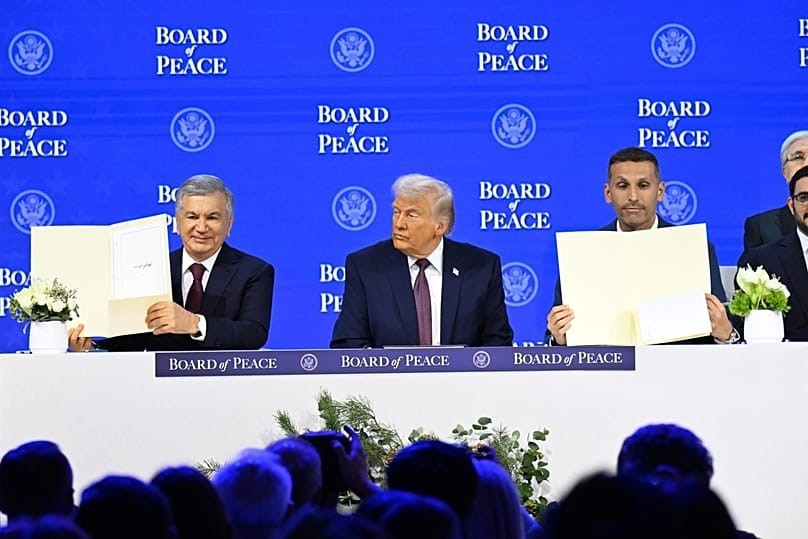
The President of Uzbekistan, Shavkat Mirziyoyev, has arrived on a working visit to Washington to participate in the inaugural meeting of President Trump’s Board of Peace on February 19, 2026, alongside the Presidents of Kazakhstan, Azerbaijan, and other heads of state. Against a backdrop of deep geopolitical tensions and raging conflicts across the world, Mirziyoyev’s second visit to the White House in less than four months suggests that U.S.-Uzbekistan relations are at their strongest in decades. Mirziyoyev will be joined by Uzbekistan’s Foreign Minister, Minister of Investments, Industry and Trade, and other high-ranking officials. Uzbek Ambassador to the U.S. Sidikov and his team have been working around-the-clock for over two weeks, gearing up for the Trump–Mirziyoyev meeting. President Mirziyoyev’s objective will be to elevate U.S.-Uzbek relations from a constructive relationship to a fully functional, deal-oriented partnership with a focus on capital flows and bilateral trade.  In addition to his desire for regional stability in West Asia, his signing up for the Board of Peace should be understood as indicating his desire to advance trade and investment and flows into Uzbekistan. The Uzbeks are keen to nail down new money and capital guarantees to fund infrastructure along the U.S.-brokered “Trump Route for International Peace and Prosperity,” aka, the Zangezur Corridor between Armenia and Azerbaijan (TRIPP) – a roughly 27-mile-long piece of land that links Europe to Central Asia and beyond through the Caucasus. TRIPP matters to Trump because it advances two goals at once: stabilizing the South Caucasus while more fully integrating U.S. trade with Uzbekistan and the Trans-Caspian International Transport Route (TITR)—a multimodal, 4,000 km transport network connecting China and East Asia with Europe via Kazakhstan, the Caspian Sea, Azerbaijan, Georgia, and Turkey. Apart from the issues on the Board of Peace agenda, Mirziyoyev will push for ironclad U.S. commitments and cold, hard cash for transport corridors and their downstream beneficiaries. Two big reasons driving Mirziyoyev ‘s thinking: first, Uzbekistan is one of only two double-landlocked countries in the world, the other being Liechtenstein—and second, Trump’s desire to nail down a peace agreement between Armenia and Azerbaijan, thereby resolving a long-standing territorial dispute that has taken thousands of lives. Mirziyoyev knows that Trump sees TRIPP as a path to lasting peace and regional prosperity across the broader region, which fits into the Board of Peace narrative. Trump has referenced TRIPP repeatedly over the past year, and Mirziyoyev is well aware of this.  At UNGA last September 23, 2025, Trump said: "President Mirziyoyev is a terrific leader, and with this TRIPP corridor, Uzbekistan is going to see massive trade flowing through – it's going to connect them directly to new markets without all the old hassles." And as Trump said on November 7, 2025, at the C5+1 Summit in Washington: "I've got great respect for President Mirziyoyev – he's doing amazing things in Uzbekistan. The Trump Route, i.e., the TRIPP, is perfect for them; it's going to cut transit times and costs, making Uzbekistan a powerhouse in regional trade." Mirziyoyev is paying...

Opinion: Turning Rivalry into Opportunity: Kazakhstan’s Strategic Autonomy

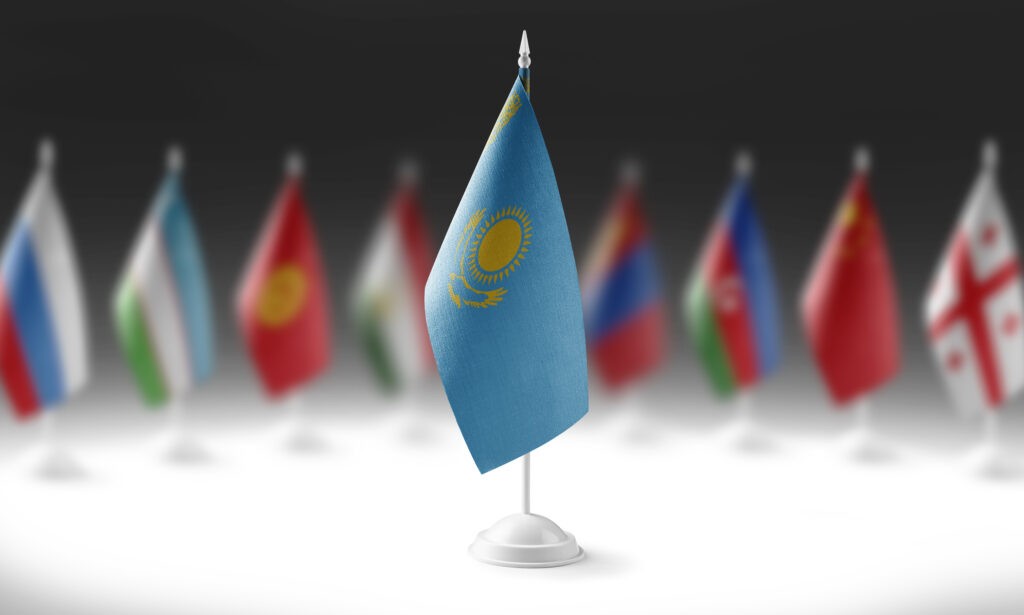
Over the past decade, global geopolitics has witnessed a clear return to Great Power competition, reviving elements of Cold War-style rivalry and a pronounced East-West divide. Yet, contrary to the belief that international relations are defined exclusively by great powers, the countries of Central Asia, historically perceived as chess pieces between Moscow, Washington, and Beijing, have been exercising their own autonomy and asserting independent foreign policy paths. Kazakhstan, the region’s largest and most resilient economy, has arguably emerged as a leading example of this movement. Through a careful balancing strategy, Kazakhstan has worked to avoid firmly aligning itself with any one geopolitical camp. Rather than choosing sides, it has chosen options. However, when pressure from one power arises, Astana’s response has rarely been resistance for its own sake, but rather negotiation and taking advantage of the opportunities that power can offer it. Essentially, if alignment is expected, it comes at a price. In this sense, great-power competition is treated less as an existential threat and more as a marketplace – one in which influence is traded. However, the question is, is there space for both Beijing and Washington? In this context, there is much to examine regarding last week’s B5+1 forum in Bishkek. Bringing together government officials and private sector representatives from Kazakhstan, Kyrgyzstan, Tajikistan, Turkmenistan, Uzbekistan, and the United States, the forum aimed to deepen economic ties and explore investment opportunities. Among the attendees was Sergio Gor, the U.S. Special Envoy for South and Central Asia. Perhaps the B5+1 forum is not just a routine investment event; it’s a signal from the U.S. to China. A cornerstone of the cooperation between the U.S. and Kazakhstan was illustrated by the creation of a partnership in rare metals. The Ulba Metallurgical Plant (UMP) is located in north-eastern Kazakhstan. UMP is one of the very few facilities worldwide capable of carrying out the full processing cycle for rare metals. What elevates this cooperation beyond conventional trade is UMP’s production of materials such as beryllium and tantalum. These materials are critical inputs for the defense industry supplied to major aerospace and defense contractors, including Boeing and Lockheed Martin, both of which conduct business with the U.S. Department of Defense. Thus, Kazakhstan’s contribution to the U.S. defense supply chains signals a broader shift in regional geopolitics. By enabling access to strategically important resources that underpin advanced military technologies, Astana is strengthening its economic alignment with Washington, while subtly influencing the broader balance of defense capabilities between Western and Eastern powers. Furthermore, another one of the headline-making deals at the B5+1 forum was the announcement of a joint venture between U.S.-based Cove Capital LLC and Kazakhstan’s National Mining Company to develop the world’s largest known undeveloped tungsten resource. This deal is significant against the backdrop of the ongoing tug-of-war between Beijing and Washington over strategic natural resources, and analysts note that the U.S. and China are already competing for Kazakhstan’s tungsten – another material crucial in the defence and microelectronics industries. China presently controls nearly...

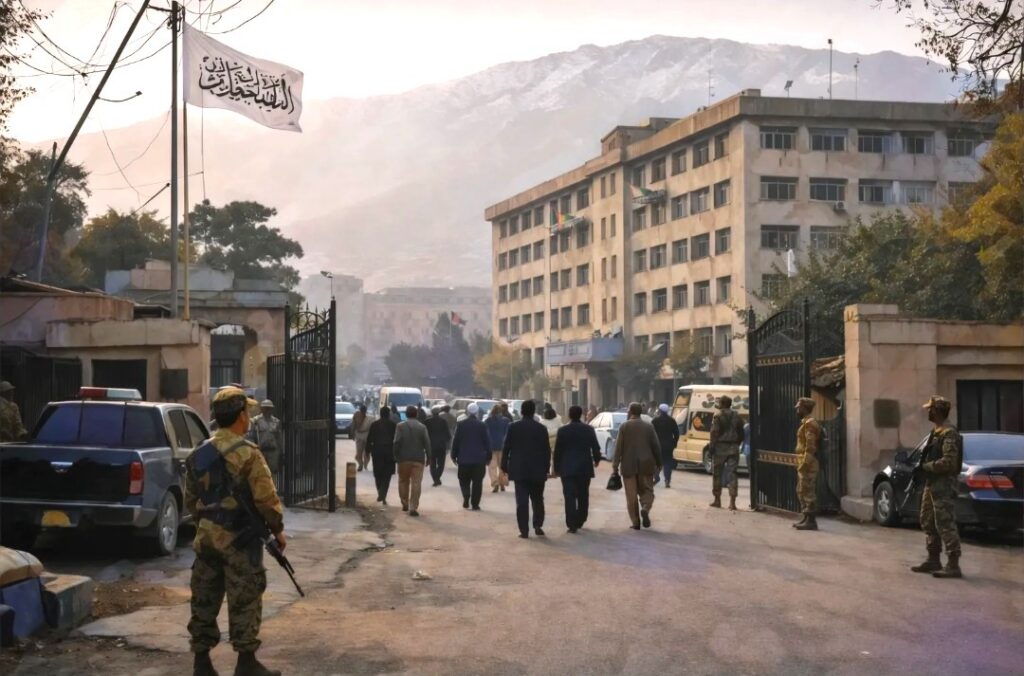
Opinion – The “Board of Peace” and Afghan Diplomacy: A View from Kabul

A new trend is becoming increasingly apparent in global politics: key decisions are being discussed not only within traditional international institutions but also through more flexible political and diplomatic formats. One such initiative is the announcement of the creation of the “Board of Peace” by U.S. President Donald Trump, a structure that, according to its authors, is intended to provide an alternative mechanism for conflict resolution. Reactions have been mixed. Some states view the new platform as an opportunity to enhance the effectiveness of peace efforts; others warn that it could weaken existing institutions, particularly the United Nations, and contribute to a gradual shift toward closed political groupings in which participants' strategic interests outweigh universal rules. At its core, this debate reflects the possibility of a deeper transformation of the international order. Whereas global security architecture was once built primarily around multilateral mechanisms, flexible coalitions and ad hoc alliances are becoming more prominent. In such a system, the role of states capable not only of adapting to change but also of offering independent diplomatic initiatives is growing. It is in this context that Afghanistan is increasingly asking what role it can occupy in a new international configuration. One of the key questions raised in Kabul’s expert community is straightforward: Will the current Afghan authorities be considered in emerging international mechanisms, including the Board of Peace? There is no clear answer. Despite ongoing global discussions on security and economic cooperation, concrete decisions regarding Afghanistan remain limited. Frozen financial assets, sanctions, and uncertainty over the country’s international status continue to impede economic recovery and complicate integration into regional processes. Against this backdrop, Afghan experts argue that the country should avoid remaining on the periphery of the evolving order and instead seek integration through sustained diplomatic engagement and regional cooperation. Central Asia could play a particularly significant role in this process. The states of the region are potentially capable of mediating to reduce tensions between Afghanistan and Pakistan and of facilitating the resolution of a conflict that directly affects broader regional security. Such a role appears logical for several reasons. Many Central Asian countries traditionally pursue pragmatic foreign policies, maintaining working relations with multiple centers of power while avoiding rigid geopolitical alignments. This approach has gradually shaped their reputation as relatively neutral and predictable partners. The element of self-interest is equally important. Stability to the south is directly linked to border security, the development of transport corridors, energy projects, and trade. In this context, mediation is not merely a diplomatic gesture but an element of a long-term regional strategy. Moreover, neutrality may prove to be Central Asia’s principal political asset. The region is not generally perceived as a direct party to the conflict and is therefore potentially well placed to offer a platform for dialogue. At the same time, assuming such a role would require readiness to accept greater responsibility. Effective mediation presupposes regional coordination, institutional maturity, and the political will to engage more actively in security matters. The emergence of initiatives such...

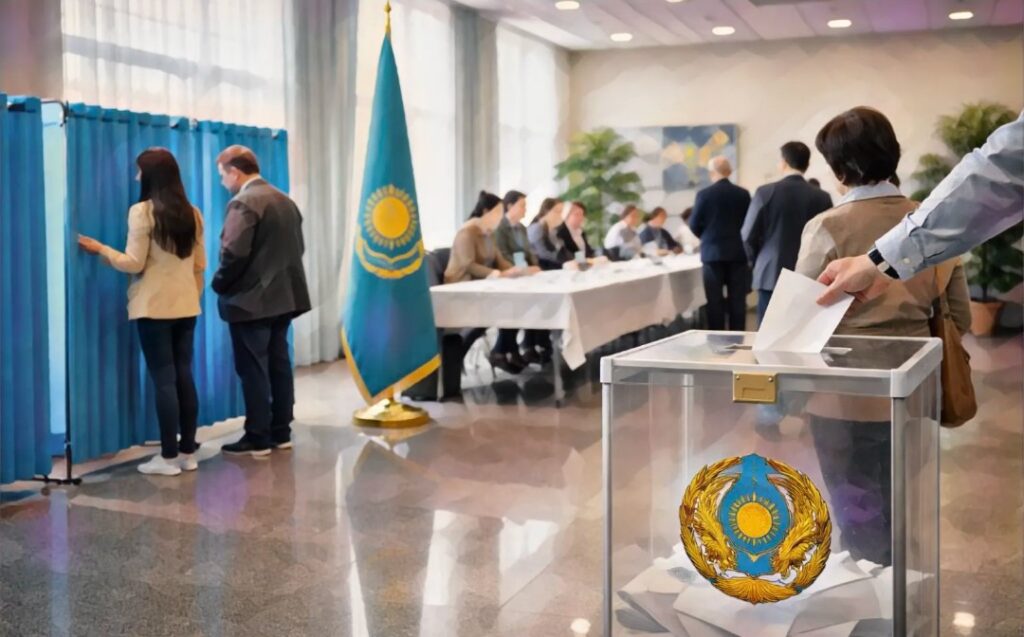
Opinion: Kazakhstan’s Constitutional Referendum – Strategic Reset or Institutional Consolidation?

Kazakhstan will hold a nationwide referendum on March 15 to adopt an entirely new constitution – an initiative President Kassym-Jomart Tokayev describes as a decisive break from the country’s super-presidential legacy. The draft, published on February 12 after deliberations by a Constitutional Commission, proposes far-reaching institutional reforms. Among the most notable changes are the replacement of the bicameral parliament with a unicameral body known as the Kurultai; the reinstatement of a vice presidency; and the constitutionalization of commitments to digital transformation, economic modernization, and strengthened sovereignty. The government presents the reform as a necessary modernization of the state in response to global turbulence. Yet the scope and timing of the proposal indicate that the referendum is as much about strategic recalibration as it is about institutional redesign. The Accelerated Timeline The speed of the process has drawn considerable attention. In September 2025, Tokayev advised against rushing constitutional reform and suggested that 2027 would allow sufficient time for public consultation. However, by February 2026, the referendum had been scheduled for mid-March. This abrupt shift suggests a deliberate political calculation rather than simple administrative urgency. One factor under discussion is the legal effect of adopting a wholly new constitution. While reforms in 2022 limited presidents to a single seven-year term, the introduction of a new constitutional order could create ambiguity regarding the continuity of those limits. Even if not explicitly intended as a reset mechanism, such a transformation inevitably introduces flexibility into questions of tenure and succession. Geopolitical pressures also help explain the acceleration. Tokayev has pointed to profound changes in global trade, security alignments, and technological competition. In a world increasingly shaped by sanctions regimes and geoeconomic fragmentation, Kazakhstan seeks to project institutional coherence and responsiveness. Constitutional reform, in this sense, becomes a signal of adaptive capacity. At the same time, the draft completes the political transition that began after the unrest of January 2022. Although earlier amendments removed former President Nursultan Nazarbayev’s constitutional privileges, the 1995 framework remained largely intact. The new proposal replaces that structure altogether, extinguishing residual legal ties to the Nazarbayev era and consolidating a distinct political phase under Tokayev’s leadership. Sovereignty as Constitutional Doctrine A defining feature of the draft is the elevation of sovereignty, independence, territorial integrity, and the unitary nature of the state to foundational, effectively immutable principles. This language carries clear geopolitical resonance, particularly in the aftermath of Russia’s invasion of Ukraine. While Kazakhstan continues to pursue a multi-vector foreign policy, the constitutional entrenchment of territorial integrity reinforces the state’s insistence on inviolable borders. The draft also expands restrictions on foreign financing of political parties and introduces stricter transparency rules for foreign-funded non-governmental organizations. These provisions reflect a doctrine of symmetrical distance: limiting political influence from any external actor, whether Russia, Western governments, or other international stakeholders. The emphasis is not ideological alignment but institutional insulation. Language and Identity: Managed Ambiguity The most domestically sensitive amendment concerns the status of Russian. The draft alters the phrasing from Russian being used “on an equal...

Opinion: Afghanistan and Central Asia – Security Without Illusions

Over the past year, Afghanistan has become neither markedly more stable nor dramatically more dangerous, despite how it is often portrayed in public discourse. There has been neither the collapse that many feared, nor the breakthrough that some had hoped for. Instead, a relatively unchanged but fragile status quo has persisted, one that Central Asian countries confront daily. For the C5 countries, Afghanistan is increasingly less a topic of speculative discussion and more a persistent factor in their immediate reality. It is no longer just an object of foreign policy, but a constant variable impacting security, trade, humanitarian issues, and regional stability. As such, many of last year’s forecasts have become outdated, based as they were on assumptions of dramatic change, whereas the reality has proven far more inertial. Illusion #1: Afghanistan Can Be Ignored The belief that Afghanistan can be temporarily “put on the back burner” is rooted in the assumption that a lack of public dialogue or political statements equates to a lack of interaction. But the actions of Central Asian states show that ignoring Afghanistan is not a viable option, even when countries intentionally avoid politicizing relations. Turkmenistan offers a clear example. Ashgabat has maintained stable trade, economic, and infrastructure ties with Afghanistan for years, all with minimal foreign policy rhetoric. Energy supplies, cross-border trade, and logistical cooperation have continued despite political and financial constraints, and regardless of international debates over the legitimacy of the Afghan authorities. This quiet pragmatism stands in contrast to both isolationist strategies and symbolic or ideological engagement. Turkmenistan may avoid making public declarations about its relationship with Afghanistan, but it nonetheless maintains robust cooperation. This calculated calmness reduces risks without signaling disengagement. Importantly, this approach does not eliminate structural asymmetries or deeper vulnerabilities. But it dispels the illusion that distancing reduces risk. On the contrary, sustained economic and logistical ties foster predictability, without which attempts to “ignore” a neighboring country become a form of strategic blindness. In this sense, Turkmenistan’s experience affirms a broader regional truth: Afghanistan cannot be removed from Central Asia’s geopolitical equation by simply looking away. It must be engaged pragmatically or dealt with later, in potentially more destabilizing forms. Illusion #2: Security Is Achieved Through Isolation Closely related to the first is the illusion that security can be ensured by building walls. Security in Afghanistan, and in the broader Afghan-Pakistani zone, is often seen as an external issue, something that can be kept out by sealing borders or minimizing engagement. Yet in practice, security is determined less by geography and more by the nature of involvement. This is reflected in the recent decision by Uzbekistan and Kazakhstan to participate in U.S. President Donald Trump's “Board of Peace” initiative. While the initiative focuses on resolving crises outside Central Asia, both countries have framed their participation as essential to their own national and regional security interests. As Abdulaziz Kamilov, advisor to the President of Uzbekistan, explained, Tashkent’s involvement stems from three factors: its own security needs, its foreign policy principles,...