• KGS/USD = 0.01144 0%
  • KZT/USD = 0.00216 0%
  • TJS/USD = 0.10663 0%
  • UZS/USD = 0.00008 0%
  • TMT/USD = 0.28530 0%
  • KGS/USD = 0.01144 0%
  • KZT/USD = 0.00216 0%
  • TJS/USD = 0.10663 0%
  • UZS/USD = 0.00008 0%
  • TMT/USD = 0.28530 0%
  • KGS/USD = 0.01144 0%
  • KZT/USD = 0.00216 0%
  • TJS/USD = 0.10663 0%
  • UZS/USD = 0.00008 0%
  • TMT/USD = 0.28530 0%
  • KGS/USD = 0.01144 0%
  • KZT/USD = 0.00216 0%
  • TJS/USD = 0.10663 0%
  • UZS/USD = 0.00008 0%
  • TMT/USD = 0.28530 0%
  • KGS/USD = 0.01144 0%
  • KZT/USD = 0.00216 0%
  • TJS/USD = 0.10663 0%
  • UZS/USD = 0.00008 0%
  • TMT/USD = 0.28530 0%
  • KGS/USD = 0.01144 0%
  • KZT/USD = 0.00216 0%
  • TJS/USD = 0.10663 0%
  • UZS/USD = 0.00008 0%
  • TMT/USD = 0.28530 0%
  • KGS/USD = 0.01144 0%
  • KZT/USD = 0.00216 0%
  • TJS/USD = 0.10663 0%
  • UZS/USD = 0.00008 0%
  • TMT/USD = 0.28530 0%
  • KGS/USD = 0.01144 0%
  • KZT/USD = 0.00216 0%
  • TJS/USD = 0.10663 0%
  • UZS/USD = 0.00008 0%
  • TMT/USD = 0.28530 0%

Viewing results 19 - 24 of 107

Recipes for Broken Hearts: Bukhara Hosts Its First Contemporary Art Biennale

The heat of Bukhara’s old city does little to deter the crowds. Tourists squeeze through narrow lanes, pausing in the shade of centuries-old madrasas or beneath towering minarets. This September, the heart of the UNESCO Creative City of Crafts and Folk Art is hosting something new: the inaugural Bukhara Biennale of contemporary art. Running from September 5 to November 20, the biennale is already being hailed as one of Central Asia’s largest and most diverse art initiatives. Its title, Recipes for Broken Hearts, reflects both its ambition and tone, blending art, history, and community in a city long known for its spiritual and cultural heritage.   A Global Effort Rooted in Bukhara The Bukhara Biennale is commissioned by Gayane Umerova, Chairperson of the Uzbekistan Art and Culture Development Foundation, which has played a pivotal role in preserving and promoting the country’s cultural legacy. Artistic director Diana Campbell sees the biennale as a continuation of Bukhara’s historic role as a center of learning and exchange. [caption id="attachment_35919" align="aligncenter" width="900"] Isiriq (wild rue) is a traditional herbal medicine also widely used in purification rituals among Uzbeks. It is often burned or hung in homes to ward off misfortune and evil. In the installation, bunches of isiriq hanging from the roof appear to reflect this age-old custom; image: TCA, Sadokat Jalolova[/caption] “The heart’s creative power comes into view when we look to tenth-century Bukhara, a time and place that offer many ways of mending heartbreaks,” said Campbell. She referenced Bukhara’s legacy as the home of polymath Ibn Sina and a crossroads on the Silk Roads. “For more than a millennium, Bukhara has been a place where people gathered to seek knowledge, healing, and hope. We believe the city holds many extraordinary recipes in its heart.” The biennale unfolds in the newly developed Bukhara Cultural District, where restored monuments are paired with modern design, featuring contributions from architects Wael Al Awar and landscape designer Günther Vogt. From Jeddah to Bukhara: Palm Waste Becomes Structure A highlight of the biennale is the AlMusalla Prize-winning installation, a reimagined musalla, or prayer space, constructed entirely from palm tree waste. Originally built in Jeddah, the structure has been transported to Bukhara as a symbol of sustainability and reuse. [caption id="attachment_35922" align="aligncenter" width="1600"] AlMusalla Prize winning installation; image: TCA, Sadokat Jalolova[/caption] Christopher Blust, engineer at AKT II, explained the origins of the project: “We were inspired by the idea of courtyards as places of gathering. Even the Prophet Muhammad’s house in Medina began with a courtyard for prayer and community.” Equally important, he said, was the material itself. “Palm fronds are discarded and often burned. We asked: Why not return to how these were used centuries ago? We shredded them, pressed them into boards, and created structural timber. This is the world’s first project to use palm waste in this way.” Architect Nicolas Fayad of East Architecture Studio noted that their design was informed by Jeddah’s traditional materials, timber, mud, and stone, reinterpreted through modern technology. “Everything visible in...

“Recipes for Broken Hearts”: Bukhara Launches First Art Biennale

This autumn, the ancient Silk Road city of Bukhara is poised to reemerge as a global cultural destination, hosting its first-ever international art biennale, Recipes for Broken Hearts. Running from September 5 to November 20, the ten-week festival will transform Bukhara, a UNESCO Creative City, into a vibrant arena for contemporary art, community rituals, and culinary experiences. The initiative is spearheaded by Gayane Umerova, chair of the Uzbekistan Arts and Culture Development Foundation (ACDF), with renowned curator Diana Campbell at the helm. More than 70 new works, created in Uzbekistan, will be displayed in historic madrasas and caravanserais, reimagined as immersive exhibition spaces. The event promises to be among the region’s largest cultural gatherings, aiming to reclaim Bukhara’s place on the global cultural map. Not Just an Exhibition, A Sensory Ritual Recipes for Broken Hearts is not a traditional exhibition. Designed as a “ritual for the senses,” it invites audiences to engage with art not just visually but through touch, scent, sound, and taste. Sculptures, textiles, music, and food converge into an experimental space for “emotional healing.” Visitors become participants rather than spectators. At the opening ceremony, instead of a red carpet, guests will be welcomed by the scent of fermentation. Korean Buddhist nun and chef Jeon Kwan will prepare kimchi, place it in a clay pot, and bury it. Ten weeks later, the fermented dish will be unearthed and shared with the public, symbolizing transformation and healing through time. A Dialogue Between Cultures The biennale’s installations span a wide geographic and cultural range. Egyptian-American artist Laila Gohar will craft navata, a crystal made from grape juice and saffron. Colombian artist Delcy Morelos will construct a dome of clay, sand, and spices to symbolize human connection to the earth. Uzbek artist Oizhon Khairullaeva and ceramist Abdurauf Tahirov will create “organs of the city,” including a beating ceramic heart and a “stomach” integrated into historic architecture. Indian sculptor Subodh Gupta will build a giant dome from enamel teapots and bowls, shaped like a yurt, where guests will be served fusion cuisine. Central to the project is the in situ approach: every piece is created in Bukhara with the support of local artisans, potters, weavers, and carpet makers, infusing contemporary works with traditional skills. “This isn’t an art fair,” explained the curators. “Each piece speaks from this land, even if the whole world sees it.” [caption id="attachment_21936" align="aligncenter" width="2560"] The Kalon Mosque, Bukhara; image: TCA, Stephen M. Bland[/caption] Bukhara as a Living Gallery Festival venues are dispersed throughout Bukhara’s historic core, effectively turning the city into an open-air gallery. Four restored caravanserais symbolize the emotional journey from grief to hope. The 16th-century Gavkushon madrasa, repurposed as the “House of Softness,” will host workshops, public readings, and a symposium titled The Craft of Mending. There, artists and scholars will explore the “culture of repair”, from object restoration to the preservation of historical memory. “Erasing history is also a form of pain. Restoration is resistance to oblivion,” notes Harvard-based art historian Aziza Izamova. Concurrently,...

Nigora Fazliddin: The Social Media Storyteller Bringing Life in Tajikistan to the World

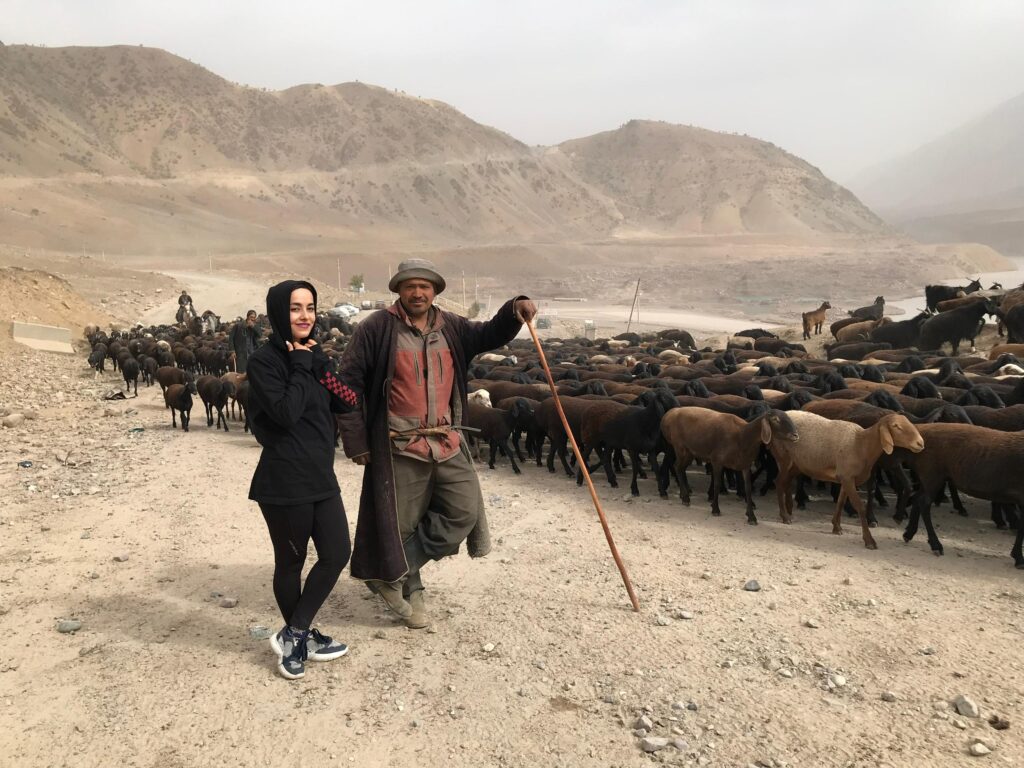
For all its beauty and Silk Road history, Tajikistan remains one of the least visited countries on earth. Life in its epic mountain ranges is rarely captured by photographers, and documentary films are few and far between – mainly half-hearted vlogs by the foreigners who pass through on the Pamir Highway. But in recent years, one Tajik filmmaker and travel influencer has made it her mission to show both her own people and the wider world what makes her homeland so extraordinary. Nigora Fazliddin, a former journalist from Dushanbe, is part of a new generation of creators using social media to bridge cultural distances. Posting simple videos and photographs from her journeys in Tajikistan, she captures the landscapes and communities that outsiders, and even many Tajiks, rarely get to see. "This love I have for our land – its wild beauty, its silence, its soul – I try to share with others," she tells The Times of Central Asia. "On X I mostly reach an international audience, since it's not very popular in Tajikistan. But on Instagram, it's a different story. That’s where Tajiks find me, and where I find them." [caption id="attachment_35211" align="aligncenter" width="400"] Image: Nigora Fazliddin[/caption] One of her favorite discoveries, she says, is Shirkent National Park in the south-west of the country, where fossilized dinosaur footprints mark the earth. "It gives you goosebumps to stand there and imagine creatures walking those same paths millions of years ago," she adds. Then there are the Pamirs, often called “the roof of the world.” At 7,495 meters, Peak Somoni attracts mountaineers from Central Asia and further afield. The region is also home to the rare Marco Polo sheep and shaggy yaks, which are found only here. But what lingers most for Fazliddin is not the challenge of climbing or the sight of wildlife, but the solitude of valleys so remote that no car can reach them. She also cherishes journeys into the Yaghnob Gorge, where people still live as their ancestors did. There she met a shepherd in his seventies, Mirzoali, who has spent four decades with his flock among the peaks. "He told me, “I’ve been a shepherd for 40 years – and I never get tired of it.’” His secret? Clean air, peace, a healthy routine – and living in the mountains year-round. That’s the kind of wisdom you can only find in the mountains," she says. [caption id="attachment_35209" align="aligncenter" width="400"] Image: Nigora Fazliddin[/caption] What Fazliddin shares online is more than travel content. For many Tajiks, especially those in cities, her images bring new perspectives to familiar places. "My Instagram has become like a mirror where people can see themselves, their roots, and the beauty they grew up with – but may have never really looked at," she explains. The responses have been moving. Her social media followers now invite her to visit their villages. For Fazliddin, these moments confirm that her work is worth doing: "It makes me feel like what I do matters – even in...

Kazakhstani Opera Talent Aigerim Altynbek Wins Contest in Italy

Kazakhstani soprano Aigerim Altynbek believes “greater heights” await after she came first in an international opera singing competition in Italy. Altynbek was among singers from 50 countries competing in the Concorso Lirico Internazionale di Portofino (CLIP) in the scenic harbor village of Portofino. The competition, which began in 2015, aims to support young talents and many of its winners and finalists have embarked on successful careers. “I want to share some incredibly joyful news with you!” Altynbek posted on Instagram after she was awarded first prize on Sunday. “This was a truly special experience for me – and I believe even greater heights lie ahead.” President Kassym-Jomart Tokayev congratulated Altynbek. “This achievement, which has made our country's culture known to the world and has been recognized by international experts, is of great significance,” Tokayev said. “You have made our state proud and brought our native art to the forefront of the world.” Altynbek performed a duet last month with Italian tenor Andrea Bocelli at Pompeii, days after an appearance with Spanish tenor José Carreras in Astana. She has already received a number of accolades, including first prize in the Città di Arcore - Giacomo Puccini opera singing competition in Italy last year. She has been studying in Italy after graduating from the Kazakh National University of Arts.  

Bridging Empires: A Japanese Historian on Kazakh-Qing Relations

Last year, I came across Professor Jin Noda’s research from the Tokyo University of Foreign Studies: The Kazakh Khanates Between the Russian and Qing Empires: Central Eurasia International Relations during the 18th–19th Centuries. As it explores Kazakh history, particularly letters written by Khan Ablai and other sultans to the Qing emperor, I reached out to Professor Noda to ask a few questions. TCA: What inspired you to write this book? Noda: I thought there was a great divide between studies of Central Asia from the Russian side and those from the Qing Chinese side. To bridge this gap, I decided to research Kazakh history using both Russian and Chinese sources. TCA: You published letters from 1779 related to Ablai Khan. What is their social significance? Jin Noda: While the “social significance” isn’t entirely clear to me, the letters are important for Kazakhs as evidence of relations with the Qing Dynasty. They also reflect Ablai’s authority — sending letters to the Qing emperor signified his direct contact with the imperial court. TCA: Were these letters originals? What challenges did you face studying them? Jin Noda: I accessed microfilmed versions at the First Historical Archive in Beijing. The poor image quality made them difficult to read, and some texts were unreadable. TCA: How much did you rely on Chinese sources, and how reliable are they? Jin Noda: For my PhD and the book, I used many Manchu documents. While they have their biases, they also offer valuable new information on the Kazakhs. I cross-referenced them with Russian sources from the same era. TCA: Are there many historical records about Kazakhs in Japan? How should they be studied? Jin Noda: Some records exist, particularly from the Japanese military’s interest in Xinjiang after the Russo-Japanese War. For Kazakhs under Russian rule, one rare case is the Kazakh politician Marsekov contacting the Japanese government during the revolution. His letter’s translation is preserved in a Japanese archive and was recently studied by Prof. Uyama and Mr. Ono. TCA: Apart from Sultan Gubaidolla’s well-known letter, did you find other sources related to him? Jin Noda: I collected Russian archival documents on his activity around 1824 in Almay and Omsk. He is known for his role in protesting Russian colonisation. TCA: As a foreign researcher, how do you assess Kazakh-Qing political relations? Jin Noda: Traditionally, Chinese discourse portrayed the Kazakhs as distant vassals. However, Qing sources place them closer to the empire, like the Mongols or the Torghuts. I believe the Kazakh khans understood the strategic advantage in their relations with the Qing. These ties held unique importance for both sides. TCA: You’ve also used Manchu archives. What did they reveal? Jin Noda: Manchu documents are rich sources — essentially direct reports from Xinjiang officials to the emperor. While they reflect the officials’ own motivations, they offer a vivid picture of the Kazakhs’ contact with the Qing. TCA: Have you received proposals to translate your book into Kazakh? Jin Noda: I’ve recently received a proposal to translate it...

Timur’s Birthplace Languishes on UNESCO List of Endangered Sites

Bukhara, Samarkand, Khiva. Uzbekistan’s cultural heritage draws visitors from around the world, but the troubled modern history of another ancient site, Shakhrisabz, is a reminder that development and mass tourism sometimes overshadow preservation. Shakhrisabz, or Green City, is less known than some other tourist destinations in Uzbekistan that were part of the Silk Road network linking cultures across Asia, Europe, and Africa many centuries ago. Yet the old urban core is more than 2,000 years old and contains spectacular monuments and other structures, some dating from the heyday of the city during the rule of the Turco-Mongol conqueror Timur, also known as Tamerlane, and the Timurids in medieval times. [caption id="attachment_34196" align="aligncenter" width="2560"] Timur Statue; image: TCA, Stephen M. Bland[/caption] UNESCO declared it a world heritage site in 2000. But the historical center of Shakhrisabz, previously called Kesh, was placed on the U.N. cultural agency´s list of world heritage sites in danger in 2016 after large sections were razed to make way for a park and tourist facilities. It has stayed on the danger list ever since as officials in Uzbekistan, assisted by international advisers, try to figure out a way to prevent it from losing its United Nations status altogether. A total of 53 locations around the world are on UNESCO’s danger list. [caption id="attachment_34197" align="aligncenter" width="2560"] The Fayzullah Ravnakhi Museum B&B, one of many buildings demolished to make way for tourist facilities; image: TCA, Stephen M. Bland[/caption] A solution in Uzbekistan’s case appears to be in the works. At a meeting in Paris this month, the UNESCO World Heritage Committee tentatively approved an Uzbek proposal that would restore Shakhrisabz in southern Uzbekistan to the regular heritage list but in reduced form – only four key Timurid monuments would be included, while the rest of the historical center would be labeled as a buffer zone. “The main focus is expected to shift from the concept of a ´complete historic city´ to the conservation of the ensemble of monuments, including the Ak-Saray Palace, while preserving their urban context,” reported Gazeta.uz, a media organization in Uzbekistan. [caption id="attachment_34198" align="aligncenter" width="2560"] Ak-Saray Palace; image: TCA, Stephen M. Bland[/caption] Uzbekistan must conduct archaeological studies, prepare a restoration plan, and take other measures in order for the proposal to succeed, according to Gazeta.uz. Uzbekistan must update UNESCO on its progress in February 2026, and the process could still take several years. Construction of the Ak-Saray Palace began in 1380 after a military victory by Timur, who was born in the city, according to UNESCO. The agency said that not one of the many Timurid monuments in Samarkand, north of Shakhrisabz, can rival the Ak-Saray Palace. “The foundations of its immense gate have been preserved: this architectural masterpiece is outstanding in its dimensions and bold design,” UNESCO said. While Shakhrisabz has less tourist infrastructure than nearby Samarkand, there are efforts to raise its profile. Last year, the Economic Cooperation Organization, whose ten members include Central Asian countries, declared it the tourism capital for 2024. Uzbekistan’s other cultural sites have also faced...