• KGS/USD = 0.01144 0%
  • KZT/USD = 0.00207 0%
  • TJS/USD = 0.10419 -0.1%
  • UZS/USD = 0.00008 0%
  • TMT/USD = 0.28571 0%
  • KGS/USD = 0.01144 0%
  • KZT/USD = 0.00207 0%
  • TJS/USD = 0.10419 -0.1%
  • UZS/USD = 0.00008 0%
  • TMT/USD = 0.28571 0%
  • KGS/USD = 0.01144 0%
  • KZT/USD = 0.00207 0%
  • TJS/USD = 0.10419 -0.1%
  • UZS/USD = 0.00008 0%
  • TMT/USD = 0.28571 0%
  • KGS/USD = 0.01144 0%
  • KZT/USD = 0.00207 0%
  • TJS/USD = 0.10419 -0.1%
  • UZS/USD = 0.00008 0%
  • TMT/USD = 0.28571 0%
  • KGS/USD = 0.01144 0%
  • KZT/USD = 0.00207 0%
  • TJS/USD = 0.10419 -0.1%
  • UZS/USD = 0.00008 0%
  • TMT/USD = 0.28571 0%
  • KGS/USD = 0.01144 0%
  • KZT/USD = 0.00207 0%
  • TJS/USD = 0.10419 -0.1%
  • UZS/USD = 0.00008 0%
  • TMT/USD = 0.28571 0%
  • KGS/USD = 0.01144 0%
  • KZT/USD = 0.00207 0%
  • TJS/USD = 0.10419 -0.1%
  • UZS/USD = 0.00008 0%
  • TMT/USD = 0.28571 0%
  • KGS/USD = 0.01144 0%
  • KZT/USD = 0.00207 0%
  • TJS/USD = 0.10419 -0.1%
  • UZS/USD = 0.00008 0%
  • TMT/USD = 0.28571 0%

Viewing results 85 - 90 of 534

From Reform to Deals: Central Asia Steps Onto the Global Stage at UNGA-80

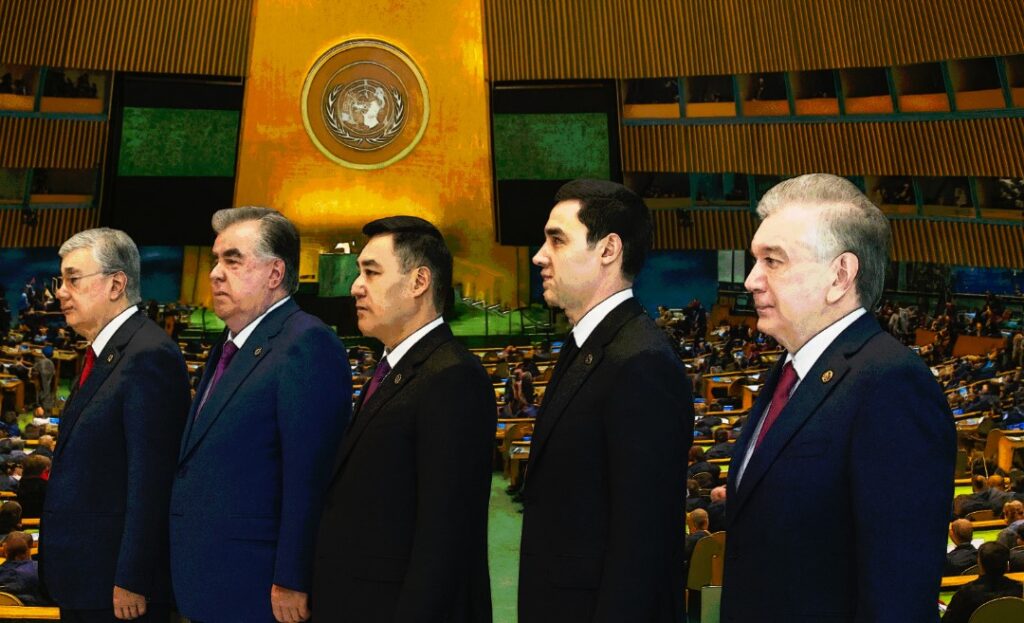
Ecology, global instability, and the need for UN reform dominated the speeches of all five Central Asian presidents at the 80th session of the UN General Assembly. Presenting a united front while emphasizing national priorities, the leaders made clear that Central Asia intends to play a pivotal role in shaping the global future. UN Reform Kazakh President Kassym-Jomart Tokayev was the first among the CIS leaders to address the assembly, speaking of a growing crisis of trust in multilateral institutions and calling for sweeping reforms. Tokayev emphasized the need to expand the UN Security Council, arguing that major powers from Asia, Africa, and Latin America must receive rotational representation, and that the influence of middle powers should be strengthened. “We need to create a new group of like-minded states that will professionally and decisively advance concrete proposals for reforming the UN so that it better responds to today’s challenges and tomorrow’s tasks,” he said, proposing Kazakhstan as a platform for these discussions. Uzbek President Shavkat Mirziyoyev echoed these concerns, highlighting the weakening of international institutions and the proliferation of global conflicts. He endorsed UN Secretary-General António Guterres’ UN-80 initiative and voiced support for the Pact for the Future, which sets out commitments to strengthen multilateral cooperation and address global challenges through 2045, the UN’s centenary. Mirziyoyev also advocated for an expanded Security Council to better represent developing countries. In his address, Kyrgyz President Sadyr Japarov called for a more just and representative Security Council, underscoring Africa’s right to greater participation. He also announced Kyrgyzstan’s candidacy for a non-permanent seat on the Security Council for 2027-2028, noting that his country has never before held such a position. Tajik President Emomali Rahmon warned of growing instability, uncertainty, and complexity in world affairs. Rahmon stressed the UN’s role as a platform for dialogue and cooperation and called for equal partnerships between large and small states to restore adherence to international law. Turkmen President Serdar Berdimuhamedov argued that the current global situation requires a "decisive shift toward coordinated interaction among states and international organizations to maintain peace and security.” He proposed declaring 2028 the Year of International Law to strengthen the legal foundations of global cooperation. Ecology and Finance On environmental issues, the Central Asian leaders focused on national and regional concerns. Tokayev addressed the ongoing shallowing of the Caspian Sea, while both he and Mirziyoyev raised the issue of the Aral Sea crisis, often described as "one of the world’s worst environmental disasters." Rahmon highlighted the rapid disappearance of glaciers, a point supported by Japarov, given the critical dependence of Kyrgyzstan and Tajikistan on mountain water resources. Berdimuhamedov, meanwhile, proposed establishing a regional center for combating desertification in Central Asia. Other initiatives included the proposed Caspian Environmental Forum in 2026 and continued advancement of the Caspian Environmental Initiative, originally introduced by Ashgabat. Financial concerns were also prominent. Rahmon called for reforms to international financial mechanisms, citing the continued suffering of vulnerable developing countries from the impacts of economic crises, poverty, disease, natural disasters,...

After Berdimuhamedov Sr.’s Visit, Azerbaijan to Gift Oil Tanker to Turkmenistan

On the sidelines of an investment forum in the Turkmen resort of Awaza, Azerbaijan’s Deputy Minister of Economy, Sahib Alekperov, announced that Baku will gift an 8,000-ton oil tanker to Turkmenistan. The gesture is intended as a symbol of goodwill and a marker of deepening relations between the two Caspian neighbors. From Symbolism to Infrastructure According to Alekperov, the tanker project is expected to be completed by the end of this year or early next. He emphasized that bilateral ties are increasingly rooted in practical cooperation. In August, Azerbaijan and Turkmenistan signed a memorandum to expand international air services, aiming to establish a reliable “air bridge” across the Caspian Sea. “This route will be in high demand among passengers,” said Alekperov, noting that better connectivity will benefit not only Azerbaijan and Turkmenistan but the broader Caspian region. Drawing a historical parallel, he added, “As it was once said that all roads lead to Rome, we can now claim that all roads lead through Turkmenistan, the shortest path between Europe and Asia.” He also noted that growing transport cooperation will enhance the investment climate and produce tangible outcomes, especially in light of the warm political ties at the highest level. Broadening Turkmen-Azerbaijani Cooperation The goodwill gestures extend beyond the tanker handover. On September 12, Turkmenistan announced plans to construct a mosque in the Azerbaijani city of Fuzuli. The Ministry of Construction and Architecture has since opened a tender for the project. Political dialogue has also intensified in recent months. In July, Gurbanguly Berdimuhamedov, Chairman of Turkmenistan’s Halk Maslahaty, paid an official visit to Azerbaijan, accompanied by his daughter Oguljahan Atabaeva, Vice President of the charitable foundation bearing his name. During meetings with Azerbaijan's President Ilham Aliyev, both sides discussed expanding transport and infrastructure cooperation, as well as boosting bilateral trade. Humanitarian collaboration was also a key topic. Atabaeva met with Leyla Aliyeva, Vice President of the Heydar Aliyev Foundation. At the conclusion of the visit, Berdimuhamedov delivered an official invitation from his son, President Serdar Berdimuhamedov, for Aliyev to visit Turkmenistan. In a statement, Aliyev’s office reaffirmed the strategic nature of the partnership: “Our nations are united by deep traditions of brotherhood, and these ties have grown even stronger during the years of independence. We are successfully cooperating in many areas,” said the Azerbaijani president.

Central Asian Presidents at UNGA-80: All Five Confirmed

New York, Sept 22, 2025 – Central Asia will have a strong presence at the 80th United Nations General Assembly (UNGA-80), with four of the region’s presidents confirmed to attend in person. One leader’s participation, however, remains unannounced. From Kazakhstan, President Kassym-Jomart Tokayev is scheduled to be in New York from September 21 to 23. The Kazakh presidency confirmed that he will deliver his country’s national statement and meet with other heads of state on the sidelines of the high-level week. Kyrgyzstan’s President Sadyr Japarov is officially confirmed to be in New York from September 22 to September 25, where he is scheduled to deliver a speech in the General Debate. Japarov will also join a UN Security Council discussion on AI and a high-level climate event, while holding bilateral meetings with Secretary-General António Guterres and leaders from multiple regions. In Tajikistan, the presidential press service announced on September 21 that President Emomali Rahmon departed Dushanbe for New York to attend UNGA-80. He is accompanied by senior officials and is expected to speak during the General Debate. From Turkmenistan, President Serdar Berdimuhamedov left Ashgabat on September 21 for a working trip to New York. Turkmen state media confirmed his participation in UNGA-80, marking his direct representation of the country at the session. Uzbekistan’s President Shavkat Mirziyoyev arrived in New York on September 20 for a visit lasting through September 24. His agenda includes addressing the General Debate on its opening day and holding bilateral meetings with UN Secretary-General António Guterres and other world leaders. With the General Debate opening on September 23, Central Asia is set to be represented at the highest level by all five of its nations: Kazakhstan, Kyrgyzstan, Tajikistan, Turkmenistan, and Uzbekistan.

Opinion: Ex-U.S. Ambassador Warns Washington Has Ceded Information Space in Central Asia

Former U.S. Ambassador to Uzbekistan and Kazakhstan, Daniel Rosenblum, has warned that Washington has “surrendered” its influence in Central Asia’s information sphere, allowing Russia and China to dominate the narrative. His remarks were reported by the Yale Daily News following a lecture at Yale University on September 15. Rosenblum, who served as U.S. ambassador to Uzbekistan from 2019 to 2022 and to Kazakhstan from 2022 to 2025, delivered a speech titled “Battling the Firehose of Falsehood: Confronting Russian Disinformation in Central Asia.” He described how Russian disinformation campaigns frequently portrayed U.S. diplomats as destabilizing actors. In one example from 2023, Russian outlets falsely claimed a NATO base had opened in Kazakhstan. “While it is easy to joke about such an absurd idea,” Rosenblum said, “the intent behind such Russian information operations is deadly serious.” Rosenblum noted that U.S. embassies attempted to counteract these narratives by highlighting tangible achievements, including COVID-19 health initiatives, agricultural partnerships, and academic exchange programs. However, he argued that much of this work has unraveled since 2023, citing the dismissal of over 1,300 State Department personnel, the elimination of USAID programs in the region, and recent cuts to Voice of America and Radio Free Europe/Radio Liberty. “Eight months into the second Trump administration, it seems clear that the information war is over in Central Asia, not because the Russians won. We have simply surrendered,” he said. Rosenblum also emphasized China’s expanding influence through the Belt and Road Initiative, observing that Beijing “was doing a pretty good job of winning friends and influencing people” via infrastructure investment and cultural outreach. In a post-lecture interview, Rosenblum underscored that the challenge is now largely domestic. “The biggest challenge today is ourselves,” he said. “We have to decide as a country, do we want to be engaged in the world or not? If we cut ourselves off from the world, we will ultimately be less secure and less prosperous.” This concern was echoed in earlier analysis for The Times of Central Asia by Arman Amini, a term member of the Council on Foreign Relations and an Atlantic Council Millennium Fellow. “Over the past decade, China has steadily expanded its presence in Central Asia, not through military force, but by building roads, trade corridors, and digital infrastructure,” Amini noted. “As the United States scaled back its regional footprint following its withdrawal from Afghanistan, Beijing moved quickly to fill the void. Today, China has positioned itself as the region’s dominant external power, while the U.S. risks being left on the sidelines.” The lecture was attended by approximately 80 people in person and online. It was organized by the Central Asia Initiative of the MacMillan Center, the Edward J. and Dorothy Clarke Memorial Fund, and Asian Crossroads, a student group dedicated to raising awareness of Central Asia.

Turkmenistan and Qatar Build Closer Ties at Doha Summit

As Doha readies an emergency Arab-Islamic Summit, Turkmenistan and Qatar have moved to underscore a steadily warming relationship. On Sunday, Turkmenistan’s Deputy Prime Minister and Foreign Minister Rashid Meredov met Qatar’s Prime Minister and Foreign Minister Sheikh Mohammed bin Abdulrahman Al-Thani on the sidelines of the summit, a show of solidarity with Qatar after this month’s attack attributed to Israel. Qatar’s Foreign Ministry also reported a separate meeting between Meredov and Minister of State for International Cooperation Maryam Al-Misnad during the ministerial preparations, where both sides discussed ways to deepen ties. Indeed, Ashgabat’s presence in Doha on the eve of the summit offers political cover for expanded cooperation, and adds a Central Asian voice to backing Qatar’s mediation role in the war in the Middle East. The relationship is not new. Doha and Ashgabat established diplomatic ties in 1996, opened a Qatari embassy in Ashgabat in 2014, and upgraded political contact with a state visit by President Serdar Berdimuhamedov to Qatar in March 2023. Turkmenistan also inaugurated its embassy in Doha. The Qatari side later highlighted that 17 agreements and memorandums of understanding were signed across economic, cultural and sporting fields. Momentum has built through 2025. On March 16, Meredov met Sheikh Mohammed bin Abdulrahman Al-Thani in Doha to prioritise energy, investment and transport, and to brief on the Serhetabat–Herat section of the TAPI gas pipeline inside Afghanistan. Turkmen statements said Qatar “highly appraised” cooperation on the project, while the Turkmen Foreign Ministry framed the visit as a step forward. Qatar’s visibility in Turkmenistan also rose in August when Doha sent a delegation to the UN’s Third Conference on Landlocked Developing Countries, hosted in the Awaza coastal zone -- the Turkmen government's marquee venue for foreign investors. That forum dovetails with Turkmenistan’s pitch that logistics, energy and tourism can be built out with Gulf capital and know-how. For Turkmenistan, cooperation with Qatar matters for three reasons. The first is energy strategy. Turkmenistan sits on the world’s fourth-largest proven gas reserves, yet remains constrained by export routes and customer concentration. The World Bank and regional energy think tanks have long flagged Ashgabat’s reliance on pipeline gas to China, and the need to diversify destinations and modalities. Pairing with Qatar -- currently the world’s third-largest LNG exporter -- offers access to market expertise, contract structuring and investment models that could help Turkmenistan de-risk projects like TAPI and swaps via Iran. The second reason is capital. The Qatar Investment Authority (QIA) has been signalling a more aggressive deployment cycle, buoyed by anticipated LNG windfalls and new programmes to crowd in venture funds and international managers to Doha. While no Turkmen-specific commitments have been announced, Ashgabat’s priority sectors -- transport links to Afghanistan and the Caspian, petrochemicals, and hospitality at Awaza -- fit the kind of long-dated infrastructure and real-asset plays that Gulf sovereigns favor. Third is private-sector linkage. Since 2023, business councils and chambers have stepped up exchanges, including a March 2025 Qatar Chamber event for a Turkmen trade delegation and the creation of...

Central Asians in Putin’s War: Fighting for Ukraine, Forced for Russia

As the war in Ukraine continues to drag on, fighters from across Central Asia have found themselves on both sides of the frontlines. In Kyiv, Kazakh national Zhasulan Duysembin has traded his past life as a sales agent for a rifle, sporting a tattoo of Kazakhstan’s flag on his back as he battles to defend his adopted home. He now fights, he says, to protect his children and believes that “Russia will not stop in Ukraine, it will go further. We must make every effort to ensure that our Kazakhstan does not suffer.” Alan Zhangozha, an ethnic Kazakh who grew up in Kyiv and now serves as a public relations officer in the Ukrainian Army, echoes this sentiment. “Ukraine’s victory will also be a victory for my Motherland,” he told The Diplomat. But as the war drags on, in Kazakhstan, families mourn men like 22-year-old Kiril Nysanbaev - a labor migrant in Russia coerced into signing up for the war who only came home in a coffin. His sister recalls how her brother told her that Russian officers beat and forced him to enlist while he was detained on dubious charges in Chelyabinsk. Nysanbaev was killed in Ukraine’s Donetsk region in March 2024, news that only reached his family three months later. Citizens of all five Central Asian countries have been pulled into the conflict since Russia’s invasion in 2022. Some have volunteered to fight for Ukraine, driven by personal ties or ideals, while others, mostly labor migrants, have been recruited, enticed, or pressured into fighting for Russia. These parallel currents reflect the complex impact of the war on a region that remains officially neutral but was historically deeply entwined with Moscow. While a handful of Central Asians now wear the blue-and-yellow insignia in Ukraine’s defense, far more have ended up in Russia's ranks, often as expendable foot soldiers. From Bishkek to Bucha In November 2022, a Kyrgyz former labor migrant, Almaz Kudabek uulu, announced the creation of the Turan Battalion, a volunteer unit of Turkic-speaking fighters formed to assist Ukraine. “Kyrgyzstan is my homeland; I will always love it. But Ukraine is my home now; I am fighting for Ukraine,” he told reporters. The battalion, joined by volunteers from Kyrgyzstan, Kazakhstan, Azerbaijan, and elsewhere, operates as a semi-autonomous unit supported by private donations and allied Ukrainian brigades. Back in Kyrgyzstan, however, the authorities opened a criminal case against Kudabek, punishable by up to eight years in prison, and local media that covered his story faced pressure. Others have supported Ukraine in tangible, humanitarian ways. Early in the war, members of Ukraine’s Kazakh diaspora erected traditional yurts in cities like Bucha and Kyiv as heated shelters dubbed “Yurts of Invincibility.” These spaces provided food, tea, and electricity during blackouts, a gesture of solidarity that irritated Moscow but drew only a muted response from Kazakhstan’s government. Moscow’s Migrant Recruits: Coercion and Casualties Far greater numbers of Central Asians have ended up fighting for Russia, which hosts millions of migrant workers from...