• KGS/USD = 0.01144 0%
  • KZT/USD = 0.00204 0%
  • TJS/USD = 0.10398 0%
  • UZS/USD = 0.00008 0%
  • TMT/USD = 0.28490 0%
  • KGS/USD = 0.01144 0%
  • KZT/USD = 0.00204 0%
  • TJS/USD = 0.10398 0%
  • UZS/USD = 0.00008 0%
  • TMT/USD = 0.28490 0%
  • KGS/USD = 0.01144 0%
  • KZT/USD = 0.00204 0%
  • TJS/USD = 0.10398 0%
  • UZS/USD = 0.00008 0%
  • TMT/USD = 0.28490 0%
  • KGS/USD = 0.01144 0%
  • KZT/USD = 0.00204 0%
  • TJS/USD = 0.10398 0%
  • UZS/USD = 0.00008 0%
  • TMT/USD = 0.28490 0%
  • KGS/USD = 0.01144 0%
  • KZT/USD = 0.00204 0%
  • TJS/USD = 0.10398 0%
  • UZS/USD = 0.00008 0%
  • TMT/USD = 0.28490 0%
  • KGS/USD = 0.01144 0%
  • KZT/USD = 0.00204 0%
  • TJS/USD = 0.10398 0%
  • UZS/USD = 0.00008 0%
  • TMT/USD = 0.28490 0%
  • KGS/USD = 0.01144 0%
  • KZT/USD = 0.00204 0%
  • TJS/USD = 0.10398 0%
  • UZS/USD = 0.00008 0%
  • TMT/USD = 0.28490 0%
  • KGS/USD = 0.01144 0%
  • KZT/USD = 0.00204 0%
  • TJS/USD = 0.10398 0%
  • UZS/USD = 0.00008 0%
  • TMT/USD = 0.28490 0%

Viewing results 13 - 18 of 932

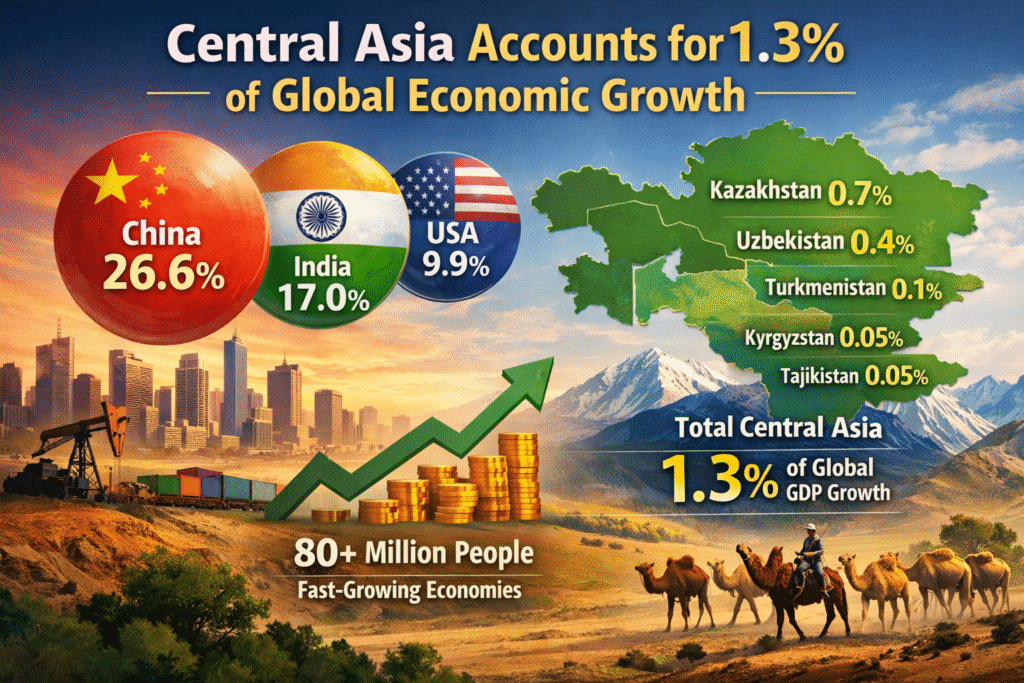
Central Asia Accounts for 1.3% of Global Economic Growth

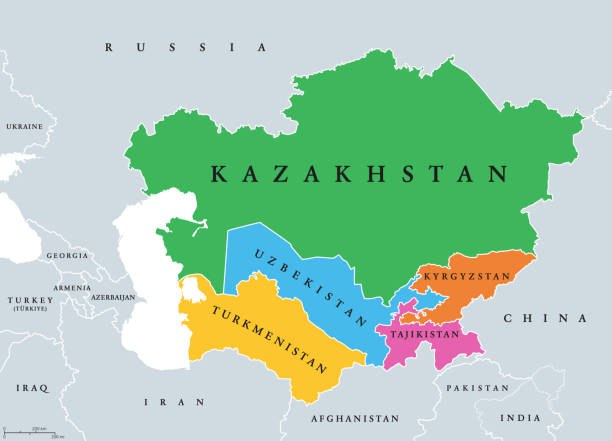
A recent study by Visual Capitalist, based on projections from the International Monetary Fund, maps who is powering global growth in 2026. The analysis highlights heavyweights like China, which accounts for 26.6% of global GDP growth, India at 17.0%, and the United States at 9.9%. Together, these three economies account for roughly 53–54% of global economic expansion, underscoring their scale and sustained growth momentum. Yet beneath those headline figures lies a quieter but strategically important development: Central Asia is steadily increasing its contribution to global economic growth. According to the study, Kazakhstan is set to contribute 0.7% of total global GDP growth in 2026, making it the clear regional anchor. Uzbekistan adds 0.4%. Turkmenistan will contribute 0.1%, while both Kyrgyzstan and Tajikistan will account for approximately 0.05% each. Taken together, this amounts to a 1.3% share of global GDP growth. While modest in absolute terms, the figure is notable given the region’s scale. With a population of over 80 million—comparable to Germany and Turkey—Central Asia’s aggregate contribution compares with these mid-sized advanced economies, which account for roughly 0.9% and 2.2% of global growth respectively. Moreover, with projected average annual growth exceeding 6%, Central Asian economies are expanding faster than much of Europe and other mature markets, reinforcing their rising relative contribution to global economic momentum.

Uzbekistan Joins a U.S. Critical Minerals Implementation Track

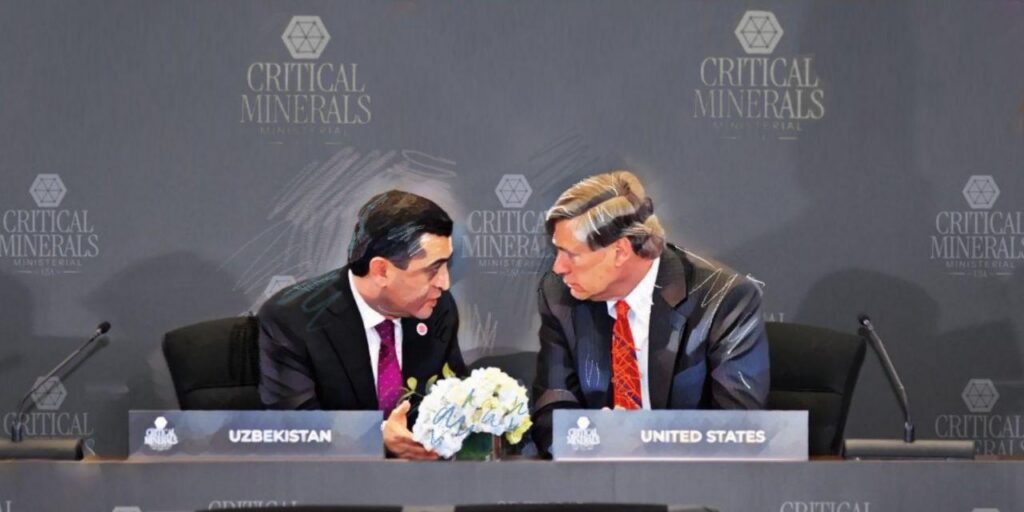
On February 4, 2026, in Washington, D.C., Uzbekistan’s Foreign Minister Bakhtiyor Saidov and U.S. Deputy Secretary of State Christopher Landau signed an intergovernmental Memorandum of Understanding (MoU) on securing supply chains for critical minerals and rare earth elements, spanning both mining and processing. A further agreement signed on February 19 brought implementation and financing to the foreground. The U.S. International Development Finance Corporation (DFC) signed “heads of terms” (i.e., commercial principles and essential terms of a proposed future agreement) for a Joint Investment Framework and outlined a proposed joint holding company. An agreement to establish an “investment platform” was exchanged in the presence of Uzbekistan’s President Shavkat Mirziyoyev. These agreements are not a single mining deal. They combine a political instrument with a financing-and-structuring track that is intended to yield a small set of projects that can be financed and built, and they treat processing capacity and supporting infrastructure not as optional add-ons but as core deliverables. They also provide a path for early projects to full review and financing while connecting them to longer-term offtake structures that match Washington’s newer supply-shock tools, including “Project Vault.” What the MoU Changes The MoU’s immediate purpose is to align government priorities for critical minerals across the value chain while setting expectations that will later shape which financing and partners are feasible. The press agency of Uzbekistan’s foreign ministry emphasized “responsible partnership” and “long-term development” as part of the public framing, placing governance and reputational risk on the same plane as the geological givens. The MoU also leaves several items deliberately unresolved in public form. These include project annexes, deposit designations, and operational timelines. That document design-choice pushes the next phase of bilateral cooperation into working-level scoping and sequencing, where only a small number of candidate projects can be advanced into full review. At the ministerial-level meeting, Washington clarified why it was framed as supply-chain security rather than commodity trade. Secretary of State Marco Rubio noted that critical minerals are inputs for infrastructure, industry, and defense, while Vice President J.D. Vance stressed the expansion of production across partner networks. As previously reported by The Times of Central Asia, this framing is part of a broader repositioning of U.S. engagement in Central Asia, where diplomatic formats are increasingly paired with mechanisms intended to generate trackable transactions and private-sector follow-through. For Uzbekistan, what is attractive about this cooperation is the potential to convert resource endowment into a lever for industrial development, rather than treating extraction as the endpoint. President Shavkat Mirziyoyev has publicly valued the country’s underground wealth at roughly $3 trillion. He has linked rising global demand for technological minerals to the case for higher value-added activity around strategic reserves, including lithium and tungsten. The same logic supports a commercially open posture. For Tashkent’s other investors, buyers, and processing partners, Uzbekistan’s diversification toward U.S.-linked capital signals non-exclusivity. Turning the MoU Into Projects The next phase is practical. A candidate project will advance only if investors and public lenders can transparently evaluate its licensing and...

Central Asia Records Over 6% Growth as Trade with Russia Expands

Central Asian economies concluded 2025 with growth exceeding 6%, significantly outpacing major developed markets such as the United States and the Eurozone, where expansion stood at approximately 1.6% and 1.1%, respectively, according to Turkish newspaper Yeni Şafak. The figure aligns with the World Bank who puts regional expansion at 6.2% and the Eurasian who Development Bank (EDB) estimates growth at 6.6%. Economists attribute the region’s performance to strong domestic demand, active state investment programs, infrastructure development, and rising exports of raw materials and industrial goods. Kazakhstan and Uzbekistan accounted for the largest contributions to overall growth, supported by large-scale public investment initiatives and expanding foreign trade. By contrast, the U.S. and European economies experienced slower growth amid high interest rates, inflationary pressures, and weaker consumer demand. Uzbek economist Mirkomil Kholboyev, writing on his Telegram channel, said the trend reflects deeper structural factors. “In general, the average real growth in Central Asia has almost always been higher than in the United States or Europe, with the exception of 2021,” he wrote. “Beyond short-term effects, lower-income countries like ours tend to grow faster than high-income economies. In wealthier countries, the return on additional capital has declined, while in our region capital remains scarce, allowing investments to generate higher returns. Demographic growth is also higher here, and the steady expansion of the labor force serves as an additional driver of economic growth.” Trade data indicate that Central Asia’s economic ties with Russia have strengthened in recent years. In 2021, the region accounted for 3.2% of Russia’s imports. By the first 10 months of 2025, that share had risen to 4.6%. Over the same period, Central Asia’s share of Russian exports increased from 5.6% to 7%. Overall, during the first 10 months of 2025, Central Asia ranked as Russia’s third-largest import partner and fourth-largest export destination. Before the war in Ukraine, the region ranked seventh among Russia’s import partners and fourth in exports. Although Russia’s economy remains significantly larger, reaching approximately $2.1 trillion in 2024 and exceeding the combined size of Central Asian economies by about 4.4 times, the increase in trade shares over the past four years is notable. Kholboyev also noted that part of the rise in imports is attributable to re-export activity.

China–Kyrgyzstan–Uzbekistan Railway: What It Means for Central Asia

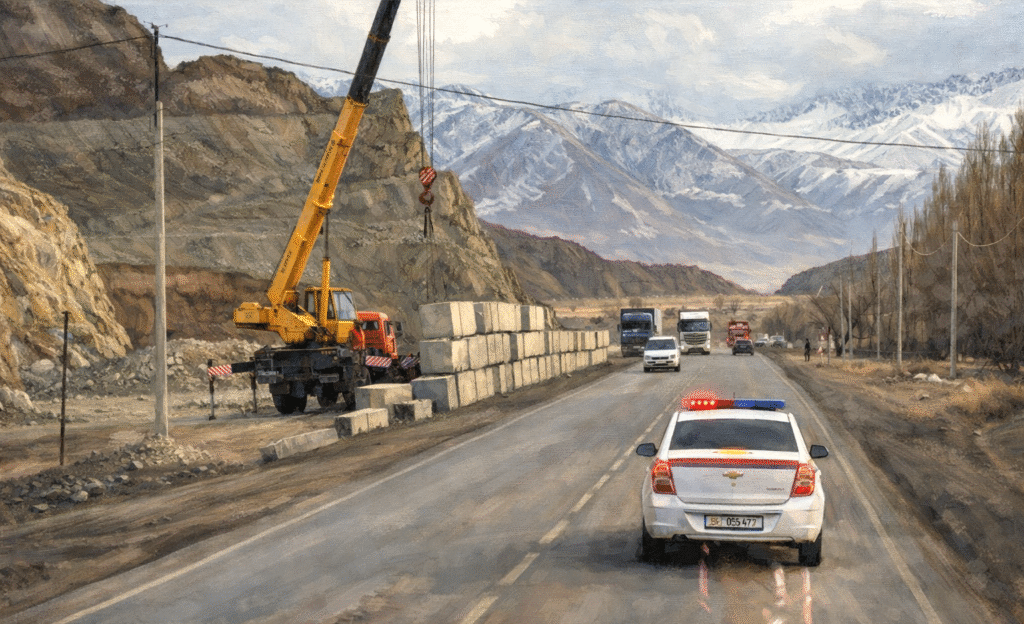
The China–Kyrgyzstan–Uzbekistan railway (CKU railway), also known as the Kashgar–Andijan railway line, is more than an infrastructure project. It represents a geopolitical initiative that could significantly shape the future of Central Asia. In June 2024, Beijing, Bishkek, and Tashkent signed the intergovernmental agreement to move the project forward. The project’s financing—estimated at $4.7 billion—was finalized in December 2025, sparking optimism in all three nations about regional connectivity, trade, and economic growth. Once completed, the railway is expected to become a vital strategic asset in China’s Belt and Road Initiative (BRI). From China’s perspective, the CKU project is a strategic line that diversifies its trade channels and strengthens overland access to Central Asia and beyond. Construction was ceremonially launched on 27 December 2024 in Kyrgyzstan, with major works progressing through 2025, including key tunnel works. For Uzbekistan, the railway could serve as a key link for commerce and transit. Tashkent aims to integrate the China–Kyrgyzstan–Uzbekistan line with existing international transport networks, including connections through Iran and Turkey. But how important is the project for Kyrgyzstan, through which, according to recent reporting, 304 km of the line will pass? According to Nurbek Satarov, Presidential Envoy in the Naryn Region, the project is vital for Kyrgyzstan’s most mountainous region, as roughly 90% of the route through the country will run through Naryn. As he told The Times of Central Asia, construction is in full swing, and the railway is expected to be completed between 2028 and 2030, despite the challenging terrain and technical difficulties. The project includes the construction of 50 bridges and 29 tunnels, underscoring the significant engineering complexities involved. But while regional and national authorities anticipate direct economic benefits from the project, critics argue that Kyrgyzstan may end up serving primarily as a transit country, with limited gains for the local economy. They also question the financial sustainability of the project, noting that it is backed by a long-term loan package of approximately $2.3 billion from Chinese banks. The financing, structured over 35 years and to be repaid by the joint venture company implementing the railway, increases Kyrgyzstan’s exposure to China-linked debt and has raised concerns about future repayment obligations. [caption id="attachment_44216" align="aligncenter" width="1536"] Site visit at the road construction project in the Naryn Oblast; image: TCA, Nikola Mikovic[/caption] However, Edil Baisalov, Kyrgyzstan’s Deputy Prime Minister, claims that the CKU will have a positive impact on the country’s economic development. “This railroad will virtually transform Kyrgyzstan – and not just Kyrgyzstan, but the whole of Central Asia,” he told The Times of Central Asia. Baisalov believes that the CKU railway, once completed, will be part of a larger transcontinental railroad that will cut transit times by at least seven days compared to the northern routes of the Trans-Siberian Railway and maritime transport. The CKU line could indeed bypass the usual northern rail routes through Russia and Kazakhstan, taking a significant share of freight from those countries and reducing their transit revenue. Kyrgyzstan, on the other hand, hopes to see direct gains...

Uzbekistan and United States to Establish Investment Platform

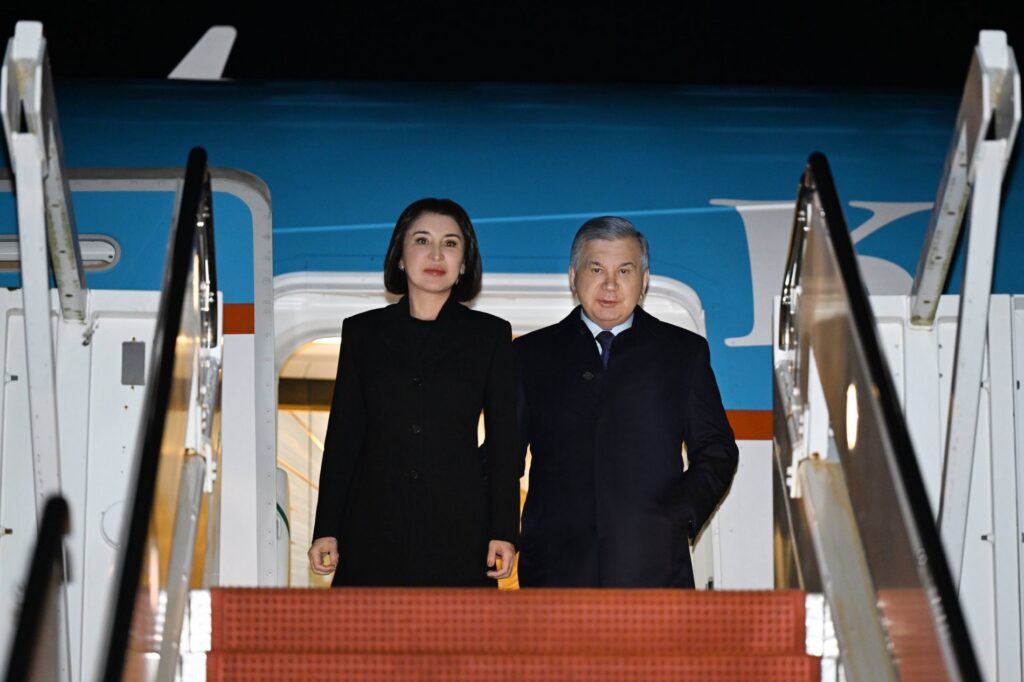
Shavkat Mirziyoyev has arrived in Washington with his spouse on a working visit that includes participation in the first summit of the Board of Peace and a series of business engagements aimed at strengthening bilateral economic ties. According to the presidential press service, the visit is focused on expanding trade, investment, and financial cooperation with U.S. partners. As part of his program in Washington, Mirziyoyev met with John Jovanovic, President and Chairman of the Export-Import Bank of the United States, and Ben Black, Chief Executive Officer of the U.S. International Development Finance Corporation. The discussions centered on expanding financial support for priority industrial and infrastructure projects in Uzbekistan. Officials noted that negotiations held last year with U.S. President Donald Trump gave new impetus to trade and investment cooperation. In particular, the two sides reviewed progress in supporting the activities of the bilateral Business Council and advancing plans to launch an Investment Platform intended to promote major projects on a systematic basis. Cooperation with the Export-Import Bank is expected to include increased financing for large-scale industrial and infrastructure initiatives, as well as assistance with the supply of high-technology equipment. During talks with the Development Finance Corporation, emphasis was placed on strengthening investment mechanisms and facilitating the corporation’s participation in national and regional projects, including the development of Uzbekistan’s financial market and energy sector. At the conclusion of the meetings, the parties exchanged an Agreement on the Establishment of an Investment Platform between Uzbekistan and the United States in the presence of the Uzbek president. The current visit builds on steps taken last November, when Uzbekistan announced the creation of the Uzbekistan-U.S. Business and Investment Council. The body was formalized by presidential decree following Mirziyoyev’s official visit to Washington within the C5+1 framework. The council is jointly chaired by senior representatives of both countries and is designed to serve as an institutional mechanism for deepening commercial cooperation. During his Washington meetings, Mirziyoyev also invited the American side to participate in the upcoming Tashkent International Investment Forum, underscoring continued efforts to attract U.S. business engagement in Uzbekistan’s economic reforms.

Uzbekistan Discusses Local Production of Hungarian Magnus Aircraft

Uzbekistan is continuing efforts to expand its aviation sector, as Deputy Minister of Transport Jasurbek Choriyev held talks with Laszlo Borosh, Chief Executive Officer of the Hungarian company Magnus Aircraft Zrt., on the potential production of the Magnus Fusion 212 aircraft in the country. According to the Ministry of Transport, the meeting focused on prospects for assembling and manufacturing the lightweight composite aircraft in Uzbekistan. The Magnus Fusion 212 is produced by the Hungary-based firm, which specializes in the design, production, and sale of innovative aircraft made from composite materials. Magnus Aircraft is headquartered in Pogány, Hungary, near Pécs-Pogány International Airport, where it operates a facility covering approximately 8,000 square meters. The company is active in several international markets, including the United States, China, Kenya, Nigeria, Serbia, and countries in the Middle East. Earlier this month, Brazilian aerospace manufacturer Embraer Defense & Security announced at the Singapore Airshow that Uzbekistan is the previously undisclosed buyer of its C-390 Millennium military transport aircraft. In a statement released on February 3, the company identified Uzbekistan as the first Central Asian country to acquire and operate the aircraft. Embraer stated that the Uzbek Air Force will use the C-390 primarily for transport and humanitarian missions, strengthening national airlift and emergency response capabilities. “We officially welcome the Republic of Uzbekistan to the group of C-390 operators,” said Bosco da Costa Junior, President and CEO of Embraer Defense & Security.