• KGS/USD = 0.01144 0%
  • KZT/USD = 0.00205 0%
  • TJS/USD = 0.10784 0%
  • UZS/USD = 0.00008 0%
  • TMT/USD = 0.28490 0%
  • KGS/USD = 0.01144 0%
  • KZT/USD = 0.00205 0%
  • TJS/USD = 0.10784 0%
  • UZS/USD = 0.00008 0%
  • TMT/USD = 0.28490 0%
  • KGS/USD = 0.01144 0%
  • KZT/USD = 0.00205 0%
  • TJS/USD = 0.10784 0%
  • UZS/USD = 0.00008 0%
  • TMT/USD = 0.28490 0%
  • KGS/USD = 0.01144 0%
  • KZT/USD = 0.00205 0%
  • TJS/USD = 0.10784 0%
  • UZS/USD = 0.00008 0%
  • TMT/USD = 0.28490 0%
  • KGS/USD = 0.01144 0%
  • KZT/USD = 0.00205 0%
  • TJS/USD = 0.10784 0%
  • UZS/USD = 0.00008 0%
  • TMT/USD = 0.28490 0%
  • KGS/USD = 0.01144 0%
  • KZT/USD = 0.00205 0%
  • TJS/USD = 0.10784 0%
  • UZS/USD = 0.00008 0%
  • TMT/USD = 0.28490 0%
  • KGS/USD = 0.01144 0%
  • KZT/USD = 0.00205 0%
  • TJS/USD = 0.10784 0%
  • UZS/USD = 0.00008 0%
  • TMT/USD = 0.28490 0%
  • KGS/USD = 0.01144 0%
  • KZT/USD = 0.00205 0%
  • TJS/USD = 0.10784 0%
  • UZS/USD = 0.00008 0%
  • TMT/USD = 0.28490 0%

Viewing results 19 - 24 of 785

Tashkent Signs $3.5 Billion in China Deals for Infrastructure and Exports

The third Uzbekistan-China Interregional Forum, held in the Chinese city of Xi’an, concluded with Tashkent signing more than $3.5 billion in investment and export agreements with Chinese partners, according to the Tashkent city administration. The agreements include $3.35 billion in investment projects and $156 million in export contracts spanning infrastructure, transport, construction, environmental technology, and industrial production. Officials said the deals are aimed at modernizing the Uzbek capital’s urban infrastructure and improving transport systems, public spaces, environmental services, and industrial capacity. The forum comes as China’s economic role in Uzbekistan continues to expand. According to Uzbekistan’s Dunyo news agency, speakers at the Xi’an forum said bilateral trade reached $18 billion last year, while Chinese investment in Uzbekistan totaled $17 billion. China has become one of Uzbekistan’s most important economic partners, with cooperation expanding from trade and construction into transport, energy, industry, and urban development. Dunyo’s report on the forum also presented the Xi’an meeting as part of a broader push to build direct ties between Uzbek regions and Chinese provinces, rather than limiting cooperation to central government agreements. Among the largest planned projects are a $1 billion initiative to develop Bus Rapid Transit, known as BRT, overpasses, and road infrastructure under the EPC+F financing model, and another $1 billion package focused on transport and social infrastructure projects. Additional agreements include $500 million for modern residential complexes in renovation zones and $400 million for drainage, irrigation, and stormwater systems. The city administration said financing is expected to come from Chinese partners without the direct use of Uzbekistan’s state budget or sovereign guarantees, although repayment would still depend on future municipal revenue streams. The projects are planned under the Engineering, Procurement, Construction, and Financing model, known as EPC+F. The financing structure is significant as many of the largest projects are municipal rather than national in scope. It allows Tashkent to pursue major road, drainage, and transport upgrades while presenting the deals as externally financed. Nevertheless, projects of this type can still create long-term obligations if future city revenues are used to cover repayments. The forum also focused on the development of Tashkent’s Yangi Avlod special industrial zone. Agreements worth $130 million were signed with Chinese companies, including Jwise, Zhongke Honghu, CAS Cloud, and UMGG. The projects are expected to support manufacturing infrastructure, digital management systems, and high-tech industrial production in the capital. Yangi Avlod has been promoted as one of Tashkent’s main industrial expansion sites. According to the zone’s official website, it is located in the Yangihayot district and is planned as a 764.5-hectare industrial area with logistics, warehouse, administrative, and commercial infrastructure. Other agreements include investments in decorative stone manufacturing, ceramic production, and smart waste-sorting equipment. Export contracts signed during the forum included three agreements worth a combined $150 million for jewelry exports, as well as deals covering cotton yarn and silver concentrate supplies. Separately, during the official visit to China, Tashkent Mayor Shavkat Umurzakov met with executives from China Railway Construction Corporation to discuss urban renovation projects, transport infrastructure, and...

Can Caspian Cargo Fleets Meet Middle Corridor Demands?

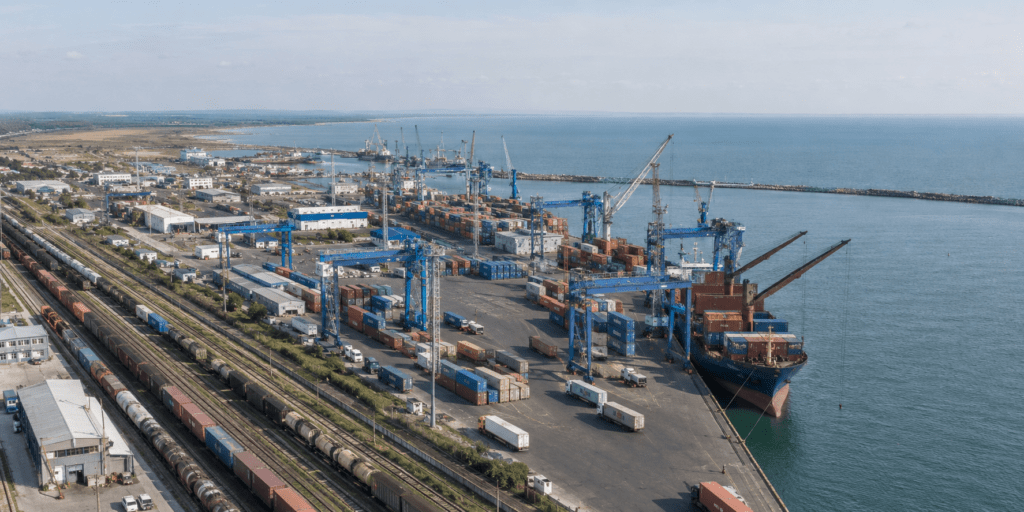
Construction of infrastructure along the Middle Corridor, also called the Trans-Caspian International Trade Route, to ship goods between China and Europe is progressing at a frantic pace. When Russia launched its full-scale invasion of Ukraine in late February 2022, it inadvertently gave a new impetus to the development of a trade network through Central Asia and the South Caucasus that had been slowly taking shape since the end of the 1990s. One of the most formidable challenges along the Middle Corridor is boosting maritime cargo across the Caspian Sea. Steps are being made, including some significant recent moves, but the capacity of shipping east-to-west over the Caspian Sea faces challenges in meeting the ever-growing demand for commercial vessels. By Leaps and Bounds In 2022, the volume of cargo through the Middle Corridor was some 1.5 million tons, more than twice the amount transported in 2021. In 2023, it topped 2.7 million tons, in 2024 was about 4.5 million tons, and in 2025 was approximately 5.2 million tons. Turkish President Recep Tayyip Erdogan visited Kazakhstan on May 13-14, where his host, President Kassym-Jomart Tokayev, said the figure could reach 10 million tons “in the near future,” and are predictions it could happen as soon as 2027. The roads, railways, and port facilities along the Middle Corridor are expanding rapidly. However, according to a report from Azerbaijan’s Trend news agency in mid-May, the Azerbaijani Caspian Shipping Company (ASCO) says that since 2013, only “a total of 35 new vessels have been commissioned.” The Merchant Fleets of Kazakhstan and Turkmenistan On the eastern side of the Caspian Sea, Kazakhstan and Turkmenistan have been working to increase their maritime shipping. Both countries invested heavily in upgrading their Caspian ports, in Kazakhstan’s case at Aktau and Kuryk, and for Turkmenistan at Turkmenbashi City. Since the end of April, both countries have moved to boost their potential to ship cargo across the Caspian. Kazakhstan’s state railway company, Kazakhstan Temir Zholy (KTZ), announced on April 30 that it would build its own maritime fleet starting with six new vessels, each with a deadweight of up to 9,900 tons and able to carry up to 537 twenty-foot equivalent units (TEU). Once completed, those six cargo ships will join the two dry cargo and three container vessels in the Caspian Sea operated by Kazakhstan’s state maritime shipping company Kazmortransflot. The three container ships – Berkut, Sunkar, and Barys – all started operation in 2019, have a deadweight of 5,200 tons, and can each carry up to 350 TEU. The two dry cargo ships, the Beket Ata and Turkestan, have a deadweight of 5,467 tons and can carry 4,182 tons. On May 12, the dry cargo ship Gadamly arrived at the Baku International Sea Port. The Gadamly is Turkmenistan’s first dry cargo vessel and is able to carry up to 240 TEU. A second cargo vessel, Manzil, should be launched before the end of this year. Arif Aghayev, the deputy chairman of Azerbaijan Railways, said at a ceremony marking the...

Uzbekistan Plans AI-Based Lending Platform to Expand Financing for Small Businesses

Uzbekistan’s president Shavkat Mirziyoyev has reviewed proposals aimed at expanding financial support for small and medium-sized businesses, including the launch of a digital lending platform that would use artificial intelligence to assess borrowers and improve access to credit, according to Uzbekistan’s presidential press service. The proposals are part of a wider effort to increase the role of small businesses in the economy and reduce barriers to financial services. Despite years of reforms, officials said many entrepreneurs in Uzbekistan still face difficulties obtaining loans, particularly those without a credit history. According to figures presented during the meeting, the total loan portfolio allocated to small and medium-sized businesses has reached 218 trillion UZS, or about $17.3 billion, equivalent to around 12% of the country’s GDP. However, unsecured online microloans remain limited, and obtaining such financing currently takes up to seven days on average. The government plans to address these challenges through a new digital financial platform where entrepreneurs will be able to submit loan applications, receive offers from several banks simultaneously, compare terms, and choose the most suitable option. The platform is expected to be integrated with Uzbekistan’s e-government databases, allowing banks to automatically access information on businesses. Officials said this would reduce paperwork, shorten processing times, and limit human influence in lending decisions. One of the most significant proposed changes is the introduction of an alternative credit scoring system using elements of AI, scheduled for implementation from December 1, 2026. Unlike traditional scoring models that rely mainly on previous borrowing history, the new approach would consider factors such as business activity, utility payments, turnover, tax records, and other digital indicators. The aim is to enable banks to assess entrepreneurs who have never taken out loans before, potentially widening access to financing for startups and small enterprises operating outside conventional banking criteria. The government also plans to use AI tools to generate recommendations for improving creditworthiness, evaluating business risks, and supporting business development. Commercial banks may also introduce an “AI consultant” program designed to help entrepreneurs develop business ideas and identify financing opportunities based on local economic specialization and growth potential within neighborhoods, known as mahallas. Other measures under consideration include increasing the unsecured portion of microloans for borrowers with positive repayment records from 100 million to 200 million UZS. Interest expenses on loans or leasing arrangements of up to 5 billion UZS would also be partially compensated regardless of the total loan or lease size. Officials also proposed annual grants of up to 300 million UZS for 100 high-performing businesses to support digitalization, the adoption of international standards, and green technologies.

Central Asia Feels Fuel Strain as Kazakhstan Prices Edge Higher

Kazakhstan's fuel market is moving into a new phase after the end of the government freeze on AI-92 gasoline and diesel. Pump prices have risen by small amounts so far. Retail prices are rising cautiously amid growing pressure from neighbors where fuel costs more. Kazakhstan still has some of the cheapest gasoline in the region, but that advantage creates a risk: cheap fuel attracts cross-border demand and makes it harder to fund the refining capacity the country says it needs. On October 16, 2025, Kazakhstan's government introduced a moratorium on further increases in AI-92 gasoline and diesel as part of a wider anti-inflation package. The decision also put the Energy Ministry, the competition agency, and regional authorities in charge of keeping supplies stable. The measure came after inflation and tariff reforms had raised concerns about household costs. The freeze ended on April 1, 2026, but by mid-April, the Energy Ministry was still trying to calm expectations. Kazinform cited Vice Minister of Energy Kaiyrkhan Tutkyshbayev on April 14 as saying most prices had risen mainly by one tenge after the moratorium was lifted, and that the state would not allow a sharp jump. The tone matched what drivers were seeing: a controlled rise rather than a sudden reset. The memory of January 2022, when an LPG price jump helped spark unrest, still hangs over fuel policy. The end of the freeze also fed into inflation expectations. National Bank Governor Timur Suleimenov warned in April that renewed growth in fuel prices and utility tariffs had to be handled cautiously, because a sharp reset could reverse the slowdown in inflation. The National Bank later said reforms in utility tariffs and fuel prices accounted for 32.9% of household inflation expectations in March. That made the fuel moratorium more than a pump-price measure: it was one of the state’s main tools for containing expectations while inflation remained in double digits. An April 9 check by Tengri Auto found that most filling stations in Almaty and the surrounding area were still selling fuel close to the previous price range. Several major networks, however, had already moved AI-92 toward 240 tenge per liter. AI-95, which was not covered by the main freeze, had risen to 328 tenge at one network. A Kazinform market check published on May 25 showed the same gradual pattern. AI-92 was listed at 238-239 tenge per liter in Astana, 238-241 tenge in Almaty, and 224-227 tenge in Shymkent. Diesel stood at 329 tenge in Astana, 330-337 tenge in Almaty, and 332-335 tenge in Shymkent. The figures point to a market that is moving, but still under close control. Fuel is also feeding into Kazakhstan's broader inflation picture. The Bureau of National Statistics put annual inflation at 10.6% in April 2026. Petrol prices were up 16.1% year-on-year and added 0.53 percentage points to annual price growth. Transport as a category added 1.1 percentage points. Fuel is one of the costs households notice most directly, and its effects spread through freight, food distribution, agriculture, taxis,...

Uzbekistan, Afghanistan Open New Cargo Terminal on Hairatan-Mazar-i-Sharif Railway

A new dry port terminal has opened on the Hairatan-Mazar-i-Sharif railway in northern Afghanistan, marking another step in efforts by Uzbekistan and Afghanistan to expand regional transport infrastructure and increase cargo capacity between Central and South Asia. According to Uzbekistan railways (‘O'zbekiston Temir Yo'llari’), an Uzbek delegation visited Mazar-i-Sharif on May 21, where officials attended the inauguration of Port No. 5, a newly constructed and restored cargo facility on the railway corridor operated by Sogdiana Trans, a subsidiary of Uzbekistan Railways. The terminal received its first freight train during the ceremony, officially launching cargo unloading operations. Uzbek and Afghan representatives said the facility is expected to increase freight volumes and improve logistics efficiency along the Hairatan–Mazar-i-Sharif line, which remains one of Afghanistan’s main rail links to Central Asia. The Hairatan–Mazar-i-Sharif railway, completed in 2010 with financing from the Asian Development Bank, links Afghanistan’s northern trade hub at Hairatan, near the Uzbek border, with Mazar-i-Sharif. The line has become a key corridor for moving fuel, food products, construction materials, and humanitarian cargo. During the visit, Uzbekistan railways Chairman Zufar Narzullayev held talks with Afghanistan’s Deputy Prime Minister for Economic Affairs, Abdul Ghani Baradar. Discussions focused on increasing the carrying capacity of the railway and accelerating infrastructure upgrades. Among the proposals was the construction of an additional 1.65-kilometer branch line near Naibabad station. Officials said the project could reduce wagon waiting times and increase overall railway efficiency. Baradar reportedly welcomed the initiatives and instructed Afghan public works authorities to coordinate technical and construction work with Uzbek counterparts. Afghanistan’s Ministry of Public Works also stressed the need to expand cargo traffic, stating that Afghan authorities are prepared to receive and unload increasing volumes of freight moving through the corridor. The opening of Port No. 5 is part of a wider Uzbek push to strengthen transport and energy links with Afghanistan, inspired by Tashkent's broader ambitions to improve access to South Asian and Middle Eastern markets. Uzbekistan has repeatedly promoted trans-Afghan transport routes as a way to reduce regional trade bottlenecks and expand Central Asia’s external connectivity. In February 2025, Baradar announced that construction of the proposed Hairatan-Herat railway extension would begin shortly after completion of a feasibility study financed by Uzbekistan. The planned route would extend the existing railway westward through Afghanistan toward Herat, potentially strengthening trade connections between Central Asia and the Middle East. During the same visit in 2025, Baradar said Uzbekistan had agreed to reduce the cost of a power transmission project to Afghanistan by $30 million.

Uzbekistan AI and 5G Push in Focus at GSMA M360 Eurasia

Policymakers, telecom executives, investors and technology leaders gathered in Samarkand on May 20-21 for GSMA M360 Eurasia 2026, a regional summit focused on digital transformation, artificial intelligence, connectivity and the future of telecommunications across Eurasia. The event brought together government representatives and industry figures to discuss how countries in Central Asia and neighboring regions can translate expanding mobile connectivity into long-term economic growth. Questions surrounding 5G deployment, AI infrastructure, education, startup ecosystems and digital skills featured prominently throughout the discussions. In an interview with The Times of Central Asia, Tair Ismailov, Strategic Engagement Director at the GSMA, discussed what governments should realistically expect from 5G, the challenges of building AI ecosystems and why education may ultimately determine whether countries benefit from rapid technological change. His comments come as Uzbekistan expands investment in telecommunications, data infrastructure and AI education while positioning itself as one of Central Asia’s fastest-growing digital economies. Why 5G May Matter More to Industry Than Consumers For many governments, 5G deployment has become a symbol of technological progress. Yet Ismailov said the economic benefits differ significantly depending on how countries adopt the technology. “Each country has its own path,” he said. “There are countries that have been pioneers in 5G, for example the U.S., South Korea and China, because they have ecosystems of equipment that they need to produce and drive.” Other countries, he argued, may benefit from moving later. “Sometimes it’s better for developing countries not to be in the avant-garde, but rather to follow examples and learn from existing cases,” he said. According to Ismailov, one of 5G’s most immediate functions is helping networks manage growing internet demand. Digital consumption patterns have changed dramatically over the last decade, he noted. “Back in the day, we never streamed videos, now we take it for granted,” Ismailov said. “Average internet consumption in the region is around 17GB per month per user. These are big numbers.” As traffic increases, networks require greater efficiency and capacity. “For networks simply to cope with this traffic, they need to be more productive, and 5G brings this productivity,” he explained. However, he suggested that the technology’s most significant economic impact may emerge outside consumer markets. “If you look at China and other markets, the biggest 5G benefits are granted to the B2B sector,” Ismailov said. “Businesses benefit from low latency and higher speeds.” Consumers may not immediately notice improvements, he added, but industries relying on automation, logistics, manufacturing or cloud services could see larger gains. “On the consumer side, you might not notice it,” he said, “but when you don’t have it, you start noticing it.” [caption id="attachment_49335" align="aligncenter" width="2560"] Image: TCA/Sadokat Jalolova[/caption] Building AI Requires More Than Data Generation As artificial intelligence expands globally, governments have begun viewing data as a strategic resource. Asked whether Uzbekistan has enough high-quality and accessible data to build a meaningful AI ecosystem, Ismailov argued that generating information is no longer the primary challenge. “I don’t think the question is generating data,” he said. “The question is...