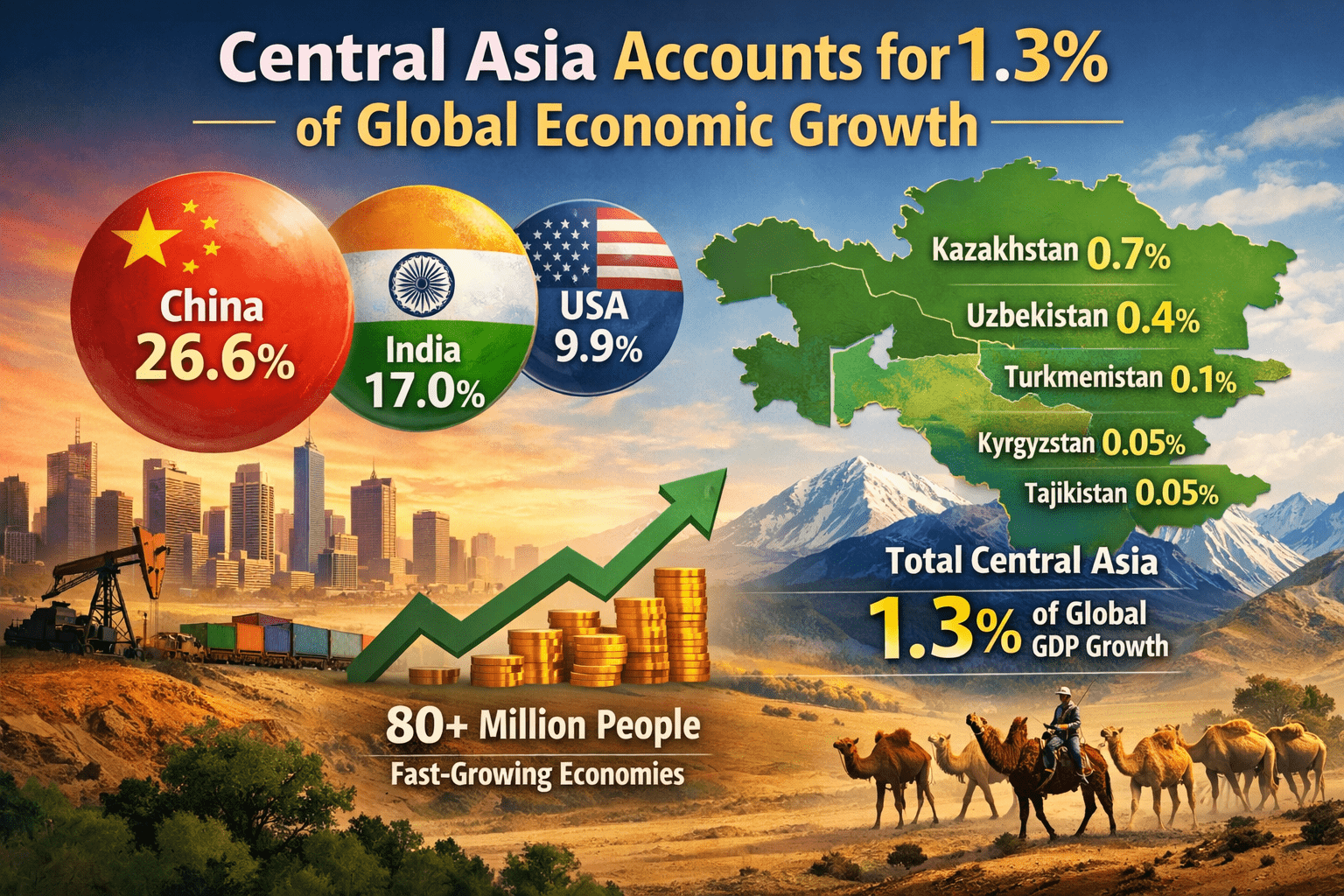
A recent study by Visual Capitalist, based on projections from the International Monetary Fund, maps who is powering global growth in 2026. The analysis highlights heavyweights like China, which accounts for 26.6% of global GDP growth, India at 17.0%, and the United States at 9.9%. Together, these three economies account for roughly 53–54% of global economic expansion, underscoring their scale and sustained growth momentum.
Yet beneath those headline figures lies a quieter but strategically important development: Central Asia is steadily increasing its contribution to global economic growth.
According to the study, Kazakhstan is set to contribute 0.7% of total global GDP growth in 2026, making it the clear regional anchor. Uzbekistan adds 0.4%. Turkmenistan will contribute 0.1%, while both Kyrgyzstan and Tajikistan will account for approximately 0.05% each.
Taken together, this amounts to a 1.3% share of global GDP growth. While modest in absolute terms, the figure is notable given the region’s scale. With a population of over 80 million—comparable to Germany and Turkey—Central Asia’s aggregate contribution compares with these mid-sized advanced economies, which account for roughly 0.9% and 2.2% of global growth respectively. Moreover, with projected average annual growth exceeding 6%, Central Asian economies are expanding faster than much of Europe and other mature markets, reinforcing their rising relative contribution to global economic momentum.