• KGS/USD = 0.01144 0%
  • KZT/USD = 0.00212 0%
  • TJS/USD = 0.10432 -0.29%
  • UZS/USD = 0.00008 0%
  • TMT/USD = 0.28571 0.28%
  • KGS/USD = 0.01144 0%
  • KZT/USD = 0.00212 0%
  • TJS/USD = 0.10432 -0.29%
  • UZS/USD = 0.00008 0%
  • TMT/USD = 0.28571 0.28%
  • KGS/USD = 0.01144 0%
  • KZT/USD = 0.00212 0%
  • TJS/USD = 0.10432 -0.29%
  • UZS/USD = 0.00008 0%
  • TMT/USD = 0.28571 0.28%
  • KGS/USD = 0.01144 0%
  • KZT/USD = 0.00212 0%
  • TJS/USD = 0.10432 -0.29%
  • UZS/USD = 0.00008 0%
  • TMT/USD = 0.28571 0.28%
  • KGS/USD = 0.01144 0%
  • KZT/USD = 0.00212 0%
  • TJS/USD = 0.10432 -0.29%
  • UZS/USD = 0.00008 0%
  • TMT/USD = 0.28571 0.28%
  • KGS/USD = 0.01144 0%
  • KZT/USD = 0.00212 0%
  • TJS/USD = 0.10432 -0.29%
  • UZS/USD = 0.00008 0%
  • TMT/USD = 0.28571 0.28%
  • KGS/USD = 0.01144 0%
  • KZT/USD = 0.00212 0%
  • TJS/USD = 0.10432 -0.29%
  • UZS/USD = 0.00008 0%
  • TMT/USD = 0.28571 0.28%
  • KGS/USD = 0.01144 0%
  • KZT/USD = 0.00212 0%
  • TJS/USD = 0.10432 -0.29%
  • UZS/USD = 0.00008 0%
  • TMT/USD = 0.28571 0.28%

Viewing results 523 - 528 of 1136

Asia Now Creating a Market for Central Asian Art in Paris

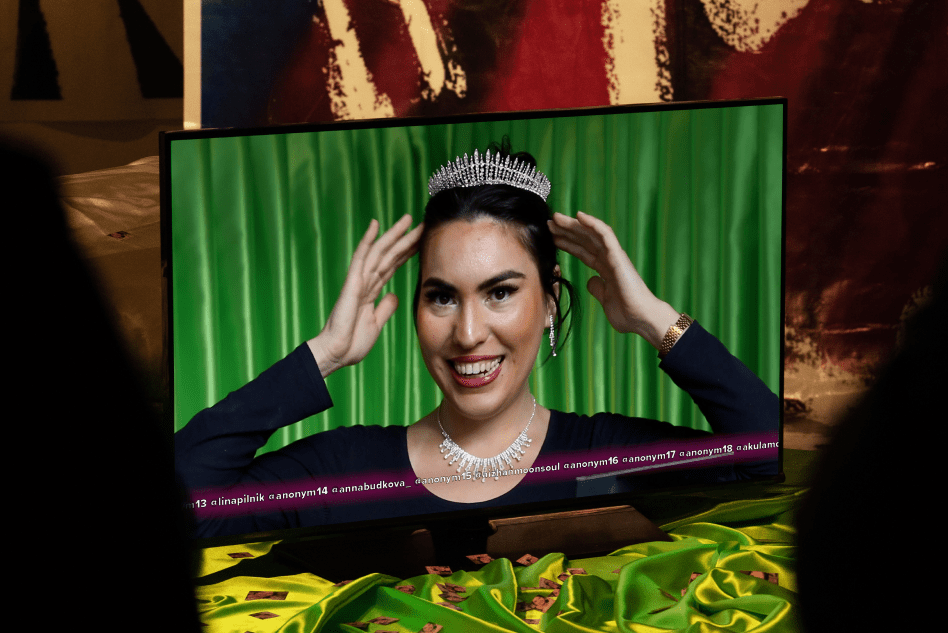
When we think about spreading knowledge of Central Asian art in Europe, we might think of exhibitions, of festivals, of panels and talks, not necessarily of an art fair. However, in the contemporary art world, it is today the market, more than art critics, which dictates the emergence of certain art scenes as a whole. For the historically underrepresented Central Asian art market, smaller fairs represent today an important alley, more than the big fairs such as Art Basel – which just had its second Paris iteration this October. Smaller “boutique fairs,” as they are called, often present curated programming which allow a wide public – not just collectors and buyers – to enjoy the art as it was an exhibition. A selling one, of course.  In Paris, the most relevant fair which has historically presented Central Asian artists to the European public is called Asia Now, and it took place in Paris from October 17 to 20. Entirely dedicated to Asian art, the fair has historically tried to fill the gap for Central Asian art in the European market in the past ten years of its existence. The fair has selected more than 70 leading and emerging contemporary art galleries from all over the world, presenting more than 220 artists coming from 26 territories from all over Asia and its diaspora, stretching from Central Asia to the Asia-Pacific, including West, South, South-East, and East Asia. Their commitment to expanding knowledge of Central Asian art in Europe culminated last year in a show which was indeed focused on Central Asia, and curated by the artist group Slav and Tatars. While seminal Central Asian galleries such as the Aspan Gallery from Almaty and Pygmalion Gallery from Astana didn’t return to Asia Now this year, the fair still presented a number of Central Asian artists and practices, interspersed between the main show, and the booths.    Central Asian Artists in the Radicant’s Main Show The main exhibition of Asia Now was curated by Radicants, a collective founded by art critic Nicolas Bourriaud, and it was centered on sacred ceremonies seen as a powerful tool for re-examining societal structures and reconnecting with ancestral roots. Called “Ceremony,” the main show was co-curated by Nicolas Bourriaud and Alexander Burenkov, a curator of Russian origins who has been working for a long time with Central Asian narratives, which are also featured prominently in the show. [caption id="attachment_25510" align="aligncenter" width="2560"] Image: TCA, Naima Morelli[/caption] The idea of ceremony ties to the tenth anniversary of the art fair, but at the same time the curators opted to explore the nuances of ritual as both a "celebration of ancestral wisdom" and a "critical tool for interrogating and redefining established traditions and power dynamics." As Burenkov noted, the decision to use the theme of ceremony emerged after conversations with Asia Now director Alexandra Fain. “The choice fell on ‘ceremony’ in all its variability and polysemy [was used] to explore the non-obvious meanings of ritual through the eyes of contemporary artists...
Mirziyoyev Offers to Bring Wounded Palestinians to Uzbekistan for Treatment

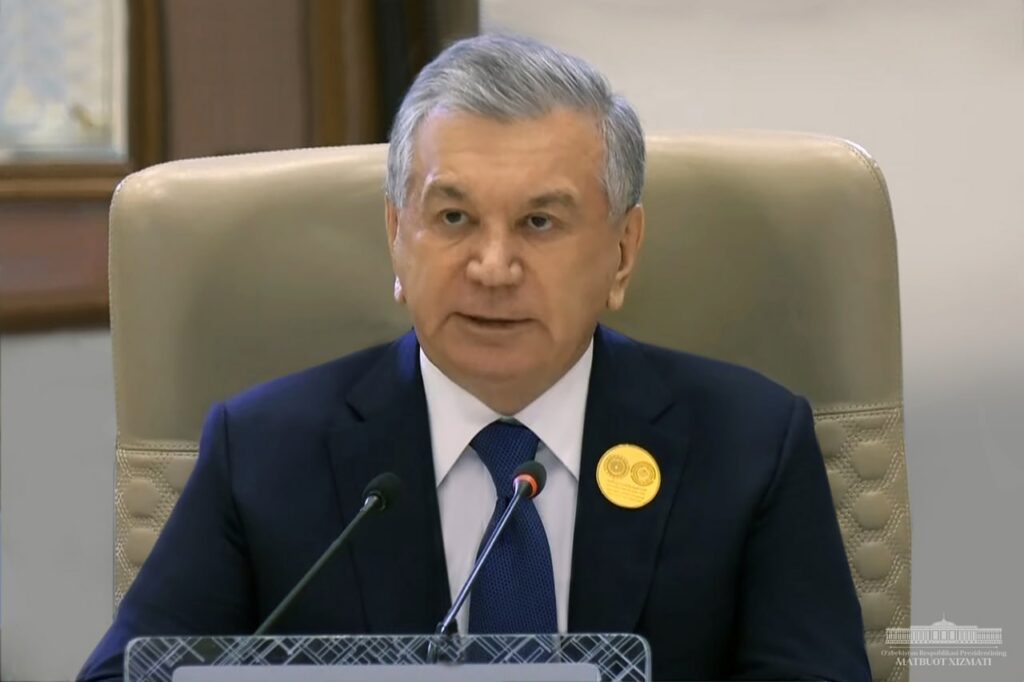
On November 11, Uzbekistan's President Shavkat Mirziyoyev delivered a speech at the extraordinary Arab-Islamic Summit in Riyadh, Saudi Arabia, expressing concern over the spread of the Middle East conflict into Lebanon. He reiterated Uzbekistan’s support for initiatives to resolve the Palestinian-Israeli issue peacefully and diplomatically. In his speech, Mirziyoyev said, “Uzbekistan fully supports all practical initiatives to address the Palestinian-Israeli problem through peace and diplomacy. We believe today’s Summit will demonstrate common political will and unity, develop effective global and regional mechanisms and specific solutions, and swiftly put them into practice.” Mirziyoyev called for the United Nations and the Security Council to play an increased role in ending hostilities. He emphasized the need for safe humanitarian corridors and the immediate initiation of peace talks. With the Palestinian national holiday on November 15 approaching, Mirziyoyev underscored the nation’s right to an independent state with East Jerusalem as its capital, based on the 1967 borders. He also supported the Global Alliance for Implementing the Two-State Solution initiated by Saudi Arabia. Mirziyoyev called for expanding humanitarian aid to Palestine and Lebanon to prevent the escalation of the crisis and confirmed Uzbekistan’s readiness to treat wounded Palestinian children and women in its hospitals. He announced plans to discuss further assistance at the Gulf Arab States – Central Asia summit in Samarkand next year. Finally, he stressed the importance of preserving the Al-Aqsa Mosque and other cultural monuments in Jerusalem, urging members of the Organization of Islamic Cooperation to prioritize protecting these historic sites. Mirziyoyev concluded by urging an urgent and unified response to the crisis and highlighting Uzbekistan’s commitment to peace and humanitarian support in the region.

Mirziyoyev Calls for Independent Palestinian State with East Jerusalem as Capital

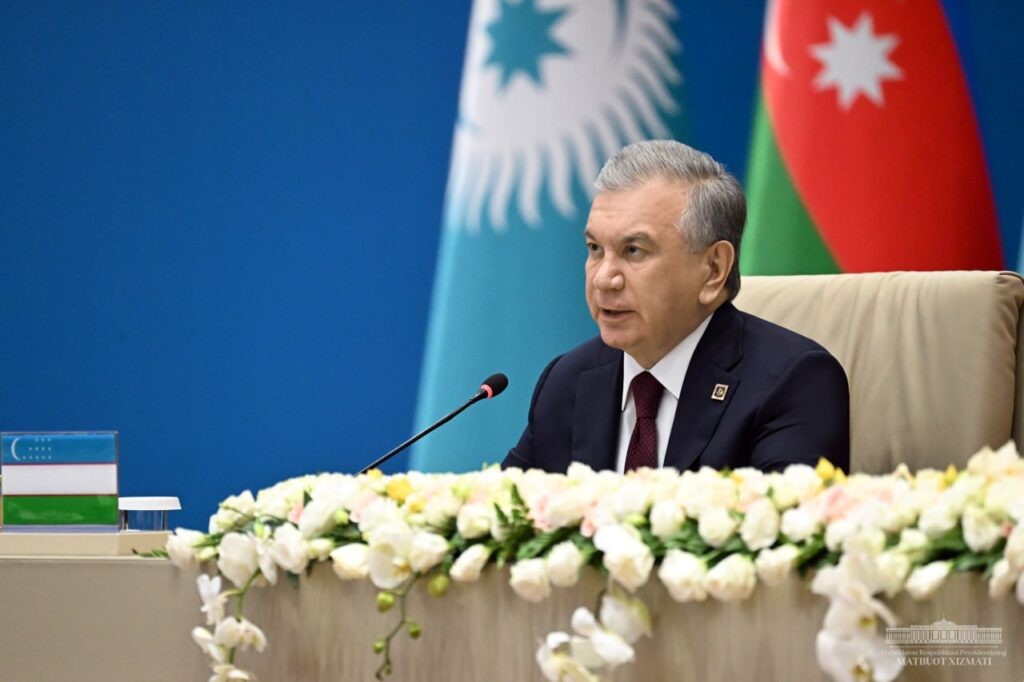
Speaking at this week's summit of the Organization of Turkic States in Bishkek, Uzbekistan's president Shavkat Mirziyoyev has once again discussed the situation in the Middle East. Mirziyoyev noted that global geopolitical processes have become increasingly complex since the start of the war in the region. The atmosphere of competition and mistrust between countries is intensifying, the hotbeds of conflict and war are increasing, and various dangers are growing. "These problems are a severe obstacle to our joint plans and big projects in trade, investment, transport, energy, agriculture, and other fields; this is the truth," Mirziyoyev said. “It is, first and foremost, about the ongoing war in the Middle East and the double standards that we see. Nothing can justify the unprecedented humanitarian tragedy in Gaza and Lebanon, the devastating attacks against civilians, especially the death of innocent children, the elderly, and women. We strongly condemn the actions aimed at restricting the activities of the United Nations Relief and Works Agency for Palestine Refugees. The only solution to this long-standing conflict is the establishment of an independent State of Palestine with East Jerusalem as its capital, based on the 1967 borders, by international regulations and resolutions,” noted Mirziyoyev. He hoped the Arab-Islamic Summit in Riyadh next week would find a clear political solution to this problem. He also highlighted the importance of Afghanistan’s stability: “When it comes to security, we believe Afghanistan should always be at the focus of our Organization. In this regard, it is crucial to establish a regular dialogue mechanism at the ministerial and expert levels. We believe that the issues of providing support to de facto authorities in addressing acute problems in Afghanistan, integrating this country into regional economic processes, and implementing social and infrastructure projects should be considered.”

Central Asia Gears Up For Another Trump Term

Leaders in Central Asia have congratulated Donald Trump on his election to another term as U.S. president, a development that governments in the region will watch closely for its impact on trade, geopolitical tensions and other priorities. Central Asian governments generally seek to balance their relationships with the West alongside more entrenched ties to nearby Russia and China, and are likely to be sensitive to any disruption of the status quo as the United States transitions from the Biden administration to another Trump term. Trump defeated Vice President Kamala Harris in the election on Tuesday, making an extraordinary political comeback and promising that he will deliver “the golden age of America.” Uzbek President Shavkat Mirziyoyev sent a message of congratulations to Trump in which he reaffirmed Uzbekistan’s commitment to “deepening the strategic partnership” with the United States, Mirziyoyev’s press office said in a statement. “In his letter, he emphasized shared goals for enhanced cooperation across trade, security, and regional stability, marking a new chapter” in relations between Uzbekistan and the United States, the statement said. Last week, Uzbekistan wrapped up talks with the United States as part of its campaign to join the World Trade Organization by early 2026. President Sadyr Japarov of Kyrgyzstan sent a similar message, according to media reports. "I believe that your leadership experience and deep knowledge will create opportunities for further deepening of comprehensive cooperation between Kyrgyzstan and the United States of America, based on the principles of mutual respect,” Japarov said. In comments relayed to Trump, Kazakh President Kassym-Jomart Tokayev “expressed confidence that bilateral cooperation in the areas of security, nuclear non-proliferation, and investment would continue to develop consistently,” his office said. Tokayev wished Trump success in efforts to ensure “global stability and security.” There is likely to be basic continuity on matters such as anti-terror cooperation and a stated commitment to trade relations between the U.S. and Central Asia. However, one area of uncertainty is Trump’s warning that he will intensify tariffs on U.S. imports of goods from China, a major economic player across Central Asia. That, in turn, could lead to major fallout for the global economy. Another prominent question is whether Trump will push Western-backed Ukraine to reach a peace deal with Russia nearly three years after Russia’s full-scale invasion. Central Asian nations – specifically, the five former Soviet republics of Kazakhstan, Kyrgyzstan, Turkmenistan, Tajikistan and Uzbekistan – have sought a position of neutrality, maintaining their relationships with Russia without offering clear support for the Russian military campaign. Relationships in the region might be due for recalibration if Russian President Vladimir Putin emerges emboldened from any Trump initiative in the conflict. Tokayev has already called for peace efforts to bring the war to an end, describing Russia as “militarily invincible.” There are concerns that Trump will erode U.S. democratic institutions in his second term, a potential disappointment for groups that would like to see the U.S. campaign harder for democratic freedoms in Central Asia. Trump has also promised mass deportations and...

WTO Momentum: Uzbekistan Wraps up Talks with U.S.

Uzbekistan has taken another big stride in its march toward membership in the World Trade Organization, a goal that it hopes to finalize ahead of the WTO ministerial meeting in the spring of 2026. A bilateral agreement with the United States has been reached after 14 months of negotiations, according to Azizbek Urunov, Uzbekistan’s chief negotiator on WTO accession. Uzbekistan has now completed talks with 21 countries as it seeks to implement reforms and integrate more closely with the global economy, demonstrating considerable momentum toward WTO accession since no deals had been negotiated at the beginning of 2023. “It has been an adventurous journey, tough but substantive negotiations,” Urunov said after the talks with American counterparts last week. Uzbekistan started the WTO accession process in 1994, several years after independence from the Soviet Union, and then dropped the effort a decade later. It resumed the campaign a few years ago. Johanna Hill, deputy director-general of the WTO, said last month that Uzbekistan’s goal was to “reduce the number of outstanding bilateral negotiations to under 10 WTO Members by next year.” [caption id="attachment_25176" align="aligncenter" width="1149"] Uzbekistan's accession process; image: WTO[/caption]   Uzbekistan is pursuing reforms in the role of state trading enterprises, exports restrictions and subsidies, technical barriers to trade and other areas, according to Hill. "Uzbekistan has been one of the most active acceding governments of late. It has pushed ahead with economic reform, in the strategic region of Central Asia, with WTO accession very high on the government's agenda,” she said. Hill cited a WTO report this year that says economies reforming their markets during WTO accession grew on average 1.5% more than economies that did not reform. The WTO report maintains that trade and more global cooperation are critical to fostering equality and inclusivity, while acknowledging rising geopolitical tensions, measures to restrict trade, greater urgency surrounding the push for sustainability and other challenges. Some analysts point to the WTO’s ministerial conference in Abu Dhabi, United Arab Emirates earlier this year as a showcase for the troubles that the organization is facing. “On the critical agenda items - agricultural trade, fisheries subsidies, and reform of the WTO’s dispute-settlement mechanism - ministers simply kicked the can down the road, undertaking to continue work and once more extend deadlines that few expect to be met,” wrote Evan Rogerson, an analyst at the S. Rajaratnam School of International Studies in Singapore. His commentary on the meeting was among several presented by the Council of Councils, an international group of policy institutes.

Mixed Picture: Perceptions of China in Central Asia

China’s growing presence in Central Asia is seen as an economic opportunity by many in the region, but is also viewed with concern by others who fear so-called debt traps and land grabs. A new report on those perceptions of China stresses that there is no overarching Central Asian viewpoint and points to nuance in attitudes among the different countries. The study by the Central Asia Barometer, a polling group that has said it will suspend operations on December 1 because of insecurity and other obstacles to carrying out its work, is significant because a lot of news about China and Central Asia focuses on official pronouncements by governments and business groups. Assessing public opinion can be more of a challenge in countries with a top-down tradition of leadership. “Favorability towards China varies widely across countries, with younger generations in Kazakhstan and Kyrgyzstan generally viewing China’s involvement more positively, particularly in areas like technology and investment,” the Central Asia Barometer said. “Older generations in these countries tend to be more skeptical, though. In Turkmenistan, the older population is more optimistic about China’s role, especially with regard to Chinese workers and investment.” The non-governmental group also noted “a decline or even negative favorability” in perceptions of China among people in Uzbekistan. The study, titled “Beyond the Silk Road” and released on Friday, is based on multiple surveys of opinions of China between 2017 and 2023 in four Central Asian states -Kazakhstan,  Kyrgyzstan, Turkmenistan, and  Uzbekistan. There was no data from Tajikistan. Perceptions of China depended on demographic factors such as ethnicity, age and gender, as well as the impact of specific Chinese infrastructure projects, and sources of information. Content on social media, for example, tended to improve attitudes toward Chinese business ventures. As of 2024, China has surpassed Russia as the top trading partner for most countries in Central Asia and is a major source of foreign investment and loans, a potential windfall that is tempered by concern about a lack of transparency in Chinese business practices. A Caspian Policy Institute analysis that was published in August explored negative perceptions of China. In July, Chinese leader Xi Jinping, architect of the Belt and Road economic initiative, traveled to Kazakhstan for a meeting of the Shanghai Cooperation Organization, a security group whose founding members include several Central Asian countries. There, Xi celebrated Chinese collaboration with President Vladimir Putin of Russia, the region’s other traditional power. Then he visited Tajikistan, a security partner that borders China and Afghanistan. The Central Asia Barometer said its data indicated a decline among some Central Asian populations in favorable views of Russia, coinciding with a change in feelings about China. “In 2022, after the Russian invasion of Ukraine, an upward shift in favorability toward China in Kazakhstan was observed while at the same time a pronounced drop in Russia’s favorability was noted,” it noted. Even so, China is not expected to supplant Russia’s longstanding influence in Central Asia. A commentary published by the Royal United Services Institute in early...