• KGS/USD = 0.01144 0%
  • KZT/USD = 0.00201 0%
  • TJS/USD = 0.10433 0%
  • UZS/USD = 0.00008 0%
  • TMT/USD = 0.28571 0%
  • KGS/USD = 0.01144 0%
  • KZT/USD = 0.00201 0%
  • TJS/USD = 0.10433 0%
  • UZS/USD = 0.00008 0%
  • TMT/USD = 0.28571 0%
  • KGS/USD = 0.01144 0%
  • KZT/USD = 0.00201 0%
  • TJS/USD = 0.10433 0%
  • UZS/USD = 0.00008 0%
  • TMT/USD = 0.28571 0%
  • KGS/USD = 0.01144 0%
  • KZT/USD = 0.00201 0%
  • TJS/USD = 0.10433 0%
  • UZS/USD = 0.00008 0%
  • TMT/USD = 0.28571 0%
  • KGS/USD = 0.01144 0%
  • KZT/USD = 0.00201 0%
  • TJS/USD = 0.10433 0%
  • UZS/USD = 0.00008 0%
  • TMT/USD = 0.28571 0%
  • KGS/USD = 0.01144 0%
  • KZT/USD = 0.00201 0%
  • TJS/USD = 0.10433 0%
  • UZS/USD = 0.00008 0%
  • TMT/USD = 0.28571 0%
  • KGS/USD = 0.01144 0%
  • KZT/USD = 0.00201 0%
  • TJS/USD = 0.10433 0%
  • UZS/USD = 0.00008 0%
  • TMT/USD = 0.28571 0%
  • KGS/USD = 0.01144 0%
  • KZT/USD = 0.00201 0%
  • TJS/USD = 0.10433 0%
  • UZS/USD = 0.00008 0%
  • TMT/USD = 0.28571 0%

Viewing results 241 - 246 of 771

World Bank Report: Central Asia Faces Rising Risks from Extreme Heat

Cities across Central Asia are becoming increasingly vulnerable to extreme heat, posing significant risks to public health, economic productivity, and infrastructure, according to a new report by the World Bank. The study, which covers 70 urban areas in Europe and Central Asia, including Astana, Bishkek, Ashgabat, Tashkent, and several smaller cities in Tajikistan and Turkmenistan, highlights the urgent need for heat adaptation strategies. Rising Mortality and Economic Losses The report finds that heat-related mortality is already a serious concern. In Ashgabat, an estimated 25-28 people per 100,000 die annually due to extreme heat. In Astana, Bishkek, and Tashkent, the toll is slightly lower, at approximately 19-21 deaths per 100,000. Without intervention, annual heat-related deaths in cities like Astana and Tashkent could rise dramatically, reaching between 10,000 and 23,000 by 2090. Economic impacts are also mounting. In 2023, higher temperatures resulted in the loss of over 87,000 full-time jobs across the region. Uzbekistan alone saw more than 22,000 job losses, while nearly 18,000 were reported in Azerbaijan. By 2050, heat-related economic losses could exceed 2% of GDP in some urban centers, such as Ashgabat. Infrastructure Under Strain Rising temperatures are damaging infrastructure across Central Asia. In Kyrgyzstan, extreme heat causes deterioration to nearly 200 kilometers of road annually, driving up repair costs and disrupting transportation. Kazakhstan is facing similar challenges: recent heatwaves have warped asphalt and concrete surfaces in the southern and northeastern regions of the country. Adaptation Measures and Challenges Despite these threats, the report outlines viable solutions. Urban greening, such as planting trees and creating shaded areas, can help cool city streets. Retrofitting buildings to improve thermal insulation without increasing energy use, establishing early warning systems, and creating cooling centers are also recommended. Urban planning strategies should incorporate climate resilience by using heat-tolerant materials and factoring climate risks into infrastructure design. Investment in parks and green spaces, alongside the use of heat vulnerability maps, can guide targeted interventions. However, the report warns that a lack of funding may hinder progress. Without innovative financing mechanisms, many adaptation plans could be stalled despite their potential to mitigate long-term risks. The World Bank concludes that while the impacts of rising temperatures are already being felt across Central Asia, timely action can prevent far more serious consequences. Policymakers are urged to prioritize heat adaptation to safeguard lives, livelihoods, and infrastructure in an increasingly warming world.

Saida Mirziyoyeva, Uzbek President’s Daughter, Grows Her Authority

Saida Mirziyoyeva, the eldest daughter of Uzbekistan’s president Shavkat Mirziyoyev, will focus on education, business, the judicial and legal system, healthcare, and water resources in her new job as head of the presidential administration. Mirziyoyev has signed a decree with details about the structure of the office that his daughter took over last month, handing her authority in a wide range of areas that are critical to Uzbekistan’s efforts to modernize its economy and society. The move points to the increasing political influence of Mirziyoyeva, a polished operator who is comfortable interacting with foreign dignitaries and other international partners. The presidential decree announced the elimination of 284 staff positions and removed redundancies in other roles in the presidential administration, presidential spokesman Sherzod Asadov said Wednesday. Five deputies have been appointed to “ensure the effective implementation of reforms” in education and the other four areas that Mirziyoyeva’s office will work on, according to Asadov. Uzbekistan also has ministries and other agencies that work in those areas. Mirziyoyeva, 40, had served as a presidential aide before being promoted to head of the presidential administration. She has spoken in support of freedom of speech and women’s rights, issues that have sometimes run up against conservative culture and tight political controls in Uzbekistan. In a recent post on social media, she also noted that Uzbekistan earned a “BB” rating with a stable outlook from the Fitch Ratings agency, describing it as “the first upgrade since 2018!” Mirziyoyev, 67, has been president of Uzbekistan since 2016. He was re-elected in a 2023 vote after a constitutional amendment that reset the number of his terms in office and lengthened presidential terms from five to seven years.

Steel Diplomacy: Central Asia’s Southern Push via Afghanistan

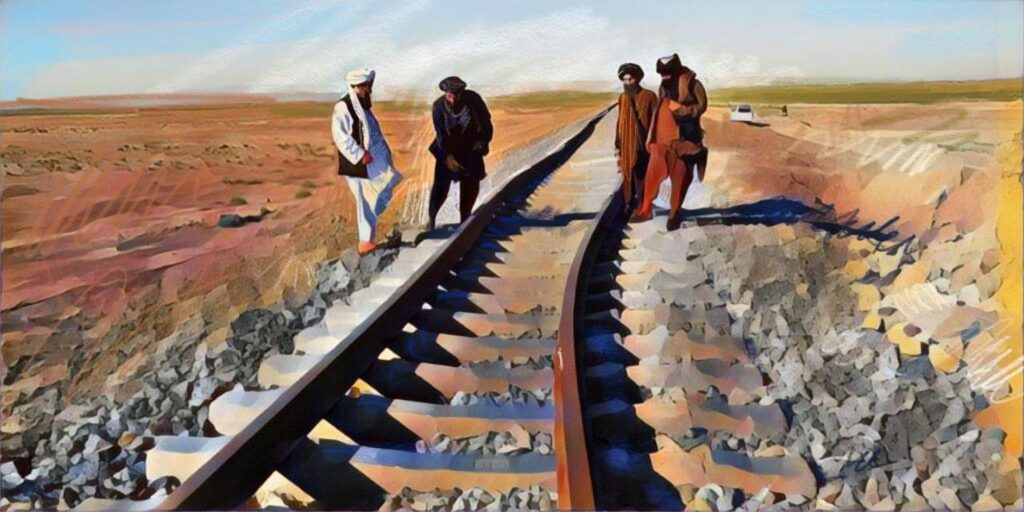
The United States and its allies may be uneasy about the Taliban’s return to power, given their extremist history, continued repression, and the collapse of decades-long Western efforts in Afghanistan. Nevertheless, the Taliban is strengthening ties with the Global South—particularly Central Asia—in search of investment for railway infrastructure. For landlocked Central Asian nations, Afghanistan is a key transit point on the shortest route to the Arabian Sea, offering an alternative to routes through Russia, China, or westward via the Caspian. The war-torn country – located at the crossroads of Central and South Asia – serves as a land bridge between the former Soviet republics and the major markets of the region, including India and Pakistan. This strategic position is why regional actors are eager to invest in the construction of the railway network in Afghanistan, fully aware that the new route would help them achieve at least some of their geopolitical and geoeconomics interest. Kazakhstani Foreign Minister Murat Nurtleu’s recent visit to Kabul was, according to reports, primarily focused on Afghan railway infrastructure. The largest Central Asian nation economy is reportedly ready to invest $500 million in the construction of the 115km (71 miles) railway from Towrgondi on Afghanistan’s border with Turkmenistan to the city of Herat. As Taliban railway officials told The Times of Central Asia, the Afghan and Kazakh delegations, who signed a memorandum of understanding on the project, are expected to finalize new agreements and contracts in the coming months. A detailed construction study is expected to be completed by winter, and Afghan authorities anticipate that construction will begin by the end of the year.  Meanwhile, Kabul hopes to reach similar deals with neighboring Uzbekistan and Turkmenistan, as well as with Russia and Pakistan. According to Taliban railway experts, these four nations – along with Kazakhstan – are expected to play a major role in the development of the 700-kilometer (approximately 435-mile) railway network in Afghanistan. The Taliban political officials, on the other hand, see the project as an opportunity for Afghanistan to increase its geopolitical importance. “It will help us reduce economic dependence and isolation, allowing Afghanistan to integrate more actively into the regional economy,” Muhammad Rehman, the Taliban-appointed Chargé d’Affaires of the Islamic Emirate of Afghanistan to Kazakhstan, told The Times of Central Asia, From his perspective, nations investing in Afghan railway infrastructure will become advocates for Afghanistan’s stability. Projects like the construction of the railway, in his view, can transform Afghanistan into a transit hub for regional countries through railway corridors. “Through the railway, Afghanistan can also import goods at a significantly lower cost, making essential commodities more affordable for its people,” Rahman stressed. More importantly, the railway opens a route for Central Asian natural resources to reach global markets via the ocean and further enhances the viability of the westward-flowing Middle Corridor. In short, the Afghan rail projects are important for connecting Eurasia. It is, therefore, no coincidence that Kazakhstan – being the richest country in terms of mineral wealth in Central Asia...

At Least 66 Uzbeks Confirmed Dead Fighting for Russia in Ukraine

A BBC-led investigation has confirmed that dozens of Uzbek citizens have died while fighting for Russia in Ukraine. Journalists from the BBC Russian Service and independent outlet Mediazona have verified 118,139 Russian military deaths in the conflict. Among them were 523 foreign nationals from 28 countries, with Tajiks (72 deaths) and Uzbeks (66 deaths) making up the largest foreign contingents. Investigators caution that the true number of casualties is likely higher. Alexander Bastrykin, head of Russia’s Investigative Committee, has publicly acknowledged that many recently naturalized Central Asians have been conscripted into the Russian military. Speaking at a public forum, Bastrykin stated that authorities had “caught” around 80,000 new Russian citizens, mostly from Uzbekistan, Tajikistan, and Kyrgyzstan, who had attempted to avoid military service. According to him, they were registered for service, and 20,000 were subsequently sent to Ukraine. These remarks have raised fresh concerns that Russia is using Central Asian migrants to bolster its military ranks. Official Neutrality and Subtle Retaliation Central Asian governments have declared neutrality in the Ukraine conflict and have largely abided by Western sanctions. Both Kazakhstan and Uzbekistan have sent humanitarian aid to Ukraine, contributing approximately $2.25 million and $1 million respectively. Kazakhstan has also made it clear that it does not recognize the self-proclaimed Donetsk and Luhansk “people’s republics.” Some analysts believe this neutral stance has triggered retaliatory actions from Moscow. Notably, a Russian court ordered the temporary suspension of operations at the Caspian Pipeline Consortium (CPC), a key route for Kazakh oil exports to the Black Sea. The 30-day halt severely affected Kazakhstan’s economy, as CPC shipments account for roughly 20% of the country's GDP.

Uzbek Banker Olimov Abducted in Paris, Freed After Ransom Payment

A high-profile Uzbek banker was abducted in central Paris last month and later released after a ransom was paid, Le Monde has reported. Kakhramonjon Olimov, 48, the sole shareholder of Anorbank, was kidnapped in the city’s 8th arrondissement on June 23 and held for nearly two days. French prosecutors have since opened an investigation, and one suspect has been charged with “organized kidnapping.” The case, described by Le Monde as “straight out of a spy novel,” has drawn international attention due to its dramatic nature and the stature of the victim. Olimov, a frequent visitor to France, had traveled to Paris on a business trip scheduled for late June. His agenda included meetings with French partners, including executives from energy giant EDF. He is reportedly involved in a gas power plant project in Surkhandarya, southern Uzbekistan, through a Dutch-registered company. According to Le Monde, Olimov and his assistant arrived in Paris from Tashkent via Istanbul on June 21. That evening, while at the hotel bar, he was approached by an unknown woman who introduced herself as Anastasia, claiming to work at a beauty salon in Turkey. Speaking in both Russian and English, she aroused suspicion due to her opulent appearance, including a white Louis Vuitton jacket and a Tiffany bracelet, which did not align with her purported background. Two days later, Olimov was kidnapped. He was transported to the basement of a villa near Nice, where he was physically assaulted, threatened, and reportedly subjected to a mock execution. He was later brought to Hôtel-Dieu hospital in Paris on June 25. Medical staff documented multiple traumas and injuries. According to reports, Olimov also exhibited severe psychological trauma, including insomnia and “hypervigilance.” “It wasn’t pleasant for him, but at least it’s over,” his personal assistant told Le Monde. Olimov is now recovering. Anorbank, which Olimov fully owns, manages more than $1 billion in assets and ranks among Uzbekistan’s top ten financial institutions, based on the bank’s own reporting. The motives behind the kidnapping remain unclear. Authorities have not disclosed the ransom amount or further details about the abductors. The case continues to raise alarms in both financial and diplomatic circles, particularly regarding the security of high net worth individuals abroad. French prosecutors are continuing their investigation. So far, only one individual has been formally charged.

#SaveChorvoq: Experts and Bloggers Demand Answers on Sea Breeze Uzbekistan Project

The Times of Central Asia earlier reported that Azerbaijani businessman Emin Agalarov plans to build “Sea Breeze Uzbekistan,” a huge tourist complex on the shores of the Charvak (Chorvoq) reservoir. The center will cover 500–700 hectares and include hotels, cottages, pools, sports areas, shops, restaurants, and a bridge connecting both sides of the reservoir. It will also host festivals, concerts, and cultural events. News of this project has sparked a strong public reaction. Many people wonder why such a big plan was made without any open discussion. The project is discussed under the hashtag #SaveChorvoq, which many use to call for action. The idea first appeared in December when Agalarov presented it to President Shavkat Mirziyoyev. In April, the president reviewed the master plan. Since then, social media has been full of debates about the environmental risks and possible water shortages. An Instagram video by environmental blogger Urikguli (Mutabar Khushvaqtova) gathered opinions from experts and influencers about how Sea Breeze Uzbekistan might affect Charvak’s water balance. Temur Ahmedov, a sustainable construction specialist, said: “Tashkent has 3.5 million people, and New Tashkent is being built too. Where will all that water come from? If Charvak’s balance is broken, we have a big problem.” Dr Yulduzkhon Abdullaeva, a doctor of natural sciences, warned: “First, biodiversity will suffer. Charvak reservoir and its surroundings house rare plants and animals. A lot of materials must be brought in that way. Because we don’t have waterways, transport will use roads, which can pollute the air. Pools and fountains will need water from Charvak, which may disturb its hydrological balance. An environmental impact assessment is necessary. The results must be made public. If the assessment is negative, the project should be cancelled. That’s why public involvement is very important.” Abdullaeva also noted: “Rare plants grow near the reservoir, and animals live there. Pools and fountains will use Charvak water, which could upset its balance. A project evaluation must be done, and if bad, construction should be stopped.” Urban planner Iskandar Soliyev expressed doubts about the developer’s promises. “I think building such a large project around the reservoir is a mistake. Even Agalarov says in his videos that first we will install water-cleaning devices, then start construction. But we know those promises are often broken. That is the main worry.” Urikguli stressed: “If errors happen or water is polluted at Charvak, we could lose our only source of drinking water. That is why a thorough environmental check and transparency are essential.” Alisher Khudoyberdiev, a hydrometeorology researcher, pointed out that motorboats could pollute the water and harm both drinking supplies and farmland. Blogger Samandar Nizomov questioned the idea of a VIP zone. “Why let the rich go in and make the poor watch from afar? Charvak is not a sea or an ocean. I don’t want to drink water with impurities.” His view echoed that of Umida Odilova: “Our reservoir is our drinking water source—for us and our children. There’s already too much building in the city. Only the...