• KGS/USD = 0.01143 0%
  • KZT/USD = 0.00216 0%
  • TJS/USD = 0.10684 -0.28%
  • UZS/USD = 0.00008 0%
  • TMT/USD = 0.28571 0%
  • KGS/USD = 0.01143 0%
  • KZT/USD = 0.00216 0%
  • TJS/USD = 0.10684 -0.28%
  • UZS/USD = 0.00008 0%
  • TMT/USD = 0.28571 0%
  • KGS/USD = 0.01143 0%
  • KZT/USD = 0.00216 0%
  • TJS/USD = 0.10684 -0.28%
  • UZS/USD = 0.00008 0%
  • TMT/USD = 0.28571 0%
  • KGS/USD = 0.01143 0%
  • KZT/USD = 0.00216 0%
  • TJS/USD = 0.10684 -0.28%
  • UZS/USD = 0.00008 0%
  • TMT/USD = 0.28571 0%
  • KGS/USD = 0.01143 0%
  • KZT/USD = 0.00216 0%
  • TJS/USD = 0.10684 -0.28%
  • UZS/USD = 0.00008 0%
  • TMT/USD = 0.28571 0%
  • KGS/USD = 0.01143 0%
  • KZT/USD = 0.00216 0%
  • TJS/USD = 0.10684 -0.28%
  • UZS/USD = 0.00008 0%
  • TMT/USD = 0.28571 0%
  • KGS/USD = 0.01143 0%
  • KZT/USD = 0.00216 0%
  • TJS/USD = 0.10684 -0.28%
  • UZS/USD = 0.00008 0%
  • TMT/USD = 0.28571 0%
  • KGS/USD = 0.01143 0%
  • KZT/USD = 0.00216 0%
  • TJS/USD = 0.10684 -0.28%
  • UZS/USD = 0.00008 0%
  • TMT/USD = 0.28571 0%

Viewing results 103 - 108 of 563

Bukhara Craftsman Keeps Ancient Woodcarving Traditions Alive

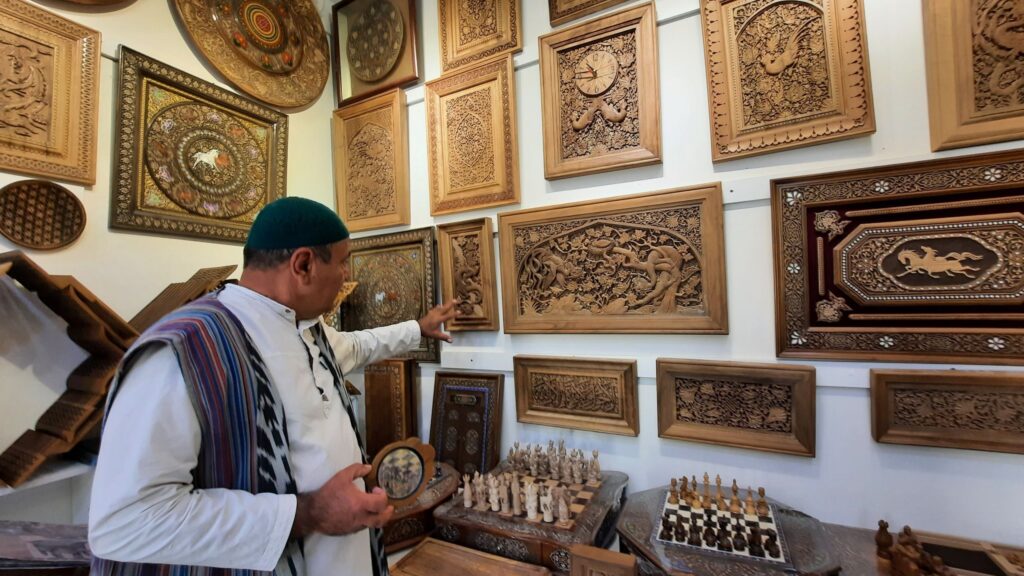
In the heart of Bukhara, one of Uzbekistan’s most historic cities, the sound of chisels meeting wood still resonates through the workshop of Shavkat Ashurov. At 57, he has dedicated more than two decades to the art of woodcarving, a tradition that has endured through centuries of upheaval and modernization in Central Asia. Ashurov’s workshop feels like a living museum. The patterns he carves are not modern inventions but trace their lineage back to the fifth and sixth centuries, long before the spread of Islam in the region. “There is only one similar piece left in Shahrisabz," Ashurov explains, "on the museum door connected to Amir Temur, and another in Turkistan. What we do here is to keep these traditions alive.” [caption id="attachment_36145" align="aligncenter" width="2560"] Ashurov's workshop. @Sadokat Jalolova[/caption] For Ashurov, woodcarving is more than a profession, it is a family legacy. “We are the fourth generation,” he said. “I only try to pass on what I know. I don’t add more than I can. What I learned from my forefathers, I hand over to my students.” He began carving more than 35 years ago, but for the past two decades has devoted himself almost entirely to the craft. Over the years, he has trained nearly 100 apprentices, though today he works with just four. The reason, he admits, is the patience the art requires. “This work takes time and patience, and not everyone can manage that,” he said. “Some of my students chose other professions. But with the ones I have, I continue.” The work itself is painstaking. A simple carved bowl may take about 40 minutes if the wood is well-prepared, but larger projects can span months. “One of our biggest works took nine months to complete,” he recalled. “It depends on inspiration too. Sometimes you work every day; sometimes you pause, waiting for the right moment to continue.” [caption id="attachment_36146" align="aligncenter" width="1280"] Chess pieces from an 83-year-old apprentice working with his teacher Ashurov. @Sadokat Jalolova[/caption] Ashurov’s designs are rich with symbolism. Many incorporate chessboard-like patterns, interlocking stars, or subtle references to family and genealogy. Over centuries, foreign influences have entered Uzbek woodcarving, but artisans like Ashurov have absorbed them into a distinctly local tradition. “Miniature lacquer work came from Europe and Russia, and we placed it into our art,” he said. “The use of mother-of-pearl came through Iran and Turkey. But we reworked them into our own tradition.” Equally important to him is honesty. “I tell customers about product defects before selling them, and I teach my students to be honest too. Honesty is as important as the design itself.” Woodcarving is both an art and a livelihood. His workshop supports not only his own household but four other families. Income is unpredictable from modest sums to as much as 100 million soums (around $8,000) depending on commissions. “It is 50 percent local buyers, 50 percent foreigners,” he said. “Our people also value this work, but foreigners are often very interested.” Social media has become an unexpected...

Learning Across Borders: Education at the Heart of Central Asia–Japan Relations

For more than three decades, Japan has cultivated a distinctive partnership with the countries of Central Asia, one rooted not in geopolitics or grand strategy alone, but in human connection. Education has emerged as one of the strongest pillars of this relationship, as young people from Uzbekistan, Kyrgyzstan, Kazakhstan, Tajikistan, and beyond increasingly look to Japan for academic training, language study, and professional development. Tokyo’s support for scholarships, university exchanges, and Japanese language programs reflects a long-term vision: to invest in people-to-people ties that strengthen mutual understanding and prepare a new generation of leaders across the region. The Times of Central Asia spoke with Central Asian students at the International University of Japan to gauge their experiences. Ilyos from Uzbekistan: "As an international student, I found Japan to be a country of fascinating contrasts - deeply rooted in tradition, yet highly modern. I was struck by the coexistence of fast-paced, bustling cities and quiet, remote towns, each offering a very different atmosphere and way of life. "I chose Japan because I’d previously studied in South Korea at the undergraduate level. That experience made me curious about Japan, as I expected certain similarities but also wanted to explore the differences. I thought that if Japan were similar to Korea, the adjustment would be smooth, and if it offered something new, it would be an even greater opportunity to broaden my perspective and prepare for my career. "I’ve been truly impressed by how consistently Japanese people follow rules, respect social order, and demonstrate a high level of etiquette in everyday interactions. This has left a strong impression on me and has shaped the way I think about discipline, respect, and community values." Farrukh from Tajikistan: "I first visited Japan back in 2019. At that time, it was a business trip, and I spent a month here. I’d been thinking about studying in Japan for a long time, but I finally had the opportunity last year when the JICE JDS Scholarship in my home country was announced. "In the time I’ve been here, I’ve never felt I was treated differently from other people, even locals. There have been minor instances when Japanese people acted very strictly, but I guess that’s how they usually are. In terms of cultural differences, one thing I noticed was how hard they work; there is a lack of work-life balance." Azmat from Uzbekistan: "Most of my colleagues from work got their Master’s degrees in Japan, and we have some agreements between the Japanese government and our organization about studying here. My ex-director, my current deputy director, and the head of division are graduates of Japanese universities. So, listening to their stories, I ended up studying in Japan. "I find the people of Japan to be very polite and patient. The way they treat us as foreigners is really good. Of course, there are some difficulties - Japan is a country of rules - but they’re minor." As Central Asia deepens its educational links with Japan, the stories of...

Uzbekistan’s Garden Blossoms at the Osaka Expo

At Osaka Expo 2025, Uzbekistan is stepping onto the global stage with a pavilion that embodies the country’s theme: culture as the foundation of future societies. Created by the Uzbekistan Art and Culture Development Foundation (ACDF), the space celebrates heritage as both a legacy and a launchpad to connect communities, bridge generations, and spark global conversations. ACDF is no stranger to ambitious cultural projects. In Tashkent, it has staged the World Conference on Creative Economy, created the first Aral Culture Summit in Nukus, and is behind the renovation of the Centre for Contemporary Art. The Foundation is also working with star architect Tadao Ando on the design of a new National Museum and restoring the storied Palace of the Grand Duke of Romanov. Its research project, Tashkent Modernism XX/XXI, has already caught international attention with publications from Rizzoli New York and Lars Müller Publishers. [video width="1280" height="720" mp4="https://timesca.com/wp-content/uploads/2025/09/IMG_6020-online-video-cutter.com_.mp4"][/video] Recently, ACDF has been igniting fresh cultural currents. In Bukhara, the UNESCO-listed jewel of the Silk Road, the debut of the first-ever Biennial, Recipes for Broken Hearts, has transformed the ancient city into a vibrant stage for contemporary creativity. As we approached the pavilion, the queue was already packed and closed off to latecomers still straggling in. Before entry, a guide explained in Japanese the concepts in motion. Designed by internationally acclaimed ATELIER BRUCKNER, the installation unfolds under the theme Garden of Knowledge: A Laboratory for a Future Society, inspired by Uzbekistan’s fertile soil and fragrant gardens where wisdom and originality take root. Built with materials sourced in Japan, the structure features 10,000 hand-glazed bricks crafted by a master artisan from Uzbekistan. Its design has already earned international acclaim, winning the prestigious Red Dot: Best of the Best, and taking home gold at the German Design Award. Inspired by Khiva and the Khorezm region’s rich architectural and intellectual legacy, it’s a two-storey 750 square meter space that blends the ancient with forward-thinking design, mirroring the life cycle of a garden. Khiva, a UNESCO World Heritage city, has long been a crossroads of learning where scholars, artisans, and merchants exchanged ideas within its madrasahs and courtyards. It reimagines this heritage as a contemporary space for gathering and exchange. [caption id="attachment_36099" align="aligncenter" width="2560"] Exhibit: transport of the future; image: TCA, Stephen M. Bland[/caption] Brick and clay symbolize earth and ancestry, while cypress wood cultivated near Osaka underscores environmental responsibility. The triangular plot draws from the tumar, a traditional Central Asian amulet of protection, while a floor-level garden evokes Uzbekistan’s landscapes. Visitors follow a symbolic journey from planting seeds of knowledge to harvesting ideas, exploring zones aligned with UNESCO’s goals, including quality education, clean energy, resilient infrastructure, and innovation. [caption id="attachment_36097" align="aligncenter" width="2560"] Exhibit blending the ancient and the modern; image: TCA, Stephen M. Bland[/caption] The experience begins in the soil, a ground-floor gallery that highlights Uzbekistan’s shift toward a green economy through renewable energy, eco-friendly transport, and energy-efficient housing, along with landmark projects such as the revitalization of the Aral Sea Basin. From there,...

Uzbekistan to Transition to 12-Year School System

Uzbekistan is preparing to transition to a 12-year general education system, Deputy Minister of Preschool and School Education Sardor Radjabov announced in an interview with Uzbekistan-24. The change will incorporate preparatory classes into formal education, extending schooling from the current 11 years to 12. The revised structure will include three stages: One year of school preparation Four years of primary education (grades 1-4) Five years of general secondary education (grades 5-9) Two years of full secondary education (grades 10-11), which may be completed at general schools, academic lyceums, military schools, or technical colleges According to Radjabov, the reform aims to enhance educational quality and eliminate obstacles faced by Uzbek students applying to foreign universities. Currently, graduates are often required to complete a one-year foundation program abroad before qualifying for undergraduate studies. “This means our children lose a year,” he said. “If we implement the 12-year education system, students will no longer need to study foundation courses in several countries and will be able to enter undergraduate programs directly.” He added that aligning Uzbekistan’s education system with international standards would expand opportunities for graduates and narrow the gap between local and global academic systems. The reform builds on earlier changes to Uzbekistan’s school structure. In 2017, President Shavkat Mirziyoyev proposed the reinstatement of an 11-year general education framework, emphasizing its role in improving the connection between schools and colleges. Since then, most schools have operated under the 11-year model.

Recipes for Broken Hearts: Bukhara Hosts Its First Contemporary Art Biennale

The heat of Bukhara’s old city does little to deter the crowds. Tourists squeeze through narrow lanes, pausing in the shade of centuries-old madrasas or beneath towering minarets. This September, the heart of the UNESCO Creative City of Crafts and Folk Art is hosting something new: the inaugural Bukhara Biennale of contemporary art. Running from September 5 to November 20, the biennale is already being hailed as one of Central Asia’s largest and most diverse art initiatives. Its title, Recipes for Broken Hearts, reflects both its ambition and tone, blending art, history, and community in a city long known for its spiritual and cultural heritage.   A Global Effort Rooted in Bukhara The Bukhara Biennale is commissioned by Gayane Umerova, Chairperson of the Uzbekistan Art and Culture Development Foundation, which has played a pivotal role in preserving and promoting the country’s cultural legacy. Artistic director Diana Campbell sees the biennale as a continuation of Bukhara’s historic role as a center of learning and exchange. [caption id="attachment_35919" align="aligncenter" width="900"] Isiriq (wild rue) is a traditional herbal medicine also widely used in purification rituals among Uzbeks. It is often burned or hung in homes to ward off misfortune and evil. In the installation, bunches of isiriq hanging from the roof appear to reflect this age-old custom; image: TCA, Sadokat Jalolova[/caption] “The heart’s creative power comes into view when we look to tenth-century Bukhara, a time and place that offer many ways of mending heartbreaks,” said Campbell. She referenced Bukhara’s legacy as the home of polymath Ibn Sina and a crossroads on the Silk Roads. “For more than a millennium, Bukhara has been a place where people gathered to seek knowledge, healing, and hope. We believe the city holds many extraordinary recipes in its heart.” The biennale unfolds in the newly developed Bukhara Cultural District, where restored monuments are paired with modern design, featuring contributions from architects Wael Al Awar and landscape designer Günther Vogt. From Jeddah to Bukhara: Palm Waste Becomes Structure A highlight of the biennale is the AlMusalla Prize-winning installation, a reimagined musalla, or prayer space, constructed entirely from palm tree waste. Originally built in Jeddah, the structure has been transported to Bukhara as a symbol of sustainability and reuse. [caption id="attachment_35922" align="aligncenter" width="1600"] AlMusalla Prize winning installation; image: TCA, Sadokat Jalolova[/caption] Christopher Blust, engineer at AKT II, explained the origins of the project: “We were inspired by the idea of courtyards as places of gathering. Even the Prophet Muhammad’s house in Medina began with a courtyard for prayer and community.” Equally important, he said, was the material itself. “Palm fronds are discarded and often burned. We asked: Why not return to how these were used centuries ago? We shredded them, pressed them into boards, and created structural timber. This is the world’s first project to use palm waste in this way.” Architect Nicolas Fayad of East Architecture Studio noted that their design was informed by Jeddah’s traditional materials, timber, mud, and stone, reinterpreted through modern technology. “Everything visible in...

Paulo Bento Declines Offer to Coach Uzbekistan National Football Team

Portuguese football coach Paulo Bento has reportedly declined an offer to lead Uzbekistan’s national team, despite the country’s historic qualification for the 2026 FIFA World Cup. According to the Portuguese sports daily A BOLA, the 56-year-old coach turned down the proposal from the Uzbekistan Football Association, stating that the terms did not align with his current career plans. Bento, who was dismissed as head coach of the United Arab Emirates in March 2024, is still available on the international coaching market. His departure from the UAE team came as a surprise, particularly since the squad remained in contention for what could have been its first-ever World Cup appearance. Bento previously managed the Portuguese national team from 2010 to 2014, leading them through UEFA Euro 2012 and the 2014 FIFA World Cup. More recently, he coached South Korea at the 2022 World Cup in Qatar. Uzbekistan’s reported interest in Bento reflects the country’s broader ambitions to elevate its football program ahead of its World Cup debut in 2026. The national team secured qualification earlier this year, marking a landmark achievement. Officials have emphasized ongoing reforms within the country’s football infrastructure, with goals to professionalize the domestic league and enhance international competitiveness.