• KGS/USD = 0.01144 0%
  • KZT/USD = 0.00202 0%
  • TJS/USD = 0.10399 -0.29%
  • UZS/USD = 0.00008 0%
  • TMT/USD = 0.28490 0%
  • KGS/USD = 0.01144 0%
  • KZT/USD = 0.00202 0%
  • TJS/USD = 0.10399 -0.29%
  • UZS/USD = 0.00008 0%
  • TMT/USD = 0.28490 0%
  • KGS/USD = 0.01144 0%
  • KZT/USD = 0.00202 0%
  • TJS/USD = 0.10399 -0.29%
  • UZS/USD = 0.00008 0%
  • TMT/USD = 0.28490 0%
  • KGS/USD = 0.01144 0%
  • KZT/USD = 0.00202 0%
  • TJS/USD = 0.10399 -0.29%
  • UZS/USD = 0.00008 0%
  • TMT/USD = 0.28490 0%
  • KGS/USD = 0.01144 0%
  • KZT/USD = 0.00202 0%
  • TJS/USD = 0.10399 -0.29%
  • UZS/USD = 0.00008 0%
  • TMT/USD = 0.28490 0%
  • KGS/USD = 0.01144 0%
  • KZT/USD = 0.00202 0%
  • TJS/USD = 0.10399 -0.29%
  • UZS/USD = 0.00008 0%
  • TMT/USD = 0.28490 0%
  • KGS/USD = 0.01144 0%
  • KZT/USD = 0.00202 0%
  • TJS/USD = 0.10399 -0.29%
  • UZS/USD = 0.00008 0%
  • TMT/USD = 0.28490 0%
  • KGS/USD = 0.01144 0%
  • KZT/USD = 0.00202 0%
  • TJS/USD = 0.10399 -0.29%
  • UZS/USD = 0.00008 0%
  • TMT/USD = 0.28490 0%

Our People > Duisenali Alimakyn

Duisenali Alimakyn's Avatar

Duisenali Alimakyn is a Kazakh journalist, translator, and researcher covering literature, culture, and science. His research, including at the George Washington University, has a strong focus on Western narratives about Central Asia over the centuries.

Articles

The First Kazakh Comic and Its Cultural Significance

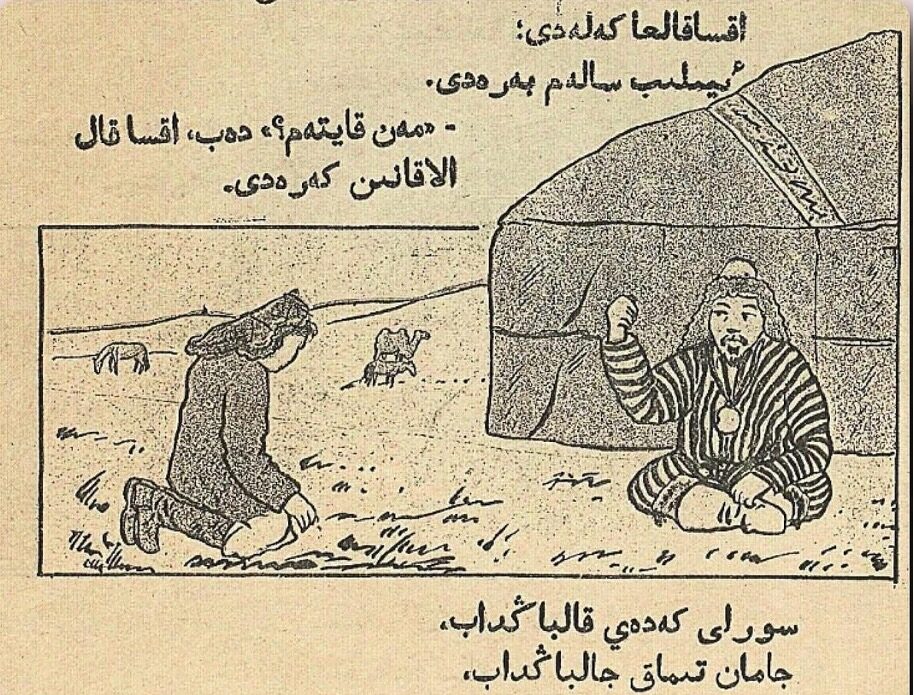
In the early 20th century, educated Kazakh thinkers were known as Alash intellectuals. Disillusioned by the Russian Empire’s growing control over the Kazakh people, they sought to establish an independent Kazakh state and protect their nation from imperial oppression. Their political and cultural struggle laid the foundation for modern Kazakhstan’s independence. The Alash Orda, a successor to the 19th-century Kazakh enlightenment movement, evolved into a more politically assertive and nationalist organization representing Kazakhs in southern Central Asia. Formed in March 1917 by prominent figures including Alikhan Bokeikhanuly, Akhmet Baitursynuly, Mirzhakyp Dulatuly, and Khalel Dosmukhameduly, the group participated in the Pan-Muslim Congress in Moscow that May. However, the congress, largely driven by Tatar leaders, failed to address Kazakh concerns, further alienating them. As a result, the Kazakhs withdrew from future congresses and focused on developing their own political structures. The Alash movement ultimately became the leading force guiding the Kazakh people during this turbulent era. [caption id="attachment_34521" align="aligncenter" width="347"] Zhusipbek Aimauytov with his daughter; image: alash.semeylib.kz[/caption] Zhusipbek Aimauytov, one of the prominent members of the Alash movement, authored important literary works such as Kartkózha, Akbilek, and Kúnékéýdiń jazyq dalasy. He was also a statesman and cultural figure who fell victim to Soviet repression, accused of nationalist sympathies. Arrested in 1929, he was sentenced to death in absentia in 1931. Despite his short life, Aimauytov left a lasting mark on Kazakh culture and literature. His writings consistently emphasized that national progress requires sacrifice, effort, and resistance against ignorance and injustice. [caption id="attachment_34523" align="aligncenter" width="826"] Cover page of Aimauytov`s comic book published in 1929[/caption] One of Aimauytov’s lesser-known yet significant contributions was the first Kazakh comic book, Ugly Headwear, which was written for children. Published in 1929 by the Kazidat publishing house, the work is composed in verse and meant to both entertain and educate young readers. The story explores timeless themes such as social injustice, class conflict, and moral reasoning. The tale begins with a poor villager and his family — a frail wife and three strong sons. They own little: one brown horse and a single cow. When the village head visits and demands taxes, he takes the family’s only cow by force and beats the father. This dramatic opening immediately draws the reader in and sets the tone for the rest of the story, which critiques the social conditions of the time. The motif of the marginalized challenging the dominant recurs across many world literatures. Known for addressing political and societal issues in his work, Aimauytov continues this in Ugly Headwear. The village leaders, religious figures, and even the wealthy refuse to help the poor man, claiming taxes are mandated by the Tsar and must be paid. Eventually, the desperate man turns to the Russian district chief, only to be humiliated and chased away. In a symbolic scene, the man’s hat — the “ugly headwear” — becomes the central object of the story. It is lost, found by a dog, taken to a barn, and later discovered by someone who...

7 months ago

Bridging Empires: A Japanese Historian on Kazakh-Qing Relations

Last year, I came across Professor Jin Noda’s research from the Tokyo University of Foreign Studies: The Kazakh Khanates Between the Russian and Qing Empires: Central Eurasia International Relations during the 18th–19th Centuries. As it explores Kazakh history, particularly letters written by Khan Ablai and other sultans to the Qing emperor, I reached out to Professor Noda to ask a few questions. TCA: What inspired you to write this book? Noda: I thought there was a great divide between studies of Central Asia from the Russian side and those from the Qing Chinese side. To bridge this gap, I decided to research Kazakh history using both Russian and Chinese sources. TCA: You published letters from 1779 related to Ablai Khan. What is their social significance? Jin Noda: While the “social significance” isn’t entirely clear to me, the letters are important for Kazakhs as evidence of relations with the Qing Dynasty. They also reflect Ablai’s authority — sending letters to the Qing emperor signified his direct contact with the imperial court. TCA: Were these letters originals? What challenges did you face studying them? Jin Noda: I accessed microfilmed versions at the First Historical Archive in Beijing. The poor image quality made them difficult to read, and some texts were unreadable. TCA: How much did you rely on Chinese sources, and how reliable are they? Jin Noda: For my PhD and the book, I used many Manchu documents. While they have their biases, they also offer valuable new information on the Kazakhs. I cross-referenced them with Russian sources from the same era. TCA: Are there many historical records about Kazakhs in Japan? How should they be studied? Jin Noda: Some records exist, particularly from the Japanese military’s interest in Xinjiang after the Russo-Japanese War. For Kazakhs under Russian rule, one rare case is the Kazakh politician Marsekov contacting the Japanese government during the revolution. His letter’s translation is preserved in a Japanese archive and was recently studied by Prof. Uyama and Mr. Ono. TCA: Apart from Sultan Gubaidolla’s well-known letter, did you find other sources related to him? Jin Noda: I collected Russian archival documents on his activity around 1824 in Almay and Omsk. He is known for his role in protesting Russian colonisation. TCA: As a foreign researcher, how do you assess Kazakh-Qing political relations? Jin Noda: Traditionally, Chinese discourse portrayed the Kazakhs as distant vassals. However, Qing sources place them closer to the empire, like the Mongols or the Torghuts. I believe the Kazakh khans understood the strategic advantage in their relations with the Qing. These ties held unique importance for both sides. TCA: You’ve also used Manchu archives. What did they reveal? Jin Noda: Manchu documents are rich sources — essentially direct reports from Xinjiang officials to the emperor. While they reflect the officials’ own motivations, they offer a vivid picture of the Kazakhs’ contact with the Qing. TCA: Have you received proposals to translate your book into Kazakh? Jin Noda: I’ve recently received a proposal to translate it...

8 months ago

How The New York Times Came to Publish an Obituary for Kazakh writer Mukhtar Auezov

While browsing old issues of The New York Times, we wondered: “Is there anything here about the Kazakhs or Kazakhstan?” One edition stood out, the June 28, 1961 issue. On page 35, alongside obituaries for several prominent figures, was one for our great writer, Mukhtar Auezov. [caption id="attachment_33412" align="aligncenter" width="378"] “Winner of Lenin Prize in 1959 for 2-Volume Work Dies Mukhtar O. Auezov, the Kazakh poet and philosopher whose two-novel work, ‘Abai’ and ‘The Road of Abai,’ earned a Lenin Prize two years ago, died yesterday in Alma-Ata.”[/caption] The article went on to note that Mukhtar Auezov was born and raised in the Shyngystau region (known today as the Abai District), and later wrote a major work about the life of Abai. It also mentioned that he studied at Leningrad University and authored numerous literary works. In 1960, Auezov visited several U.S. states as part of a Soviet writers’ delegation. Upon returning home, he expressed in interviews his admiration for the towering skyscrapers of New York City. What pleased us even more was that The New York Times included a photograph of Auezov alongside the obituary. This shows that even in the 1960s, American literary circles recognized and took notice of a Kazakh writer. In other words, Auezov left a lasting impression on the American public. Other articles about him may have appeared in the U.S. press, but so far this obituary is the only one we have been able to find. Mukhtar Omarkhanuli Auezov holds the distinction of being the first known Kazakh writer to set foot on American soil. His official visit was well covered by the U.S. press and known to the American public at the time. This likely explains why such a major publication honored him with a dedicated obituary, informing readers around the world of his passing. The gesture reflects a significant level of respect and recognition. Mukhtar Auezov indeed visited the United States from February 17 to March 17, 1960, as part of a delegation of Soviet writers. This trip was part of the “Agreement Between the United States of America and the Union of Soviet Socialist Republics on Exchanges in the Cultural, Technical, and Educational Fields.” According to the agreement, four American writers visited the USSR in 1959, and in return, a Soviet delegation traveled to the U.S. in February/March 1960. To give readers a closer look at his journey, we are sharing excerpts from Mukhtar Auezov’s diary, where he reflects on the trip. The entries were later published in a bilingual edition, Mukhtar Auezov: Impressions of America, in 2021, in both Kazakh and English. Below are a few details from Auezov’s impressions of the U.S.: That day we toured Washington, D.C. It’s a very beautiful city. No two houses look alike. Even the cars are all different, though there are many, they never repeat. We visited the old part of the city, the area known as ‘Georgetown.’ All the houses here are old, yet highly stylish, elegant two-story homes. There is one...

8 months ago

A British Scholar’s Glimpse into Kazakh Life a Century Ago

A century ago, in 1925, British historian, writer, and revolutionary Ralph Fox published People of the Steppes, a compelling account of his travels offering rare insights into the life and culture of the Kazakh people. Fox (1900–1936) was no ordinary observer. A journalist, Marxist, and author of biographies on Lenin and Genghis Khan, he traveled through Soviet Central Asia in the early 1920s and spent his final years working at the Marx-Engels Institute in Moscow, where he wrote his last major tome. In the foreword to People of the Steppes, Fox states that his aim was not political propaganda but to record what he had witnessed. His observations, written as he journeyed through the steppe from the Orenburg region to the Aral Sea, provide a vivid portrait of nomadic life. As the train carried him across Turkestan, Fox was struck by the sights outside his window: “For the first time I see, through the train windows, the round black tents of the nomads, shaped like broad beehives, and I whisper to myself that under just such a tent was Chingiz Khan born… Sometimes there passes a family on the march, the elders and children perched above their household goods on the beautiful shaggy Bactrian camels, the youths on horseback, small, sturdy ponies. It is all strange to me and I feel a beauty of slowness and order in their movements, the eternal rhythm of a wandering shepherd's life.” Fox shortly visited a nomadic camp, recording his impressions in the sub-section “The Tents of the Kazakhs”. “We sat on some empty crates and watched the hens scutter across the floor," he wrote, "while his wife, a quiet, kindly woman, brought us a bowl of Kummis (Mare’s milk) to drink." The hospitality of the Kazakhs left a lasting impression: “ They roused me when the meal was ready. ‘The Kazaks, men and women, sat round the pot in the dim tent, for smoke filled all the upper part now, and the sun had set. Brown arms were thrust into the mess, or painted wooden spoons, while we dainty whites were given wooden bowls. ‘The meat was tough and greasy, and to me only the little cakes of dough were palatable, though they were gritty with sand, so I did not eat much… It was all fantastic around that evil-smelling fire.” The next day, Fox encountered a group of Lesser Horde Kazakhs migrating from Siberia along the Syr Darya River. He noted that some had already settled in Torgai, while others aimed to reach the Urals. “ Once there, they would willingly sell off their surplus stock to buy their necessities on the bazaars to last them through the following year, at Kazalinsk, at Jussali, at Perovsk and ‘Turkestan, the great bazaars of the Syr Daria.” Fox also explored the broader historical and cultural context of the Kazakhs, noting that their nomadic lifestyle limited the development of written literature but fostered rich oral traditions and epic poetry: “It is hard to unravel their...

9 months ago

The Photographs of Prokudin-Gorsky: A Glimpse of a Lost World

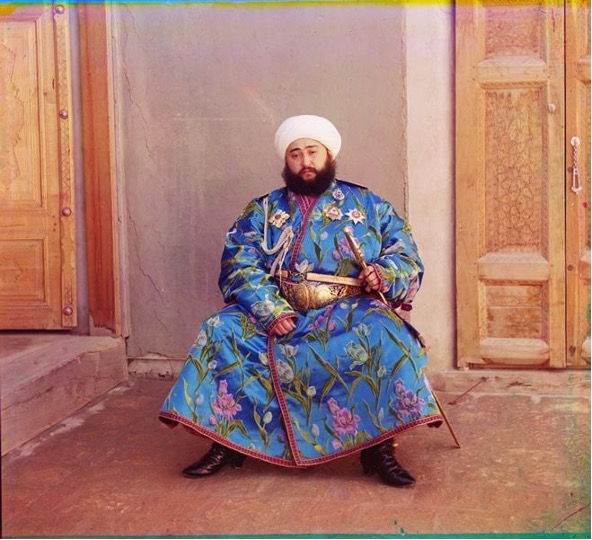
Using the emerging technology of color photography, Sergey Mikhaylovich Prokudin-Gorsky (1863–1944) undertook several photographic expeditions to capture images of the Russian Empire. Most of his work took place between 1909 and 1915, though some photographs date as early as 1905. At the time, the Russian Empire stretched roughly 7,000 miles east to west and 3,000 miles north to south. It encompassed one-sixth of the Earth’s land surface, making it the largest empire in history, spanning what are now eleven time zones. [caption id="attachment_32008" align="aligncenter" width="484"] Abutment for a dam and house belonging to the government. [Kuzminskoe] Prokudin-Gorsky, Sergey Mikhaylovich, 1912[/caption]Tsar Nicholas II supported Prokudin-Gorsky’s ambitious endeavor by granting him travel permits and access to various modes of transportation, including trains, boats, and automobiles. His journeys are preserved in photographic albums that include the original negatives. One album also features miscellaneous images, including scenes from other parts of Europe. The photographs capture a broad array of subjects: religious architecture and shrines (churches, cathedrals, mosques, and monasteries); religious and secular artifacts (such as vestments, icons, and items linked to saints, former Tsars, and the Napoleonic Wars); infrastructure and public works (railroads, bridges, dams, and roads); a variety of industries (including mining, textile production, and street vending); agricultural scenes (like tea plantations and field work); portraits, which often showed people in traditional dress, as well as cityscapes, villages, natural landscapes, and blooming plants. Besides being a photographer, Sergey Prokudin-Gorsky was a chemist who is renowned for his pioneering contributions to color photography in the early 20th century. In 1901, he traveled to Berlin to study photochemistry before returning to Russia, where he outfitted a railroad car as a mobile darkroom with the support of Tsar Nicholas II. As he traveled across the Russian Empire, he documented its people and landscapes, eventually earning recognition in Russia, Germany, and France. In 1906, he was appointed head of the photography section of Fotograf-Liubitel, Russia’s leading photography journal. One of his most famous works is a color portrait of Leo Tolstoy, taken in 1908. “By capturing the result of artistic inspiration in the full richness of its colors on the light-sensitive photographic plate, we pass the priceless document to future generations,” wrote Prokudin-Gorsky. As a nobleman, inventor, professor, and pioneer of color photography in Russia, Prokudin-Gorsky had a deep sense of national identity and heritage. Although he was unable to complete his grand project due to the outbreak of World War I and increasing social unrest across the Russian Empire, he still managed to capture photographs in regions such as the Urals, Siberia, Crimea, Dagestan, Finland, and Central Asia, as well as along the Volga and Oka rivers. Unfortunately, much of his photographic archive was lost in the aftermath of the 1917 Revolution. Prokudin-Gorsky created unique black-and-white negatives using a triple-frame method, taking three separate exposures through blue, green, and red filters. This technique allowed the images to be printed or projected in color, often for magic lantern slide presentations. The complete collection of 1,902 triple-frame glass...

10 months ago