• KGS/USD = 0.01144 0%
  • KZT/USD = 0.00191 -0%
  • TJS/USD = 0.10838 0.37%
  • UZS/USD = 0.00008 0%
  • TMT/USD = 0.28571 0.28%
  • KGS/USD = 0.01144 0%
  • KZT/USD = 0.00191 -0%
  • TJS/USD = 0.10838 0.37%
  • UZS/USD = 0.00008 0%
  • TMT/USD = 0.28571 0.28%
  • KGS/USD = 0.01144 0%
  • KZT/USD = 0.00191 -0%
  • TJS/USD = 0.10838 0.37%
  • UZS/USD = 0.00008 0%
  • TMT/USD = 0.28571 0.28%
  • KGS/USD = 0.01144 0%
  • KZT/USD = 0.00191 -0%
  • TJS/USD = 0.10838 0.37%
  • UZS/USD = 0.00008 0%
  • TMT/USD = 0.28571 0.28%
  • KGS/USD = 0.01144 0%
  • KZT/USD = 0.00191 -0%
  • TJS/USD = 0.10838 0.37%
  • UZS/USD = 0.00008 0%
  • TMT/USD = 0.28571 0.28%
  • KGS/USD = 0.01144 0%
  • KZT/USD = 0.00191 -0%
  • TJS/USD = 0.10838 0.37%
  • UZS/USD = 0.00008 0%
  • TMT/USD = 0.28571 0.28%
  • KGS/USD = 0.01144 0%
  • KZT/USD = 0.00191 -0%
  • TJS/USD = 0.10838 0.37%
  • UZS/USD = 0.00008 0%
  • TMT/USD = 0.28571 0.28%
  • KGS/USD = 0.01144 0%
  • KZT/USD = 0.00191 -0%
  • TJS/USD = 0.10838 0.37%
  • UZS/USD = 0.00008 0%
  • TMT/USD = 0.28571 0.28%
11 November 2025

Our People > Naima Morelli

Naima Morelli's Avatar

Naima Morelli

Journalist

Naima is an arts writer and journalist specialized in contemporary art from Asia-Pacific and the MENA region. She has written for the Financial Times, Al-Jazeera, The Art Newspaper, ArtAsiaPacific, Internazionale and Il Manifesto, among others, and she is a regular contributor to Plural Art Mag, Middle East Monitor and Middle East Eye as well as writing curatorial texts for galleries. She is the author of three books on Southeast Asian contemporary art.

Articles

Where Wings Grow: New Show at Aspan Gallery, Almaty

Let’s move Aspan Gallery from name to place, from reputation to reality. As one of the Kazakh galleries most visible on the fair circuit, known for its impeccable presentations and strong roster of Central Asian artists, visiting its headquarters in Almaty felt almost inevitable. It didn’t disappoint. Tucked into the underground floor of a shopping complex in a leafy area of Almaty, where you might catch a glimpse of a stylish passerby balancing a matcha cup before descending the stairs, the gallery unfolds as a quiet enclave. There, Where Wings Grow opens as a multifaceted meditation on the cycles of nature, and particularly on the steppe, explored by several Central Asian artists through ecological, historical, and mythic lenses. What emerges is not a nostalgic portrait of a nomadic past but a layered reflection on resilience and renewal. At the center of the curatorial vision is Alan Medoev, the archaeologist whose 1960s expeditions uncovered hundreds of sites across the Kazakh steppe. His discoveries challenged Soviet portrayals of the region as an empty expanse and instead presented it as a cradle of memory. The exhibition extends that lineage, tracing how the steppe continues to act as an archive where cultural, personal, and ecological time intersect. The installation is clean and deliberate: suspended collages, unframed paintings, and subtle shifts in light. Walking through, one feels the exhibition itself has been conceived as a kind of landscape. [caption id="attachment_37355" align="aligncenter" width="1920"] Where Wings Grow, installation view; image: Theo Frost[/caption] The Interplay Between Distance and Proximity This quality resonated strongly when encountering the works. At a distance, some pieces seemed almost naïve or casual in their painterly surfaces, but up close, their textures, materials, and embedded details revealed far more intricate worlds. This is true of Saule Suleimenova’s Plasticographies (two works titled Zhana Omir – New Life and Steppe Romanticism). From afar, they appear to be simple, even sentimental landscapes. Up close, however, they are revealed as collages of discarded plastic: fragments of packaging, commercial logos, counterfeit brands, and old ID cards. Suleimenova, who grew up in Almaty and trained as an architect before turning to socially engaged art, calls plastic “a treasure” and uses it to question both waste and memory. Within these luminous surfaces are startling details such as embryonic forms and small figures hidden in the texture. These unsettling images evoke new generations coming into a world shaped by waste, suggesting both renewal and ecological crisis. Steppe Romanticism distills the landscape into minimal horizons and contemplative silence. Yet knowing it is made of plastic prevents forgetting the contradiction, serenity marked by civilization’s residue. It recalls how landscapes themselves operate, inviting from afar but, up close, layered with scars, residues, and histories. [caption id="attachment_37353" align="aligncenter" width="2560"] Moldakul Narymbetov, "Untitled"; image: Aspan Gallery.[/caption] In a similar spirit, Moldakul Narymbetov’s paintings establish the exhibition’s tone. A founding member of the radical Kyzyl Tractor collective and one of the central figures in Kazakh contemporary art, Narymbetov (1948–2012) was known for fusing folklore, shamanic motifs, and gestural abstraction....

1 month ago

Kazakhstan’s Cultural Reawakening: Almaty Opens Its New Museum of Arts

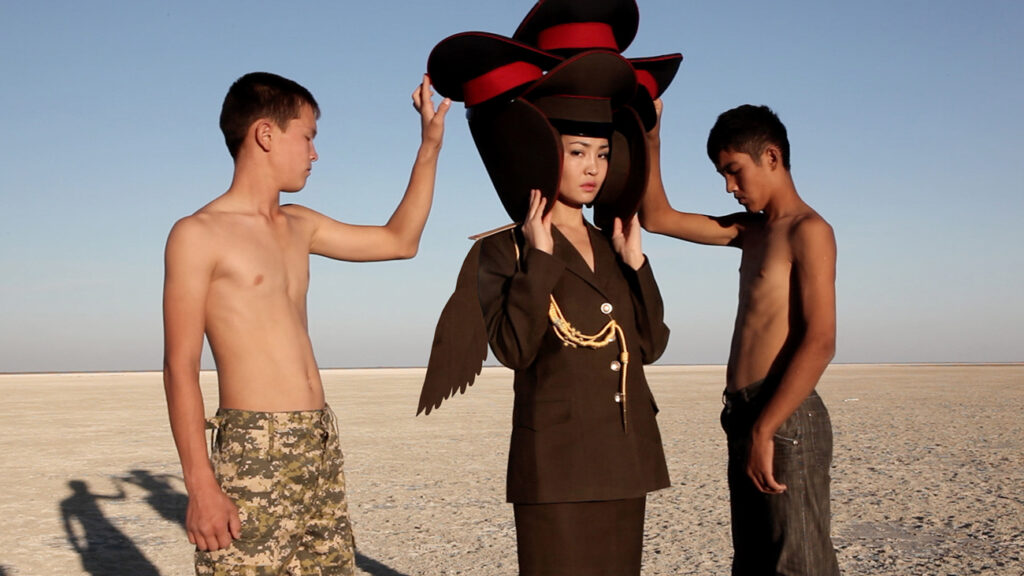
First, a young Kazakh schoolgirl in a black dress with a starched collar, her hair tousled by the wind of the Aral Sea, clutches a large Russian book tightly to her chest as she stands before a lonely school building in the middle of nowhere. Then, a camel speaks: “Give me back the sea!” “No!” cries a woman, her face hidden beneath a military hat. She stands before an abandoned edifice, her head wrapped in fur, her body strangely adorned with eggs. [caption id="attachment_36257" align="aligncenter" width="900"] Image: Almagul Menlibayeva[/caption] This series of surreal images is from the video Transoxiana Dream, by one of Central Asia’s pioneering contemporary artists, Almagul Menlibayeva. The Times of Central Asia attended her major solo show, I Understand Everything, curated by Thai curator Gritiya Gaweewong, a powerful exploration of memory, trauma, and identity, which provides the “treble clef” for the opening of the Almaty Museum of Arts. The show brings together works spanning decades, from Menlibayeva’s early paintings and collages in the 1980s, to her recent internationally recognized video and photography works. Through a variety of mediums, she charts the collapse of the Soviet Union, the ecological devastation of Kazakhstan, and suppressed cultural memory. [caption id="attachment_36258" align="aligncenter" width="2560"] Almagul Menlibayeva, People Talking against a Blue Background, 1988; image: Almaty Museum of Arts[/caption] As always in her practice, the feminine and feminist narratives are at the forefront. Menlibayeva’s women are at times bound with nature or with military rule, alternately merciful or merciless. Her works tackle ecological concerns, tying them directly to the destruction of patriarchy. “For us, opening our program with Menlibayeva’s show was highly significant,” says Meruyert Kaliyeva, the museum’s artistic director. “She is a pioneering Central Asian artist who is known internationally but at the same time has always dealt with topics and themes that are important locally.” A New Museum in Almaty The inauguration of the Almaty Museum of Arts represents a decisive step in shaping Kazakhstan’s creative future. As the country’s first large-scale contemporary art museum, it houses over 700 works collected across three decades, offering a panoramic view of modern Kazakh art while opening pathways to Central Asian and international dialogues. [caption id="attachment_36265" align="aligncenter" width="2560"] Almaty Museum of Arts; image: Alexey Poptsov[/caption] Its mission extends beyond exhibitions: the institution positions itself as a center for education, research, and collaboration, aiming to nurture local artists and connect them to global networks. For Kazakhstan, long without a dedicated contemporary art museum, this moment signals a new era, one in which cultural identity is asserted with confidence, and the arts are recognized as a vital force for national memory as well as international visibility. Kaliyeva emphasizes how essential it is that Kazakh artists now have a platform where voices once peripheral to national culture can take center stage. She also stresses the urgency of the moment: in a world reshaped by geopolitical fractures, climate crises, and cultural decolonization, this opening is necessary: “It’s a moment for Kazakhstan to assert its own narratives, to host...

2 months ago

Bridging Continents: Launching the VIMA Art Fair in Cyprus

In the art world, fairs often have a meteoric rise and fall in an oversaturated market of competing events. But every so often, one lands with a quiet, deliberate weight, embedding itself in the soil of its context and revitalizing it. VIMA Art Fair in Limassol, Cyprus, is one such project. Unfolding in a transformed wine warehouse near the sea, VIMA resisted the sterile polish of typical fair venues. Here, the Mediterranean wind mingled with the hum of languages, from Russian to Arabic, Greek, and Turkish, to English. The fair was founded by three Russians who have established themselves in Cyprus - Edgar Gadzhiev, Lara Kotreleva, and Nadezhda Zinovskaya - all of whom have brought a deep well of curatorial and institutional experience from Central Asia, Eurasia, and beyond. The trio have diverse backgrounds: Zinovskaya used to manage Ayarkut, an international art foundation operating across Kazakhstan and Mexico, together with Gadzhiev, who specialized in marketing in the cultural sector. Lara Kotreleva, meanwhile, has a museological background in Moscow and founded Sphere Space, an ongoing research initiative dedicated to architectural heritage in Limassol. To set up the fair, they teamed up with an expert committee comprising the Cypriots Alexandros Diogenous and Tasos Stylianou, co-founders of Limassol Art Walks, and Andre Zivanari, director of the Point Center for Contemporary Art in the capital, Nicosia. Of the 27 participants at the fair, there was an emphasis on the ten Cypriot galleries, commercial, not-for-profit, and artist-run spaces, part of Cyprus’s flourishing contemporary art scene, as well as on a number of Middle Eastern and Greek galleries. The Caucasus also made an appearance, with Georgia’s Window Project (Tbilisi) presenting a thoughtful mix of Georgian and international artists. Their mission centers on bridging generational narratives, with a particular emphasis on promoting emerging Georgian talents alongside an often-overlooked older generation of artists. At VIMA, the gallery highlighted the work of female artists, including Tamar Giorgadze, Sigrid Gloerfelt, Natela Grigalashvili, Tamara K.E., and Anie Toidze. Representing Azerbaijan, pop/off/art (Baku) featured a dynamic selection of artists primarily from the post-Soviet sphere as well as Eastern and Central Europe, showcasing works by Despina Flessa, Andrey Krasulin, and Shamil Shaaev. The mood was easygoing and fresh, but did not shy away from important socio-political themes that are unavoidable on the island, from the Greek-Turkish divide, to the arrival of a number of expats fleeing wars. Through a program of talks and a collateral exhibition, the fair leaned into this complexity and spelled out the necessity of communities coexisting, as well as articulating the desire to create new cultural infrastructure through public and private collaboration. The Times of Central Asia spoke with Edgar Gadzhiev, Lara Kotreleva, and Nadezhda Zinovskaya. [caption id="attachment_32435" align="aligncenter" width="1920"] Portrait of the co-founders of the VIMA Art Fair, Edgar Gadzhiev, Nadezhda Zinovskaya, and Lara Kotrelevaimage; image courtesy of the VIMA Art Fair[/caption] TCA: Why did you choose Cyprus as the location to launch this project? Gadzhiev: It wasn’t a random decision. We conducted long-term research, and it became...

6 months ago

Central Asian Perspectives Take Center Stage in Milan

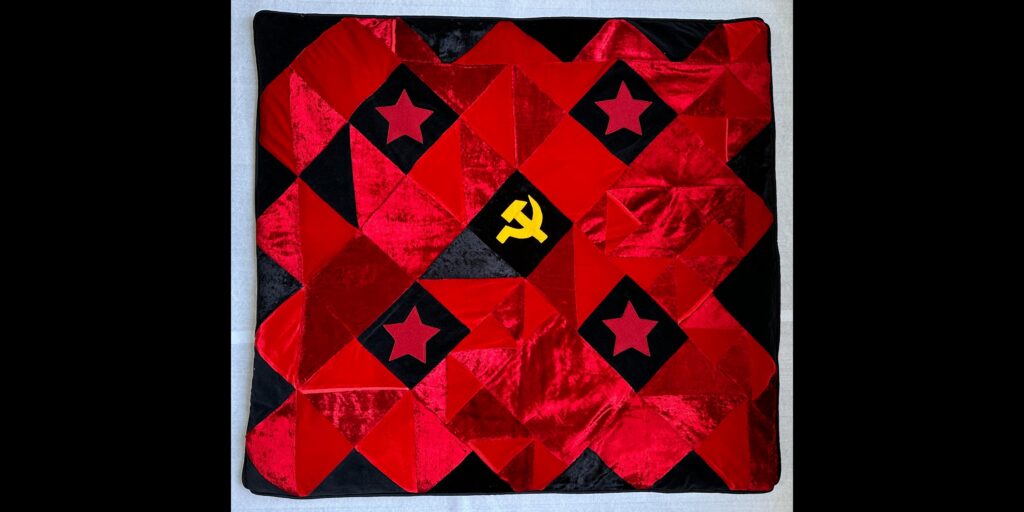
A pale Milanese dawn draped the city in shifting greys, as visitors crossed the threshold into the space of Fondazione Elpis, a foundation created to promote dialogue with emerging geographies and young artists. This time, it was Central Asian artists who were in the spotlight, claiming a shared history fractured by Soviet rule and global currents. The show YOU ARE HERE: Central Asia redraws a regional map, allowing artists to redraw the borders of their belonging beyond nation-states. At the same time, it invites each visitor to relate to the works by locating its place within these stitched, erased, and reconfigured narratives. Curators Dilda Ramazan and Aida Sulova orchestrated twenty-seven artists into a living constellation: from Munara Abdukakharova’s rolled patchwork, its golden hammer-and-sickle motifs softened by the hand-stitched curves of Kyrgyz kurak korpe, to Vyacheslav Akhunov’s furious erasures of scraped notes, the show reassembled in unexpected patterns stories of resilience, resistance, and reimagined belonging. YOU ARE HERE not only reframed Central Asia for a European audience but asserted that the region’s histories are neither static nor singular, they are stitched, erased, reconfigured, and claimed anew by the very people who live them. The Times of Central Asia spoke with Kazakh curator, Dilda Ramazan. [caption id="attachment_31541" align="aligncenter" width="2560"] "YOU ARE HERE. Central Asia", installation view, primo piano, Fondazione Elpis, Milano © Fabrizio Vatieri Studio[/caption] TCA: Can you tell us about the genesis of the show? The show emerged after the invitation of the Fondazione Elpis, whose founder, Marina Nissim, became interested in the region and its artists after seeing one of the Central Asian pavilions at the Venice Biennale. By presenting the complex Central Asian landscape to a European public who might not know it very well, we wanted to give artists the platform for free expression without framing the region from the stereotypical perspective, as is often the case in the Western context. We wanted the artists to reflect on the idea of space and belonging through the idea of locating oneself. TCA: Do you feel there is a growing awareness of Central Asia in Europe? Yes, I can feel and see it, but it is a natural process one should expect within the logic of globalization. The exhibition addressed the impact of Soviet and post-Soviet transitions on the cultural identities of Central Asian nations by showcasing artists of several generations. Some of them had a direct experience of living under the Soviet regime, so again the artists spoke for themselves and the region’s past through their works. [caption id="attachment_31542" align="aligncenter" width="2560"] Emil Tilekov, Traces and Shadows, 2024 © Fabrizio Vatieri Studio[/caption] TCA: How is the theme of migration explored in the exhibition, particularly concerning its economic and emotional implications for Central Asian communities? Migration was one of the key aspects evoked in the show because it is still an experience lived by the artists and/or their relatives and families. Two Kyrgyz artists, for example, raised this issue in their projects. This was the case in the video by Chingiz...

6 months ago

Altynai Osmo’s New Show in New York: Restoring Female Narratives

In the heart of Tribeca in New York, the Sapar Contemporary Art Gallery has launched a new exhibition, Beneath the Earth and Above the Clouds, which brings Central Asian narratives to the forefront. This dual show – which runs until May 15, 2025 - features Altynai Osmo and Aya Shalkar, two artists who have been devoted to exploring female narratives in the region, and do this through works that are both steeped into tradition, and modern and vibrant at the same time. The Times of Central Asia spoke with Altynai Osmo, a multimedia artist from Kyrgyzstan whose work weaves the threads of nomadic heritage with contemporary expression. Born in Bishkek and nurtured by the serene shores of Lake Issyk-Kul, Osmo's artistic journey is deeply rooted in the traditions of her homeland. A graduate of Central Saint Martins in London, she seamlessly blends mediums — textiles, metals, video, and installation — to explore themes of identity, matriarchy, and the evolving role of women in Central Asian societies. Her works such as Blessing Yurt, a red fringed costume inspired by the Kyrgyz nomadic traditional dwelling, not only pay homage to ancestral practices but also challenges present-day socio-political narratives. Speaking with TCA, Osmo reflects on the layers of meaning in her new series, her enduring engagement with mythology and matriarchy, and how her practice bridges personal memory and collective history. [caption id="attachment_31131" align="aligncenter" width="2231"] Image courtesy of Altynai Osmo/Sapar Contemporary Art Gallery[/caption] TCA: Can you tell me about how your previous practice led to this new series for the show? My previous work has always involved exploring the intersections of feminine identity, cultural memory, and inherited spirituality in Central Asia, particularly in Kyrgyzstan. This new series evolved naturally from that foundation. It reflects a more layered and intentional engagement with Central Asian history, mythology and matriarchal histories — particularly the symbolic and spiritual dimensions that have often been erased, distorted and forgotten. The materials and narratives I use now draw more explicitly from the Kyrgyz epic, Manas, ancestral craftsmanship, and belief systems like Tengrism, allowing me to express deeper reflections on women's roles across time. TCA: Your Kyrk Kyz series reinterprets the legendary warrior women of Central Asia. How does this mythology resonate with contemporary Kyrgyz identity and gender roles? The Kyrk Kyz legend, with its origin in female strength and collective action, presents a striking contrast to the more patriarchal norms that dominate present-day Kyrgyz/Central Asian society. Revisiting these stories reminds us that women were once seen as the protectors of land, lineage, and cultural continuity. By reimagining these warriors through my art, I want to challenge modern gender expectations and inspire a reconnection to a more empowering view of womanhood that is already rooted in our collective past. [caption id="attachment_31132" align="aligncenter" width="2560"] Image courtesy of Altynai Osmo/Sapar Contemporary Art Gallery[/caption] TCA: The use of felt in your masks ties your work to nomadic traditions. How does the choice of materials reinforce the themes of your work? Felt is not just a...

7 months ago