“There is a Kazakh proverb that says: a foolish person arrives with noise, sweeping everything away in their path, while a wise person arrives quietly, carefully observing the world around them.”
Syrlybek Bekbota, the curator of the Kazakhstan Pavilion at the 61st Venice Biennale – the most important art event in the world – offers me this thought at the dawn of the exhibition’s opening, and it feels like both a manifesto and an omen.
The theme of the pavilion is perfectly in line with the overarching curatorial theme, In Minor Keys, conceived by the late Cameroonian-Swiss curator Koyo Kouoh, who tragically passed away before the Biennale opened.
And yet the controversies around this edition contradicted this minor key premise, instead turning it into a highly political event: the jury’s resignation, widespread protests against the participation of Israel and Russia, rallies against the exploitation of art workers.
The Kazakh pavilion was not immune to controversies itself, after artist Äsel Kadyrhanova’s installation Machine (2013) – a meditation on Stalin-era repression featuring a vintage typewriter, Soviet-era arrest warrants, and red thread – was dismantled before the exhibition opened.
However, on the day of the pavilion inauguration itself, no trace of the controversies was visible inside the high-ceilinged space.
Listening to the Quiet
Housed within the Museo Storico Navale near the Arsenale entrance, Qoñyr: The Archive of Silence marks Kazakhstan’s third participation in the International Art Exhibition of La Biennale di Venezia, and its most ambitious yet.
It is also worth noting that it is the first time a Central Asian nation has selected its pavilion curator and artists through an open call – open to citizens of Kazakhstan, with priority given to those currently living and working in the country. It is a deliberate emphasis on rootedness rather than the diaspora-friendly internationalism that, for better or worse, dominates many national pavilions.
The exhibition centres around the word qoñyr, a key term in Kazakh cosmology. While its literal meaning refers to the colour brown, qoñyr carries a far richer metaphorical significance: it can describe a sonic register, the scent of earth, or a form of silence with deeply embodied meaning.
It is the attentiveness to minor vibrations – the wind, the breath, a footstep – that renders audible what is usually displaced by noise. The pavilion takes its cue from a traditional Kazakh instrumental composition of the same name by the twentieth-century composer Äbiken Khasenov, whose work embodies a broader cultural shift: as cultural theorist Zira Nauryzbay has noted, Kazakh music before the twentieth century was predominantly composed in major keys, while the century’s upheavals – Soviet occupation, famine, mass deportations – precipitated a distinctive turn toward minor tonalities. That sonic transformation is the exhibition’s guiding metaphor.
“In periods of global instability, attention is often drawn to loud events and immediate reactions,” the curator Bekbota explains. “Within this atmosphere of noise, personal memory, everyday experience, and quieter forms of knowledge can easily remain unnoticed.” His curatorial wager is that restraint, rather than volume, can open a deeper kind of attention. “A quieter voice opens a space for deeper attention, reflection, and a more personal encounter with the subject.”
A Journey Through Six Rooms
“The Museo Storico Navale is not an easy space to work with,” co-commissioner Danagul Tolepbay – former gallerist and an active figure in the Kazakhstani art scene – told me at the opening. “On a technical level it has been very challenging, but we are pretty happy with the result.” Despite the difficulties, the space lends the exhibition a genuine journeying quality, one that begins well before the visitor steps inside.
The experience opens with Dübir, a sound installation by ADYR-ASPAN – a duo formed by the artists and researchers Gulmaral Tattibayeva and Natalya Ligay, whose collaborative practice weaves together sound, video, and archival material to explore the cultural and spatial memory of the steppe.
The work is heard before it is located. Layered recordings of horse hooves, the creak of wagon wheels, drawn-out song, and children’s voices thread through the Venetian soundscape – audible while still in the street, then intensifying as visitors approach the pavilion. As Tattibayeva describes it, these sounds were never mere background but a system of orientation in space and time, a nomadic cartography that predates any fixed architecture.
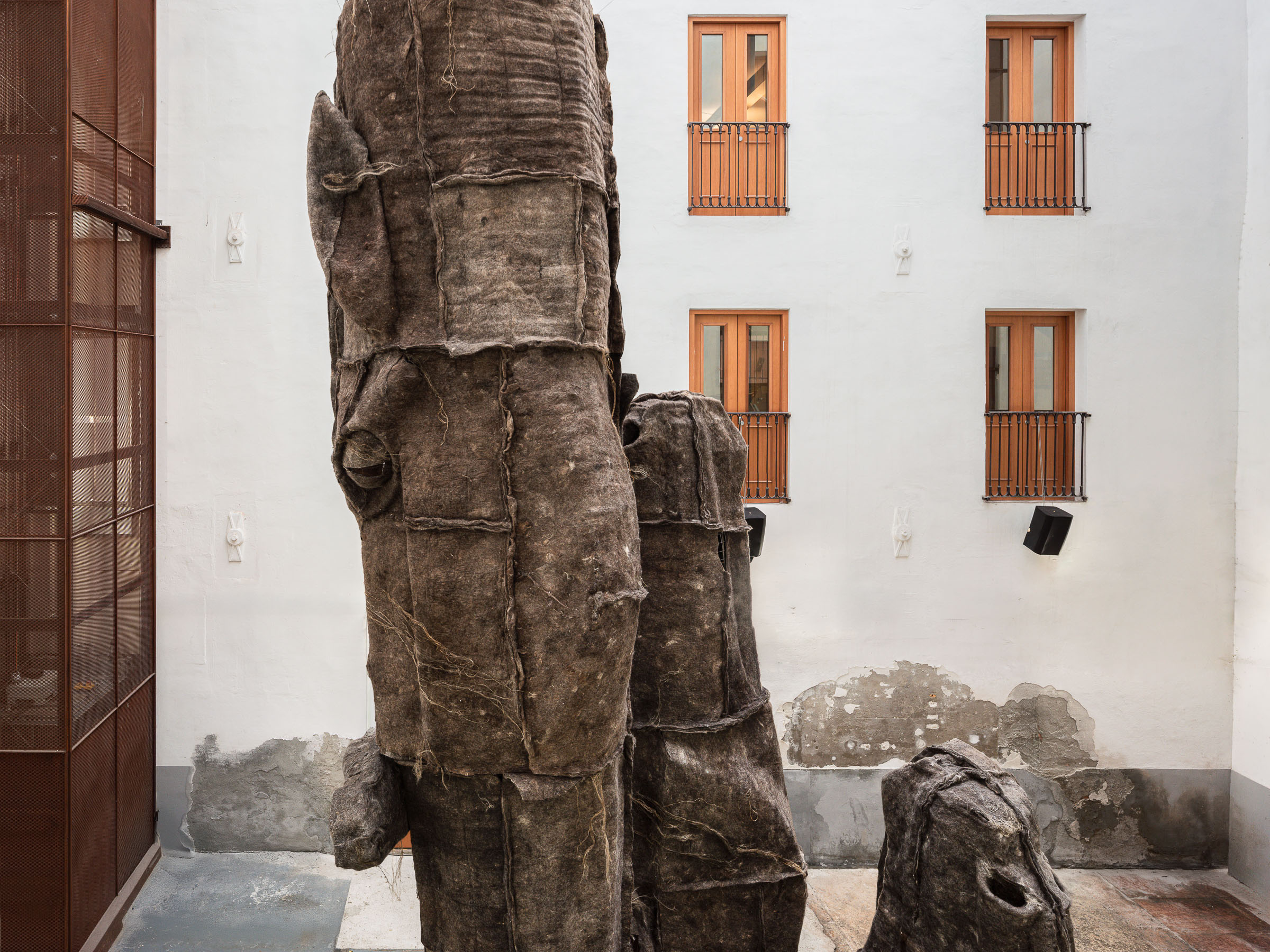
The very high-ceilinged courtyard then reveals Steppe Architectonics by Smail Bayaliyev — one of the founders of the legendary Kazakhstani avant-garde collective Kyzyl Tractor, whose decades-long practice has used felt, kashma wool, and other materials rooted in nomadic tradition to produce monumental sculptures, raw paintings, and ritual-inflected performances.
Three enormous structures of raw felt and steppe grass rise toward the ceiling like stones or primitive trees. Seen from a distance, the viewer realises they are enormous horse heads, hanging from above or erupting from the ground.
To access the six rooms of the exhibition proper, visitors climb three floors of a metal staircase, stepping into a different dimension: a series of dark, acoustically designed rooms, each calibrated to hold sound.
The first room presents Aitys: The Limits of Translation, a video installation by Bekbota himself. An artist and curator whose practice centres on nomadic mythology and post-Soviet cultural identity, Bekbota positions the aitys – a traditional Kazakh musical-poetic contest of improvised verbal exchange – as a living form in dialogue with contemporary critical thought.
The work is, among other things, a challenge to the hierarchical assumptions that still govern how non-Western cultural forms are received within international art institutions; namely the persistent tendency to sort practices into the “contemporary” on one side and the “traditional” or “peripheral” on the other. In Bekbota’s framing, the aitys is an actual structure for thinking, and as such it belongs fully in the present of the Central Asian structure of thought.
That tension between hearing and understanding deepens in the subsequent rooms through the works of Mansur Smagambetov and Oralbek Kaboke. Smagambetov is recognized for his video art, installations, and public art that explore social inequality, ecological trauma, and historical memory using ironic forms and kitsch.
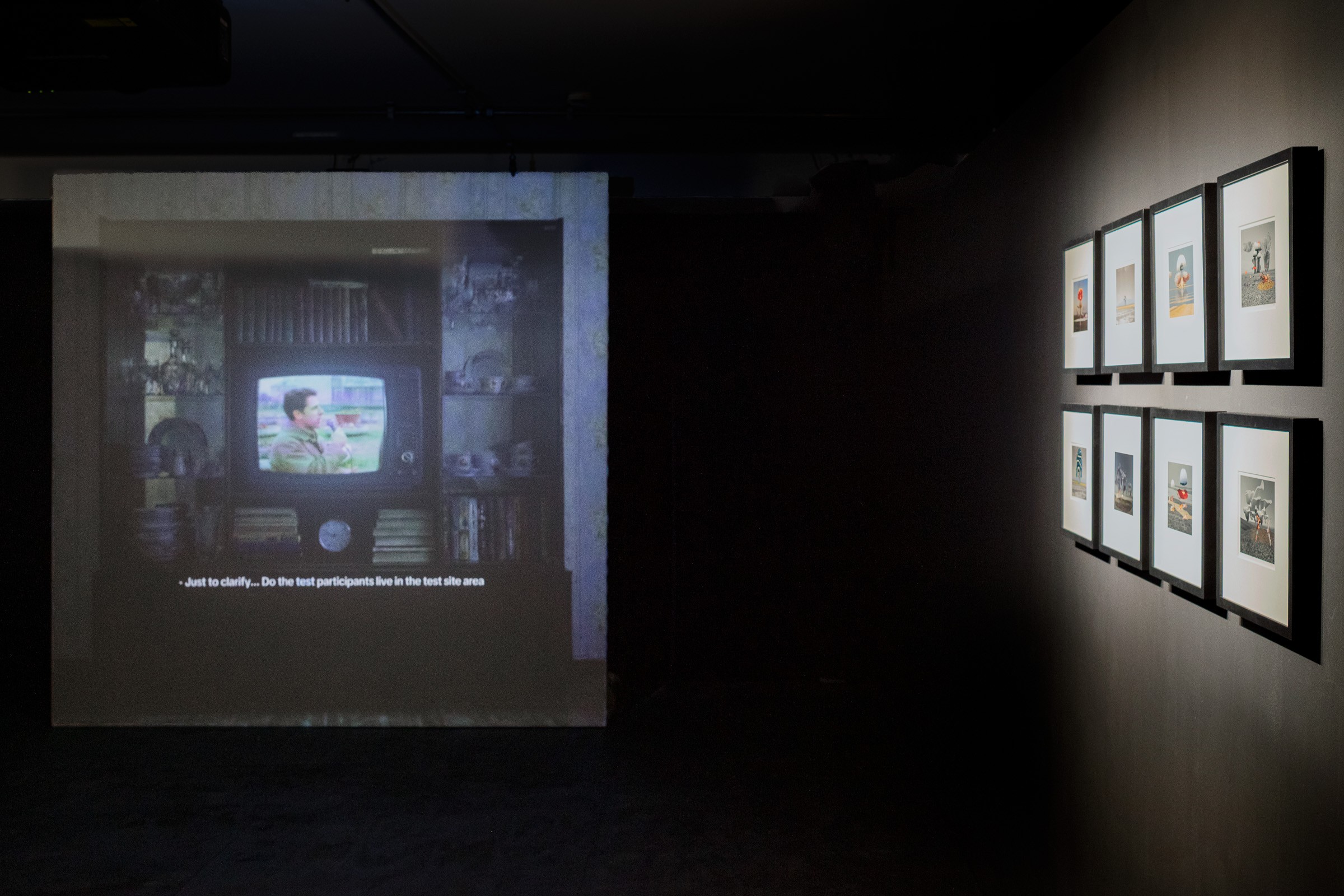
His The Audibility of Childhood combines AI-generated domestic interiors with fragments of Soviet television broadcasts to revisit the experience of growing up near a nuclear testing site in Kazakhstan – capturing the gap between a child’s pride at hearing their city spoken aloud from the distant metropolis and the catastrophic reality that those broadcasts were actually reporting, which remained entirely outside a child’s comprehension.
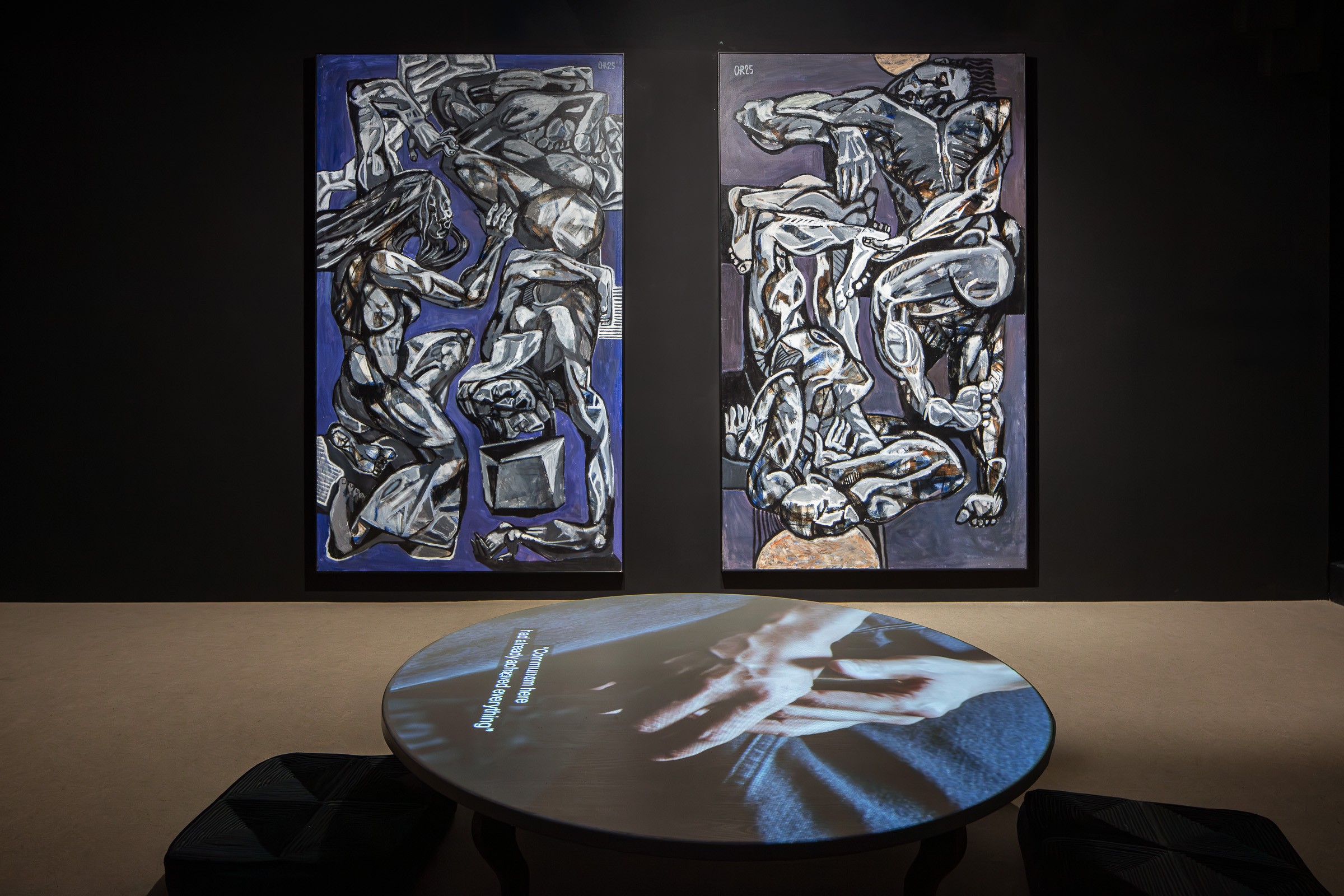
Kaboke, known for his sculptures and dynamic paintings that merge national heritage with modern life, joins Smagambetov in a shared work structured around the traditional Qazaq round table, using that communal form as a site for conversations about memory, historical disruption, and the Soviet reshaping of the steppe.
Nearby, Nurbol Nurakhmet – a young Kazakhstani painter of portraits, still-lives and scenes of everyday life in Kazakhstan – contributes Kitchen Recipes, a series of small, framed collages placing mushroom clouds alongside scenes of cooking and domestic routine, collapsing nuclear history into the texture of the ordinary. He points out how these histories were never separate from daily life to begin with.
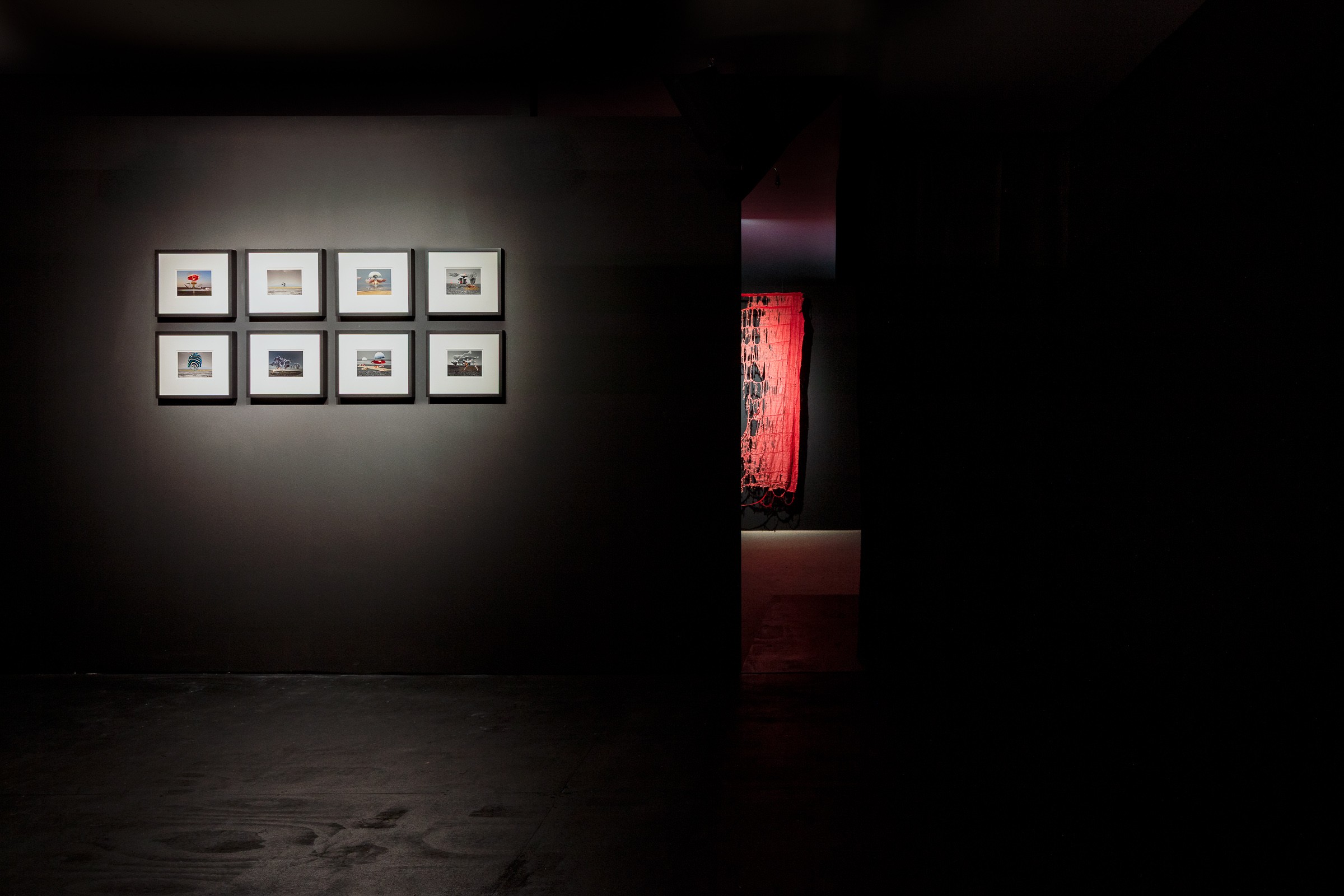
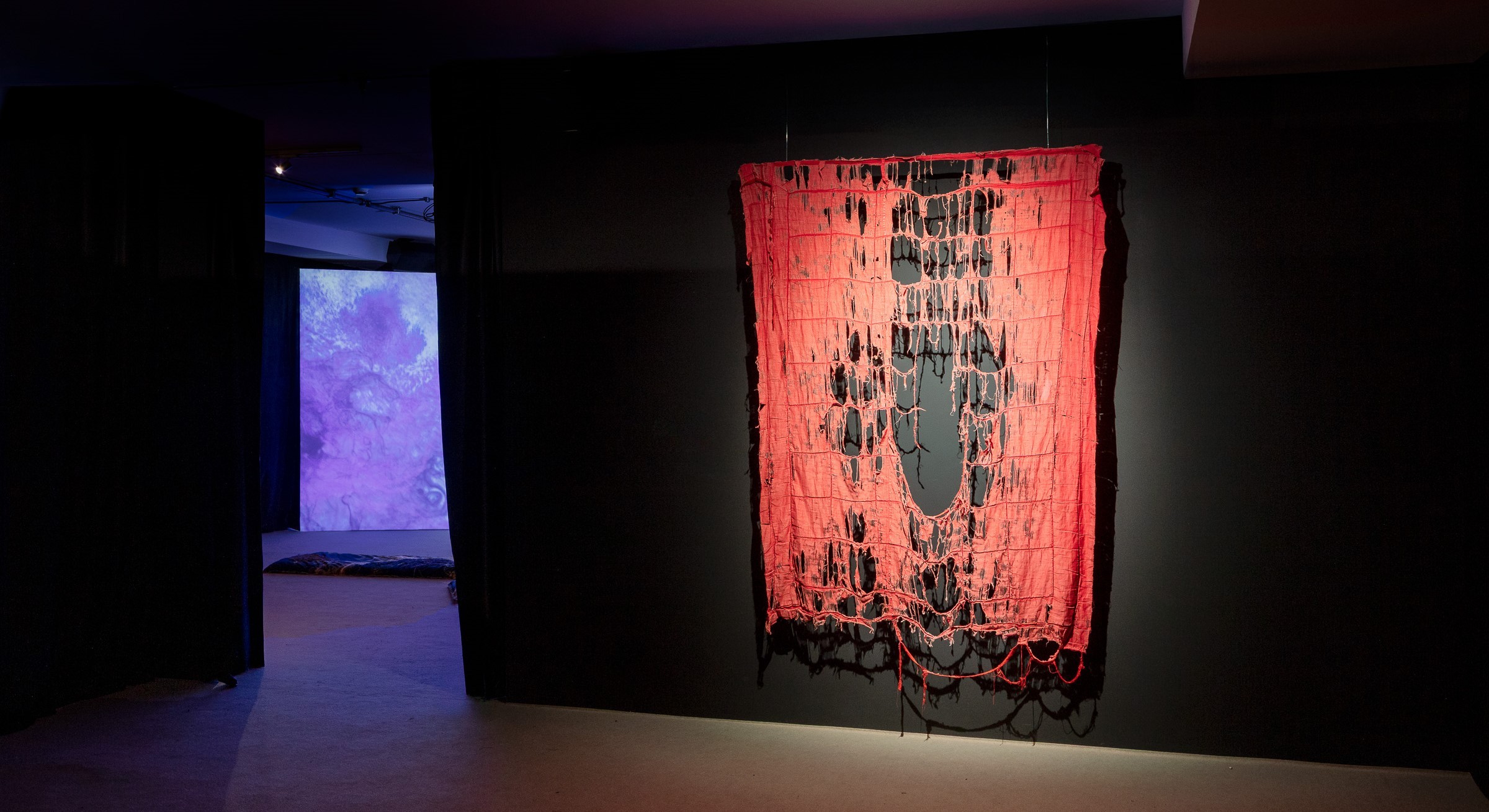
A different kind of material intimacy governs the following room, where Anar Aubakir presents Matrix of a New Subject. The work uses the reclaimed inner layer of a worn camel-wool quilt, transformed into something resembling an Alberto Burri artwork, where the fabric of the canvas itself is torn and marked by use. Described as a family heirloom blanket staged as material and generational rupture, the work treats the quilt’s fibres as carriers of memory, inscribed by the wears of time.
The journey concludes with Qoñyr Äulie: Immersion into the Quiet Depths, a three-screen digital installation by Ardak Mukanova, a versatile multimedia artist, designer and researcher specializing in the intersection of digital and physical domains.
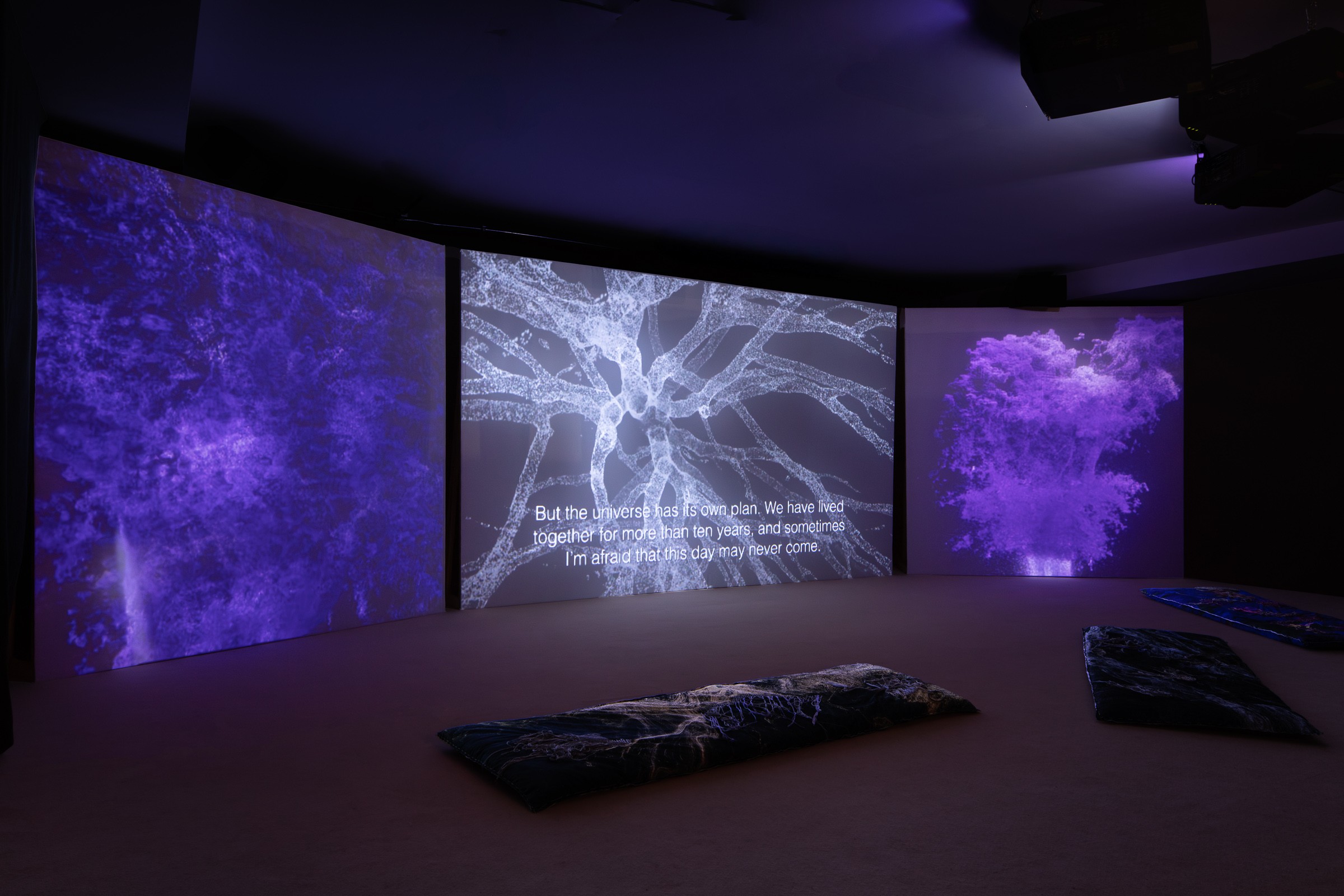
Her work draws on the sacred cave of Qoñyr Äulie in East Kazakhstan, a site associated with healing and pilgrimage for centuries, using LiDAR scans of the cave itself, transformed into a glowing digital landscape that feels simultaneously sacred and synthetic.
Figures move slowly through the darkness as though entering another temporal register. The installation follows a descent through layered cultural and spiritual strata, somewhere between cave, dream, and digital reconstruction, where the boundary between the astral expanses of the universe and the interior depths of the body dissolves.
Qoñyr: The Archive of Silence is a genuinely accomplished exhibition, one that refuses the twin traps of folkloric self-exoticisation and frantic contemporaneity.
“Rather than relying on familiar stereotypes, [the exhibition] approaches the country through inner memory, quiet narratives, and the texture of everyday experience,” Bekbota concludes. “Within the space, traces of nomadic culture meet contemporary reinterpretation. Through archive, landscape, and personal memory, Kazakhstan appears not as something singular or stable, but as a living, shifting, and polyphonic process.”
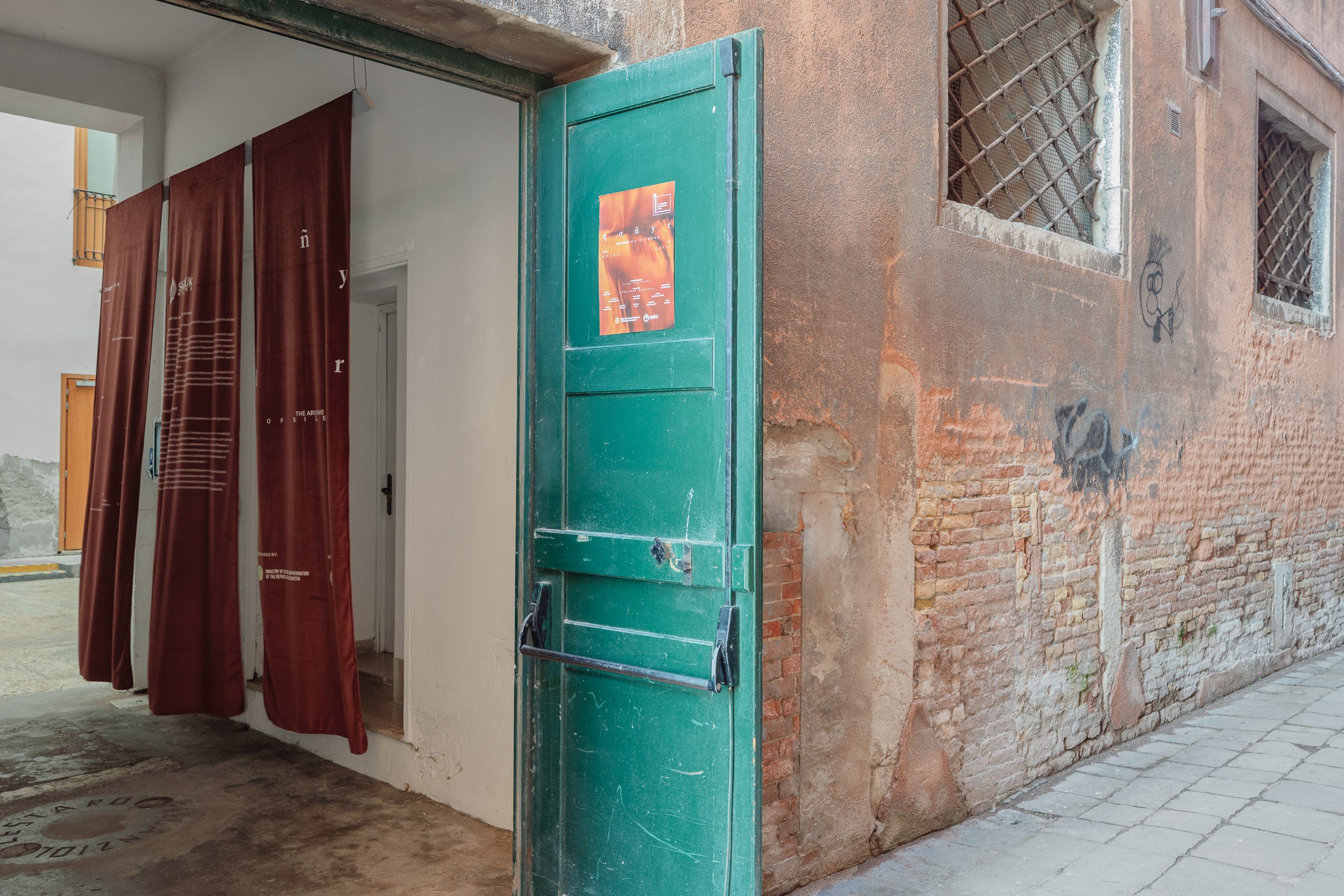
Qoñyr: The Archive of Silence, Kazakhstan Pavilion, Museo Storico Navale, Venice. 9 May – 22 November 2026.