• KGS/USD = 0.01144 0%
  • KZT/USD = 0.00212 0%
  • TJS/USD = 0.10609 0.28%
  • UZS/USD = 0.00008 0%
  • TMT/USD = 0.28530 0%
  • KGS/USD = 0.01144 0%
  • KZT/USD = 0.00212 0%
  • TJS/USD = 0.10609 0.28%
  • UZS/USD = 0.00008 0%
  • TMT/USD = 0.28530 0%
  • KGS/USD = 0.01144 0%
  • KZT/USD = 0.00212 0%
  • TJS/USD = 0.10609 0.28%
  • UZS/USD = 0.00008 0%
  • TMT/USD = 0.28530 0%
  • KGS/USD = 0.01144 0%
  • KZT/USD = 0.00212 0%
  • TJS/USD = 0.10609 0.28%
  • UZS/USD = 0.00008 0%
  • TMT/USD = 0.28530 0%
  • KGS/USD = 0.01144 0%
  • KZT/USD = 0.00212 0%
  • TJS/USD = 0.10609 0.28%
  • UZS/USD = 0.00008 0%
  • TMT/USD = 0.28530 0%
  • KGS/USD = 0.01144 0%
  • KZT/USD = 0.00212 0%
  • TJS/USD = 0.10609 0.28%
  • UZS/USD = 0.00008 0%
  • TMT/USD = 0.28530 0%
  • KGS/USD = 0.01144 0%
  • KZT/USD = 0.00212 0%
  • TJS/USD = 0.10609 0.28%
  • UZS/USD = 0.00008 0%
  • TMT/USD = 0.28530 0%
  • KGS/USD = 0.01144 0%
  • KZT/USD = 0.00212 0%
  • TJS/USD = 0.10609 0.28%
  • UZS/USD = 0.00008 0%
  • TMT/USD = 0.28530 0%

Our People > Dr. Robert M. Cutler

Dr. Robert M. Cutler's Avatar

Dr. Robert M. Cutler

Senior Editor and Contributor

Robert M. Cutler has written and consulted on Central Asian affairs for over 30 years at all levels. He was a founding member of the Central Eurasian Studies Society’s executive board and founding editor of its Perspectives publication. He has written for Asia Times, Foreign Policy Magazine, The National Interest, Euractiv, Radio Free Europe, National Post (Toronto), FSU Oil & Gas Monitor, and many other outlets.

He directs the NATO Association of Canada’s Energy Security Program, where he is also senior fellow, and is a practitioner member at the University of Waterloo’s Institute for Complexity and Innovation. Educated at MIT, the Graduate Institute of International Studies (Geneva), and the University of Michigan, he was for many years a senior researcher at Carleton University’s Institute of European, Russian, and Eurasian Studies, and is past chairman of the Montreal Press Club’s Board of Directors.

Articles

Tokayev Moves to Reclaim Kazakhstan’s Energy Future

In January 2025, Kazakhstan’s President Kassym-Jomart Tokayev instructed the government to seek revisions to the nation’s production-sharing agreements (PSAs). The first known result of that directive has now surfaced, with the International Consortium of Investigative Journalists (ICIJ) publishing a report regarding a confidential interim ruling in an arbitration case. According to this information, Kazakhstan is pursuing a $160 billion claim against the North Caspian Operating Company (NCOC), the consortium managing the Kashagan oil field. The ruling states that after royalty payments, NCOC receives 98% of remaining revenue from Kashagan’s output. The document concerns a narrower environmental dispute, but the 98% figure alters the landscape. The contract in question dates to the 1990s, when Kazakhstan — newly independent, fiscally constrained, and eager for technical expertise — entered into deals that prioritized attracting investment over securing long-term national benefit. The government now argues that those historical constraints no longer apply, while the revenue-sharing terms remain effectively frozen in place. Rather than seek unilateral redress or executive override, Tokayev’s administration has turned to arbitration. The venue, the Permanent Court of Arbitration in The Hague, and the legal framing mark a continuation of Kazakhstan’s methodical approach to reasserting national interests in its domestic political economy. This latest move cannot be understood as an isolated decision. It reflects a trajectory of state behavior extending back three decades. In the early 1990s, when Chevron’s bid for Tengiz was effectively imposed as a condition for U.S. bilateral assistance, Kazakhstan lacked both the leverage and the institutional competence to resist — a dynamic I analyzed in detail at the time. Chevron’s refusal to direct more than a token amount of investment to social infrastructure nearly sank the agreement. A similar dynamic surrounded the financing and structuring of the Caspian Pipeline Consortium (CPC). Kazakhstan’s attempts to assert greater influence were often thwarted, not least by the asymmetry of legal expertise and negotiating experience. That imbalance began to shift by the early 2000s. The creation of KazMunaiGas (KMG) in 2002 consolidated the state's participation in the energy sector and enabled its strategic action to become more coordinated. By 2003, Kazakhstan was insisting on conformity with international accounting standards at Tengiz, not only to ensure transparency but also to block attempts by foreign operators to defer investment obligations. Environmental enforcement became more assertive as well, with fines imposed on Tengizchevroil for massive open-air sulfur storage, a practice that had long provoked public concern. The Kashagan field, discovered in the late 1990s and described as the largest oil find since Alaska’s Prudhoe Bay in 1968, became the focal point of these tensions. From the outset, Kazakhstan’s participation in the consortium was marginal. A restructuring of the consortium in the early 2000s brought KMG back in, but cost overruns and delays continued. By 2007, the government had suspended work at Kashagan, citing both ecological violations and spiraling expenditures, in a sequence of events I traced contemporaneously during the legislative and consortium restructuring that followed. Amendments to the Law on the Subsurface followed, granting...

12 months ago
Why Europe Is Betting Big on Kazakhstan’s Future

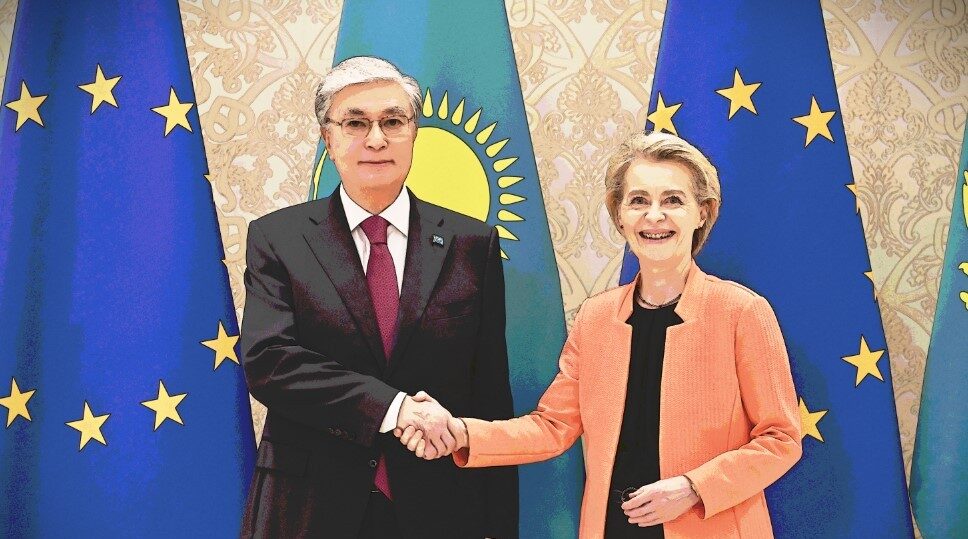
On April 3, Kazakhstan’s President Kassym-Jomart Tokayev met with European Commission President Ursula von der Leyen in Samarkand, ahead of the Central Asia–European Union summit. Although the meeting was brief, it came at a key moment, bringing into focus a set of shared economic and technological priorities that both sides increasingly treat as strategic. Tokayev made his position plain: Kazakhstan is looking to push forward in four core areas of cooperation with the EU: energy, industrial infrastructure, transport and logistics, and digital technology. Each of these lines up with the country’s broader goals for economic modernization. The two leaders also acknowledged recent steps toward a simplified EU visa regime for Kazakhstani nationals, which would ease movement for businesses and professionals in both directions. The meeting itself fits into a growing pattern. It builds on the first five-country Central Asia–EU leaders’ summit held in Astana back in October 2022. That gathering marked a turning point, putting the EU’s regional engagement on firmer institutional footing. It went beyond symbolic gestures and aimed at unlocking concrete investment opportunities. Since then, the EU has moved quickly to back up its commitments with financial and logistical support. Much of this has flowed through the Global Gateway initiative, a flagship program designed to channel European investment into infrastructure projects in developing and strategically situated economies. The European Bank for Reconstruction and Development (EBRD) has had a visible role in this process, running studies and financing projects across the transport, energy, and trade connectivity sectors. One EBRD-backed report, published in 2023, offered a striking projection: around €18.5 billion would be needed to scale container transport between the EU and Central Asia by a factor of eight. The goal was to go from fewer than 100,000 TEUs per year to roughly 865,000 by 2040. In response, the EU and the EBRD convened an Investors' Forum in early 2024, bringing in more than €10 billion in early-stage pledges. A second forum is now scheduled for 2025, with new focus areas, including mining, supply chains, and processing industries. During the Samarkand discussion, von der Leyen underlined the strategic significance of the Middle Corridor, also known as the Trans-Caspian International Transport Route (TITR). This project has been gaining traction in EU planning circles as an alternative to routes running through Russia or the Gulf. The corridor promises not only economic returns but greater resilience in east–west supply chains. Kazakhstan, by geography and by political posture, is positioned at the center of this shift. Its participation is not just beneficial but also structurally important. The timing of the meeting was also notable. Just a day earlier, Kazakhstan’s Ministry of Industry and Construction had announced a major find: a substantial deposit of rare earth elements at the Kuirektykol site. State-supported geological teams working in that region reported an estimated one million tons of potential material. Preliminary surveys from two zones, Irgiz and Dos 2, showed mineral content exceeding 0.1%, with some samples reaching as high as 0.25%. This level is a strong signal...

1 year ago

How Kazakhstan and Azerbaijan Are Rewiring the Middle Corridor

Kazakhstan's acceleration of its strategic alignment with Azerbaijan signals more than bilateral convergence. It reflects a deeper structural reconfiguration of Eurasian connectivity, a reconfiguration that is not additive but integrative. As documented in multiple announcements and institutional moves across March 2025, their cooperation has crossed the threshold from parallel development to systemic coordination. This evolving dynamic illustrates the emergence of a regionally endogenous axis that, without proclaiming itself as such, is shaping the wider functional geometry of Eurasia. At the material core of this shift is the Middle Corridor — the Trans-Caspian International Transport Route (TITR) — linking China to Europe via Central Asia, the Caspian Sea, and the South Caucasus. While long viewed as a technical alternative to the Northern and Southern corridors, the Middle Corridor is now exhibiting the dynamics of what in systems theory would be called self-amplifying dynamic feedback loops. (The technical term is “autopoiesis,” literally “self-creation” of “self-production.”) In particular, institutional feedback, infrastructure reinforcement, and regulatory adaptation are all feeding into one another in ways characteristic of an autonomously emergent macroregional logic. Kazakhstan’s announcement in December 2024 of the financing of a new terminal at Alat port in Azerbaijan, on which construction began in 2025, illustrates this logic in material form. Simultaneously, Kazakhstan is upgrading its Aktau port, backed by Chinese capital from Lianyungang, to triple its container throughput by 2028. This situation exemplifies the transformation of quantity into quality. Specifically, the upgrades are instantiating a network strategy that values not only volumes but also redundancy, flexibility, and strategic optionality. The new fiber-optic cable agreement signed in March 2025 further reinforces this convergence. A 380-kilometer undersea connection between Sumqayit and Aktau — part of the broader Digital Silk Road — will reduce latency between the two countries from hours to milliseconds. In system-theoretic terms, this is not merely a technical augmentation. It converts the corridor from a physical transit route into a distributed digital platform capable of supporting real-time adaptive coordination. This shift from “throughput” to “synchronization” is foundational. It also deepens the infrastructure-energy-information triad that has become characteristic of new macroregional systems. Kazakhstan’s expanded use of the Baku-Tbilisi-Ceyhan (BTC) pipeline, projected to carry 1.7 million tons of its oil in 2025, is not simply diversification. It is the strategic concretization of Azerbaijan’s role as a downstream node for Central Asian hydrocarbons. This is occurring alongside green transition signaling, including a modest floating solar project at Lake Boyukshor and a trilateral renewable energy agreement between Kazakhstan, Azerbaijan, and Uzbekistan. The repurposing of hydrocarbon corridors for hybrid energy flows is not substitution but overlay, in effect a dual-pathway system. Meanwhile, capital commitment is reinforcing the commercial aspect. A $300 million joint investment fund announced by the two countries has already designated the construction of an intermodal terminal at Alat as its inaugural project. Additional integration comes from the UAE-backed $50 million grain terminal at Kuryk, which will further diversify the system's carrying capacity by drawing agro-logistics into the corridor's functionality. In my recent article on the...

1 year ago

What Does Turkey’s “Return” to Europe Mean for Central Asia?

Turkey’s ties with Europe are undergoing a reinvigoration. This phenomenon is foregrounded by recent high-level diplomatic engagements and burgeoning military and economic linkages, which may at first glance appear as a realignment within the Euro-Atlantic system. It holds deeper implications, however, and most consequentially for Central Asia. Turkey is re-entering the European strategic imagination, this time not as a supplicant but as a self-assured middle power. Europe's altered international environment, by changing its external posture, will provide the Central Asian states with additional geopolitical resources in a world marked by shifting alignments and competing centers of power. To grasp the systems-level implications of this shift, one must first dispense with the linear narrative of bilateralism that has long framed Turkey-Europe or Turkey-Central Asia relations in isolation. Instead, Turkey’s position as a hub of multi-vectorial networks — anchored in NATO, increasingly interlocked with EU markets, yet culturally and politically entwined with Turkic Central Asia — makes it a proactive agent whose movement in one sphere triggers systemic perturbations across others. Thus, when Turkey edges closer to Europe, it also subtly reconfigures the vector of Central Asia’s international relations. The second Trump administration is continuing the transition in Europe’s security architecture that was inaugurated during the first. With longstanding assumptions about American commitment to the Atlantic alliance shaken, Europe finds itself unmoored. In this new context, Turkey’s military interventions — its incursions in northern and now central Syria, its containment of Russian advances in Ukraine, and its supply of military drones to Azerbaijan — demonstrate a degree of strategic autonomy that is rare among NATO members. Europe has noticed. The readjustment of its view of Turkey is evident through invitations to summits with key EU players, overtures from German and Polish leaders, and discussions around deepening the customs union. Turkey is no longer peripheral country knocking at the EU’s door; shifts in the international system have made it an increasingly indispensable node in the continent’s security and energy architectures. This European courtship of Turkey has ramifications well beyond Brussels or Berlin, or even Ankara. For the Central Asian states, afflicted by asymmetric dependencies on Russia, Turkey’s geopolitical normalization with Europe presents a "demonstration effect". That is, it puts the spotlight on a regional actor that is using soft power affinities and hard power capabilities to parlay its peripheral status into centrality. Turkey’s return to Europe showcases a successful strategy of multidirectional engagement. Such "strategic hedging" obviates obedience to any single bloc, instead leveraging the overall system's recursive entanglements for national-interest advantage. The Turkish-Azerbaijani partnership is illustrative. Turkey’s provision of military assistance used during the Second Karabakh War in 2020, notably the Bayraktar TB2 drones, enabled Azerbaijan to shift the regional balance. Russia is no longer the hegemonic power in the South Caucasus and must compete in a condition where it is diplomatically and militarily weakened by its war against Ukraine. Baku stands to benefit from its multisectoral economic cooperation with Ankara, which goes far beyond military assistance. Specifically, Azerbaijan's partnership with Turkey...

1 year ago

Inside the EU’s New Power Play in Eurasia

Kaja Kallas’s late-March 2025 tour of Central Asia, in her role as the European Union’s High Representative for Foreign Affairs and Security Policy, was a high-signal intervention in structural terms. It indicates a major re-evaluation of the EU’s posture toward a region historically treated as a far-flung, liminal borderland. As the inaugural EU–Central Asia Summit in Samarkand on April 3–4 approaches, her visible diplomatic activity was less about spectacle than about configuring a new field of co-adaptive engagement. Not only the European Union but also, separately, the United Kingdom are both seeking new regional footholds for building durable alignments. Central Asia, for decades considered through a lens of post-Soviet dependency or one of Chinese infrastructural absorption, is now increasingly recognized as a network node of emergent geopolitical agency. No longer just a space "between" other spaces, it is becoming a strategic space in its own right. Kallas’s mission and the UK’s parallel outreach signify a turn toward a negotiated interdependence that does not dissolve classical interest-based diplomacy but rather "complexifies" it by embedding it in a landscape of developmental trajectories and overlapping power centers. The arc of Kallas’s visit traced a deliberate sequence: Ashgabat, Tashkent, Almaty, Bishkek. In Ashgabat, she chaired the 20th EU–Central Asia Ministerial Meeting, a session nominally bureaucratic but substantively strategic. Discussions reaffirmed the 2023 EU–Central Asia Roadmap and activated the Global Gateway as an organizing frame for infrastructural, digital, and energy cooperation. Bilateral exchanges with officials in Turkmenistan brought the sensitive issue of sanctions circumvention into the open: Turkmenistan, though nominally neutral, remains enmeshed in logistics corridors proximate to Russian interest. From there, Kallas moved to Uzbekistan, where preparations for the April 3–4 Samarkand summit took clearer shape. Talks with President Shavkat Mirziyoyev and Foreign Minister Bakhtiyor Saidov in Tashkent widened the terrain of diplomatic discourse to include the energy transition, educational exchange, and regional transport integration. By hosting summits and fostering cooperation, Uzbekistan is seeking to establish for itself a profile as a key facilitator in Eurasian affairs. In Kazakhstan, her final significant stop, the meetings with President Kassym-Jomart Tokayev and Foreign Minister Murat Nurtleu emphasized macroeconomic diversification and critical raw material supply chains. These are areas in which the EU is not merely a partner but a principal stakeholder. And yet, it is not only the EU that has begun this strategic deepening. The United Kingdom, post-Brexit and still actively reconfiguring its global engagements, has moved in parallel. April 2025 marked the first anniversary of the UK–Kazakhstan Strategic Partnership and Cooperation Agreement. Foreign Office Minister Stephen Doughty’s recent hosting of the Kazakhstan–UK Strategic Dialogue marked 33 years of formal relations. These diplomatic celebrations, beyond their performativity, represent the UK’s recognition that Kazakhstan, and Central Asia more broadly, is a region where its strategic, commercial, and normative interests intersect. In this broader convergence, Kazakhstan plays a central structural role of a balancing nature. It shares long borders with both Russia and China; it hosts a significant Russian-speaking population; and it has maintained a political posture...

1 year ago