• KGS/USD = 0.01144 0%
  • KZT/USD = 0.00213 0%
  • TJS/USD = 0.10714 0.09%
  • UZS/USD = 0.00008 0%
  • TMT/USD = 0.28571 0%
  • KGS/USD = 0.01144 0%
  • KZT/USD = 0.00213 0%
  • TJS/USD = 0.10714 0.09%
  • UZS/USD = 0.00008 0%
  • TMT/USD = 0.28571 0%
  • KGS/USD = 0.01144 0%
  • KZT/USD = 0.00213 0%
  • TJS/USD = 0.10714 0.09%
  • UZS/USD = 0.00008 0%
  • TMT/USD = 0.28571 0%
  • KGS/USD = 0.01144 0%
  • KZT/USD = 0.00213 0%
  • TJS/USD = 0.10714 0.09%
  • UZS/USD = 0.00008 0%
  • TMT/USD = 0.28571 0%
  • KGS/USD = 0.01144 0%
  • KZT/USD = 0.00213 0%
  • TJS/USD = 0.10714 0.09%
  • UZS/USD = 0.00008 0%
  • TMT/USD = 0.28571 0%
  • KGS/USD = 0.01144 0%
  • KZT/USD = 0.00213 0%
  • TJS/USD = 0.10714 0.09%
  • UZS/USD = 0.00008 0%
  • TMT/USD = 0.28571 0%
  • KGS/USD = 0.01144 0%
  • KZT/USD = 0.00213 0%
  • TJS/USD = 0.10714 0.09%
  • UZS/USD = 0.00008 0%
  • TMT/USD = 0.28571 0%
  • KGS/USD = 0.01144 0%
  • KZT/USD = 0.00213 0%
  • TJS/USD = 0.10714 0.09%
  • UZS/USD = 0.00008 0%
  • TMT/USD = 0.28571 0%

Our People > Dr. Robert M. Cutler

Dr. Robert M. Cutler's Avatar

Dr. Robert M. Cutler

Senior Editor and Contributor

Robert M. Cutler has written and consulted on Central Asian affairs for over 30 years at all levels. He was a founding member of the Central Eurasian Studies Society’s executive board and founding editor of its Perspectives publication. He has written for Asia Times, Foreign Policy Magazine, The National Interest, Euractiv, Radio Free Europe, National Post (Toronto), FSU Oil & Gas Monitor, and many other outlets.

He directs the NATO Association of Canada’s Energy Security Program, where he is also senior fellow, and is a practitioner member at the University of Waterloo’s Institute for Complexity and Innovation. Educated at MIT, the Graduate Institute of International Studies (Geneva), and the University of Michigan, he was for many years a senior researcher at Carleton University’s Institute of European, Russian, and Eurasian Studies, and is past chairman of the Montreal Press Club’s Board of Directors.

Articles

Kazakhstan and Azerbaijan Are Reinforcing the Middle Corridor’s South Caucasus Link

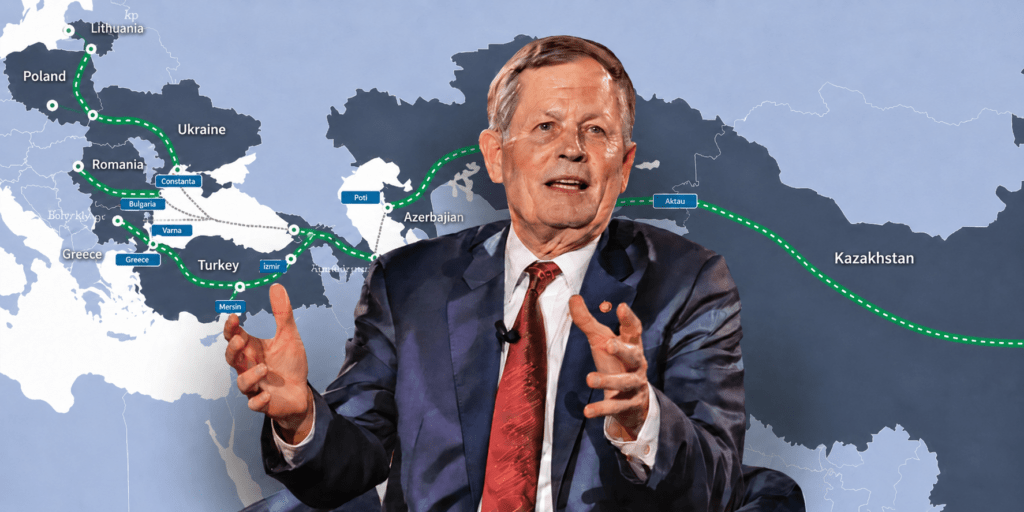
On April 7 Kazakhstan’s Foreign Minister Yermek Kosherbayev visited Tbilisi to hold talks with Georgian Foreign Minister Maka Bochorishvili and sign a 2026–2027 foreign-ministry cooperation program. He called Georgia “a key link” in the Europe–Asia transport architecture and said the common task was to raise corridor capacity, improve service predictability, and ensure tariff transparency. The materialization of the bilateral cooperation is already evident from last June’s opening of the Poti multimodal terminal by a joint Kazakhstani-Georgian company. The real meaning of Kosherbayev's discussions in Tbilisi lies in their context. On April 2 in Baku, Prime Minister Olzhas Bektenov said Kazakhstan plans an intergovernmental agreement with Azerbaijan this year to strengthen the status of the Middle Corridor (also known as the Trans-Caspian International Transport Corridor, TITR), and he proposed moving quickly on the Digital Monitoring Center under the Organization of Turkic States (OTS). On April 6 in Tbilisi, Azerbaijani President Ilham Aliyev called the Azerbaijan–Georgia segment the corridor’s “main transport artery.” Then on April 8 in Baku, Aliyev received Kosherbayev together with Kazakhstan’s transport minister. The official readout ranged from the Middle Corridor to joint investment, green-energy, and fiber-optic projects. Kosherbayev’s April 7 stop in Tbilisi thus belongs to a short Kazakhstan-led diplomatic run across the corridor’s western nodes. Kazakhstan and Azerbaijan Tighten the Corridor Kazakhstan’s early-April engagement in the South Caucasus rests on its eastward-looking framework with China. Two China–Kazakhstan documents were already in evidence in October 2023: a Memorandum of Understanding (MoU) on deepening the development of the China-Europe Railway Trans-Caspian route, and an intergovernmental agreement on developing that route. China’s National Development and Reform Commission (NDRC) subsequently clarified that the agreement focused on stronger transit organization, fewer administrative barriers, and improved logistics and transport operations. In July 2024, Kazakhstan’s President Kassym-Jomart Tokayev and his Chinese counterpart Xi Jinping jointly attended the opening of the Trans-Caspian direct fast transport service; NDRC then recorded a work mechanism with Kazakhstan’s transport ministry to carry that cooperation forward. On January 1, the first Trans-Caspian train of 2026 departed Xi’an for Baku carrying 45 containers of photovoltaic equipment. Chinese reports assert that the route had accumulated 466 runs by the end of November 2025, moved onto a weekly six-outbound and three-inbound timetable, and cut travel times from the roughly 20-day average recorded in 2025 to a standard 15 days, with the fastest runs taking 11 days. On April 3, it was also reported that there were 85 Xi’an Trans-Caspian trains in the first quarter of 2026, up 150% year-on-year, while the Kazakhstan–Xi’an terminal in Almaty handled more than 6,000 containers in that quarter alone, a 60% increase from a year earlier. A separate quasi-official Chinese trade-services portal reported that Trans-Caspian trains had reached daily service and that 371 such trains had run in January–October 2025, up 33%. China’s NDRC also said in late 2025 that Aktau and Baku should be strengthened as hub nodes in this corridor system. Azerbaijan is the indispensable partner without which the route’s western logic does not function. Bektenov’s...

1 month ago

Kazakhstan Gains Weight in China’s Energy System

The newly extended U.S. waiver for Russian oil transit through Kazakhstan and the reported giant onshore hydrocarbon discovery in western Kazakhstan point in different directions, yet they belong in the same analytical frame. One concerns an existing flow that already reaches China through working infrastructure, while the other concerns a possible future source that has not yet reached the stage of commercially proven reserves. Together, they mark a change in Kazakhstan’s position. The country is increasingly important to China both as a corridor and as a possible larger upstream partner. The U.S. waiver now runs until March 19, 2027. Kazakhstan is not a giant direct oil supplier to China in the way that Russia or Saudi Arabia is; China’s import structure is broader. But Kazakh-origin oil shipments, Russian transit oil, and adjacent energy links now constitute a single, more complex relationship. According to official Chinese sources, oil imported from Kazakhstan enters mainly through the China-Kazakhstan crude pipeline. More Than Kazakhstan’s Own Barrels Kazakhstan-China Pipeline LLP reported that in 2024, the Atasu-Alashankou route carried 1.2 million tons of oil and 9.989 million tons of transit oil, against a design capacity of 20 million tons a year. Official Chinese figures sharpen the point. By the end of 2024, total cumulative throughput on the pipeline had reached 280 million tons, including 19.139 million tons in 2024, while cumulative crude imported from Kazakhstan was lower. Kazakhstan’s significance to China is therefore larger than Kazakhstan’s own volumes would suggest, because the route carries more than Kazakhstan’s own oil. A glance at Europe keeps that proportion straight. Eurostat reports that Kazakhstan supplied 12.7% of the European Union’s petroleum oil imports in 2025. The European External Action Service said that Kazakhstan accounted for 10.9% of EU oil imports in the first quarter of 2024. This made it the bloc’s third-largest supplier in that period, and a more important direct oil supplier to Europe than to China. The significance of Kazakhstan’s geographic proximity to China becomes clearer when one looks beyond crude oil. Kazakhstan is not only a direct oil supplier, but also a transit corridor for multiple China-bound energy flows. The Kazakhstan-China oil pipeline is one of China’s major import routes. At the same time, while Kazakhstan’s own gas exports to China remain limited due to rising domestic demand, gas from Turkmenistan and Russia both pass through its territory. Oil and gas do not form a single operational system, but together they show that China’s energy connection with Kazakhstan extends beyond one commodity and beyond Kazakhstan’s own barrels. The Source Side May Be Growing In this context, the reported discovery on the Zhylyoi carbonate platform makes a difference because it widens the source side of the relationship without changing present flows. According to public statements by KazMunayGas officials, the Karaton, Kazhygali, and Zhylyoi formation has resource potential of 4.7 billion metric tons of hydrocarbons, and the broader Zhylyoi carbonate reservoir may hold as much as 20 billion metric tons of oil equivalent. The field is onshore in...

1 month ago

The Iran War Is Repricing Central Asia’s Connectivity

Europe’s aviation regulator has extended its current conflict-zone bulletin for the Middle East and Persian Gulf through April 10 and continues to advise operators to avoid Iranian and adjacent airspace at all altitudes. Reuters reported soon after that the squeeze on normal flight paths was pushing more traffic into narrower routes, notably over Azerbaijan and Central Asia. The Strait of Hormuz, meanwhile, has not returned to normal commercial use. A limited number of exempted vessels have crossed, but passage remains selective, politicized, and uncertain rather than routine. The question, consequently, is no longer only whether Central Asia has alternatives to single-route dependence but whether those alternatives remain commercially usable, taking into account the increased risk, delay, insurance, fuel burn, and congestion. What has changed is the cost of maintaining reliable connectivity. The Cost of Reliability The Iran conflict imposes higher operating costs on the wider Eurasian air corridor that is now taking displaced traffic. EUROCONTROL estimates that about 1,150 flights a day continue to be affected by re-routing linked to the Middle East crisis. These add roughly 206,000 kilometers of flying and 602 tons of extra fuel burn per day. Maritime trends are similar. In March, war-risk premiums in or near the Gulf had risen more than tenfold in some cases, with hull war premiums moving from about 0.25% of vessel value to as much as 3%. Air-freight rates on some routes rose by as much as 70% as shippers redirected urgent cargo away from disrupted sea lanes and restricted airspace. Higher surcharges and narrower margins for operational error can make routes lose commercial value even if they remain formally open. The wider macroeconomic setting has also made resilience more expensive. Higher oil prices make every detour costlier, raising freight charges, power costs, and production costs across the region’s trading partners. Even where Central Asian cargo does not move through Iranian waters, the same pattern is still present. Asian policymakers were already confronting a combined oil-price and currency shock at a moment when roughly 80% of the oil shipped through Hormuz normally goes to Asia. The World Bank’s March food and nutrition security update notes that around 20% of global oil supplies and about one-third of global fertilizer trade transit the Strait of Hormuz. Urea prices, for example, surged by nearly 46% month on month between February and March 2026. Importers in Central Asia, as well as in Europe and the South Caucasus, remain under pressure from higher household food costs and tighter producer margins. The price of resilience is now showing up in increased costs for farm inputs, food costs, and household budgets. How the Burden Falls Kazakhstan remains the best placed in the region to absorb the shift. The CPC pipeline still carries about 80% of Kazakhstan’s oil exports; oil income contributes 52% of the state budget. Earlier disruptions had constrained Kazakhstan to reroute 300,000 tons of crude, and the country continues to rely on supplementary outlets such as Ust-Luga, the Baku–Tbilisi–Ceyhan pipeline, and China when its main...

1 month ago

Berdimuhamedov’s Beijing Visit and the Reshaping of Central Asia’s Gas System

The visit by Turkmenistan’s Gurbanguly Berdimuhamedov, Chairman of the Halk Maslahaty, to Beijing on March 17–19 did more than routinely reaffirm Turkmenistan’s ties with China. It opened onto a wider issue in Central Asian energy, not simply about continuing the cooperation between Ashgabat and Beijing, but about how the renewal of that cooperation would affect the Central Asia–wide gas production and transmission system that increasingly intersects with China’s wider infrastructural and industrial presence in the region. No dramatic announcement of any new export route highlighted that wider significance, which emerged from a narrower sequence of policy initiatives that carried broader implications. Xi Jinping used the visit to restate the importance of cooperation in natural gas while widening the agenda to include connectivity, clean energy, artificial intelligence, and the digital economy. Within days of the meeting, Turkmenistan moved ahead on a new phase of development at Galkynysh with CNPC. These events signal a further deepening Chinese role in the upstream and systemic organization of Central Asian energy. What Beijing Actually Signaled Beijing’s own language about the matter was direct. In the official Xinhua account of Xi’s March 18 meeting with Berdimuhamedov, China called for the two sides to “expand the scale of cooperation in the natural gas sector” and to raise trade and investment levels. Such language confirms that gas remains at the center of the relationship even as the bilateral agenda widens. For all the parallel discussions of digitalization, transport links, and non-resource cooperation, the political weight of Sino-Turkmen ties still rests primarily on energy. The Chinese side, however, did not treat gas as a self-contained file. Gas remains the primary, but it is increasingly embedded within a wider pattern of regional engagement comprising energy, transport, and adjacent economic sectors. The same Beijing readout on the meeting with Berdimuhamedov placed connectivity, artificial intelligence, the digital economy, and clean energy alongside natural gas under a broader heading of expanded cooperation. This framing removes gas from its status as a stand-alone commodity and places it within a larger operational perspective. Neither the main Chinese readout nor the public official Turkmen framing of the visit highlighted Line D of the Central Asia–China gas pipeline system. Line D has long stood as the clearest indicator of a future expansion of Turkmen gas exports through Tajikistan and Kyrgyzstan into China. Had the visit produced a concrete breakthrough on that front, the official language would have been the obvious place to signal it. The practical movement after the trip lay elsewhere. Why It Matters Beyond Turkmenistan The focus lay at Galkynysh. In the immediate wake of the visit, President Serdar Berdimuhamedov authorized Turkmengaz to conclude a turnkey contract with CNPC Amudarya Petroleum Company Ltd. for Phase 4 of the Galkynysh gas field. The official Turkmen account linked the decision to meetings held during Gurbanguly Berdimuhamedov’s visit to China and specified facilities capable of processing 10 billion cubic meters of marketable gas per year. TCA reported the same move as a new phase of CNPC-backed field development....

2 months ago

The Iran Conflict Is Stress-Testing Central Asia’s Southern Corridors

Kazakhstan President Kassym-Jomart Tokayev’s proposal of Turkestan city as a venue for Iran-war negotiations shows how directly the conflict had already begun to affect Central Asia itself. The region is no longer simply observing events in Iran. By the time Tokayev made the offer, Central Asian governments were already dealing with evacuations, route disruption, emergency diplomatic coordination, and growing concern over the war’s economic effects. The Iran war has thus become a real test of Central Asia’s southern diversification strategy. Governments across the region have, in recent years, sought to widen access to world markets through Iran, the South Caucasus, and, in some cases, Afghanistan and Pakistan. These channels reduce dependence on northern routes by opening access to Türkiye, Europe, Gulf markets, and the Indian Ocean. The present crisis subjects that strategy to wartime conditions. The strain of war makes it easier to distinguish durable links, conditional ones, and routes that remain more aspirational than real. The C6 and Crisis Coordination The first effects have been practical. Turkmenistan has opened four additional checkpoints along its frontier with Iran, supplementing the Serakhs crossing, while Azerbaijan’s overland route through Astara became another critical outlet, evacuating 312 people from 17 countries between February 28 and March 2. Turkmenistan, according to official reporting, transited more than 200 foreign citizens from 16 countries during the same period. Uzbekistan used the Turkmen route to repatriate its citizens, while Kazakhstan directed its nationals toward overland exits through Turkmenistan, Azerbaijan, Armenia, and Türkiye. The war is already affecting borders, consular work, and the regional diplomatic agenda. This immediate response gives sharper political meaning to the widening of the Central Asian C5 into a C6 with Azerbaijan. The March 2 call among the five Central Asian foreign ministers and Azerbaijan showed that the format was already there to be used under pressure. What had until now appeared mainly as a corridor framework shaped by summit diplomacy and expert work appeared instead as a working format for crisis coordination linking Central Asia to the South Caucasus. The C6 idea is becoming more practical and more overtly diplomatic. The Organization of Turkic States adds a second, broader layer. Its foreign ministers met in Istanbul on March 7 and issued a joint statement expressing concern over the escalation in the Middle East, condemning actions that endanger civilians, warning against further regional destabilization, and affirming that threats to the security and interests of member states concern the organization as a whole. The statement was cautious, and the OTS is not turning into a military instrument. Even so, the war is testing whether a Turkic political space extending from Turkey through the South Caucasus to Central Asia can do more than express concern as regional security deteriorates. The C6 is becoming a working format for immediate coordination, while the OTS remains the broader political frame within which that coordination takes on institutional meaning. Corridor Stress and Resilience The trans-Iran transit option offers Central Asia a continuous land arc from regional railheads and road networks...

2 months ago