• KGS/USD = 0.01144 0%
  • KZT/USD = 0.00208 0%
  • TJS/USD = 0.10482 0.48%
  • UZS/USD = 0.00008 0%
  • TMT/USD = 0.28490 0%
  • KGS/USD = 0.01144 0%
  • KZT/USD = 0.00208 0%
  • TJS/USD = 0.10482 0.48%
  • UZS/USD = 0.00008 0%
  • TMT/USD = 0.28490 0%
  • KGS/USD = 0.01144 0%
  • KZT/USD = 0.00208 0%
  • TJS/USD = 0.10482 0.48%
  • UZS/USD = 0.00008 0%
  • TMT/USD = 0.28490 0%
  • KGS/USD = 0.01144 0%
  • KZT/USD = 0.00208 0%
  • TJS/USD = 0.10482 0.48%
  • UZS/USD = 0.00008 0%
  • TMT/USD = 0.28490 0%
  • KGS/USD = 0.01144 0%
  • KZT/USD = 0.00208 0%
  • TJS/USD = 0.10482 0.48%
  • UZS/USD = 0.00008 0%
  • TMT/USD = 0.28490 0%
  • KGS/USD = 0.01144 0%
  • KZT/USD = 0.00208 0%
  • TJS/USD = 0.10482 0.48%
  • UZS/USD = 0.00008 0%
  • TMT/USD = 0.28490 0%
  • KGS/USD = 0.01144 0%
  • KZT/USD = 0.00208 0%
  • TJS/USD = 0.10482 0.48%
  • UZS/USD = 0.00008 0%
  • TMT/USD = 0.28490 0%
  • KGS/USD = 0.01144 0%
  • KZT/USD = 0.00208 0%
  • TJS/USD = 0.10482 0.48%
  • UZS/USD = 0.00008 0%
  • TMT/USD = 0.28490 0%

Our People > Sergey Kwan

Sergey Kwan's Avatar

Sergey Kwan

Journalist

Sergey Kwan has worked for The Times of Central Asia as a journalist, translator and editor since its foundation in March 1999. Prior to this, from 1996-1997, he worked as a translator at The Kyrgyzstan Chronicle, and from 1997-1999, as a translator at The Central Asian Post.
divider
Kwan studied at the Bishkek Polytechnic Institute from 1990-1994, before completing his training in print journalism in Denmark.

Articles

Freight Volumes on Middle Corridor Through Kazakhstan Rise Fivefold in Seven Years

Freight volumes transported along the Trans-Caspian International Transport Route (TITR) through Kazakhstan have increased more than fivefold over the past seven years, highlighting the growing importance of the corridor as companies seek alternatives to routes passing through Russia. According to Kazakhstan’s Ministry of Transport, volumes have risen from 0.8 million tons to 4.5 million tons annually. Also known as the Middle Corridor, the TITR is a multimodal transport route linking China and Europe via Central Asia and the South Caucasus. The rapid growth of the route reflects wider shifts in Eurasian logistics since Russia’s full-scale invasion of Ukraine in 2022. With many Western companies seeking alternatives to traditional northern routes through Russia, governments and logistics operators across Central Asia and the South Caucasus have accelerated investment in the Trans-Caspian corridor, hoping to position it as a key artery linking Asian manufacturing hubs with European markets. Container transportation has been one of the fastest-growing segments of the corridor. In 2025, approximately 77,000 TEUs were transported along the TITR. Authorities aim to increase this figure to 300,000 TEUs by 2029. Despite rapid growth, the corridor still carries far less cargo than traditional northern routes through Russia, underscoring both its potential and the scale of investment still required. The expansion reflects ongoing infrastructure development and growing cooperation among participating countries and logistics operators. Key contributing factors include improved conditions for international freight transport, such as simplified customs procedures, as well as significantly shorter delivery times, reduced from roughly 28-32 days to 13-17 days. Demand has also risen for integrated “single-window” logistics services designed to enhance transparency and reliability. Kazakhstan, Azerbaijan, and Georgia continue to coordinate efforts under joint roadmaps to eliminate remaining bottlenecks along the corridor. To ensure year-round navigation and strengthen competitiveness, Kazakhstan is investing in infrastructure on the Caspian Sea coast. Dredging has already been completed at Kuryk Port, while similar work is planned at Aktau Port this year to increase depth and improve vessel access. Construction is also underway at Kuryk on the Sarzha multifunctional terminal, a project being implemented in cooperation with Abu Dhabi Ports Group from the United Arab Emirates. The terminal is expected to have an annual capacity of five million tons. Meanwhile, a container hub has been launched at Aktau Port, further enhancing maritime logistics capacity along the corridor. Kazakhstan has also expanded its transport infrastructure abroad. A Kazakh-operated terminal with a capacity of 120,000 TEUs has been launched at the Georgian port of Poti, improving cargo handling efficiency along the TITR. The European Union is also supporting the corridor’s development. A grant has been allocated for the reconstruction of Berths No. 3 and No. 12 at Aktau Port. The funding will be used to purchase wind-resistant ship-to-shore cranes to ensure stable operations during adverse weather conditions. On the railway side, Kazakhstan is upgrading more than 2,000 kilometres of rail infrastructure connected to the corridor. In 2025, construction and modernisation work were completed on 911 kilometres of railway lines. Key projects include the construction of second...

2 weeks ago

Kyrgyzstan’s Health Ministry Proposes Higher Taxes on Sugary Drinks and Salty Foods to Protect Public Health

Kyrgyzstan’s Ministry of Health has proposed reforms to the country’s excise tax system targeting sugar-sweetened beverages and foods with high salt content in an effort to reduce their consumption and improve public health. The proposal was discussed on March 9 at a meeting involving representatives of the Ministry of Economy and Commerce, the Ministry of Finance, the State Tax Service, the Ministry of Agriculture, the World Health Organization (WHO), UNICEF, and leading business associations. Currently, Kyrgyzstan applies a uniform excise tax of 3 soms (about $0.03) per liter on sugar-sweetened non-alcoholic beverages, regardless of their sugar content. The Ministry of Health proposes introducing a differentiated excise tax system in which the rate would depend on the amount of sugar in a beverage: Up to 5 grams of sugar per 100 ml - 5 soms (about $0.06) per liter 5-8 grams per 100 ml - 7 soms (about $0.08) per liter 8-11 grams per 100 ml - 9 soms (about $0.10) per liter More than 11 grams per 100 ml - 11 soms (about $0.12) per liter Officials say the new structure would encourage manufacturers to reduce sugar content in beverages, promote healthier consumer habits, and decrease consumption of high-sugar products. The ministry also proposes introducing a fixed excise tax of 20 soms (about $0.20) per liter on energy drinks, citing their high levels of sugar and caffeine and the potential health risks they pose, particularly for adolescents. Authorities are also considering similar differentiated taxation for foods with high salt content, including fried and salty snacks such as chips, salted crackers, and similar products. The goal is to discourage excessive consumption of high-salt foods and reduce related health risks. Representatives of the World Health Organization and UNICEF have expressed support for the proposal. WHO representative Alina Altymyshova noted that similar measures are widely used around the world. According to her, 116 countries already apply various forms of taxation or regulation on foods and beverages high in sugar and salt to help prevent noncommunicable diseases and promote healthier diets. She also highlighted numerous international studies demonstrating the negative health impacts of regular consumption of sugary beverages, particularly among children and adolescents. Deputy Health Minister Temirbek Erkinov warned that unhealthy diets are becoming a growing public health challenge in Kyrgyzstan. According to data from the National Statistical Committee for 2023, about 9% of children in Kyrgyzstan, roughly one in eleven, are overweight. Other indicators highlight widespread unhealthy dietary habits: 75% of children aged 6-23 months consume unhealthy foods 78% regularly drink sugary beverages 16% do not consume fruits and vegetables daily More than 84,000 people in Kyrgyzstan are currently registered with diabetes, with the number increasing by 5,000 to 7,000 cases each year. “The issue of nutrition and related diseases is becoming one of the most serious challenges for the public health system,” Erkinov said. Health officials believe measures to reduce the consumption of foods high in sugar and salt should become an important tool in preventing noncommunicable diseases and improving the country’s...

2 weeks ago

Kyrgyzstan Signs Deal to Acquire Two Airbus A321 Aircraft

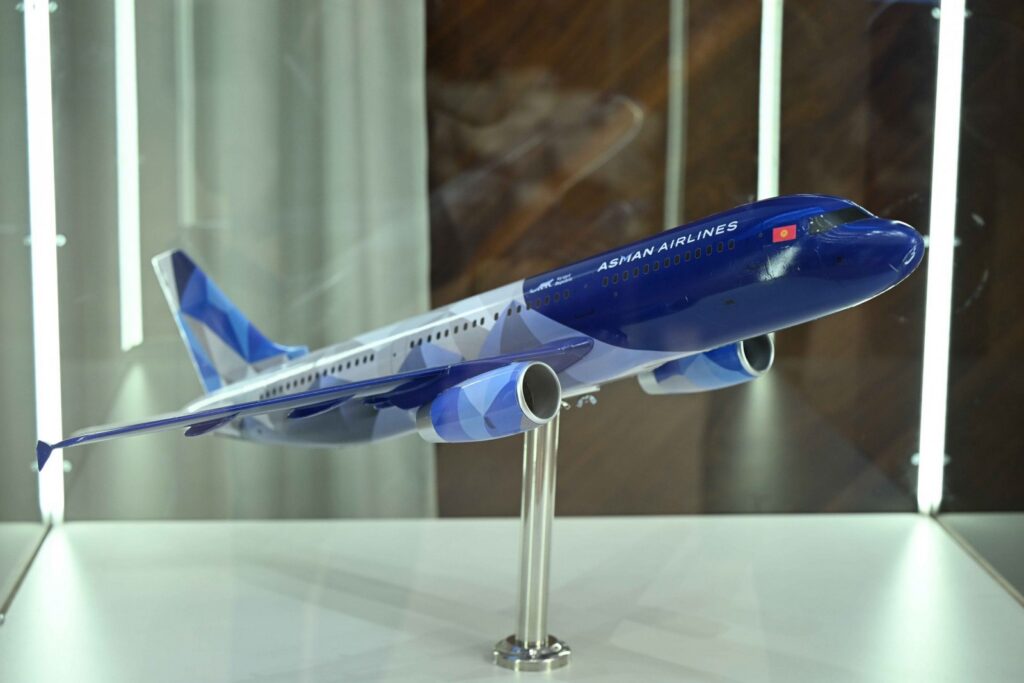
Kyrgyzstan has signed an agreement to acquire two Airbus A321ceo aircraft as part of efforts to expand the country’s civil aviation sector and launch new international routes. The signing ceremony took place on March 5 in Bishkek, where the agreement was signed by Manasbek Samidinov, chairman of the board of Airports of Kyrgyzstan OJSC, and Maurice Prendergast, senior vice president of BBAM Aircraft Leasing & Management. The event was attended by Johan Pelissier, president of Airbus Europe, and Kyrgyz Prime Minister Adylbek Kasymaliev. According to the agreement, the aircraft will be delivered to Kyrgyzstan by the end of 2026. They are intended for the state-owned carrier Asman Airlines, a subsidiary of Airports of Kyrgyzstan. The new aircraft are expected to support the launch of international flights and improve operational capacity. Asman Airlines currently operates three Dash 8 Q400 aircraft, Canadian-made short-haul turboprop planes capable of carrying up to 80 passengers over distances of up to 2,000 kilometers. These aircraft serve domestic routes across Kyrgyzstan after the airline recently restored air connections between Bishkek and several remote regional centers. Speaking at the ceremony, Kasymaliev said that the acquisition of modern and efficient aircraft would help raise Kyrgyzstan’s civil aviation sector to a new level of development. He added that between 2021 and 2025 the number of passengers served at Kyrgyzstan’s airports on domestic and international routes increased by 52%, while the number of flights rose by 53%. Kasymaliev also noted that audits conducted by the International Civil Aviation Organization (ICAO) in 2023-2024 confirmed that Kyrgyzstan’s aviation system complies with international standards. According to the latest audit, the aviation security compliance rate reached 85.76%, a significant improvement compared with previous results. “These achievements create the necessary conditions for Kyrgyzstan to be removed from the European Union’s aviation safety blacklist,” the prime minister said, adding that the final audit by the European Commission is expected in the coming days. Later the same day, President Sadyr Japarov met with Johan Pelissier and Maurice Prendergast to discuss the development of Kyrgyzstan’s aviation sector. During the meeting, Japarov highlighted the rapid modernization of airport infrastructure and the expansion of domestic air routes. While previously only four airports in the country were fully operational, all 11 airports in Kyrgyzstan are now functioning. Construction of a new international airport in Jalal-Abad is also underway. The president also confirmed that Kyrgyzstan is in the final stage of the process to be removed from the European Union’s aviation safety blacklist, with the final inspection expected later this month.

2 weeks ago

Turkmen Natural Gas Could Supplement Azeri Supplies to Europe via the Southern Gas Corridor

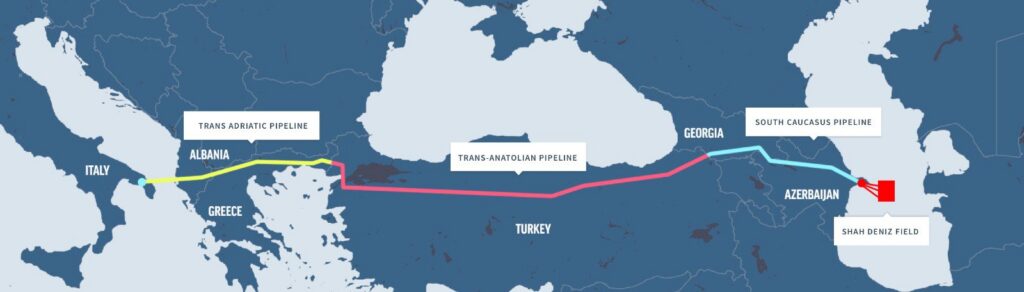
Turkmenistan views the Trans-Caspian Gas Pipeline project as one of the most important directions for diversifying its energy exports and strengthening energy security on the European continent, Turkmenistan’s former president Gurbanguly Berdymuhamedov said in an interview with the Al Arabiya television channel during his visit to the United States in February, according to official Turkmen media. The Trans-Caspian Gas Pipeline is a proposed infrastructure project designed to transport natural gas from Turkmenistan to Azerbaijan across the Caspian Sea, where it could connect to the Southern Gas Corridor (SGC). The SGC is intended to reduce Europe’s dependence on Russian gas and diversify the continent’s energy supplies by bringing natural gas from the Caspian region to European markets. Its primary supply source is Azerbaijan’s Shah Deniz gas field in the Caspian Sea. The corridor stretches from Azerbaijan through Georgia and Türkiye to Greece, Albania, and Italy. Turkmenistan is widely viewed as a potential additional supplier for the SGC, which could become increasingly important if Azerbaijani gas alone proves insufficient to meet rising European demand. Berdymuhamedov said that progress on the Trans-Caspian Gas Pipeline requires resolving international legal issues, particularly those related to the delimitation of the Caspian seabed. A Turkmen-Azerbaijani working commission has been established for this purpose. “We hope that its work will yield significant practical results,” he said. Berdymuhamedov also emphasized Turkmenistan’s large hydrocarbon resources, noting that the country ranks fourth globally in proven natural gas reserves. “For some time in the past, the bulk of Turkmen natural gas exports went to Russia, which received up to 40 billion cubic meters per year. Currently, China is our main gas buyer, with supply volumes at roughly the same level,” Berdymuhamedov said. He added that Turkmenistan’s policy of diversification allows the country to supply gas within the region through swap arrangements involving Iran and Azerbaijan, as well as Kazakhstan, Uzbekistan, and other neighboring states. Turkey is also considered a key link for potential Turkmen gas exports to Europe. Turkish Vice President Fuat Oktay previously said that, in cooperation with Azerbaijan, Turkmen natural gas could be transported through the Trans-Anatolian Natural Gas Pipeline (TANAP), which runs across Türkiye and forms the central segment of the Southern Gas Corridor. Oktay expressed confidence that negotiations between Turkey's Ministry of Energy and Natural Resources, the Turkish state energy company BOTAŞ, and Turkmenistan’s state-owned gas producer, Türkmengaz, could soon produce positive results. He also stated that Turkish state companies are ready to participate in the development of hydrocarbon resources at the jointly developed Turkmen-Azerbaijani Dostluk field in the Caspian Sea. Speaking at the 12th Ministerial Meeting of the Southern Gas Corridor Advisory Council in Baku on March 3, Zafer Demircan, Turkey's Deputy Minister of Energy and Natural Resources, highlighted the corridor’s strategic importance. “There is a strong common understanding of the crucial role of the Southern Gas Corridor in achieving long-term energy supply security,” Demircan said. “This valuable concept is evolving toward a Green Energy Corridor linking states in the Caucasus and Central Asia with Europe. Türkiye...

3 weeks ago

South Korea Supports Kyrgyzstan’s Transition to Electric Transport

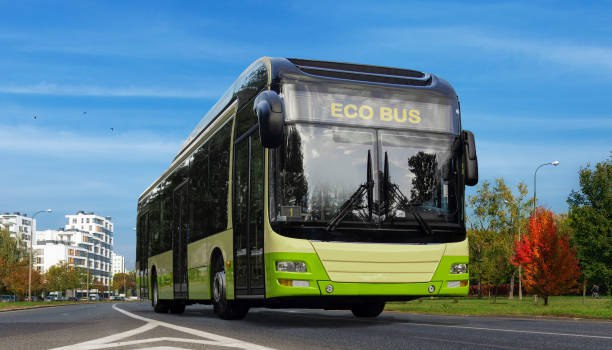
South Korea is expanding support for Kyrgyzstan’s transition to electric mobility through new investments in charging infrastructure and the electrification of government vehicles. Blue Networks Co., Ltd., a South Korean company specializing in electric vehicle (EV) charging infrastructure that has installed more than 3,500 charging stations in South Korea, plans to install 300 EV charging stations across Kyrgyzstan by July 2026. The initiative was discussed during a March 3 meeting between Kyrgyz Energy Minister Taalaibek Ibraev and representatives of Blue Networks. Cooperation between Kyrgyzstan and Blue Networks began in 2024, when the state-owned energy company Chakan HPP and the South Korean firm signed a memorandum on the joint development and operation of EV charging stations. In 2025, the partners signed a framework agreement to establish a manufacturing facility in Kyrgyzstan to assemble EV charging stations. As part of the agreement, a joint venture has already been established, and the launch of the assembly plant is scheduled for April 2026. Digitalization was also a key topic during the meeting. Blue Networks said it is developing software to manage EV charging infrastructure and agreed to provide Kyrgyzstan’s Ministry of Energy with access to the system to ensure transparency, monitoring, and efficient management of the future charging network. The initiative forms part of broader support from South Korea for Kyrgyzstan’s transition to electric mobility. On March 3, the Korea International Cooperation Agency (KOICA) handed over electric vehicles under the project “Electric Vehicle Transition Project for Public Service Fleet to Realize Green Mobility in the Kyrgyz Republic.” The ceremony was attended by Kyrgyz Deputy Minister of Economy and Commerce Mederbek Tumanov, South Korean Ambassador to Kyrgyzstan Kim Kwangjae, KOICA Country Director Lim Soyeon, and representatives of participating government institutions. According to the KOICA Kyrgyzstan office, ten electric SUVs will be distributed among key government institutions during the first phase of the project. The initiative, which runs from 2024 to 2027 with a budget of about $11 million, aims to reduce greenhouse gas emissions and support the adoption of electric vehicles in the public sector through the provision of vehicles, charging infrastructure, and training programs. These initiatives align with the Kyrgyz government’s strategy to promote environmentally friendly transport and reduce air pollution in Bishkek and other major cities. The number of electric vehicles in Kyrgyzstan has been steadily increasing. According to First Deputy Prime Minister Daniyar Amangeldiev, more than 200 electric vehicles are imported into the country daily under a VAT exemption scheme. As a member of the Eurasian Economic Union (EAEU), Kyrgyzstan also benefits from an annual quota allowing the duty-free import of up to 15,000 electric vehicles. Despite this rapid growth, electric vehicles still represent a small share of the national vehicle fleet. According to the Ministry of Natural Resources, Ecology, and Technical Supervision, Kyrgyzstan had more than 1.9 million registered vehicles as of early 2026, a 13% increase compared with 2024. Of these vehicles, 972,000 run on gasoline, 339,000 on diesel, 56,900 on gas, and 37,000 are hybrids. Electric vehicles account for...

3 weeks ago