Turkmenistan views the Trans-Caspian Gas Pipeline project as one of the most important directions for diversifying its energy exports and strengthening energy security on the European continent, Turkmenistan’s former president Gurbanguly Berdymuhamedov said in an interview with the Al Arabiya television channel during his visit to the United States in February, according to official Turkmen media.
The Trans-Caspian Gas Pipeline is a proposed infrastructure project designed to transport natural gas from Turkmenistan to Azerbaijan across the Caspian Sea, where it could connect to the Southern Gas Corridor (SGC).
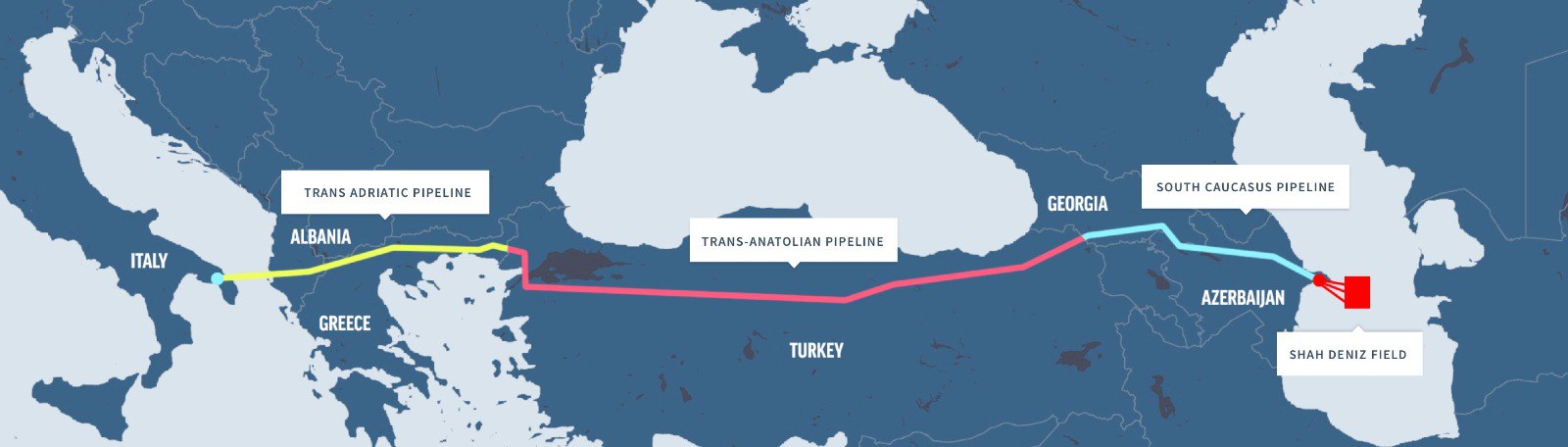
The SGC is intended to reduce Europe’s dependence on Russian gas and diversify the continent’s energy supplies by bringing natural gas from the Caspian region to European markets. Its primary supply source is Azerbaijan’s Shah Deniz gas field in the Caspian Sea. The corridor stretches from Azerbaijan through Georgia and Türkiye to Greece, Albania, and Italy.
Turkmenistan is widely viewed as a potential additional supplier for the SGC, which could become increasingly important if Azerbaijani gas alone proves insufficient to meet rising European demand.
Berdymuhamedov said that progress on the Trans-Caspian Gas Pipeline requires resolving international legal issues, particularly those related to the delimitation of the Caspian seabed. A Turkmen-Azerbaijani working commission has been established for this purpose.
“We hope that its work will yield significant practical results,” he said.
Berdymuhamedov also emphasized Turkmenistan’s large hydrocarbon resources, noting that the country ranks fourth globally in proven natural gas reserves.
“For some time in the past, the bulk of Turkmen natural gas exports went to Russia, which received up to 40 billion cubic meters per year. Currently, China is our main gas buyer, with supply volumes at roughly the same level,” Berdymuhamedov said.
He added that Turkmenistan’s policy of diversification allows the country to supply gas within the region through swap arrangements involving Iran and Azerbaijan, as well as Kazakhstan, Uzbekistan, and other neighboring states.
Turkey is also considered a key link for potential Turkmen gas exports to Europe.
Turkish Vice President Fuat Oktay previously said that, in cooperation with Azerbaijan, Turkmen natural gas could be transported through the Trans-Anatolian Natural Gas Pipeline (TANAP), which runs across Türkiye and forms the central segment of the Southern Gas Corridor.
Oktay expressed confidence that negotiations between Turkey’s Ministry of Energy and Natural Resources, the Turkish state energy company BOTAŞ, and Turkmenistan’s state-owned gas producer, Türkmengaz, could soon produce positive results.
He also stated that Turkish state companies are ready to participate in the development of hydrocarbon resources at the jointly developed Turkmen-Azerbaijani Dostluk field in the Caspian Sea.
Speaking at the 12th Ministerial Meeting of the Southern Gas Corridor Advisory Council in Baku on March 3, Zafer Demircan, Turkey’s Deputy Minister of Energy and Natural Resources, highlighted the corridor’s strategic importance.
“There is a strong common understanding of the crucial role of the Southern Gas Corridor in achieving long-term energy supply security,” Demircan said. “This valuable concept is evolving toward a Green Energy Corridor linking states in the Caucasus and Central Asia with Europe. Türkiye is the most feasible route not only for natural gas transportation but also for electricity transmission.”
Participants at the Southern Gas Corridor Advisory Council meeting emphasized the system’s growing role in supplying Azerbaijani gas to European markets. According to Azerbaijan’s Ministry of Energy, the country supplied 12.5 billion cubic meters (bcm) of natural gas to EU member states in 2025, a 53.8% increase compared with 2021 levels.
At the same meeting, EU Commissioner for Energy and Housing Dan Jørgensen said that Caspian gas has already contributed to a sharp reduction in Europe’s reliance on Russian energy supplies.
“With the help of Caspian gas, the EU’s dependence on Russian gas fell from 45% of total imports in 2022 to 12% in 2025, and these numbers will continue to fall,” Jørgensen said. “In less than two years, the remaining 35 billion cubic meters of Russian gas that we are still importing every year will be out of our markets.”
Jørgensen also reaffirmed the EU’s commitment to strengthening regional connectivity with the Black Sea region, Turkey, the South Caucasus, and Central Asia.
“The EU stands ready to explore further opportunities to strengthen energy connectivity and the energy transition in the region, including through the mobilization of guarantees and blended finance instruments,” he said.