• KZT/USD = 0.00221
  • TJS/USD = 0.10840
  • UZS/USD = 0.00009
  • TMT/USD = 0.29760
  • KZT/USD = 0.00221
  • TJS/USD = 0.10840
  • UZS/USD = 0.00009
  • TMT/USD = 0.29760
  • KZT/USD = 0.00221
  • TJS/USD = 0.10840
  • UZS/USD = 0.00009
  • TMT/USD = 0.29760
  • KZT/USD = 0.00221
  • TJS/USD = 0.10840
  • UZS/USD = 0.00009
  • TMT/USD = 0.29760
  • KZT/USD = 0.00221
  • TJS/USD = 0.10840
  • UZS/USD = 0.00009
  • TMT/USD = 0.29760
  • KZT/USD = 0.00221
  • TJS/USD = 0.10840
  • UZS/USD = 0.00009
  • TMT/USD = 0.29760
  • KZT/USD = 0.00221
  • TJS/USD = 0.10840
  • UZS/USD = 0.00009
  • TMT/USD = 0.29760
  • KZT/USD = 0.00221
  • TJS/USD = 0.10840
  • UZS/USD = 0.00009
  • TMT/USD = 0.29760
07 October 2026

Our People > Zamirbek Minbaev

Zamirbek Minbaev's Avatar

Contributor

Zamirbek Minbaev is an independent analyst based in Kyrgyzstan, working on systemic risk, sanctions-era statecraft, Central Asian geopolitical positioning, and political-economic architecture.

Articles

Opinion: The Reform Paradox for Uzbekistan: Global Capital, Political Control

In mid-May, Uzbekistan is preparing to take a major step onto the global financial stage – one that reflects its broader, decade-long push to open its economy to international investors. The country's National Investment Fund (UzNIF), a $2.4 billion vehicle holding minority stakes in 13 strategic state-owned enterprises, is preparing to list 30% of its capital on the London and Tashkent stock exchanges — the first time such a state-backed investment vehicle is being listed on international equity markets. For President Shavkat Mirziyoyev, the move signals that Uzbekistan wants to be seen as an investable, reforming, and globally connected state. But the planned listing also captures the central paradox of Uzbekistan's current trajectory: the country is opening economically while remaining politically closed. Foreign investors are being invited in. State assets are being partially exposed to market discipline. Capital markets are being developed. Yet the political system remains tightly managed, with limited opposition, weak institutional pluralism, and few independent channels for releasing social pressure. That is why Uzbekistan's stability should not be read only as a strength. It should also be read as a system test: can controlled modernization keep producing legitimacy without creating political mechanisms for absorbing the expectations it generates? Mirziyoyev as a Controlled Modernizer Shavkat Mirziyoyev’s political style is not that of a frontline strongman constantly mobilizing society against enemies. His approach is administrative, developmental, and transactional: reform from above, personnel control, investment attraction, infrastructure, market opening, and the redistribution of economic flows. In this sense, Mirziyoyev is best understood not as a liberal reformer in the Western sense, but as a controlled modernizer. The reform agenda is real. Uzbekistan has moved to attract foreign capital, open selected state assets, improve its business image, and position itself as a more predictable investment destination. The UzNIF listing fits this broader effort: it is designed to deepen capital markets, signal openness to international investors, and show that the state is willing to place parts of its economic architecture under market scrutiny. But the political architecture remains tightly managed. Freedom House continues to rate Uzbekistan as "Not Free" — 12 points out of 100 in its 2026 report — citing the concentration of power in the executive branch, the absence of a genuine parliamentary opposition, and severe restrictions on independent journalists and human rights defenders. This is the central tension: Uzbekistan is reforming economically, but not politically. [caption id="attachment_48249" align="aligncenter" width="2560"] Tashkent has opened up to investment over the past decade. Image: Joe Luc Barnes[/caption] Growth as Legitimacy For now, the model works because growth provides legitimacy. The World Bank expects Uzbekistan's economy to grow by around 6.4% in 2026, following 7.7% growth in 2025 – supported by domestic demand, private consumption, and continued investment. Public debt remains comparatively moderate at around 28% of GDP, and the country benefits from the perception that it is one of the more dynamic economies in the region. This gives the ruling system room to maneuver. The reform narrative allows the leadership to present itself as forward-looking without opening the...

5 months ago

Opinion: Bishkek Between Sanctions and Africa: The Quiet Architecture of Proxy Sovereignty

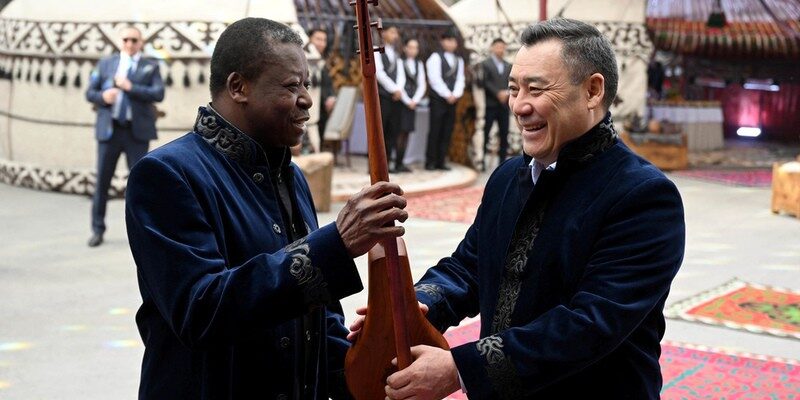
The official visit of Togo’s head of government, Faure Gnassingbé, to Kyrgyzstan on April 28–30 should not be read as an isolated diplomatic event. It is taking place inside an unusually dense cluster of activity: the SCO Council of Defence Ministers, the presence of China’s defence minister, the fifth meeting of Shanghai Cooperation Organization (SCO) digital and ICT ministers, and a parallel SCO Forum on Artificial Intelligence. Bishkek, in other words, was not simply hosting an African leader. It was presenting itself — intentionally or not — as a Eurasian platform where security, digital governance, AI, transport, tourism, and external partnerships intersect. This geometry deserves attention. Bishkek as a Digital Interface Over the past several years, Kyrgyzstan has worked to reposition itself — not only as a mountainous transit country, but as a provider of digital state capacity: e-government tools, secure documents, digital identification, fintech infrastructure, and special financial regimes such as the proposed Tamchy special financial and investment territory, which combines Kyrgyz sovereignty with elements of English law and international arbitration. For many African countries, this offer can be attractive. Governments across the continent are looking for administrative modernization, digital sovereignty, and alternatives to legacy Western-controlled infrastructure. For Bishkek, such partnerships offer something equally valuable: visibility, geopolitical relevance, and an opportunity to export state technology beyond Central Asia. Togo is a particularly interesting test case. Lomé is one of West Africa’s important maritime and logistical hubs, with access not only to the Gulf of Guinea but, indirectly, to the Sahel region — Mali, Burkina Faso, and Niger — where Russia has expanded its security footprint. If Kyrgyz digital infrastructure were to enter this corridor, it would not be a minor technical export. It would connect a Central Asian jurisdiction to one of Africa’s most strategically sensitive zones. It must be said honestly: this remains a hypothesis. Public information about specific Kyrgyz digital products being offered to Togo remains limited. But the political signal is difficult to ignore: Bishkek is not approaching this visit as a routine bilateral courtesy. The Russia Question There is a more sensitive layer to this picture. Kyrgyzstan is a close partner of Russia. Russia, in turn, is under heavy Western sanctions and is searching for alternative financial, commercial, and logistical routes. This creates a natural suspicion that Kyrgyz digital and financial infrastructure could — directly or indirectly — become useful to Russian-linked actors. This does not mean every Kyrgyz initiative abroad is directed from Moscow. That reading is too simplistic. A more precise framing is this: Kyrgyzstan may be becoming part of a distributed sanctions-era infrastructure in which Russian, Chinese, Central Asian, and Global South interests increasingly overlap. In this sense, Bishkek may not be a “front office” for Russia alone. It may be emerging as a Eurasian adapter — a jurisdiction through which larger actors can interact with sensitive markets under a less toxic, more flexible brand. A7A5 and the Closing Window The crypto-financial dimension makes this issue urgent. A7A5, a ruble-pegged stablecoin issued...

5 months ago