President Recep Tayyip Erdoğan’s May 13-14 state visit to Kazakhstan and the May 15 informal summit of the Organization of Turkic States in Turkistan should not be read as isolated diplomatic events. Together, they point to a larger shift in Central Asia’s geopolitical architecture.
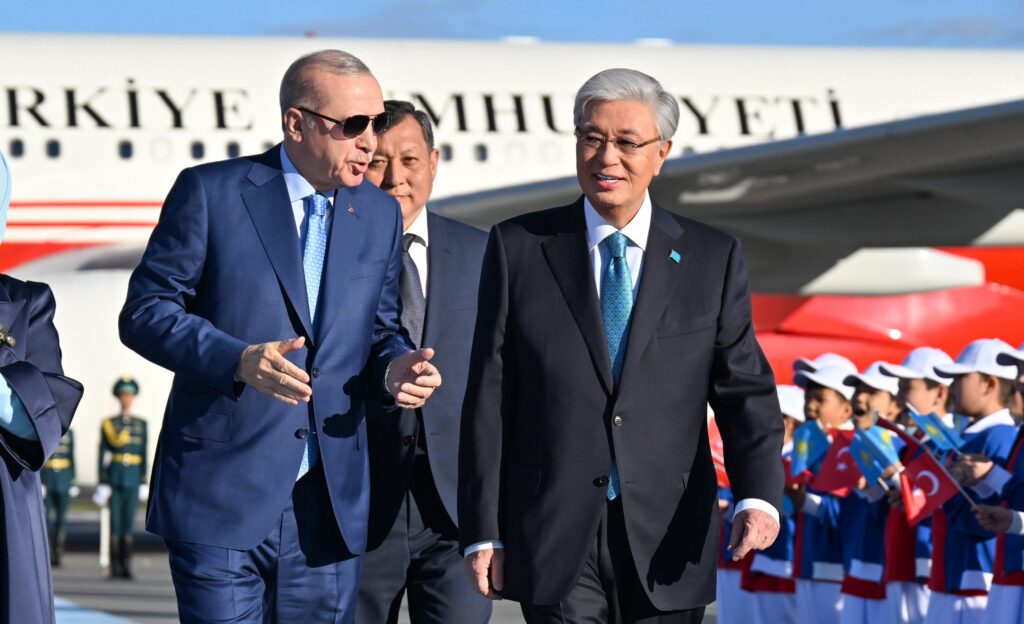
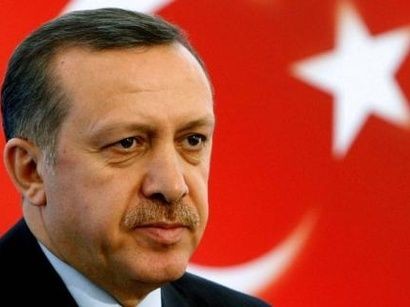
During Erdoğan’s visit to Astana, Kazakhstan and Turkey signed the Declaration on Eternal Friendship and Expanded Strategic Partnership, along with agreements covering trade, transport, energy, education, investment, defense cooperation, oil and gas, and financial-sector collaboration. The two sides also reaffirmed their goal of raising bilateral trade to $15 billion. Erdoğan was awarded the newly established Khoja Ahmed Yassawi Order, a symbolic gesture tied to the summit being hosted in Turkistan, the city most closely associated with Yassawi’s legacy.
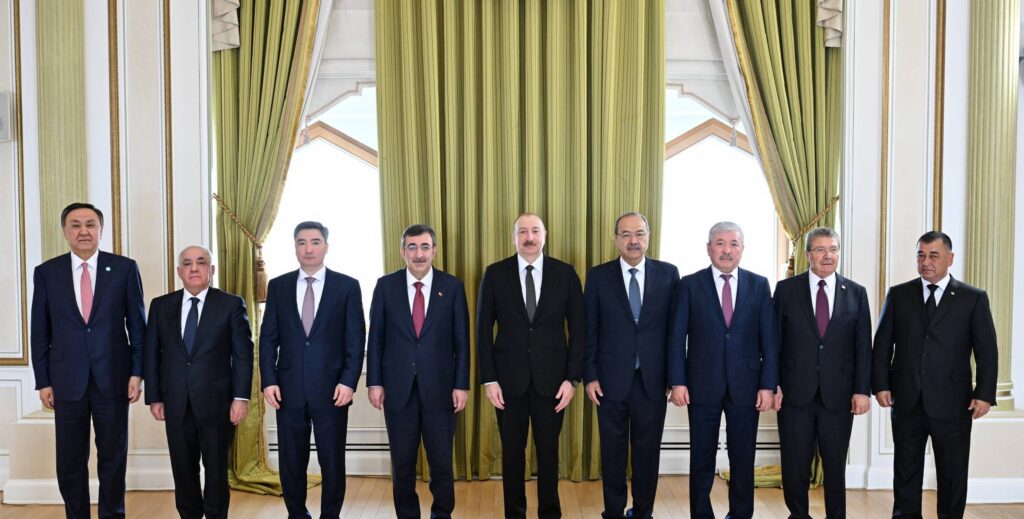
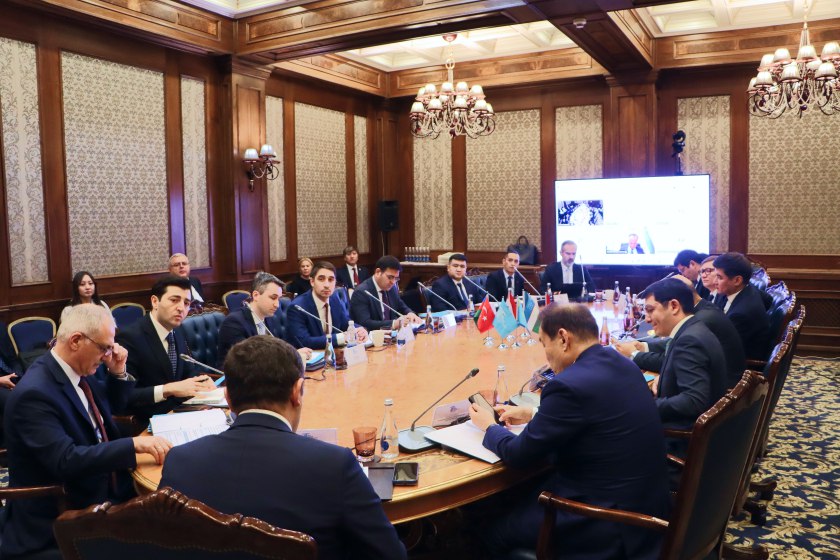
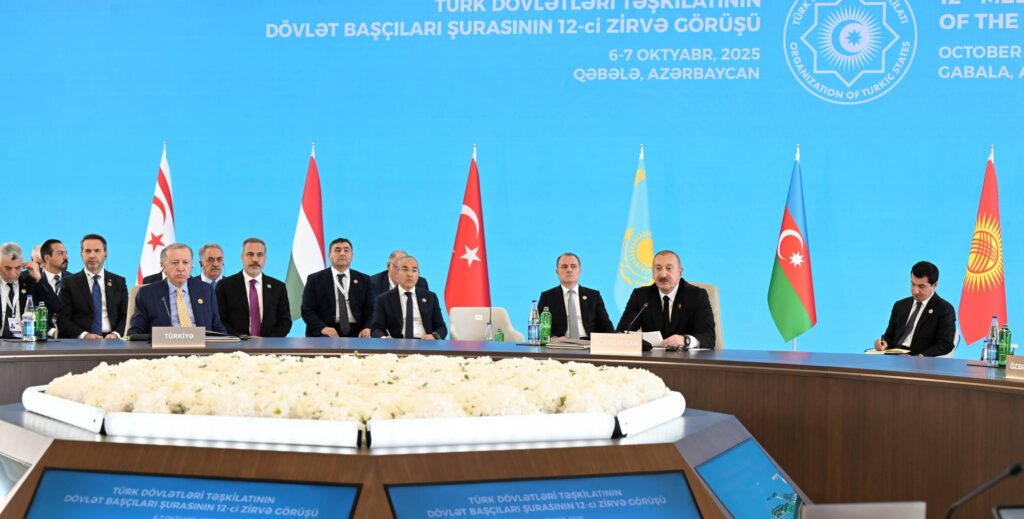
A day later, Turkistan hosted the informal summit of the Organization of Turkic States under the theme “Artificial Intelligence and Digital Development.”
The timing matters. Central Asia is no longer operating inside a simple Russia-China framework. Russia remains deeply embedded in the region through security history, infrastructure, language, labor migration, and energy networks. China remains the region’s main infrastructure and trade heavyweight. The West is increasingly focused on sanctions, critical minerals, connectivity, and the Middle Corridor.
But Turkey is becoming something different: not a replacement for Russia or China, but a useful third vector.
Its influence is built on identity, logistics, defense technology, education, digital cooperation, and institutional networking through the Turkic States framework, rather than overwhelming capital or military dominance.
Turkey as a Corridor Power
Turkey cannot match China’s investment scale in Central Asia. It also cannot match Russia’s historical security depth. Ankara does not need to replace either power to matter.
Its comparative advantage is different.
Turkey connects Central Asia westward, to the South Caucasus, the Black Sea, the Mediterranean, and Europe. It also offers a language of partnership that is culturally familiar and politically less threatening than great-power patronage.
Tokayev captured this dimension during the joint statements in Astana, describing Turkey as a “golden bridge” connecting Europe and Asia. The framing is telling: not a partner of equal weight, but a connector, exactly the function of a corridor power.
A corridor power does not dominate a region directly. It expands the routes, partnerships, platforms, and strategic options available to states that do not want to be trapped between larger powers.
That is why the Erdoğan-Tokayev meeting and the Turkistan summit matter. The issue goes beyond bilateral trade. It is the gradual construction of a Turkic corridor linking identity, transport, defense, digital governance, and markets.
The OTS as Identity Infrastructure
The Organization of Turkic States is often dismissed as symbolic: summits, speeches, flags, cultural rhetoric, and references to shared history. That reading is incomplete.
Identity is not just emotion. In international politics, identity can become infrastructure.
Shared language, educational networks, media links, cultural affinity, and repeated institutional contact reduce the cost of trust-building. They make it easier to sign agreements, build transport projects, expand student exchanges, coordinate business forums, and create political habits of consultation.
The OTS is not the European Union. It is not NATO. It is not a customs union with strong enforcement powers. It does not need to become any of these to matter.
Its value lies in creating a soft institutional layer where Central Asian states can coordinate without formally choosing between Moscow, Beijing, Brussels, or Washington.
That makes it especially useful for states seeking more room for maneuver without openly breaking existing relationships.
The Middle Corridor: Where Identity Becomes Infrastructure
The Middle Corridor is the hard infrastructure side of this story.
For years, the Trans-Caspian route was discussed as an underdeveloped alternative. Russia’s war in Ukraine changed the equation. The northern corridor through Russia became more politically sensitive, while European, Turkish, Chinese, and Central Asian interest in non-Russian connectivity increased sharply.
For Kazakhstan, the Middle Corridor offers a way to reduce overdependence on Russian routes. For Azerbaijan and Georgia, it expands their role as transit states. For Turkey, it turns geography into strategy: Ankara becomes the western gate of a route linking China and Central Asia to Europe.
But expectations should remain realistic.
The route still faces real bottlenecks: Caspian shipping capacity, port infrastructure, customs delays, rail coordination, tariff harmonization, and the need for predictable cross-border procedures. Falling Caspian Sea levels add another structural pressure on port capacity at Aktau and Kuryk.
The Middle Corridor cannot replace northern routes overnight. Its strategic importance is growing because optionality itself has become valuable.
In today’s Eurasia, the most important asset for small and mid-sized states is not alignment. It is route diversity.
Digital Cooperation and the New Turkic Agenda
The Turkistan summit’s focus on artificial intelligence and digital development shows that the Turkic framework has moved beyond culture and transport.
Digital governance is becoming part of regional competition. Across Central Asia, governments are building digital ID systems, e-government platforms, fintech infrastructure, AI strategies, and data governance models. These systems are not neutral. They shape state capacity, public services, surveillance risks, financial inclusion, and future economic competitiveness.
The digital and financial dimension of this shift is becoming tangible. During Erdoğan’s visit, Kazakh and Turkish partners discussed cooperation across finance, platforms, and investment. Companies such as Kaspi.kz and Freedom Holding show how Kazakhstan’s own digital and financial champions are increasingly looking beyond the domestic market and toward broader regional connectivity.
These are not always flagship megaprojects. Often, they are the less visible plumbing of integration: payment systems, e-commerce links, brokerage platforms, digital services, and financial infrastructure. But this is precisely how identity rhetoric becomes operational connectivity.
For Central Asian governments, Turkey offers an additional technological partner that is not fully Western, Russian, or Chinese.
That matters because the next phase of Central Asian sovereignty will extend beyond borders, pipelines, and railways. It will also involve data, platforms, payment systems, AI standards, and digital public infrastructure.
The Limits of Turkey’s Rise
Turkey’s role should not be exaggerated.
Ankara faces serious economic constraints at home. It cannot provide China-scale lending, and it cannot offer Russia-style hard security guarantees in Central Asia. Its influence also depends on the willingness of Central Asian governments to use Turkic identity without allowing it to become political dependence.
Central Asian states are pragmatic.
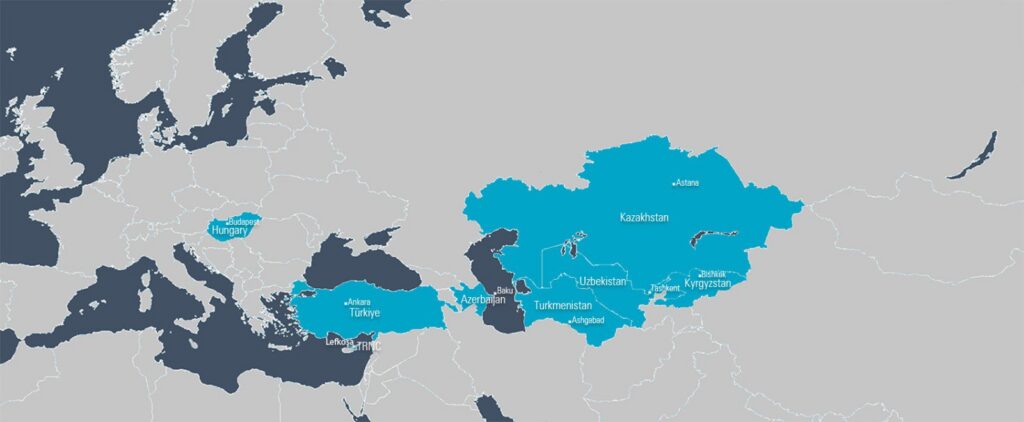
Kazakhstan will continue balancing between Russia, China, the West, and Turkey. Uzbekistan will use the Turkic framework selectively while preserving its own sovereignty. Kyrgyzstan may see more immediate cultural and political benefits, while Azerbaijan remains central as the bridge between Central Asia and Turkey.
Even the states most enthusiastic about Turkic cooperation will avoid surrendering strategic autonomy.
This is why Turkey’s rise in Central Asia is best understood as the growth of a third vector, not expansion in an imperial sense.
Its strength lies precisely in the fact that it is not total.
Turkey gives the region additional language, routes, partners, and institutional platforms. That may be enough to change the balance.
Central Asia’s Strategic Optionality
The real significance of the Turkistan summit is not that the Turkic world is becoming a bloc. It is not. The Turkic states remain diverse, sovereign, and sometimes cautious toward one another.
But the Turkic world is becoming a corridor: political, logistical, cultural, and increasingly digital.
A region long described as “between Russia and China” is slowly adding more layers to its external architecture. The European Union brings capital, standards, and sanctions complexity. China brings infrastructure and trade. Russia brings legacy networks and security entanglement. Turkey brings identity, connectivity, defense technology, and westward access.
None of these vectors is sufficient on its own. Together, however, they give Central Asian states what they want most: maneuvering space.
For Central Asia, this is not about choosing Turkey over Russia or China. It is about multiplying options.
Turkey is not becoming the dominant power in Central Asia. But it is becoming a useful third pole, one that helps the region avoid being reduced to a chessboard between larger players.
The central question is whether Ankara and the Turkic states can turn shared identity into practical capacity: faster corridors, deeper digital cooperation, more resilient supply chains, and institutions that do more than produce declarations.
If they can, the Organization of Turkic States will no longer be only a cultural project.
It will become part of Central Asia’s strategic infrastructure.
The views expressed in this article are those of the author and do not necessarily reflect the official policy or position of the publication, its affiliates, or any other organizations mentioned.