• KGS/USD = 0.01144 0%
  • KZT/USD = 0.00213 0%
  • TJS/USD = 0.10714 0.09%
  • UZS/USD = 0.00008 0%
  • TMT/USD = 0.28571 0%
  • KGS/USD = 0.01144 0%
  • KZT/USD = 0.00213 0%
  • TJS/USD = 0.10714 0.09%
  • UZS/USD = 0.00008 0%
  • TMT/USD = 0.28571 0%
  • KGS/USD = 0.01144 0%
  • KZT/USD = 0.00213 0%
  • TJS/USD = 0.10714 0.09%
  • UZS/USD = 0.00008 0%
  • TMT/USD = 0.28571 0%
  • KGS/USD = 0.01144 0%
  • KZT/USD = 0.00213 0%
  • TJS/USD = 0.10714 0.09%
  • UZS/USD = 0.00008 0%
  • TMT/USD = 0.28571 0%
  • KGS/USD = 0.01144 0%
  • KZT/USD = 0.00213 0%
  • TJS/USD = 0.10714 0.09%
  • UZS/USD = 0.00008 0%
  • TMT/USD = 0.28571 0%
  • KGS/USD = 0.01144 0%
  • KZT/USD = 0.00213 0%
  • TJS/USD = 0.10714 0.09%
  • UZS/USD = 0.00008 0%
  • TMT/USD = 0.28571 0%
  • KGS/USD = 0.01144 0%
  • KZT/USD = 0.00213 0%
  • TJS/USD = 0.10714 0.09%
  • UZS/USD = 0.00008 0%
  • TMT/USD = 0.28571 0%
  • KGS/USD = 0.01144 0%
  • KZT/USD = 0.00213 0%
  • TJS/USD = 0.10714 0.09%
  • UZS/USD = 0.00008 0%
  • TMT/USD = 0.28571 0%

Viewing results 1 - 6 of 136

Aliyev, Tokayev Pledge Deeper Cooperation as Azerbaijan Lifts Armenia Transit Ban

Azerbaijan’s President Ilham Aliyev began a state visit to Kazakhstan on Monday with a series of high-level meetings and a significant policy shift: Baku is lifting all restrictions on the transit of goods to Armenia. The move, announced during joint talks with Kazakh President Kassym-Jomart Tokayev in Astana, is one of the most concrete regional gestures since the end of the Second Karabakh War. The visit began with an official welcoming ceremony at Akorda Presidential Palace in Astana, where Presidents Kassym-Jomart Tokayev and Ilham Aliyev reviewed an honor guard before holding bilateral talks and chairing the second meeting of the Kazakhstan–Azerbaijan Supreme Intergovernmental Council. Speaking at a joint press briefing after the meeting, Aliyev confirmed that, “All restrictions on the transit of goods from Azerbaijan to Armenia and from third countries to Armenia through Azerbaijan have been lifted.” While no formal agreement was signed on Monday, the announcement is being viewed as a confidence-building measure at a moment of cautious diplomacy in the South Caucasus. Tokayev welcomed the development and stressed the importance of expanding cooperation between Kazakhstan and Azerbaijan in key sectors such as transport and energy. Ties on a Strategic Track Aliyev’s visit comes as Kazakhstan and Azerbaijan are expanding cooperation in multiple areas, including rail, ports, digital infrastructure, and energy. Monday’s talks produced several new accords and project announcements, including commitments to expand freight flows along the Trans-Caspian International Transport Route (Middle Corridor) - a logistics network connecting China to Europe via Central Asia, the Caspian Sea, and the South Caucasus. Since Russia’s 2022 invasion of Ukraine upended established overland trade routes, the corridor’s importance has surged, with Astana and Baku positioning themselves as key actors in a reconfigured Eurasian logistics network that bypasses Russian territory. In his welcoming address, Tokayev framed Aliyev’s state visit as of “critically important significance for the further development of our strategic partnership.” Tokayev described the relationship as “allied in nature,” calling Azerbaijan “a regional power that has strengthened its authority on the international stage.” He emphasized that developing multifaceted cooperation “remains a priority” and highlighted trade, economic, and political partnership as key goals. “Azerbaijan is a special country for Kazakhstan, a fraternal state,” Tokayev stated. “We are united by common historical roots, a rich spiritual and cultural heritage, and, ultimately, a shared mentality and outlook on developments. On this unshakable foundation, we are successfully developing our multifaceted cooperation.” Aliyev, in turn, praised Kazakhstan’s ongoing political and economic reforms, saying his country “fully supports [Tokayev’s] course of modernization” and is aiming to “strengthen cooperation in all areas” In a related development, Azerbaijan’s state energy firm SOCAR and Kazakhstan’s sovereign wealth fund Samruk-Kazyna are expected to deepen their collaboration in upstream energy projects and petrochemical exports, though no new energy deals were signed on Monday. Transit Opening to Armenia: Why Now? Aliyev’s announcement on transit restrictions - made in Astana, not Baku - was notable not just for its content, but its timing and setting. Since the end of the 2020 Second Karabakh...

Kazakhstan and Germany Partner on Sustainable Water Management

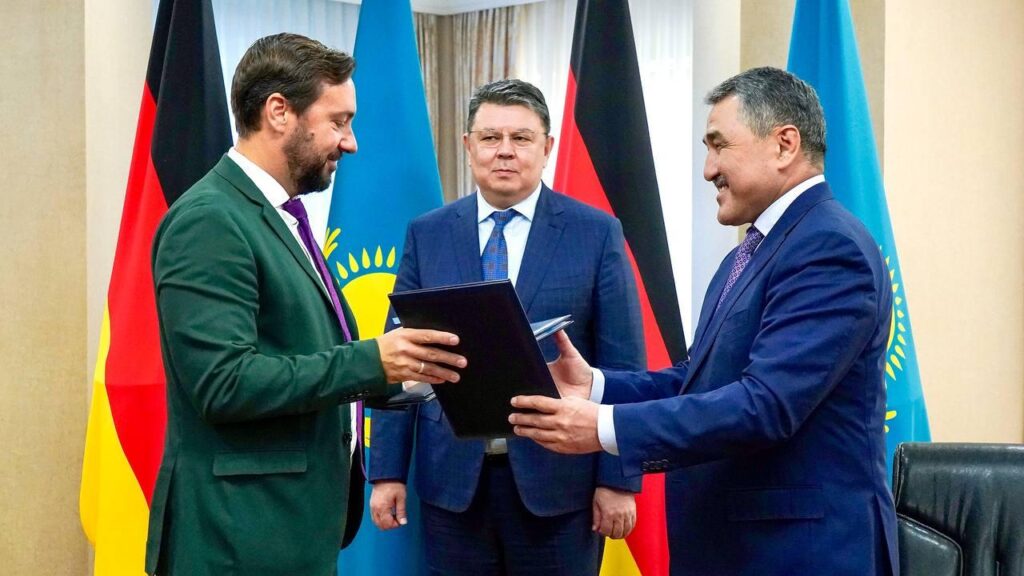
Kazakhstan’s Ministry of Water Resources and Irrigation and the German Water Partnership (GWP) signed a Strategic Partnership Agreement on October 8 aimed at enhancing bilateral cooperation in sustainable water management. The agreement will allow Kazakhstan to adopt international best practices and advanced water-saving technologies, strengthen climate resilience in the water sector, improve flood and drought response, and expand training for water-sector professionals. GWP is Germany’s leading water-sector network with a strong international focus. It brings together around 300 companies, trade associations, and institutions from business, science, and research. German expertise is already contributing to Kazakhstan’s digital projects in water resource forecasting, modeling, and accounting. German technologies are also being used in the construction of hydraulic infrastructure across the country. Following the signing, Deputy Prime Minister Kanat Bozumbayev and GWP Managing Director Boris Greifeneder discussed plans to deepen cooperation. One key proposal was the establishment of a Kazakh-German Water Innovation Hub, to be housed at the Information and Analytical Center of the Ministry of Water Resources and Irrigation, with GWP’s support. In a related initiative, the Kazakh-German University (DKU), the National Academy of Sciences of Kazakhstan, and the Kazakh National Agrarian Research University, supported by Germany’s Hanns Seidel Foundation, recently launched a new scientific and educational hub: the Kazakh-German Nexus Institute. Headquartered in Almaty, the Nexus Institute will focus on developing evidence-based policies for sustainable land and water use in Central Asia. Water resource management remains a critical priority for Kazakhstan, particularly in the country’s arid southern regions where agriculture depends heavily on efficient irrigation systems.

Kyrgyz-Chinese Trade and Economic Cooperation Center Opens in Chongqing

A new Kyrgyz-Chinese Trade and Economic Cooperation Center has officially opened in Chongqing, one of southwest China’s largest industrial and transportation hubs. According to Kyrgyzstan’s Ministry of Economy and Commerce, the 300-square-meter facility will serve as a platform for bilateral business cooperation. Kyrgyz entrepreneurs will be able to register their companies and conduct business activities in China free of charge. Also on September 26, Chongqing hosted the opening of Kyrgyzstan’s Trade Pavilion, which will showcase and sell national products such as honey, alcoholic beverages, confectionery, and handicrafts. China remains one of Kyrgyzstan’s most important trade partners, with an increasing share of transactions now carried out in Chinese yuan. Earlier this year, Kyrgyzstan’s state-owned Eldik Bank became the first bank in Central Asia to join China’s Cross-Border Interbank Payment System (CIPS). The system enables direct and instant settlements in yuan with Chinese partners and other participants, bypassing intermediaries and reducing transaction costs. Eldik Bank officials said the move would expand business opportunities and deepen bilateral economic ties. Trade between Kyrgyzstan and China surged by 44.7% in 2024, reaching $5.3 billion, according to Kyrgyz government statistics. Exports from Kyrgyzstan to China grew dramatically to $2.04 billion, 93 times higher than in 2023. China also remained Kyrgyzstan’s largest foreign investor, accounting for 23.9% of total foreign direct investment (FDI) in 2024, valued at $872.6 million.

From Hydropower to Human Capital: Japarov Plans Strategic Visit to Japan

Kyrgyz President Sadyr Japarov is preparing for a visit to Japan that underscores growing strategic ties between the two countries. Kyrgyz officials say they plan to sign energy and infrastructure agreements in Tokyo, including support for a training center for the national electric grid and upgrades at the Kurpsai hydropower plant, according to Trend, citing the Kyrgyz Energy Ministry. The same report notes that grant funding from Japan’s international cooperation programs will back grid training and modernization efforts. The timing reflects Tokyo’s recent step-up in activity vis-à-vis Central Asia. As previously reported by The Times of Central Asia, in late August 2025, Japan’s foreign minister undertook a multi-country tour that emphasized long-term engagement and connectivity across the region. Japanese officials framed their approach as trust-building, focused on people-to-people links, infrastructure, and practical cooperation. Energy cooperation is expected to feature prominently during the visit. Kyrgyz officials say the Japan-backed training center is moving through final approval, and modernization of the Kurpsai facility is planned with Japanese grant support. Bishkek has also invited Japanese participation in additional hydropower projects, positioning Japan as a technology and financing partner in Kyrgyzstan’s power sector. Labor mobility and skills are another focus. The authorities in Kyrgyzstan have been working with Japanese counterparts to create safe, legal pathways for Kyrgyz workers. In July, Kyrgyz officials met with Japan’s construction human-resources association to align training standards and prepare workers for job opportunities in Japan, and free Japanese-language courses were launched in Bishkek to improve employability for prospective migrants. Education and cultural exchange underpin the relationship. Over three decades, Japan has funded scholarships, exchanges, and language programs that connect Central Asian students to Japanese universities. An overview of these initiatives highlights how education has become a durable pillar of Japan’s regional engagement, building familiarity with Japanese business practices and technology among Kyrgyz graduates. For Bishkek, the visit is about turning ongoing cooperation into signed projects and new resources. Officials point to the grid training center and Kurpsai upgrades as near-term deliverables, while the broader agenda includes workforce programs and academic ties. The message from both sides is continuity: steady, practical steps rather than headline-grabbing announcements. Regionally, Japan’s approach offers Central Asian countries additional partners for finance, training, and technology. For Kyrgyzstan, deeper ties with Tokyo complement existing relationships while helping diversify investment sources and markets. The outcome to watch is whether the visit locks in concrete funding and timelines for priority energy and skills initiatives outlined by the Kyrgyz side.

QazTrade Opens Office in Tianjin to Strengthen Kazakhstan-China Trade Ties

Kazakhstan’s QazTrade Center for Trade Policy Development has opened a new office, Kazakhstan Hall, at the International Trade and Shipping Service Center in Tianjin, one of northern China’s leading industrial and port cities. Spanning 100 square meters, the office is designed primarily to showcase Kazakhstani food products and facilitate trade promotion in the Chinese market. It is currently operating in pilot mode, with an expanding exhibition area and ongoing preparations to formally register QazTrade’s representative office. The official opening ceremony is expected later this autumn. According to QazTrade, trade turnover between Kazakhstan and Tianjin reached $347.9 million in 2023 and rose to $474 million in 2024, a sign of steady growth in bilateral commerce. Tianjin serves as a key logistics and trade hub for Shanghai Cooperation Organization (SCO) member states. It offers Kazakhstan access to a “green-light corridor” for SCO countries, multimodal transport links between Asia and Europe, and a variety of investment and financial services. “The opening of the QazTrade office in Tianjin is an important step for us,” said QazTrade Director General Aitmukhammed Aldazharov. “Through the Tianjin port, we will be able to deliver Kazakhstani goods to any country in the world faster and more efficiently.” Growing Bilateral Trade Kazakhstan-China trade continues to gain momentum. During a meeting with Kazakh Minister of Trade and Integration Arman Shakkaliyev on August 20 in Beijing, Chinese Minister of Commerce Wang Wentao stated that bilateral trade reached $43.8 billion in 2024, a 9.2% increase compared to the previous year. In the first half of 2025 alone, trade turnover totaled $21.8 billion. Kazakhstan and China have set a joint target to double bilateral trade by 2030, with expanded cooperation in logistics, agriculture, energy, and manufacturing forming the core of future initiatives.

Uzbekistan’s Pharma Pivot: Strategic Gains or Growing Dependence on China

Since 2016, Uzbekistan has steadily deepened its partnership with China across multiple sectors. Energy, infrastructure, agriculture, and the digital economy have long been the pillars of this cooperation. Yet recent discussions showed that the pharmaceutical sector will be another critical area for cooperation in the long term. Much like renewable energy and critical minerals, the pharmaceutical sector is now viewed in Tashkent as a strategic domain where Chinese expertise and investment could accelerate development and add value to the domestic economy. The Compelling Logic of Partnership China's strength lies in its ability to produce high-quality, affordable medicines and distribute them globally at scale. For Uzbekistan - whose growing population and rising demand for advanced healthcare have placed pressure on its system - this makes China a natural partner. At present, the Uzbek pharmaceutical market remains heavily import-dependent: by the end of 2024, imported drugs accounted for 87% of retail sales in monetary terms and 63% in physical volume. This reliance not only exposes vulnerabilities but also highlights the untapped potential for local production. Recognizing this, Tashkent has moved to create favorable conditions for investment. The country has established specialized pharmaceutical Special Economic Zones (SEZ) such as Parkent-Pharm and Andijan-Pharm. These SEZs offer investors an attractive package of incentives, from exemptions on customs duties and VAT for raw materials and equipment, to a 20% preference in government procurement for local products. Such regulatory incentives, combined with a growing domestic market, have already begun to draw interest from Chinese pharmaceutical firms. Strategic Priorities Recently, Uzbekistan has signed a series of memorandums of understanding with Chinese firms such as Zhendong Health Industry, Guojo Medical Technology, and Langtian Pharma Group, signaling a stronger bilateral focus on the pharmaceutical sector. These agreements align closely with Uzbekistan’s strategic goal of building a robust domestic pharmaceutical industry with an emphasis on access to capital and technology, localization, and human capital development. One of Uzbekistan’s key priorities is securing access to capital and expertise. Without investment and collaboration with experienced companies, the state cannot establish modern laboratories and production facilities. In this regard, the Uzbek company, Ozwell, has signed an MoU with Zhendong Health Industry Group to jointly implement a modern pharmaceutical laboratory. The partnership involves a total investment of $9.5 million, with $4.5 million allocated toward creating a world-class laboratory facility and $5 million designated for establishing and scaling up a production complex. This agreement reflects Tashkent’s desire to tap into Chinese technical knowledge and experience, while simultaneously building domestic capacity and developing local talent in the long term. Another critical priority is the localization of drug production. By reducing dependency on imports, Uzbekistan is aiming to strengthen supply chain resilience, meet domestic demand, and create new opportunities for regional exports. In this regard, the MoU established with Langtian Pharma Group and Guojo Medical Technology is designed to investigate opportunities for domestic production while promoting technological collaboration and knowledge transfer within the pharmaceutical industry. The final priority is the development of human capital. In this regard, Uzbekistan...