• KGS/USD = 0.01143 0%
  • KZT/USD = 0.00208 0%
  • TJS/USD = 0.10438 -0.1%
  • UZS/USD = 0.00008 0%
  • TMT/USD = 0.28579 0%
  • KGS/USD = 0.01143 0%
  • KZT/USD = 0.00208 0%
  • TJS/USD = 0.10438 -0.1%
  • UZS/USD = 0.00008 0%
  • TMT/USD = 0.28579 0%
  • KGS/USD = 0.01143 0%
  • KZT/USD = 0.00208 0%
  • TJS/USD = 0.10438 -0.1%
  • UZS/USD = 0.00008 0%
  • TMT/USD = 0.28579 0%
  • KGS/USD = 0.01143 0%
  • KZT/USD = 0.00208 0%
  • TJS/USD = 0.10438 -0.1%
  • UZS/USD = 0.00008 0%
  • TMT/USD = 0.28579 0%
  • KGS/USD = 0.01143 0%
  • KZT/USD = 0.00208 0%
  • TJS/USD = 0.10438 -0.1%
  • UZS/USD = 0.00008 0%
  • TMT/USD = 0.28579 0%
  • KGS/USD = 0.01143 0%
  • KZT/USD = 0.00208 0%
  • TJS/USD = 0.10438 -0.1%
  • UZS/USD = 0.00008 0%
  • TMT/USD = 0.28579 0%
  • KGS/USD = 0.01143 0%
  • KZT/USD = 0.00208 0%
  • TJS/USD = 0.10438 -0.1%
  • UZS/USD = 0.00008 0%
  • TMT/USD = 0.28579 0%
  • KGS/USD = 0.01143 0%
  • KZT/USD = 0.00208 0%
  • TJS/USD = 0.10438 -0.1%
  • UZS/USD = 0.00008 0%
  • TMT/USD = 0.28579 0%

Viewing results 1 - 6 of 1240

Top Five Central Asian Horror Films in the Run-up to Halloween

In the run-up to Halloween, TCA has compiled a short list of the best Central Asian horror films. Although the region is not widely known for its movies in the genre, here are five horror films from Central Asia that are a must-watch.   Dästür – Kazakhstan (2023) [caption id="attachment_24810" align="aligncenter" width="619"] Dästür theatrical release poster[/caption] In Dästür, the plot revolves around a girl from a remote aul (village) who is raped by the spoiled son of an influential businessman. The attacker's father does everything in his power to cover up the crime, including arranging a forced marriage in accordance with local traditions. However, after the girl moves into her husband's home, a series of strange and mysterious deaths begin to occur among those responsible for her plight.   Invisible – Uzbekistan (2011) [caption id="attachment_24825" align="aligncenter" width="374"] Invisible theatrical release poster[/caption] At the heart of Invisible is a hospital where a mysterious man arrives in critical condition. After a complicated surgery, the doctor begins to sense that something terrifying and inexplicable is affecting the patient. As events unfold, his suspicions are confirmed: some patients appear to be possessed, and he is plagued by hallucinations and unsettling nightmares.   Claustro – Kazakhstan (2023) [caption id="attachment_24811" align="aligncenter" width="539"] Claustro theatrical release poster[/caption] Kazakh horror Claustro takes viewers into the mysterious world of confined space. During a holiday party, two casual acquaintances, Kem and Max, retreat to an apartment, only to find themselves trapped as the place refuses to let them leave. Windows and doors lead to new, endless mazes of rooms, creating a feeling of complete isolation.   Albarsty – Kyrgyzstan (2017) [caption id="attachment_24812" align="aligncenter" width="524"] Albarsty theatrical release poster[/caption] Albarsty is a psychological horror that immerses viewers in the world of fear, loss, and the supernatural. The main characters, Zamir and Ainura, struggle with a deep emotional crisis following the tragic loss of their child and their inability to conceive again. Seeking comfort and renewed hope, they decide to adopt a boy, Ulan, whom they suspect has brought an unwelcome entity — a demon (albarsty) into their home.   Qash – Kazakhstan (2022) [caption id="attachment_24813" align="aligncenter" width="544"] Qash theatrical release poster[/caption] Set amidst the famine of the 1930s, Qash tells the story of a gravedigger, Isatay, who embarks on a risky journey to the nearest town to save his aul. On his way, he meets a mysterious wanderer who shows him a path that leads to nowhere. Qash delves into the theme of survival, immersing the audience in an atmosphere of despair and hopelessness while challenging the moral choices individuals make under extreme conditions.
Kazakhstan Hosts Summit of Central Asian Countries and Germany

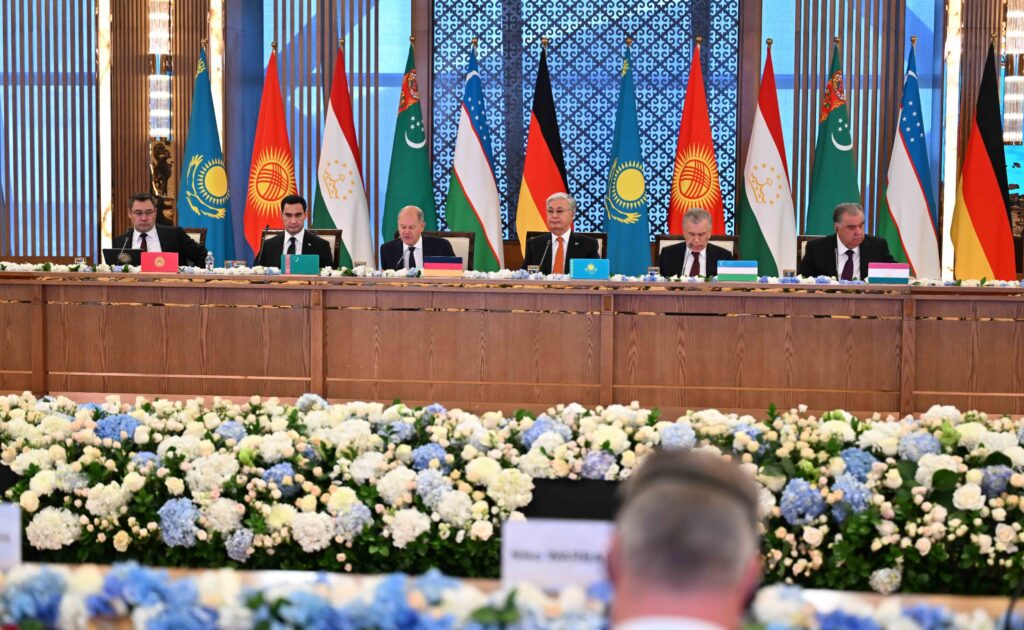
Opening the summit in Astana, Kazakh President Kassym-Jomart Tokayev expressed gratitude to Federal Chancellor Olaf Scholz and Central Asian leaders for their participation and support of regional cooperation. Noting the strengthened relationship following the high-level dialog launched in Berlin last September, he stated, “I believe this is evidence of interest and aspiration from the Central Asian states and Germany for comprehensive development of strategic partnerships. Our meeting is called to summarize joint work and outline new ways to deepen cooperation. Today, we will discuss important trade, investment, energy, ecology, transportation and logistics, education, and science issues. I am confident that our constructive discussions will lead to concrete solutions that will benefit all our countries.” According to the President of Kazakhstan, Germany's socio-economic, scientific, and technological progress is an example for many countries. The positive impact of German technologies and investments in various spheres of the economy cannot be overestimated. Hence, full-scale partnership with Germany, one of the world's most developed countries and the largest economy in the European Union, is a priority for Kazakhstan and other Central Asian states. The most promising areas of cooperation between Central Asian states and Germany include increasing trade turnover, cooperation in the energy sector, development of industrial cooperation, transportation and logistics interconnection, and development of scientific and educational ties. With reference to the above, Tokayev stated: “Wide investment prospects are opened by the development of the Middle Corridor, including the modernization and digitalization of the Caspian Sea ports and construction of cargo terminals. Further integration of Central Asian and European transportation and logistics systems remains urgent. Kazakhstan welcomes the decision of European partners to allocate 10 billion euros under the Global Gateway program for the development of the Middle Corridor. We count on Germany's assistance connecting this route with the Trans-European Transport Network (TEN-T) and the Global Gateway strategy." Citing the need for sustained focus on strengthening and ensuring international security and stability,  Tokayev then emphasized: “Our countries closely cooperate in a multilateral format, including within the framework of the United Nations. We intend to continue to strongly support the efforts of this non-alternative universal Organization in the fight against terrorism, extremism, illegal migration, climate change, peacekeeping, and disarmament. Kazakhstan is ready to participate in the UN reform process. We believe that several developed countries, including Germany, certainly deserve a place as permanent members of the UN Security Council. I want to take this opportunity to wish the Kyrgyz Republic success in promoting its candidacy for the post of a non-permanent member of the UN Security Council for 2027-2028. I am confident that Kyrgyzstan will be able to significantly contribute to strengthening stability and security in Central Asia and beyond." Following speeches by Federal Chancellor of Germany Olaf Scholz, President of Kyrgyzstan Sadyr Japarov, President of Tajikistan Emomali Rahmon, President of Turkmenistan Serdar Berdimuhamedov and President of Uzbekistan Shavkat Mirziyoyev, a Joint Declaration was adopted by the Heads of the Central Asian states and the Federal Chancellor of Germany.

CAREC Think Tank Development Forum to Focus on Climate Solutions

The 8th CAREC Think Tank Development Forum (CTTDF) will be held on August 27 and 28 in Almaty. Themed “The Climate Challenge: Thinking Beyond Borders for Collective Action,” the forum aims to address regional climate challenges by fostering collaborations for policy recommendations and joint research. The CAREC Institute, the Eurasian Development Bank, the Asian Development Bank, and other partners will organize the forum, which will bring together policymakers, experts, and leaders from across Asia to advance regional cooperation on climate action. Headquartered in Urumqi in China’s Xinjiang, the CAREC Institute is an intergovernmental organization contributing to the Central Asia Regional Economic Cooperation (CAREC) Program through knowledge generation and capacity building. The Institute is jointly shared and governed by the CAREC's eleven member countries: Afghanistan, Azerbaijan, China, Georgia, Kazakhstan, Kyrgyzstan, Mongolia, Pakistan, Tajikistan, Turkmenistan, and Uzbekistan. The forum participants will engage in meaningful policy discourse to identify solutions for a climate-resilient region, explore joint research opportunities, and facilitate innovative climate studies beyond mainstream agendas. Representatives from international organizations, high-level government officials, esteemed university scholars, and experts from leading think tanks will be key speakers. The Director of the CAREC Institute and the Vice President of the Asian Development Bank will address the opening ceremony. The forum will include a research presentation by Arman Akhunbaev, Eurasian Development Bank’s head of the Center for Infrastructure and Industrial Research, with insights into the financial solutions to close the investment gap in Central Asia's drinking water and sanitation infrastructure. The forum will also feature presentations, panel discussions, case studies, and interactive sessions designed to foster dialogue and develop actionable strategies for climate resilience in the CAREC region.

Turkmenistan Tourism: Dinosaur Footprints, a Mystical Crater and Healing Lakes

Dotted with historical and cultural sites, and blessed with beautiful nature and a good climate, Turkmenistan is beginning to develop its tourism industry. Turkmen authorities are expanding tourist itineraries, and improving the infrastructure and quality of services. Measures are also in place to provide a clean environment, safe drinking water and better food hygiene. Turkmenistan has a variety of natural wonders. The unique landscapes of Kopetdag, the Karakum desert, the Amu Darya river, Koytendag, the subtropics of south-western Turkmenistan and the Turkmen coast of the Caspian Sea are ideal spots for ecological tourism. The Aydere Gorge in western Kopetdag is also popular with travelers. Here there are dozens of picturesque valleys with pure springs, as well as ancient fortresses and historical monuments that guard the secrets of ancient times. Koytendag, located in the south-east of the country, attracts tourists seeking the traces of dinosaurs that lived here in prehistoric times. The Sumbar Gorge in the south-west of the country also offers great opportunities for tourism development. Its beautiful mountain valleys, life-giving springs, and diversity of animal life make this place especially attractive. The national tourist zone Avaza on the Caspian Sea coast attracts tourists from all over the world. Its comfortable climate, therapeutic mud, and mineral springs create ideal conditions for the development of ecotourism. The Caspian Sea coast, with its amazing nature, changing in every season, impresses one with its beauty and charm. Places that are also worth visiting in Turkmenistan: Darvaza In the heart of Turkmenistan's Karakum Desert is the Darvaza gas crater, which looks like a gateway to the underworld. The fire pit results from unsuccessful drilling conducted by Soviet geologists in 1971. To prevent the natural gas from harming people and livestock, the geologists decided to set it on fire. The fire, which was supposed to go out in a few days, is still burning to this day. The tongues of flame, reaching ten meters in height, can be seen from several kilometers away. The crater is about 60 meters in diameter and 20 meters deep. Darvaza is located 266 kilometers north of Ashgabat and 90 kilometers north of the village of Erbent. Several sinkholes can be found in the vicinity of the crater; one of them is filled with a bright turquoise liquid. The most impressive sight is Darvaza in the early evening light. Arriving before sunset, you can enjoy a fantastic contrast: the crater, bathed in the orange rays of the setting sun, gradually sinks into darkness, illuminating the desert landscape with bright flames. Other sinkholes are best viewed during daylight hours, but one should be careful as the loose earth near the edges crumbles and chunks of earth fall into the abyss. There is a strong smell of gas near the pit, and the temperature is quite high, so staying here for a long time is not recommended. Yekedeshik Yekedeshik, or “one hole,” is a mysterious cave city located near the village of Takhta Bazar in Mary province, on the left bank of...

UNICEF: Central Asia Must Work To Keep Children Out Of Alternative Care

About 60,000 children across the five Central Asian countries remain in alternative, care despite the known and devastating effects of family separation and child institutionalization, according to a new policy report released by UNICEF. Regina De Dominicis, UNICEF Regional Director for Europe and Central Asia, highlighted the dire and lifelong consequences of institutionalization for children and stressed the need for more investment in family support services. “We have seen progress in recent years in reducing the number of children in alternative care – including the closure of institutions. We must continue this work so that no child is ever placed in alternative care because of poverty, disability or challenging behavior, or because their family lacks access to services they need to care for their child at home,” she said. The report states that 203 children per 100,000 in the region live in care institutions, nearly double the world average of 105 per 100,000. While progress has been made in reducing the overall number of children in institutions, the report notes that children with disabilities are disproportionately represented in these homes. Between 2015 and 2021, the proportion of children with disabilities in residential institutions increased in all Central Asian countries except Kazakhstan, indicating persistent social norms and a lack of social services for these children. UNICEF emphasizes the need to close institutions and support families to prevent unnecessary placement of children in residential care. The organization offers a comprehensive approach to ensure that all children, regardless of their circumstances, grow up in a family environment: 1. Implement effective childcare reforms to keep children with their families where possible, including planning to close large-scale institutions and develop a comprehensive continuum of child and family support and protection services. 2. Investment in a range of child and family support services, including statutory family support services and a strong social service workforce, for the early identification of and intervention in situations when children are at risk of separation. 3. Securing family-based alternative care, including stronger support for extended family members who care for children and strategies to keep siblings together where possible. 4. Protecting children who are already in alternative care against violence, neglect, and abuse through robust safeguarding policies and practices. 5. Investing in more and better data on children who are at risk of family separation, in alternative care, or who have left care. 6. Raising public awareness of the benefits of keeping families together and the urgent need to prioritize family-based care. 7. Ensuring that children have a voice in the decisions that affect them and are consulted when new policies and practices are developed to meet their needs and rights. UNICEF works with governments and partners in Central Asia to keep and support families and community-based care. This also includes implementing deinstitutionalization policies, expanding family support services to prevent separation, а family reunification, and facilitating safe transitions to independent living.

Uzbekistan to Supply Extra Water to Kazakhstan for Irrigation

Kazinform has reported that following a  meeting in Astana between Kazakh  Minister of Water Resources and Irrigation, Nurzhan Nurjigitov, and Uzbek Minister of Water Management Shavkat Hamroev, Uzbekistan is to provide Kazakhstan with an additional 500 million cubic meters of water until the end of the irrigation season. Since April 1, Uzbekistan has supplied more than 4 billion cubic meters of water to Kazakhstan through the Syr Darya. It had been previously agreed that Uzbekistan would provide Kazakhstan with 3.7 billion cubic meters of water within six months but the Uzbek side fulfilled its obligation in just 4 months. The report states that the key goal was to fully satisfy the demand for irrigation water from farmers of  Kazakhstan's southern regions and today, the Shardara Reservoir holds 1.5 billion cubic meters of water, almost 500 million more than last year. A total of 4 billion cubic meters of water entered the Shardara reservoir. Commenting on the success of the project, the official representative of the Ministry of Water Resources and Irrigation of Kazakhstan, Moldir Abdualieva stated, “Due to the preliminary agreement with our neighbors on the working order of the Toktogul and Bahri-Tajik reservoirs, water regularly flows to the Kazakh part of the Dostlik interstate canal. Now, 90 cubic meters of water per second comes to the country through this channel. This is enough to fully supply the farmers of the Turkestan region with irrigation water,”