• KGS/USD = 0.01144 0%
  • KZT/USD = 0.00208 0%
  • TJS/USD = 0.10391 -0.48%
  • UZS/USD = 0.00008 0%
  • TMT/USD = 0.28571 0%
  • KGS/USD = 0.01144 0%
  • KZT/USD = 0.00208 0%
  • TJS/USD = 0.10391 -0.48%
  • UZS/USD = 0.00008 0%
  • TMT/USD = 0.28571 0%
  • KGS/USD = 0.01144 0%
  • KZT/USD = 0.00208 0%
  • TJS/USD = 0.10391 -0.48%
  • UZS/USD = 0.00008 0%
  • TMT/USD = 0.28571 0%
  • KGS/USD = 0.01144 0%
  • KZT/USD = 0.00208 0%
  • TJS/USD = 0.10391 -0.48%
  • UZS/USD = 0.00008 0%
  • TMT/USD = 0.28571 0%
  • KGS/USD = 0.01144 0%
  • KZT/USD = 0.00208 0%
  • TJS/USD = 0.10391 -0.48%
  • UZS/USD = 0.00008 0%
  • TMT/USD = 0.28571 0%
  • KGS/USD = 0.01144 0%
  • KZT/USD = 0.00208 0%
  • TJS/USD = 0.10391 -0.48%
  • UZS/USD = 0.00008 0%
  • TMT/USD = 0.28571 0%
  • KGS/USD = 0.01144 0%
  • KZT/USD = 0.00208 0%
  • TJS/USD = 0.10391 -0.48%
  • UZS/USD = 0.00008 0%
  • TMT/USD = 0.28571 0%
  • KGS/USD = 0.01144 0%
  • KZT/USD = 0.00208 0%
  • TJS/USD = 0.10391 -0.48%
  • UZS/USD = 0.00008 0%
  • TMT/USD = 0.28571 0%

Viewing results 1 - 6 of 185

Kyrgyzstan Draws International Attention to Glacier Meltdown

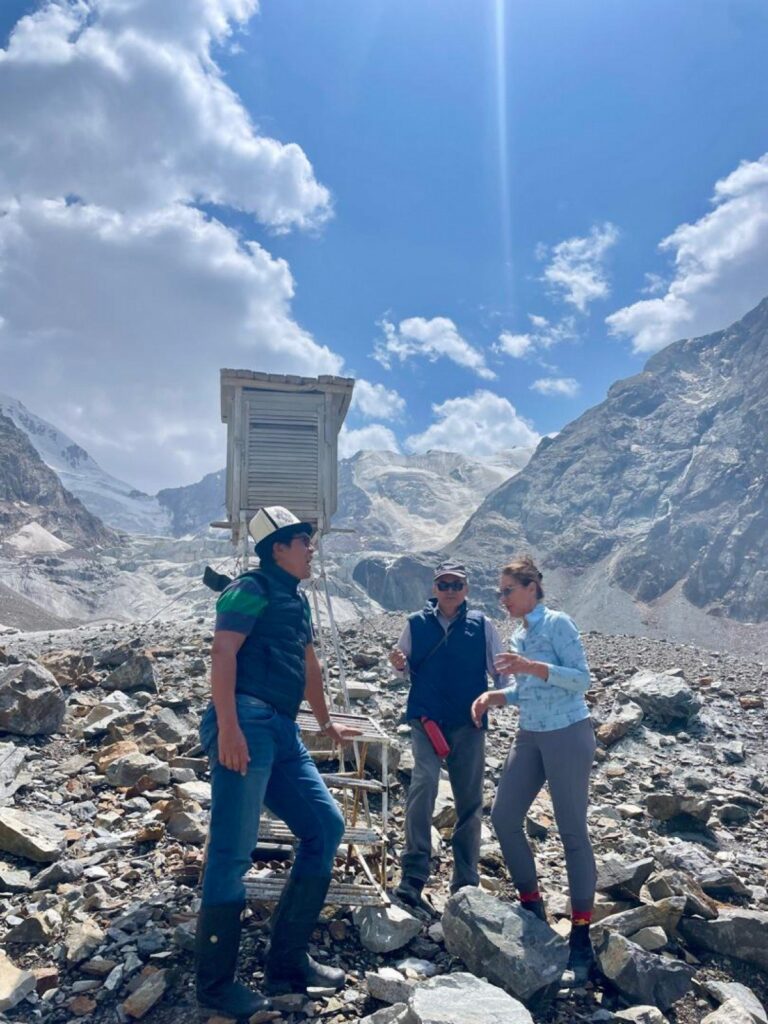
Kyrgyzstan is intensifying efforts to combat climate change and safeguard its rapidly melting glaciers through continued collaboration with the United Nations and international partners. Officials emphasize that glacier preservation is key to ensuring long-term water security for the region. On August 15, Deputy Chairman of the Cabinet of Ministers Edil Baisalov and UN Resident Coordinator in the Kyrgyz Republic Antje Grawe visited the Tien-Shan High-Altitude Physical and Geographical Station of Kyrgyzstan’s National Academy of Sciences. The joint expedition aimed to raise both domestic and global awareness of the alarming retreat of Kyrgyz glaciers, particularly the Kara-Batkak glacier, a vital source of freshwater for Kyrgyzstan and the broader Central Asian region. Located in the Terskey Ala-Too range of the Inner Tien Shan mountains, south of Lake Issyk-Kul, the Kara-Batkak glacier has long served as a key indicator of climate change. At the research station, Baisalov and Grawe reviewed decades of scientific observations and discussed policies for climate adaptation, biodiversity protection, and water resource management. “Kyrgyzstan is a land of glaciers, and it is our duty to safeguard this unique resource,” Baisalov said. “The shrinking of our glaciers is not just an environmental concern, it is a matter of national security, water stability, and the country’s future development.” Grawe underscored the broader global significance of Kyrgyz scientific research and stressed the urgency of climate finance for mountain nations: “Research on the Kara-Batkak glacier matters far beyond Kyrgyzstan. It guides national strategies and strengthens global climate action. Protecting glaciers also preserves biodiversity and sustains the ecosystems communities rely on. Therefore, climate finance must reach mountain countries like Kyrgyzstan to scale up adaptation, safeguard nature, and secure the water future of millions in Kyrgyzstan and beyond.” Also present was Rysbek Satylkanov, Director of the Institute of Water Problems and Hydropower, who presented the latest scientific data on glacial retreat and its impact on national water systems. Established in 1957, the Tien-Shan station is a unique high-altitude research facility conducting glaciological, meteorological, and hydrological monitoring. The Kara-Batkak glacier, within its observation zone, remains a crucial barometer of climate change in Central Asia. According to the World Meteorological Organization and the World Glacier Monitoring Service, five of the past six years have witnessed the fastest glacier retreat ever recorded. The years 2022-2024 marked the most significant three-year loss of glacier mass in history. Glaciers once considered “eternal ice” may not survive the 21st century. There are over 275,000 glaciers worldwide, covering approximately 700,000 square kilometers and storing about 70% of the Earth’s freshwater. Their disappearance poses a severe threat to water supplies for hundreds of millions of people. In response, the UN General Assembly has declared 2025 the International Year of Glaciers’ Preservation and designated March 21 as the annual World Day for Glaciers. The initiative aims to raise awareness of the essential role glaciers play in global climate and hydrological systems, and their significance to ecological and economic stability.

Climate Study’s Dire Forecast Undermined by Faulty Uzbekistan Data

A widely publicized climate study predicting severe global economic losses from climate change is under scrutiny following the discovery of a critical data error involving Uzbekistan. As reported by The Washington Post on August 7, the error significantly skewed the study’s projections, prompting renewed debate over the reliability of economic modeling in climate science. Published in Nature in 2023, the original study warned that unchecked climate change could reduce global GDP by 19% by 2050 and by an alarming 62% by 2100, nearly three times higher than earlier forecasts. The study attracted substantial media attention and became the second-most-cited climate paper in 2024, according to CarbonBrief. Its projections were used by U.S. government agencies and the World Bank in financial planning. However, a new commentary in Nature, led by Solomon Hsiang, director of Stanford University’s Global Policy Laboratory, revealed that the study’s extreme forecasts were largely driven by distorted GDP data from Uzbekistan. Once researchers excluded Uzbekistan from the model, the projected global GDP losses dropped sharply from 62% to 23% by 2100, and from 19% to 6% by 2050. The flawed dataset suggested that Uzbekistan’s GDP plummeted by nearly 90% in 2000, then rebounded by over 90% in certain regions by 2010, figures inconsistent with historical records. According to the World Bank, Uzbekistan’s actual annual growth between 1980 and 2020 ranged between -0.2% and +7.7%. “These extreme swings warped the study’s model, creating the illusion that global GDP was far more sensitive to climate than it really is,” Hsiang told The Washington Post. The original study’s authors, based at Germany’s Potsdam Institute for Climate Impact Research, acknowledged the error but stood by their conclusions. After revising the Uzbekistan data and adjusting the model, they reduced their 2050 forecast from a 19% to a 17% GDP loss. “We’re grateful for the scrutiny,” said co-author Leonie Wenz of the Technical University of Berlin. “But the main conclusions still hold.” Still, critics argue that retroactive methodological adjustments raise concerns about scientific integrity. “Science doesn’t work by adjusting experiments to get the answer you want,” Hsiang cautioned. The incident highlights both the power and the fragility of large-scale climate modeling and the importance of validating every data point, regardless of a country's size.

Tokayev Calls for Global Action at UN LLDC3 Summit in Turkmenistan

At the Third United Nations Conference on the Landlocked Developing Countries (LLDC3), held from August 5-8 in the Turkmen resort town of Awaza, Kazakhstan’s President Kassym-Jomart Tokayev urged the international community to deepen cooperation, enhance regional connectivity, and take decisive collective action in support of the 32 countries that lack direct access to the sea and remain on the periphery of global trade. A Global Call for Equality and Interconnectedness Speaking at the plenary session, Tokayev highlighted Kazakhstan’s leadership in advancing the LLDC agenda. In 2003, Almaty hosted the first UN conference on landlocked countries, which culminated in the Almaty Programme of Action (APoA). Two decades later, the president noted, structural barriers, such as limited market access, underdeveloped infrastructure, and high exposure to geopolitical shocks, remain largely unchanged. “Landlocked countries should be seen as equal and promising partners in global development,” Tokayev said. “Our voice must be louder and our cooperation deeper.” [caption id="attachment_34680" align="alignnone" width="300"] @akorda[/caption] The Awaza Action Programme: A Roadmap for 2024-2034 The centerpiece of LLDC3 was the adoption of the Awaza Action Programme for the coming decade, structured around five strategic priorities: structural transformation of economies, development of sustainable infrastructure, trade facilitation, regional integration, and resilience. Kazakhstan endorsed the plan and called for stronger political and financial support from transit countries, international institutions, and private investors. Tokayev emphasized the need for innovative financing tools to mobilize investment in transport, energy, and digital infrastructure. Addressing the Climate Challenge The president also highlighted the disproportionate climate-related vulnerabilities faced by LLDCs, including water scarcity, glacial melt, and desertification. He called for a balanced and inclusive approach to climate policy and invited participants to the Regional Environmental Summit, scheduled for April 2026 in Astana, to be co-hosted with the United Nations. Tokayev also pointed to Kazakhstan’s recent achievements in digital innovation and sustainability, citing the launch of the Alem.AI Artificial Intelligence Center and the commissioning of a new national supercomputer. “We are open to international scientific cooperation,” he said. [caption id="attachment_34681" align="alignnone" width="300"] @akorda[/caption] Central Asia as a Model of Regional Resilience Despite geographic constraints, Tokayev presented Central Asia as a case study in overcoming isolation through cooperation. “Geography does not determine destiny,” he said. “With political will, strategic investment, and international partnership, lack of access to the sea can become not a barrier but a source of growth.” Kazakhstan is investing heavily in transport corridors such as the Middle Corridor (Trans-Caspian International Route) and the North-South Corridor, strengthening its role in the Eurasian logistics network. Energy Diplomacy and Regional Projects On the sidelines of the conference, Central Asian leaders convened for informal talks, where they discussed priority areas of cooperation, including energy. Topics included development of Turkmenistan’s Galkynysh Gas Field, one of the world’s largest, and ongoing transport projects such as the Kazakhstan-Turkmenistan-Iran railway and the Turkmenbashi-Garabogaz-Kazakhstan border highway. According to the UN, trade costs in LLDCs are 74% higher than in coastal states, and cross-border shipping takes twice as long. Collectively, these countries account for only 1.2% of...

The Caspian Sea Hits Historic Low

The Caspian Sea has dropped to its lowest recorded level, now sitting at less than 29 meters below sea level. The northern basin, bordering Russia and Kazakhstan, is shrinking particularly rapidly. As the water recedes, the exposed seabed is threatening key marine ecosystems. Experts warn the decline is already causing serious disruption to biodiversity in the region. Declining Volga Flow and Climate Change The downward trend in sea levels began in the 1990s and has accelerated since 2020, with a nearly 80-centimeter drop in the past four years. The primary factor is a decrease in the annual flow of the Volga River, which supplies approximately 80% of the Caspian's inflow and contributes 64% to the lake's total water balance. In recent years, the Volga’s annual discharge has ranged between 210 and 232 cubic kilometers, well below the historical average of around 250 cubic kilometers. At the same time, rising air temperatures are increasing evaporation rates, further depleting water levels. Scientists link these changes to global climate change and the ongoing rise in greenhouse gas emissions. Ecological and Economic Impact Human activity is compounding the problem. Significant water extraction from rivers for agriculture, industry, and municipal use is reducing the volume of water reaching the sea. Russia’s Ministry of Natural Resources is currently developing a comprehensive program to adapt to these shifting environmental conditions. The initiative aims to enhance forecasting, mitigate the consequences of shallowing, and adjust economic activities to reflect the new hydrological realities. Experts suggest that only a sustained annual inflow of around 270 cubic kilometers, comparable to levels recorded in the 1970s and 1990s, can halt the lake's ongoing decline. Changing Coastlines and Public Concern A recent video by Kazakh filmmaker Adai Myrzatay has stirred widespread attention on social media. The footage juxtaposes images of the Caspian coastline in 2013 and 2025. Twelve years ago, the pier was surrounded by open water and untouched shoreline. Today, the water has receded dramatically. Bushes now encircle the pier, and high-rise buildings stand where the shoreline once lay. The video has been viewed over 1.5 million times. The falling water level is leading to the loss of biological diversity and shrinking spawning grounds for species such as the Caspian seal and sturgeon. The shallowing is also disrupting shipping and fishing operations and raising the risk of international disputes over increasingly scarce water resources. A Shared Challenge for Five Nations The Caspian Sea, the world’s largest enclosed inland body of water, receives inflow from more than 130 rivers, including the Volga, Ural, Terek, Sulak, and Samur. Its coastline is shared by five countries: Russia, Kazakhstan, Turkmenistan, Azerbaijan, and Iran. While the Volga's inflow increased slightly to 232 cubic kilometers in 2024, it remains insufficient to reverse or even stabilize the sea’s decline. Experts agree that regional cooperation and a coordinated, long-term strategy for water resource management are essential to confronting this environmental crisis.

World Bank Report: Central Asia Faces Rising Risks from Extreme Heat

Cities across Central Asia are becoming increasingly vulnerable to extreme heat, posing significant risks to public health, economic productivity, and infrastructure, according to a new report by the World Bank. The study, which covers 70 urban areas in Europe and Central Asia, including Astana, Bishkek, Ashgabat, Tashkent, and several smaller cities in Tajikistan and Turkmenistan, highlights the urgent need for heat adaptation strategies. Rising Mortality and Economic Losses The report finds that heat-related mortality is already a serious concern. In Ashgabat, an estimated 25-28 people per 100,000 die annually due to extreme heat. In Astana, Bishkek, and Tashkent, the toll is slightly lower, at approximately 19-21 deaths per 100,000. Without intervention, annual heat-related deaths in cities like Astana and Tashkent could rise dramatically, reaching between 10,000 and 23,000 by 2090. Economic impacts are also mounting. In 2023, higher temperatures resulted in the loss of over 87,000 full-time jobs across the region. Uzbekistan alone saw more than 22,000 job losses, while nearly 18,000 were reported in Azerbaijan. By 2050, heat-related economic losses could exceed 2% of GDP in some urban centers, such as Ashgabat. Infrastructure Under Strain Rising temperatures are damaging infrastructure across Central Asia. In Kyrgyzstan, extreme heat causes deterioration to nearly 200 kilometers of road annually, driving up repair costs and disrupting transportation. Kazakhstan is facing similar challenges: recent heatwaves have warped asphalt and concrete surfaces in the southern and northeastern regions of the country. Adaptation Measures and Challenges Despite these threats, the report outlines viable solutions. Urban greening, such as planting trees and creating shaded areas, can help cool city streets. Retrofitting buildings to improve thermal insulation without increasing energy use, establishing early warning systems, and creating cooling centers are also recommended. Urban planning strategies should incorporate climate resilience by using heat-tolerant materials and factoring climate risks into infrastructure design. Investment in parks and green spaces, alongside the use of heat vulnerability maps, can guide targeted interventions. However, the report warns that a lack of funding may hinder progress. Without innovative financing mechanisms, many adaptation plans could be stalled despite their potential to mitigate long-term risks. The World Bank concludes that while the impacts of rising temperatures are already being felt across Central Asia, timely action can prevent far more serious consequences. Policymakers are urged to prioritize heat adaptation to safeguard lives, livelihoods, and infrastructure in an increasingly warming world.

Kyrgyzstan Endorses National Program to Strengthen Climate Cooperation with Green Climate Fund

Kyrgyzstan has taken a step toward climate resilience by approving its Country Program for Cooperation with the Green Climate Fund (GCF) through 2027. The program defines national priorities for climate action and outlines a portfolio of projects seeking international funding. The GCF, the principal financial mechanism under the UN Framework Convention on Climate Change (UNFCCC), supports developing nations in mitigating and adapting to the impacts of climate change. Kyrgyzstan’s newly approved framework highlights several priority initiatives: Reducing greenhouse gas emissions in the housing sector Enhancing ecosystem resilience and introducing climate-smart water treatment systems in the Issyk-Kul region Promoting climate-resilient agriculture and water resource management in the Batken region Improving disaster preparedness and access to climate data Expanding climate finance mechanisms for small and medium enterprises (SMEs) and households According to the Ministry of Natural Resources, Ecology and Technical Supervision, Kyrgyzstan mobilized significant international climate finance between 2010 and 2023. Major contributors included the World Bank ($303.7 million), the Asian Development Bank ($194.4 million), German institutions and climate funds ($73.1 million), and the United Nations Development Programme ($63.1 million). These funds were disbursed as a mix of grants and concessional loans. Data from the International Aid Transparency Initiative (IATI) indicate that energy projects received the largest share of this climate financing ($306.6 million), followed by agriculture, forestry, and fisheries ($140.5 million), and water-related projects ($122.8 million). Between 2011 and 2021, Kyrgyzstan received approximately $620 million in international technical assistance for climate-related initiatives, with grants comprising about 81% of total funding. The new Country Program reflects Kyrgyzstan’s broader commitment to sustainable development and climate adaptation, particularly in vulnerable regions such as Batken and Issyk-Kul. National priorities continue to focus on energy efficiency, risk reduction, and scaling green finance solutions for local communities and businesses.