• KGS/USD = 0.01144 0%
  • KZT/USD = 0.00204 0%
  • TJS/USD = 0.10415 -0.19%
  • UZS/USD = 0.00008 0%
  • TMT/USD = 0.28571 0%
  • KGS/USD = 0.01144 0%
  • KZT/USD = 0.00204 0%
  • TJS/USD = 0.10415 -0.19%
  • UZS/USD = 0.00008 0%
  • TMT/USD = 0.28571 0%
  • KGS/USD = 0.01144 0%
  • KZT/USD = 0.00204 0%
  • TJS/USD = 0.10415 -0.19%
  • UZS/USD = 0.00008 0%
  • TMT/USD = 0.28571 0%
  • KGS/USD = 0.01144 0%
  • KZT/USD = 0.00204 0%
  • TJS/USD = 0.10415 -0.19%
  • UZS/USD = 0.00008 0%
  • TMT/USD = 0.28571 0%
  • KGS/USD = 0.01144 0%
  • KZT/USD = 0.00204 0%
  • TJS/USD = 0.10415 -0.19%
  • UZS/USD = 0.00008 0%
  • TMT/USD = 0.28571 0%
  • KGS/USD = 0.01144 0%
  • KZT/USD = 0.00204 0%
  • TJS/USD = 0.10415 -0.19%
  • UZS/USD = 0.00008 0%
  • TMT/USD = 0.28571 0%
  • KGS/USD = 0.01144 0%
  • KZT/USD = 0.00204 0%
  • TJS/USD = 0.10415 -0.19%
  • UZS/USD = 0.00008 0%
  • TMT/USD = 0.28571 0%
  • KGS/USD = 0.01144 0%
  • KZT/USD = 0.00204 0%
  • TJS/USD = 0.10415 -0.19%
  • UZS/USD = 0.00008 0%
  • TMT/USD = 0.28571 0%

Viewing results 1 - 6 of 13

Montenegro Will Not Extradite NeMolchi Founder to Kazakhstan

The authorities in Montenegro have decided that the director of Kazakhstan’s NeMolchi.kz (Don’t be silent) foundation, Dina Smailova (Tansari), will not be deported to Kazakhstan, where she faces charges of knowingly disseminating false information, violation of privacy, and fraud. Smailova’s Legal Battles and Exile Since 2017, Smailova has faced a plethora of criminal cases. In 2021, she left Kazakhstan and relocated to Georgia. After she departed, Almaty police launched new inquiries against her. In June 2022, Smailova said that these investigations were opened “because I criticize the activities of the Almaty police, because I demand the resignation of the leadership, because I do not recognize the police who torture our people in their dungeons!” In early 2024, Smailova left Georgia and requested asylum in the European Union, and in April of that year, she was detained in Montenegro based on an Interpol warrant from Kazakhstan’s Interior Ministry. Kazakhstan and Montenegro do not have an extradition agreement, so Montenegrin officials needed time to consider the Kazakh authorities’ request to repatriate Smailova to Kazakhstan. Smailova was therefore quickly freed from custody but remained in Montenegro, and in July, she and her husband, Almat Mukhamedzhanov, were granted international protection status in the country, signaling that she was unlikely to be extradited. On September 4, Montenegro’s Supreme Court ruled to deny Kazakhstan’s request for her extradition, and on September 12, Smailova wrote on Facebook that the decision had come into force. NeMolchi.kz is an organization that defends the rights of women and children in Kazakhstan and reports on incidents of domestic violence, a problem that has become more visible in the country in recent years. Violence against women has become a priority issue for the Kazakh government, especially since the high-profile murder of a young woman named Saltanat Nukenova in 2023. The Nukenova Case and Public Outcry Saltanat Nukenova was killed in an Astana restaurant by her husband, Kuandyk Bishimbayev, a former Kazakh Minister of National Economy. Bishimbayev was convicted of taking bribes and, in March 2018, was sentenced to ten years in prison. His term was later reduced to four years, and he was eventually released early in December 2020. On November 9, 2023, Bishimbayev and Nukenova went to an Astana restaurant where they had a private room reserved. Bishimbayev and Nukenova quarreled, following which Bishimbayev severely beat his wife, then waited several hours while she lay dying from head injuries he inflicted on her before calling for medical help. Later that same month, it was reported that the police in East Kazakhstan Province had started investigating Smailova for fraud. Police questioned “hundreds” of people who had donated to NeMolchi.kz, on the suspicion that Smailova had used some of the donated money for personal purchases. Before the end of 2023, formal charges were lodged against Smailova, and Kazakhstan put out an international warrant for her arrest. Bishimbayev’s trial was televised and drew a huge audience in Kazakhstan. He was found guilty and sentenced to 24 years in prison. The details of the beating of...

Embezzlement Scandal at Kazakh Charity Fund Implicates Influential Officials

A high-profile scandal is unfolding in Kazakhstan involving the alleged embezzlement of billions of tenge from the Biz Birgemiz Qazaqstan (“We Are Together”) charity fund. Testimony from the fund’s embattled director, Perizat Kairat, alongside ongoing press investigations, has implicated several prominent officials. The Rise and Fall of Perizat Kairat Charitable giving in Kazakhstan remains underdeveloped, with many humanitarian organizations struggling to secure adequate funding. The Biz Birgemiz Qazaqstan fund, however, stood out. Backed by donations from large banks, business leaders, and individuals, it quickly amassed substantial sums. Established in June 2021, the fund came under scrutiny after Kairat’s arrest in November 2024. She was initially charged with embezzling more than KZT 1.5 billion ($2.8 million) raised during the spring 2024 floods, the worst to hit Kazakhstan in 80 years, affecting twelve regions and leaving thousands homeless. Subsequent investigations raised the alleged embezzled amount to KZT 2.9 billion ($5.4 million). The authorities claim Kairat and her mother, Gaini Alashbaeva, used the funds to purchase luxury real estate, vehicles, designer goods, and pay for lavish travel. Funds collected for humanitarian aid to Gaza residents were also reportedly misappropriated. Additional allegations include collecting over KZT 105 million ($200,000) for festivals such as Central Asia Fest and Almaty Uni, which were never held, and for a rehabilitation center, which was never built. Support for the fund was boosted by advertising through Kazakhstan’s largest financial platform, Kaspi.kz, which promoted it within its mobile app. During court proceedings, Kaspi.kz confirmed transferring KZT 620 million ($1.2 million) to the fund. Another major contributor, Jusan Bank (now Alatau City Bank), reportedly also donated KZT 300 million ($560,000). Misplaced Trust Public trust in the fund was bolstered by the widespread belief that it was affiliated with the state. For instance, an elderly woman from Pavlodar testified that she donated KZT 1 million, believing it was a government initiative. Parents from Nazarbayev Intellectual Schools (NIS) who transferred KZT 901,000 are now demanding its return to assist a seriously ill teacher. Witnesses claim Kairat collected cash through intermediaries using large market-style bags. Political Connections and Allegations Perizat Kairat’s defense has drawn high-level political figures into the spotlight. On July 14, she requested the court summon Bauyrzhan Baybek, former mayor of Almaty and ex-first deputy chairman of the ruling Amanat Party (formerly Nur Otan), for questioning. Kairat alleges that the fund was “created under the leadership of Baybek,” claiming all its founders, except herself, were current or former party employees. Amanat, Kazakhstan’s dominant political party, has publicly denied any connection to Kairat or the foundation. Though President Kassym-Jomart Tokayev resigned from the party leadership in April 2022, Amanat remains politically influential and retains close ties to many government officials. Kazakh outlet Orda.kz examined Kairat’s social media to explore potential links between the fund and state institutions. It found the foundation's founders had associations with the BizBirgemiz volunteer movement, launched during the COVID-19 pandemic under a state initiative of the same name. Just a month after its registration, the foundation hosted a charity...

“Be a Man”: Bishkek Vice Mayor Detained in Public Showdown

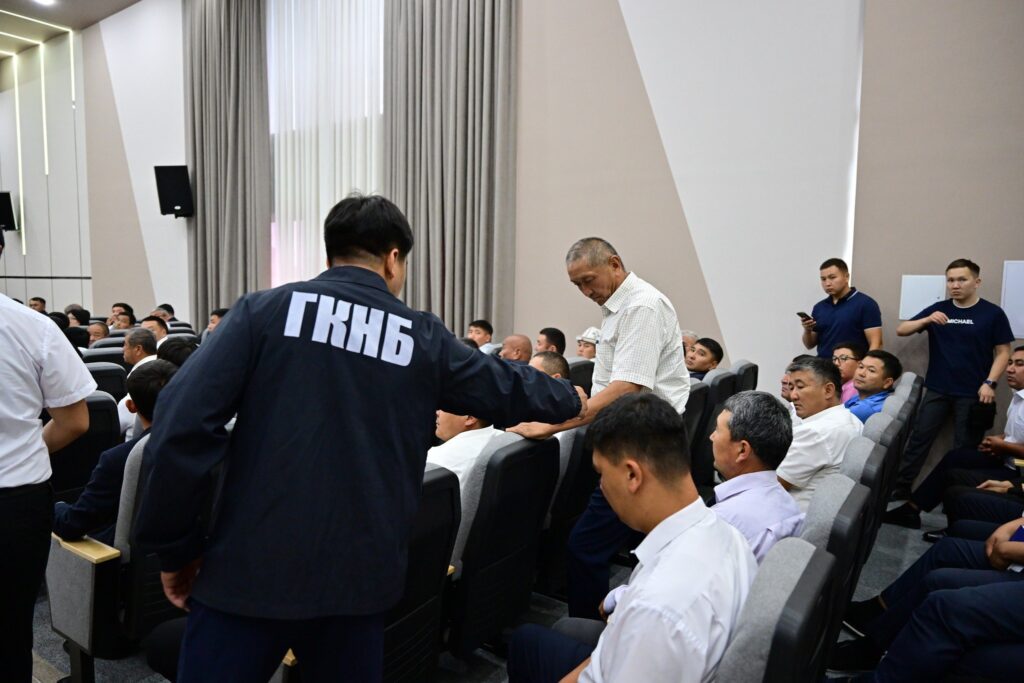
The Vice Mayor of Bishkek, Zhamalbek Yrsaliev, has been detained during a public meeting in the Tunguch neighborhood, presided over by Kamchybek Tashiyev, the controversial Chairman of Kyrgyzstan’s State Committee for National Security (GKNB). Residents at the July 16 meeting accused Yrsaliev of illegally occupying a 1,500 m² municipal land plot where unauthorized commercial kiosks and children's attractions had been operating for six years without any lease payments. According to Economist.kg, this misuse cost the city budget over 2.9 million Kyrgyz som ($33,160), and stalled the planned development of a public square and playground. During the meeting, Tashiyev confronted Yrsaliev directly. In a moment caught on video, he told the vice mayor to take responsibility for his actions and “Be a man,” ordering the security services to detain him immediately. Officers escorted Yrsaliev from the event to the GKNB headquarters. According to Sputnik Kyrgyzstan, Yrsaliev admitted responsibility and apologized, but Tashiyev continued to reprimand him, telling Yrsaliev, “You will not deceive the people.” The investigation is ongoing. The charges against Yrsaliev include abuse of office and corruption. Alongside him, officials from the Lenin and Oktyabr district administrations were also detained during the same operation, according to preliminary reports. Appointed as vice mayor in May 2024, Yrsaliev previously served as vice-mayor of Bishkek for housing and communal services, and akim of the Pervomaisky district. The arrest marks another chapter in Kyrgyzstan’s sweeping anti-corruption campaign under President Sadyr Japarov. In January 2023, former Deputy Prime Minister Zhenish Razakov was detained on suspicion of a $1 million fraud and abuse of office, and in December 2024, the authorities arrested the head of the state tax service and his deputy. While Yrsaliev’s detention has been officially framed as part of an anti-corruption effort, it unfolds within a broader political climate in Kyrgyzstan marked by increasing executive consolidation and the expanded role of the GKNB in domestic affairs. Independent watchdogs, including Freedom House, have noted a rise in politically motivated prosecutions and diminished judicial independence in recent years, raising concerns that cases such as this may serve not only legal but also political purposes. Further updates are expected as the investigation continues.

Tackling Corruption in Kazakhstan: The Latest Trends

As previously reported by The Times of Central Asia, anti-corruption efforts are a cornerstone of President Kassym-Jomart Tokayev’s agenda. Court-ordered funds confiscated from corrupt officials have been used to finance public infrastructure: over the past three years, 150 billion tenge have been allocated to build 89 schools. On June 30, Tokayev signed a decree dissolving the country’s standalone Anti-Corruption Agency and transferring its functions to the National Security Committee (NSC), in what officials described as a move to modernize and streamline public administration. A recent analysis by Ranking.kz sheds light on the latest trends, identifying the institutions most often entangled in scandals and criminal investigations. Corruption Reaches Across All Levels Between January and May 2025, the Kazakh authorities charged 640 individuals with corruption-related offenses, representing a 3% decrease compared to the same period in 2024. However, the number of identified offenders rose to 464, up 4.3% from 445 last year. During the same period, 405 individuals were referred to the courts, an increase of 9.2% year-on-year. The largest number of defendants were employees of Akimats and their subordinate departments, totaling 66 individuals, though this figure is one-third lower than in 2024. In addition, 49 police officers, 16 employees from the Ministry of Finance, 11 from the Ministry of Agriculture, and 7 from the Criminal Executive Committee under the Ministry of Internal Affairs were brought to court. Notably, three regional akims were among those referred to court this year, compared to just one in the same period last year. One judge was also prosecuted. In total, 57 individuals from 12 different ministries faced judicial proceedings, up slightly from 54 last year. However, the data does not encompass all divisions; for instance, the figures for the Ministry of Internal Affairs include only selected departments. Bribery Remains the Most Common Offense Bribery continues to be the most prevalent form of corruption, with 167 recorded cases in the first five months of 2025, a 27.5% increase from the previous year. Internal affairs personnel were the most frequently detained for bribery (22 cases), followed by local government officials (13 cases) and employees of the Ministry of Finance (9 cases). In terms of the number of individuals involved, bribery accounted for 99 people. Corruption-related fraud followed, with 71 cases documented, rounding out the top three categories of offenses. Kazakhstan in Global Perspective Kazakhstan ranked 88th out of 180 countries in the 2024 Corruption Perceptions Index published by Transparency International, scoring 40 out of 100. This position is shared with North Macedonia, Suriname, and Vietnam. The index, based on assessments from organizations such as the World Bank and the World Economic Forum, ranks countries from 0 (most corrupt) to 100 (least corrupt). According to the same report, 17% of Kazakhstani citizens who accessed public services in the previous year admitted to paying bribes. By way of comparison, in Denmark and Finland, the top-ranked countries, only 1% of citizens reported such experiences. Within the Commonwealth of Independent States (CIS), Kazakhstan ranks third, behind Armenia (63rd) and Moldova (77th)....

Kyrgyz Anti-Corruption Crackdown: Officials Arrested During Live Meeting in Osh

Several officials were arrested during a high-level government meeting in the southern Kyrgyz city of Osh, as part of an ongoing anti-corruption campaign led by the State Committee for National Security (GKNB). Kamchybek Tashiev, chairman of the GKNB, ordered the arrests during a gathering with the heads of state agencies. Six civil servants were detained on the spot after Tashiev accused them of embezzling state funds and providing false information. Among those taken into custody were the head of the Tax Service in the Uzgen district and the deputy head of the Tax Service in the Kara-Suu district. “Take him out, he’s lying!” Tashiev said, pointing to the deputy head of the Kara-Suu Tax Inspectorate. He also stated that the head of the service had already been transferred to the GKNB’s central office in Bishkek for interrogation. The detentions extended beyond the tax authorities. According to local media reports, two employees from the Cadastral Service in the Nookat district, a representative of the judiciary, and a passport office staff member in Uzgen were also arrested. All face allegations of corruption and misappropriation of public funds. These events in Osh follow a series of high-profile detentions in northern Kyrgyzstan. Over the past month, at least three mayors and several senior officials have been arrested in the Chui and Issyk-Kul regions. They are accused of abuse of office, illicit enrichment, and orchestrating corruption networks. During the meeting, Tashiev reiterated the GKNB’s commitment to combating corruption at all levels of government. He referenced the arrest of former State Tax Service head Altynbek Abduvapov in late 2024 as a prominent example. Investigators claim Abduvapov accumulated approximately $55 million in assets through illegal means. “He never had a business of his own. Employees say they gave him bribes ranging from $50,000 to $100,000 every month. We are confiscating everything. Altynbek Abduvapov will now be a poor man,” Tashiev declared. Political analysts suggest the crackdown indicates both an intensification of anti-corruption efforts and a recalibration of power dynamics between Kyrgyzstan’s northern and southern regions. While critics have accused the authorities of selective justice, GKNB officials maintain that the arrests are supported by solid evidence and reveal systemic governance failures.

Kazakhstan Confronts Major Data Leak in High-Stakes Security Crackdown

A detective thriller worthy of a Hollywood script is quietly playing out in the daily lives of Kazakhstani citizens, one with implications for nearly every household. At its core lies the largest leak of personal data in Kazakhstan’s history, unfolding across Almaty and Astana. The incident touches on something deeply personal: data that could be weaponized by fraudsters for illicit gain. Sixteen Million Records Exposed In early June, the Telegram channel SecuriXy.kz, known for its cybersecurity reporting, revealed a massive breach of Kazakh citizens' personal data. "A CSV file containing the personal data of Kazakh citizens, containing 16.3 million lines, has been discovered. The table contains the following fields: Last name, First name, Middle name, Gender, Date of birth, ID number, IIN [Bank Identification Number], Mobile phone number, Work phone number, Home phone number, Citizenship, Nationality, Address, Confirmed address, Start and end dates of residence," the channel stated. The analysis identified 16,302,107 records, 16.9 million unique phone numbers, and 15,851,699 unique individual identification numbers (IINs), the number of citizens whose information had been compromised. “The ‘address’ field often contains the addresses of dental clinics, polyclinics, the Tax Committee, universities, and other organizations,” the channel noted. The leak included highly sensitive personal data such as contact details and IINs, which the channel warned could be used for: “Phishing, social engineering, document forgery, and telephone fraud.” The data appears to have been compiled over a significant period. SecuriXy.kz reported that, “Most of the records were entered into the system after 2011,” with over two million added in 2022 alone. Data from 2023-2024 also appears, underscoring the leak's relevance. The revelation sparked swift reactions from officials. The Ministry of Digital Development, Innovation, and Aerospace Industry (MCIAI) released a statement confirming an investigation in collaboration with law enforcement and intelligence agencies. “It should be noted that the initial analysis indicates that the information may have originated from private information systems. No hacker attacks or leaks of personal data from state information systems have been recorded at this time. It is premature to draw final conclusions or confirm the accuracy of the information until the investigation is complete,” the ministry stated, adding that similar past incidents often involved outdated data compiled by service sector firms or microfinance institutions. “The ministry is monitoring the situation," the authorities concluded. "Additional information will be posted after the investigation is complete.” Cybersecurity experts, however, were less dismissive. Enlik Satieva, vice president of the TSARKA Group, a cybersecurity firm affiliated with the government, stressed the seriousness of the breach. "These are not just names," she stated. "The published database contains the most important personal data of citizens. In particular, it includes surnames, first names, patronymics, gender, dates of birth, IINs, citizenship, nationality, residential addresses, registration and residence periods, as well as mobile, home, and work phone numbers." Satieva suggested that some of the data may have been sourced from medical organizations, and that the leak might stem from a specific entity or multiple sources linked through IINs. Criminal Case and Contradictions...