• KGS/USD = 0.01144 0%
  • KZT/USD = 0.00208 0%
  • TJS/USD = 0.10414 -0.29%
  • UZS/USD = 0.00008 0%
  • TMT/USD = 0.28571 0%
  • KGS/USD = 0.01144 0%
  • KZT/USD = 0.00208 0%
  • TJS/USD = 0.10414 -0.29%
  • UZS/USD = 0.00008 0%
  • TMT/USD = 0.28571 0%
  • KGS/USD = 0.01144 0%
  • KZT/USD = 0.00208 0%
  • TJS/USD = 0.10414 -0.29%
  • UZS/USD = 0.00008 0%
  • TMT/USD = 0.28571 0%
  • KGS/USD = 0.01144 0%
  • KZT/USD = 0.00208 0%
  • TJS/USD = 0.10414 -0.29%
  • UZS/USD = 0.00008 0%
  • TMT/USD = 0.28571 0%
  • KGS/USD = 0.01144 0%
  • KZT/USD = 0.00208 0%
  • TJS/USD = 0.10414 -0.29%
  • UZS/USD = 0.00008 0%
  • TMT/USD = 0.28571 0%
  • KGS/USD = 0.01144 0%
  • KZT/USD = 0.00208 0%
  • TJS/USD = 0.10414 -0.29%
  • UZS/USD = 0.00008 0%
  • TMT/USD = 0.28571 0%
  • KGS/USD = 0.01144 0%
  • KZT/USD = 0.00208 0%
  • TJS/USD = 0.10414 -0.29%
  • UZS/USD = 0.00008 0%
  • TMT/USD = 0.28571 0%
  • KGS/USD = 0.01144 0%
  • KZT/USD = 0.00208 0%
  • TJS/USD = 0.10414 -0.29%
  • UZS/USD = 0.00008 0%
  • TMT/USD = 0.28571 0%

Viewing results 1 - 6 of 274

Former Justice Minister From ‘Old Kazakhstan’ Sentenced to Nine Years in Prison

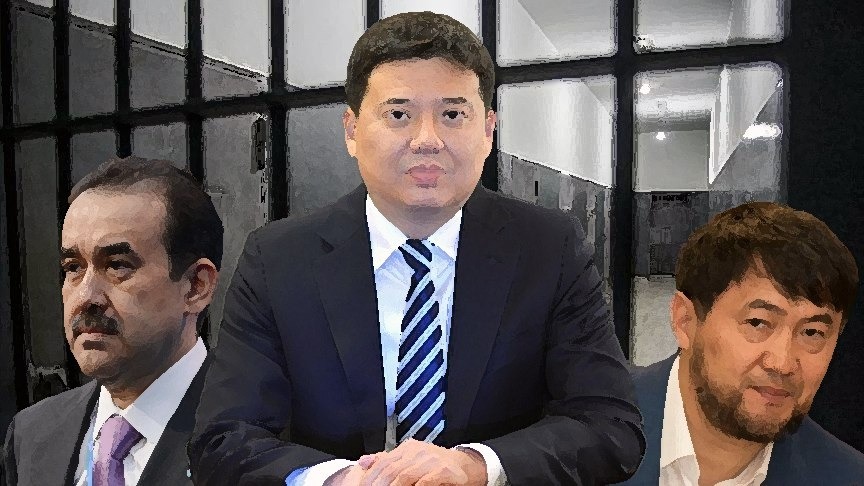
Former Minister of Justice Marat Beketayev has been sentenced to nine years in prison with confiscation of property for crimes linked to large-scale corruption. Beketayev is widely regarded as a representative of the "Old Kazakhstan" of the first president, Nursultan Nazarbayev, a term widely used to describe officials removed from power in the wake of the January 2022 unrest and associated with systemic corruption. Verdict Handed Down The Anti-Corruption Service of Kazakhstan announced on June 30 that Beketayev was convicted of fraud, embezzlement on an especially large scale, and illegal participation in entrepreneurial activities. Details of the case remain classified. The charges were formally submitted to the court in March 2025. Beketayev served as Minister of Justice from 2016 until early 2022. Following the January unrest, he was appointed as an advisor to the Prime Minister but was quietly dismissed in December 2022, a fact that only became public knowledge in February 2023. He was detained in October 2023 while allegedly attempting to flee the country. According to investigators, he abused his office by lobbying for the interests of an affiliated company and awarding it annual contracts for unnecessary services, actions that reportedly inflicted significant financial damage on the state. Fallout from the January Events Beketayev’s dismissal came immediately after the events known in Kazakhstan as "Bloody January" (Qantar), when protests initially triggered by rising liquefied gas prices escalated into nationwide unrest. From January 3-7, 2022, major cities were engulfed in chaos. Government buildings, law enforcement agencies, and military units were attacked; 238 people were reportedly killed, including children and police officers. The worst violence occurred in Almaty, where protesters stormed the city administration, the president’s residence, and the airport. Order was restored on January 8 with the intervention of the Collective Security Treaty Organization (CSTO), at the request of President Kassym-Jomart Tokayev. Open-source information and official investigations suggest the unrest was orchestrated by supporters of former president Nursultan Nazarbayev, who had stepped down in 2019 after nearly 30 years in power. In the aftermath, many high-ranking officials were removed or prosecuted. Among them was former Prime Minister and National Security Committee (KNB) Chairman Karim Massimov, who was sentenced to 18 years in prison for orchestrating what authorities describe as a coup attempt. Nazarbayev’s nephews, Samat Abish and Kairat Satybaldy, also faced charges. Abish received an eight-year suspended sentence due to his "sincere repentance," while Satybaldy, accused of economic crimes, paid approximately 700 billion tenge ($1.5 billion) in restitution and was released. The post-Qantar purge extended to numerous grassroots organizers and ordinary citizens involved in the unrest. In political discourse, the divide between Tokayev's supporters and the remnants of Nazarbayev’s influence is often described as a split between "New Kazakhstan" and "Old Kazakhstan." Beketayev’s Legacy and Links to Major Scandals Beketayev is considered an ally of Massimov and thus part of the old power structure. He was also involved in one of Kazakhstan’s most controversial international legal disputes, the case involving Moldovan businessmen Anatol and Gabriel Stati. In 2017, $22...

Kazakhstan’s Youth Face Barriers to Entrepreneurship

A recent analysis by the analytical portal Ranking.kz reveals a concerning stagnation in youth entrepreneurship in Kazakhstan. Despite government rhetoric promoting innovation and small business, the number of young individual entrepreneurs has remained nearly flat over the past two years. Youth Entrepreneurship by the Numbers As of the end of Q1 2025, Kazakhstan recorded 736,100 individual entrepreneurs (IE) under the age of 35. Of these, 698,900 are active. The growth rate over two years is just 0.2%, signaling stagnation rather than progress. The decline in young entrepreneurs' share of the total business landscape underscores this trend. In 2023, they made up 50.9% of all active IEs; by 2025, that figure dropped to 47.3%. According to the National Statistics Bureau, today’s young entrepreneur in Kazakhstan is more likely to be a woman (55.4%) than a man (44.6%). Urban residents dominate the demographic, comprising about 75.3% of the total, while rural entrepreneurs represent only 24.7%. Sectoral Growth and Decline Trade remains the leading sector for young entrepreneurs, employing 303,300 individuals, though it saw no growth over the past year. The most significant expansion occurred in transportation and logistics, which grew by 90.1% to 49,700 entrepreneurs. Construction also showed positive movement, with a 10.7% increase, totaling 21,000 entrepreneurs. In contrast, other sectors experienced contraction: agriculture dropped by 25.1%, manufacturing by 11.9%, and real estate by 2.8%. These declines suggest a shift away from traditionally accessible sectors for new entrepreneurs. Geographically, growth was concentrated in major urban centers. Almaty leads with 121,200 active young entrepreneurs, followed by Astana (89,500) and Shymkent (62,100). Modest gains were also observed in the Almaty, Kostanay, Pavlodar, and North Kazakhstan regions. The Ulytau region registered the lowest number, with just 6,700 young individual entrepreneurs. Barriers to Growth The Atameken National Chamber of Entrepreneurs' 2024 "Business Climate" rating provides insight into regional variations in the ease of doing business. Entrepreneurs in Shymkent, Kyzylorda, and Ulytau reported the most favorable conditions. Conversely, Astana, Pavlodar, and North Kazakhstan ranked lowest. Key challenges cited by entrepreneurs include: High tax burdens (44% of respondents) Excessive bureaucracy and a complex licensing system (43.1%) Frequent inspections by regulatory authorities (42.4%) Corruption, especially in land allocation and public procurement These issues are reflected in the National Bank's 2025 Q1 business sentiment survey, where 31.4% of respondents cited taxes as the primary obstacle, while 30% pointed to broader economic conditions and high competition. Despite a vibrant and youthful potential workforce, Kazakhstan’s business environment continues to present structural challenges that deter innovation and sustainable growth. Addressing these barriers will be critical if the country is to harness its demographic dividend and support the next generation of entrepreneurs.

New York Mayor Eric Adams Under Scrutiny for Ties to Uzbek Businessman

New York City Mayor Eric Adams is facing renewed federal scrutiny over alleged ties to a Brooklyn-based businessman with close links to the Uzbek government. As The Times of Central Asia reported last year, the investigation centers on whether Adams helped improve Uzbekistan’s public image in exchange for campaign contributions. According to court documents reviewed by THE CITY, the businessman, Tolib Mansurov, a dual citizen of the United States and Uzbekistan, allegedly served as an intermediary for the Uzbek government while also helping to fund Adams’ mayoral campaigns. In return, Adams is said to have provided favorable public exposure that enhanced Uzbekistan’s reputation, despite the country’s record of human rights abuses. Prosecutors describe Mansurov as a well-connected figure who maintained frequent communication with officials at Uzbekistan’s mission to the United Nations. He organized multiple events involving Adams and the Uzbek-American community in New York. One notable event was a flag-raising ceremony at Bowling Green on September 2, 2023, during which Adams became the first New York City mayor to raise the Uzbek flag in the financial district. “Happy Uzbekistan Independence Day!” Mansurov posted on social media. “Mayor Eric Adams made history by being the first to raise the Uzbek flag on Wall Street!” Mansurov also arranged a roundtable at City Hall and hosted various cultural gatherings, including Ramadan dinners and community meetings, through the Silk Road Foundation, a nonprofit he founded. Prosecutors allege the foundation coordinated closely with Uzbekistan’s UN mission. Alongside his community engagement, Mansurov reportedly funneled illegal straw donations into Adams’ campaign. In one instance, he allegedly reimbursed four employees who made individual contributions. He later arranged ten more donations of $1,000 each, again reimbursing at least one donor, according to investigators. In private messages, Adams reportedly referred to Mansurov as “my strongest go-to person.” In May 2024, months after the FBI had seized Adams’ electronic devices, the mayor used a new phone and the encrypted app Signal to ask Mansurov for a favor. He requested that Mansurov quickly gather 20 donations of $250 each to meet the threshold for matching public campaign funds. Mansurov has not been charged but is cooperating with investigators. He has denied any involvement in money laundering, though prosecutors say he received over $11 million from a Cyprus-based entity, which he allegedly used to purchase real estate in Brooklyn. This is not the first time Adams’ campaign financing has come under legal scrutiny. Federal prosecutors have previously accused him of accepting illicit donations and perks from Turkish interests. The FBI is also examining his fundraising ties to individuals connected to China. Commenting on the broader implications, exiled Uzbek journalist Shahida Yakub said, “The regime is trying to gain legitimacy in the West. They always want to be liked by the U.S. The mayor of New York is important.” Federal investigators continue to probe Adams’ relationships with foreign governments and the role of campaign donations in potentially influencing his political conduct.

Former Head of Astana Metro Project Detained in Turkey

Kazakhstan’s National Security Committee (KNB) has confirmed the detention of Talgat Ardan, the former head of the Astana Light Rail Transit (LRT) project, in Turkey. Ardan, who had been placed on an international wanted list, is accused of embezzling significant budgetary funds allocated for the capital’s metro system. Legal proceedings against Ardan stem from a major corruption case that surfaced in 2020. A criminal trial launched in Astana that autumn revealed the alleged embezzlement of billions of tenge earmarked for the LRT’s construction. In May 2021, seven individuals were sentenced to prison terms ranging from seven to ten years. Two key figures, Ardan and former Astana deputy mayor Kanat Sultanbekov, were named as the scheme’s organizers and subsequently added to Interpol’s red notice list. “In September 2019, the General Prosecutor’s Office of the Republic of Kazakhstan submitted an extradition request to Turkey’s Ministry of Justice. Following this, Turkish authorities initiated a search. This year, the KNB confirmed Ardan’s whereabouts, and he was detained by law enforcement in Antalya,” the committee’s press service reported. On May 9, a court in Antalya approved his deportation to Kazakhstan, where he remains in custody pending extradition proceedings. An Astana court had previously found Ardan guilty in absentia under Articles 189, Part 4, and 361, Part 4 of the Criminal Code, covering the embezzlement of budget funds and abuse of office. He was sentenced to nine years in prison. Investigators reported that KZT 5.8 billion (approximately $11 million) was misappropriated during the construction of the LRT line. Ardan led the project from 2014 to 2017. The Astana LRT was originally slated for completion before the Expo 2017 exhibition but suffered repeated delays due to financial shortfalls. In 2022, President Kassym-Jomart Tokayev questioned the viability of the project, pointing to its 22-kilometer route and limited utility. He suggested repurposing the already-installed infrastructure. Nevertheless, city authorities opted to continue construction. Then-Mayor Altai Kulginov argued that dismantling the partially built system would cost more than completing it. As previously reported by The Times of Central Asia, the city’s current mayor, Zhenis Kasymbek, has pledged to open the first phase of the LRT by the end of this year.

Shadows of Power: Assassination Attempt Exposes Kazakhstan’s Turbulent Past

The assassination attempt on the deputy akim (head of the local government) in Shymkent, Kazakhstan’s third-largest city with a population exceeding one million, has drawn intense public attention. Shymkent, designated a city of republican significance, rarely sees violence of this nature targeting high-ranking officials. Ruslan Berdenov, the official in question, was wounded by shotgun fire from a smoothbore weapon on the steps of the city administration building, which struck him in the thigh and the shoulder. The attack appears less like a calculated contract killing and more like an act of personal retribution. Despite its entrenched presence in Russian criminal culture, the phenomenon of contract killings has not firmly taken root in Kazakhstan or the broader Central Asian region. Nonetheless, several contract-style assassinations have left a deep imprint on the public consciousness. The following cases are among the most significant. Alexander Svichinsky On December 28, 1992, Alexander Svichinsky, the general director of the Karaganda Metallurgical Plant, was gunned down in Temirtau. This was the first confirmed contract killing in post-Soviet Kazakhstan. Svichinsky, who had risen through the ranks at Karmet Combine from mechanic to general director, had recently succeeded Oleg Soskovets, who later served in both the Kazakh and Russian governments. He was shot in the back of the head at the plant’s gatehouse. President Nursultan Nazarbayev took personal control of the investigation. Gabdrakhim Mendeshev, a veteran criminal investigator, eventually uncovered the truth: the hit was arranged by a demoted former deputy of Svichinsky. The intermediary, a driver at the plant, enlisted three Lithuanian nationals staying at a local hotel to carry out the murder. Following Svichinsky’s death, the plant’s fortunes declined. It was eventually sold to Indian industrialist Lakshmi Mittal’s Ispat Corporation. Iosif Milgram A year later, in December 1993, Almaty saw its first major contract killing. Iosif Milgram, the head of the Almatygorstroy construction firm, and his driver Dmitry Tarasov were murdered in the courtyard of Milgram’s home. The case went unsolved until 1998 when a traffic stop led to the arrest of Zakir Salakhutdinov. After killing a police officer during the stop, Salakhutdinov was detained and eventually confessed to the murder of Milgram. Investigators discovered that Milgram had accused his business partner, Valentin Li, of embezzlement. Li allegedly paid Salakhutdinov $20,000 to carry out the killing. In 1999, Salakhutdinov was sentenced to death and Li received a 15-year sentence, although he was released early due to illness. Nurlan Turysov In 2002, businessman Nurlan Turysov and his wife Bayan Atabaeva were murdered in their Almaty apartment. Turysov was the son of Karatay Turysov, a prominent political figure in Soviet Kazakhstan who had served as vice-premier of the republic’s Council of Ministers. Investigators believe Turysov was acquainted with the killers, as he let them in himself. He was shot twice in the temple and once in the back of the head. Hearing the shots, his wife attempted to flee and was attacked at the window, stabbed, and then shot in the head. The apartment was ransacked, suggesting the killers...

Swiss Bank Investigated Over Ties to Central Asian Elites

Swiss bank Reyl, part of Intesa Sanpaolo Group, is under investigation by Switzerland’s financial regulator FINMA for allegedly failing to prevent money laundering and mishandling accounts belonging to high-risk clients, including relatives of prominent former Central Asian leaders. The investigation stems from confidential correspondence reviewed by the Organized Crime and Corruption Reporting Project (OCCRP) and Le Monde. High-Risk Clients from Central Asia Among the individuals named are the daughters of the former presidents of Uzbekistan and Kazakhstan. OCCRP also identified the bank’s connections with the son-in-law of a powerful Central Asian leader. One such client is Lola Karimova, daughter of the late Uzbek president Islam Karimov, and her husband, Timur Tillyaev. The couple, known for their lavish lifestyle, relocated to Geneva by 2013. In 2012, Swiss regulators warned another financial institution, Fidurhône, that the couple posed a high compliance risk. By 2014, Fidurhône was instructed to sever ties with them after account balances surged to 190 million Swiss francs. The bank faced the threat of losing its license for non-compliance, and one partner was fined for failing to report suspicious transactions. In 2020, Tillyaev’s company became a client of Reyl, which was followed by the opening of his personal account. By late 2023, one of these accounts held 83 million francs (approximately $97 million). In January 2024, FINMA requested full disclosure of all Reyl accounts linked to Uzbekistan, including Tillyaev’s. The bank stated it was re-evaluating its relationship with him due to reputational concerns amid renewed media focus on his sister-in-law, Gulnara Karimova. The eldest daughter of Islam Karimov, Gulnara Karimova was once a prominent public figure in Uzbekistan, known for her ventures in business, fashion, and music under the name Googoosha. She also served in diplomatic roles. Her fall from grace began in 2014 with her house arrest, followed by a series of legal proceedings after her father’s death in 2016. In 2017, she was sentenced to nine years for corruption, which was later increased to over 13 years. Kazakhstan Connection Kazakhstan’s former president Nursultan Nazarbayev, who ruled for nearly three decades, oversaw the emergence of a wealthy inner circle. OCCRP has previously reported that he established private foundations controlling assets worth approximately $8 billion. His daughter, Dinara Kulibayeva, moved to Switzerland in 2007 and entrusted Reyl with managing part of her wealth. For years, bank CEO François Reyl personally oversaw her accounts. However, in 2023, FINMA launched an inquiry into the origin of the large deposits in her accounts. In May 2024, the bank was ordered to provide comprehensive documentation on her financial holdings and those of her Luxembourg-based company, which had secured a €25 million loan from Reyl to purchase real estate in France. The investigation was prompted by a suspicious activity report filed by Reyl and the opening of a criminal case in Switzerland. A lawyer representing Kulibayeva stated she had fully cooperated with authorities and that her wealth derives from shares in Halyk Bank, one of Kazakhstan’s largest financial institutions. The bank confirmed that her...