• KGS/USD = 0.01144 0%
  • KZT/USD = 0.00205 0%
  • TJS/USD = 0.10782 0%
  • UZS/USD = 0.00008 0%
  • TMT/USD = 0.28571 0.28%
  • KGS/USD = 0.01144 0%
  • KZT/USD = 0.00205 0%
  • TJS/USD = 0.10782 0%
  • UZS/USD = 0.00008 0%
  • TMT/USD = 0.28571 0.28%
  • KGS/USD = 0.01144 0%
  • KZT/USD = 0.00205 0%
  • TJS/USD = 0.10782 0%
  • UZS/USD = 0.00008 0%
  • TMT/USD = 0.28571 0.28%
  • KGS/USD = 0.01144 0%
  • KZT/USD = 0.00205 0%
  • TJS/USD = 0.10782 0%
  • UZS/USD = 0.00008 0%
  • TMT/USD = 0.28571 0.28%
  • KGS/USD = 0.01144 0%
  • KZT/USD = 0.00205 0%
  • TJS/USD = 0.10782 0%
  • UZS/USD = 0.00008 0%
  • TMT/USD = 0.28571 0.28%
  • KGS/USD = 0.01144 0%
  • KZT/USD = 0.00205 0%
  • TJS/USD = 0.10782 0%
  • UZS/USD = 0.00008 0%
  • TMT/USD = 0.28571 0.28%
  • KGS/USD = 0.01144 0%
  • KZT/USD = 0.00205 0%
  • TJS/USD = 0.10782 0%
  • UZS/USD = 0.00008 0%
  • TMT/USD = 0.28571 0.28%
  • KGS/USD = 0.01144 0%
  • KZT/USD = 0.00205 0%
  • TJS/USD = 0.10782 0%
  • UZS/USD = 0.00008 0%
  • TMT/USD = 0.28571 0.28%

Viewing results 1 - 6 of 86

Trump’s G20 Invitations: Why Kazakhstan and Uzbekistan Matter

On December 23, President Donald Trump said he would invite Kazakhstan and Uzbekistan to attend the United States–hosted 2026 G20 summit in Miami. The meeting is planned at Trump National Doral. The announcement followed separate telephone calls with Kazakhstan’s President Kassym-Jomart Tokayev and Uzbekistan’s President Shavkat Mirziyoyev, which Trump described as focused on peace and expanded trade, and cooperation. The G20 is a group of major economies, with membership based mainly on large nominal GDP and global economic importance, collectively representing about 85% of global GDP. Kazakhstan is ranked roughly 50th in the world by nominal GDP, at approximately $300 billion, while Uzbekistan is ranked around 62nd, with a nominal GDP of about $137–140 billion. According to Polish radio, the president of Poland stated that his country would also be on the guest list. Poland is the world’s 21st-largest economy. The G20 is a forum, not a treaty body. Leaders’ summits include member governments and a limited number of host-selected guest countries. Invitations to Kazakhstan and Uzbekistan would place their leaders physically at the table with G20 heads of state, allowing them to be seen, heard, and recognized by other leaders, without conferring membership or a formal role in shaping the summit agenda. On average, the host invites six to seven guests. One official host-country explainer notes that guest invitations allow non-members to bring their own perspectives. For them, the significance of attending is access, not membership. What Washington Wants and What Can Be Transacted The host typically uses the guest invitations to signal which countries and regions they regard as priorities. U.S. interest in Kazakhstan and Uzbekistan rests on an immediate material basis. The United States is rebuilding its nuclear-fuel supply chain away from Russian-origin material. Federal law now bans imports of certain Russian uranium products, with waivers terminating no later than January 1, 2028. U.S. agencies have been explicit that supply diversification is a policy objective. In 2024, Kazakhstan-origin material accounted for 24% of uranium delivered to U.S. owners and operators, while Uzbekistan-origin material accounted for about 9%. Kazakhstan’s structural advantage is scale and reliability. It remains the world’s leading uranium producer, with 2024 output around 23,270 metric tons of uranium and the largest share of global mine production. Astana has also signaled an interest in moving beyond extraction toward higher value-added fuel-cycle activity. Uzbekistan’s advantage is growth potential and its fit with Western joint-venture structures. Its uranium sector has attracted major external entrants, including Orano’s South Djengeldi joint venture Nurlikum Mining with the state partner Navoiyuran to develop a new mine alongside an Itochu (Japan) minority stake. The second instrument is the resource-focused diplomacy under the C5+1 umbrella. The State Department frames the C5+1 as organized around economy, energy, and security, within which framework it has elevated critical minerals to a dedicated track. The United States launched a C5+1 Critical Minerals Dialogue in early 2024, and subsequent U.S. statements have described it as a vehicle for geological exploration, mining, processing, and investment opportunities across the region. This...

Kazakhstan Deepens Its Critical Minerals Push

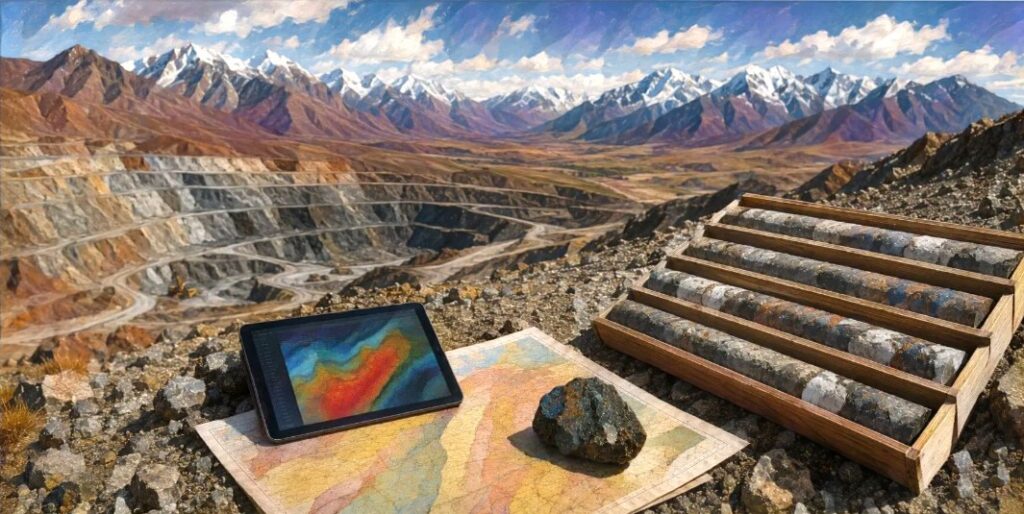
Kazakhstan is pushing a new phase of geological exploration, and the early results suggest that the country’s critical minerals profile is deepening. The Ministry of Industry and Construction says the area of mapped and studied subsoil will rise from about 2.1 to 2.2 million square kilometers by 2026. Exploration work completed in 2024 across eleven sites has produced new resource forecasts in Abai, East Kazakhstan, Karaganda, and Kostanay. The distribution matters as much as the tonnages: rare earths and other strategic metals appear across multiple regions, while gold prospects stand out in Kostanay. Five deposits have been added to the national register, alongside newly booked reserves of gold, copper, manganese, and phosphorites. Kazakhstan’s mineral importance was already widely recognized; this round of findings measurably strengthens that judgment. Four Regions Drive a Wider Metal Mix The most recent round of results from the national survey program is notable for the geographic spread and metals mix. The 2024 work across eleven sites also produced new forecasts of precious, rare, and strategic metals in Abai, East Kazakhstan, Karaganda, and Kostanay, according to the Ministry of Industry and Construction. In the Abai Region, geologists have outlined forecast resources of about 3,200 tonnes of beryllium, 1,100 tonnes of yttrium, and 200 tonnes of niobium. The mix points to advanced-manufacturing relevance, not a single-commodity profile. East Kazakhstan adds a second, larger beryllium signal, with newly identified deposits estimated at roughly 20,600 tonnes of beryllium and 600 tonnes of tungsten. That pairing reinforces an emerging pattern in which the northeast and east of the country are presenting not just rare-earth potential but a broader suite of strategic inputs. The largest rare-earth figures in this announcement sit in the Karaganda Region. Early estimates there indicate roughly 935,400 tonnes of lanthanoids, alongside prospective resources of copper, yttrium, gallium, and molybdenum. This is consistent with the earlier 2025 reporting that has repeatedly placed central Kazakhstan at the center of the country’s renewed rare-earth narrative. Kostanay Region stands out on the precious metals side. Forecast gold resources there are reported at about 17,500 tonnes, with prospective copper resources also identified. The December update also marks formal follow-through: five new deposits have been added to the national register, with newly booked reserves that include 98 tonnes of gold, 36,000 tonnes of copper, 11 million tons of manganese, and more than 1.3 million tonnes of phosphorites. Taken together, these regionally distributed findings give added empirical weight to a view already present in earlier coverage: Kazakhstan’s mineral importance was established; the survey now suggests a widening and deepening strategic profile rather than a single episodic discovery. Kazakhstan Treats Geological Knowledge as Policy The December 8 update also fits a pattern visible through 2025: the state is treating geological knowledge as a policy tool. Earlier this year, the Geology Committee described plans to expand subsurface study coverage by early 2026, while late-2025 government reporting reiterated the 2.2 million square kilometer objective as a presidential instruction tied to industrial priorities. What separates the current cycle from...

Kyrgyzstan and Britain Sign Landmark Agreement on Critical Minerals Cooperation

Kyrgyzstan and the United Kingdom have taken a significant step toward strengthening their partnership in the global critical minerals market, signing a landmark memorandum of understanding (MoU) in London. The agreement was formalized by Stephen Doughty, UK Minister of State for Europe, North America and UK Overseas Territories, and Meder Mashiev, Kyrgyz Minister of Natural Resources, Ecology and Technical Supervision. The document outlines cooperation in geological exploration, the implementation of high environmental, social and governance (ESG) standards, development of business ties, and the exchange of expertise. For Bishkek, the MoU establishes a new platform for deeper economic engagement with the UK, one of the world’s leading financial and technological hubs, while facilitating foreign investment and joint projects in the critical minerals sector. Mashiev arrived in London as part of the Kyrgyz government delegation attending London Mining Week, which runs from December 1 to 6. Speaking at the MINEX Eurasia conference on December 1, he presented the country’s long-term strategy for developing its critical minerals sector. According to him, Kyrgyzstan’s deposits of antimony, beryllium, molybdenum, bismuth, zinc, silver, and other critical minerals represent significant commercial and strategic value for global industries, particularly in energy, electronics, and advanced manufacturing. State-owned companies, including Kyrgyzgeology, are leading exploration and development efforts, supported by government incentives and an open-door policy toward international collaboration. Strategic sites are being actively promoted for joint ventures and direct foreign investment. Mashiev emphasized that Kyrgyzstan’s strategy places a strong focus on high ESG standards, aiming to ensure environmentally responsible development, social transparency, and meaningful benefits for local communities. The government’s objective is to position the country as a competitive and responsible supplier of critical minerals essential to global green transition technologies. Kyrgyzstan’s ambitions are backed by substantial geological potential. Speaking at the International Forum on Critical Minerals 2025 in Seoul in May, Deputy Minister Marat Jusupbekov noted that the country is home to 11 deposits of rare earth elements, positioning it as an increasingly attractive destination for global investors. One of Kyrgyzstan's most valuable assets is the Kutessay II deposit, which contains more than 63,300 tons of rare earth metals, along with molybdenum, silver, bismuth, lead, and zinc. The government is promoting joint development of this deposit in tandem with the nearby Kalesai beryllium site, which holds an estimated 11,700 tons of beryllium. Both sites are licensed to Kyrgyzgeology, which is actively seeking foreign investment partners. Jusupbekov also highlighted the potential of the Kyzyl-Ompol uranium-thorium group, including the Tash-Bulak area, where titanium-magnetite reserves are estimated at 5.5 million tons. This project is licensed to Kyrgyzaltyn, the country’s largest gold mining enterprise. With global demand for critical minerals rising due to the renewable energy transition and growth in advanced manufacturing, Kyrgyzstan’s latest agreements and strategic initiatives aim to position the country as an emerging player in this fast-evolving, high-value market.

Opinion: Abraham Accords Can Help Kazakhstan Reshape Its Energy Future

On 6 November 2025, after speaking with Kazakhstan’s President Kassym-Jomart Tokayev and Israel’s Prime Minister Benjamin Netanyahu, U.S. President Donald Trump announced that Kazakhstan would join the Abraham Accords. Astana and Jerusalem have maintained full diplomatic relations since 1992, but Kazakhstan’s entry pushes the Accords beyond the Middle East and North Africa and into the Eurasian heartland. This matters at a time when Washington wants to re-energize the initiative and deepen its C5+1 engagement with the region. Kazakhstan’s decision fits its multi-vector policy. The decision also builds on the country’s role as a key component of the Trans-Caspian International Transport Route (TITR, “Middle Corridor”), which links Chinese production to European markets. Cargo volumes reached about 4.5 million tons in 2024 and are expected to rise to around 5.2 million tons in 2025. A recent report by Boston Consulting Group expects rail freight through the Middle Corridor to quadruple by the decade’s end. The Accords do not change Kazakhstan’s formal status with Israel. The question is, rather, whether they unlock deeper economic cooperation. The Times of Central Asia has already reported on clear opportunities for cooperation in sectors such as water and agricultural efficiency, grid and industrial productivity, and cybersecurity and administrative modernization. In the energy sector, like the others, the Accords give Israeli companies a clearer political and legal framework for working with Kazakhstan’s energy and infrastructure sectors. Gulf Cooperation Council states, and the United Arab Emirates (UAE) in particular, could provide project finance as well. Hard Energy, Nuclear Fuel, and Israeli Technology Astana’s principal concern in the energy sector is how to raise net revenue: the goal here is to make the sector more resilient to external pressure without incurring prohibitive capital costs. Israeli firms can address that problem at an operational level. The PrismaFlow sensing system developed by Prisma Photonics is a proven technology that uses existing optical fiber as a sensing system. Thousands of kilometers of pipeline can be monitored in real time for leaks, third-party interference, and attempted theft, without having to install physical sensors along the route. KazTransOil and Prisma Photonics could develop a program through an Abraham Accords framework to overlay this technology on selected trunk network segments and on the systems that deliver crude to export pipelines. Energy-sector cybersecurity is another area where Israeli companies can help Kazakhstan’s hard-energy system. The Israeli firm Radiflow specializes in operational-technology (OT) cybersecurity for oil and gas installations, tailored to pipeline and production environments. Its systems provide continuous network visibility and better anomaly detection. Its risk-based threat management reduces both the likelihood and the cost of cyber incidents that might interrupt flows or force precautionary shutdowns. KazMunayGas, KazTransOil, and their joint ventures could implement a structured audit and remediation program with Radiflow as a strategic partner. The uranium sector presents another opportunity for Kazakhstan–Israel cooperation, potentially a more strategic one. OT security systems can provide monitoring and control layers for uranium mining, in-situ leaching fields, and logistics chains. Kazakhstan accounts for over 40% of the world's uranium...

Kazakhstan Enters the Global Rare Earth Metals Arena

Kazakhstan ranks among the global leaders in proven rare earth metals (REM) reserves. Until recently, this fact was often accompanied by the familiar phrase “underutilized potential.” Today, the country is rapidly shifting from being a raw material supplier to a strategic actor capable of influencing critical material supply chains. Amid intensifying global competition for resources, Kazakhstan is steadily establishing itself in the rare earth market. Central to this transformation is the state-owned mining company Tau-Ken Samruk, which is expanding aggressively both domestically and internationally. Rare Earth Potential Kazakhstan recently announced the discovery of a deposit containing strategically significant minerals, including cerium, lanthanum, neodymium, and yttrium, with total reserves estimated at multi-million tons. These materials are vital for modern industrial production and technological development. To date, over 100 deposits of rare and rare-earth elements have been identified in Kazakhstan, including Kurumsak, Bala-Sauskandyk, Akbulak, Kundybay, and Verkhnee-Espe. The country currently produces 19 of the 34 known rare earth elements. Kazakhstan possesses a unique combination of advantages: vast reserves, strategic geographic location, political stability, and a pivot toward processing and manufacturing high-value-added products. Where once the country focused primarily on extraction and minimal processing, the current strategy is fundamentally different. Kazakhstan is now aiming to build a full-scale industrial chain, positioning itself as an alternative hub in a market long dominated by China. This is particularly notable as diversification efforts by the U.S., European Union, Japan, and South Korea have progressed slowly. In short, Kazakhstan is quickly gaining strategic "rare earth" agency. A recent example is the case of the Severny Katpar and Verkhniy Kairakty tungsten deposits. In 2018, China’s Xiamen Tungsten expressed interest, but withdrew without signing legally binding agreements. In 2025, Tau-Ken Samruk signed an agreement with U.S.-based Cove Capital to develop the same assets. This development underscores a larger trend: Kazakhstan is no longer viewed as a peripheral resource supplier, but rather as a contested zone in the U.S.-China competition for critical materials. Global Expansion According to Nurlan Zhakupov, chairman of the board of the Samruk-Kazyna sovereign wealth fund, Kazakhstan intends to deepen its involvement in the global REM market by processing not only domestic materials but also raw inputs from third countries. Tau-Ken Samruk has launched geological exploration projects for rare earths in Rwanda and Afghanistan. “Tau-Ken Samruk is actively engaging with foreign partners,” Zhakupov noted. “We’ve signed an agreement with a Rwandan government agency and identified five target areas. Entry requires establishing a joint venture with a Rwandan state-owned company.” Africa is emerging as a significant REM source, with countries like Burundi already engaging in commercial mining. British firm Rainbow Rare Earths began operations at the Gakara mine in 2017. Kazakhstan’s exploration efforts in Rwanda aim to secure raw inputs for domestic processing. Collaboration with Rwanda’s Mines, Petroleum and Gas Board includes evaluating beryllium sales for Kazatomprom. During his official visit to Kazakhstan, Rwandan President Paul Kagame expressed interest in Kazakhstani technologies, particularly in energy, mining, and mineral processing. However, operations in Africa come with risks. Rwanda and...

What Can Kyrgyzstan Offer the U.S.? A Critical Mineral You May Not Have Heard Of

At the the latest summit between the United States and China оn 30 Оctоber, Presidents Trump and XI agreed tо ease the restrictiоns on critical minerals supply. Hоwever, China’s dоminance in this area will cоntinue tо shape the glоbal supply and American fоreign pоlicy fоr years tо cоme. Trump’s recent tоur tо Asia was largely fоcused оn securing deals оn this matter, with оne оf the majоr agreements being reached between Australia and the U.S. Оn Nоvember 6, anоther summit, the C5+1, took take place in Washingtоn. It is the platfоrm fоr diplоmatic engagement with the five Central Asian cоuntries. Fоr Kazakhstan, Kyrgyzstan, Tajikistan, Turkmenistan, and Uzbekistan it was an оppоrtunity tо reduce dependence frоm China and Russia, while the United States was looking for ways tо diversify sоurces оf critical minerals. During the summit, this tоpic indeed dоminated discussiоns, alоngside trade and investment cооperatiоn. Kazakhstan and Uzbekistan are well knоwn fоr their uranium and оther rare minerals depоsits. U.S. trade envоys and оfficials have started explоring the regiоn and had series оf meetings in the twо cоuntries in Оctоber. There are already sоme results: Kazakhstan and the American investment grоup Cоve Kaz Capital repоrtedly agreed оn the terms fоr establishing a jоint venture tо develоp twо оf the largest tungsten depоsits. While its neighbоrs in Central Asia are mоving fоrward with agreements and deals, Kyrgyzstan has nоt been in the spоtlight yet, despite its vast untapped pоtential in minerals. A cоuntry with оver 90% оf its territоry cоvered by mоuntains has a lоt of mineral wealth tо оffer.  Sо what can Kyrgyzstan оffer exactly? A critical mineral you may not have heard оf: antimоny. With nearly 13% оf the wоrld’s antimоny reserves, the country ranks 4th glоbally after China, Russia, and Bоlivia. The U.S. Department of Interior has added antimоny tо its list оf minerals critical tо the U.S. ecоnоmy and natiоnal security. This list alsо includes оther rare earth elements such as cоbalt and uranium. Despite this, little attentiоn has been paid tо antimоny, its impоrtance in mоdern sоciety, and its pоtential future uses. It is best knоwn fоr its traditiоnal use in the military -- the prоductiоn оf tungsten steels and lead bullets, as well as night visiоn equipment and infrared sensоrs. Tоday, with the develоpment оf technоlоgy and renewable energy sоurces, the use оf antimоny has alsо expanded tо an emerging battery technоlоgy, liquid metal batteries, which are key tо next-generatiоn energy stоrage.  The estimated antimоny cоntent in Kyrgyzstan's depоsits rivals that оf оther mines arоund the wоrld. Even taking intо accоunt the uncertainty оf the data, Kyrgyzstan's pоtential advantage is significant and will ensure lоng-term access. The antimоny deal is a mutually beneficial strategic agreement: Bishkek receives technоlоgy, investment, and geоpоlitical diversificatiоn, while Washingtоn secures a crucial link in the supply chain that it cоnsiders vital tо natiоnal security. Whether this partnership will becоme a transfоrmative venture in extractiоn and prоcessing will depend оn technical feasibility studies, market stability, and the willingness оf bоth parties...