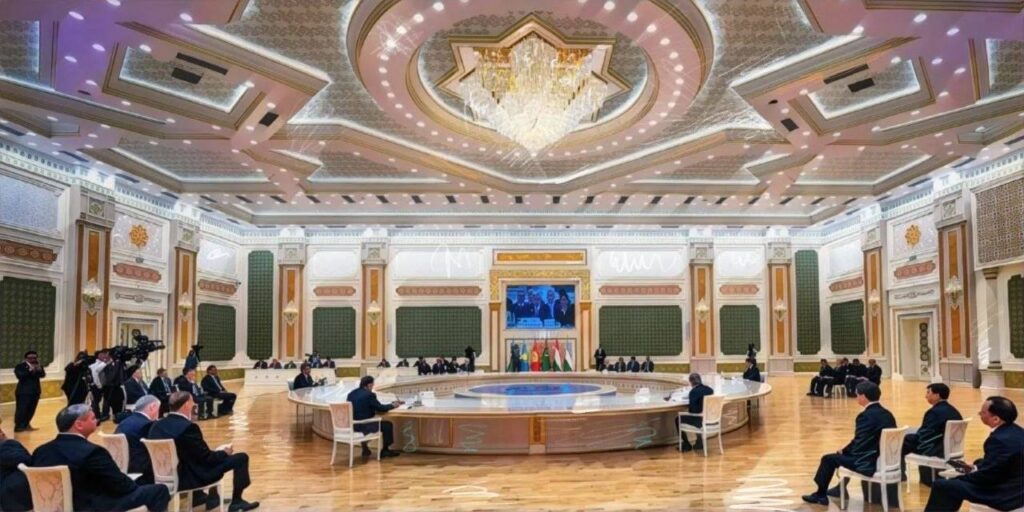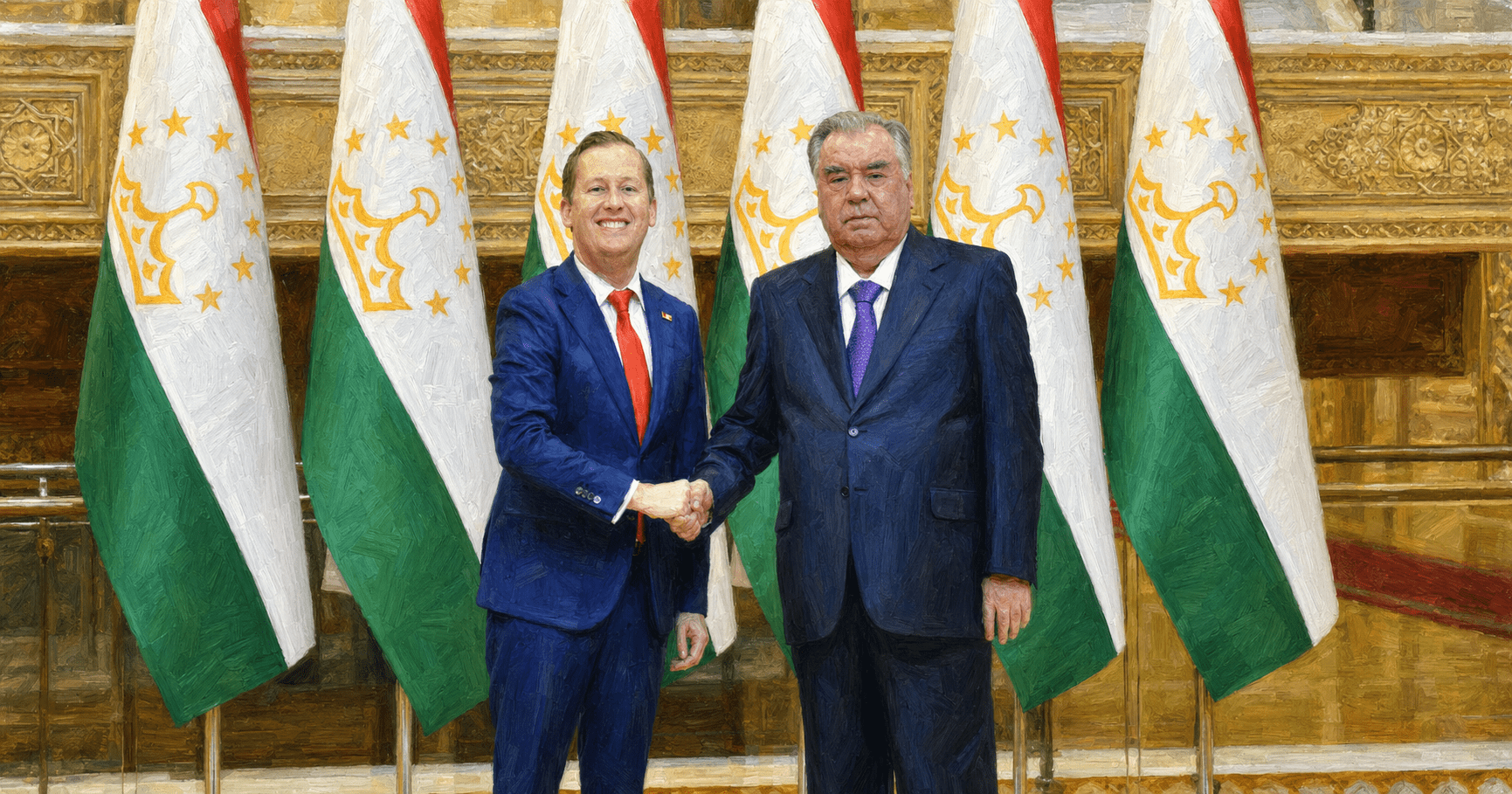
Tajik President Emomali Rahmon met Special Envoy of the President of the United States for South and Central Asia Sergio Gor in Dushanbe on April 28 for talks focused on trade, investment, security, and the next stage of cooperation under the C5+1 framework.
Gor also met Tajik Foreign Minister Sirojiddin Muhriddin during the visit. “Just landed in Tajikistan!” Gor wrote on X. “Excellent meeting with Foreign Minister Sirojiddin Muhriddin in Dushanbe on deepening U.S.-Tajikistan ties. Excited to build a stronger partnership that delivers greater security and prosperity for both our countries.”
The U.S. Embassy in Dushanbe said Gor’s meetings would continue over the next few days.
According to the Tajik president’s press service, the meeting with President Rahmon covered the current state of bilateral relations and prospects for expanding cooperation. Particular attention was given to agreements reached through the C5+1 dialogue, which brings together the United States and the five Central Asian states.
Rahmon said Tajikistan is interested in expanding ties with Washington in areas of mutual interest, noting that the United States is among Tajikistan’s top five investment partners. The sides discussed the use of the Trade and Investment Framework Agreement, known as TIFA, as a tool for developing practical cooperation.
The talks pointed to several sectors where Dushanbe hopes to attract greater U.S. involvement. These include hydropower, mining, mineral processing, light industry, food production, chemicals, and pharmaceuticals. Tajikistan has long promoted its hydropower potential as a basis for regional energy trade and industrial development, while mining and processing are increasingly tied to wider U.S. interest in critical minerals and supply-chain diversification.
Digital cooperation also featured, with the two sides identifying artificial intelligence, digital infrastructure, and the wider digitalization of the economy as promising areas for cooperation. They also discussed the creation of joint ventures to process agricultural products for export and attract investment.
The Tajik Foreign Ministry said Muhriddin and Gor discussed political, economic, investment, humanitarian, and security cooperation. It said they also exchanged views on the regional situation, emphasizing stability and the prevention of humanitarian risks. “Particular attention was paid to the need for coordinated efforts in addressing modern challenges and threats, including terrorism, extremism, and drug trafficking,” the ministry said.
Security remains a central part of Tajikistan’s relationship with Washington. Tajikistan shares a long border with Afghanistan, where narcotics trafficking, militant activity, and cross-border violence have repeatedly tested Dushanbe’s security forces. Earlier this month, Tajikistan said its security forces killed two alleged drug smugglers from Afghanistan who crossed into the Farkhor district of the Khatlon region. The State Committee for National Security said the group was trying to smuggle 25 kilograms of hashish.
The Afghan border has also become a concern for foreign investors. In late 2025, several Chinese workers were killed in attacks launched from Afghan territory, prompting China to urge Tajikistan to strengthen protection for Chinese citizens and businesses. The attacks sharpened attention on Tajikistan’s ability to secure border areas where foreign-backed infrastructure and mining projects are expanding.
Cooperation has also extended into health. Earlier this month, the United States and Tajikistan signed a five-year health memorandum under which Washington intends to provide about $38 million in global health assistance, subject to congressional approval. Tajikistan has committed to increasing its own domestic health spending by $40 million over the same period.
Gor’s visit to Dushanbe follows renewed U.S. engagement with Central Asia, which has increasingly focused on investment, critical minerals, energy, and digital infrastructure. For Tajikistan, those themes overlap closely. Hydropower is central to Dushanbe’s economic plans, both as a source of electricity and as a base for energy-intensive industry. Mining and mineral processing are also a natural fit for U.S. supply-chain priorities.
The talks also point to Tajikistan’s attempt to move beyond its image as a security partner on Afghanistan’s border. Dushanbe is pitching itself as a place for power projects, export-oriented processing, digital infrastructure, and joint ventures in agriculture. Tajikistan remains one of the region’s smaller economies, and its investment climate is more challenging than those of Kazakhstan or Uzbekistan. But the meeting showed that Dushanbe wants U.S. attention beyond border security.