• KGS/USD = 0.01144 0%
  • KZT/USD = 0.00206 0%
  • TJS/USD = 0.10778 0%
  • UZS/USD = 0.00008 0%
  • TMT/USD = 0.28490 -0.28%
  • KGS/USD = 0.01144 0%
  • KZT/USD = 0.00206 0%
  • TJS/USD = 0.10778 0%
  • UZS/USD = 0.00008 0%
  • TMT/USD = 0.28490 -0.28%
  • KGS/USD = 0.01144 0%
  • KZT/USD = 0.00206 0%
  • TJS/USD = 0.10778 0%
  • UZS/USD = 0.00008 0%
  • TMT/USD = 0.28490 -0.28%
  • KGS/USD = 0.01144 0%
  • KZT/USD = 0.00206 0%
  • TJS/USD = 0.10778 0%
  • UZS/USD = 0.00008 0%
  • TMT/USD = 0.28490 -0.28%
  • KGS/USD = 0.01144 0%
  • KZT/USD = 0.00206 0%
  • TJS/USD = 0.10778 0%
  • UZS/USD = 0.00008 0%
  • TMT/USD = 0.28490 -0.28%
  • KGS/USD = 0.01144 0%
  • KZT/USD = 0.00206 0%
  • TJS/USD = 0.10778 0%
  • UZS/USD = 0.00008 0%
  • TMT/USD = 0.28490 -0.28%
  • KGS/USD = 0.01144 0%
  • KZT/USD = 0.00206 0%
  • TJS/USD = 0.10778 0%
  • UZS/USD = 0.00008 0%
  • TMT/USD = 0.28490 -0.28%
  • KGS/USD = 0.01144 0%
  • KZT/USD = 0.00206 0%
  • TJS/USD = 0.10778 0%
  • UZS/USD = 0.00008 0%
  • TMT/USD = 0.28490 -0.28%

Viewing results 1 - 6 of 89

Navigation Seals in the EAEU: Digital Modernization or a New Barrier for Kazakhstani Businesses?

Since February 2026, the countries of the Eurasian Economic Union (EAEU), Kazakhstan, Kyrgyzstan, Tajikistan, Belarus, and Russia, have begun the phased introduction of a navigation seal system to track cargo shipments. The mechanism is designed to increase transit transparency, strengthen control over the movement of goods, and speed up logistics operations. However, business representatives warn that the new system could lead to higher logistics costs and create additional administrative barriers for carriers. Against the backdrop of the launch of the project’s first phase in Kazakhstan, debate is growing over whether digitalization will deliver the expected benefits, or become another source of pressure on the market. New Transport Control System The agreement on the use of navigation seals in the EAEU was signed by the heads of state on April 19, 2021, and ratified by Kazakhstan in 2023. The document provides for the tracking of goods transported through the territories of two or more member states of the union. In Kazakhstan, amendments were introduced to national legislation to implement the agreement, the information systems of controlling authorities were modernized, and pilot projects were conducted in both road and rail transport. Under a resolution of the Government of Kazakhstan dated September 10, 2024, the national operator of the transport tracking system is the Institute of Space Technology and Technologies LLP, which operates under the Aerospace Committee of the Ministry of Digital Development. By decision of the Eurasian Economic Commission’s Collegium dated September 23, 2025, phased transport tracking using navigation seals began on February 11, 2026, for goods transported between EAEU countries. In 2025, the national operator, together with the State Revenue Committee of the Ministry of Finance of Kazakhstan, conducted a pilot project on the use of navigation seals in transit transportation. Testing took place at road border crossings and along railway routes. The main objective was to test procedures for installing and removing seals, as well as to verify the interaction between government information systems and the Transit platform. As a result of the pilot project, more than 890 shipments involving 1,757 vehicles were tracked, and a total of 1,637 navigation seals were installed. The devices were used at key road checkpoints and along the railway route between Altynkol and Saryagash stations. Based on the results, authorities concluded that the system was technically and organizationally ready for large-scale implementation. How “Digital Seals” Work According to Osken Toishibekov, director of the Institute of Space Technology and Technologies, the system is based on the Transit information platform, which connects carriers, operators, and government agencies. He explained to The Times of Central Asia that a navigation seal is a device equipped with an electronic module and a sealing element with satellite navigation capabilities. It enables the location of a vehicle to be tracked via GPS, with data transmitted to the system through mobile networks. The device records attempts to open or damage the seal, break the sealing cable, interfere with the equipment, or trigger other abnormal events. All information is automatically transmitted to the...

Digital Inequality in Central Asia: Who Is Winning the AI Race in Finance?

AI in Central Asia’s financial sector is no longer a fashionable add-on. It has become a dividing line between leaders and laggards. A comprehensive report by the National Bank of Kazakhstan and the Fintech AI Center highlights a stark reality: while some institutions are building sovereign data centers, others are still attempting to automate basic document management processes. Kazakhstan is setting the pace. In his introduction to the report, Timur Suleimenov, Governor of the National Bank of Kazakhstan, echoes President Tokayev’s digital modernization agenda, writing: “Artificial intelligence is rapidly becoming a new paradigm for the development of the national economy… Our country faces the task of not only avoiding being left on the periphery of the global technological trend, but also of using its potential to accelerate economic modernization.” The regional AI race in finance is effectively underway, and the findings reveal deep digital inequality. The Balance of Power: Leaders and Followers A review of AI implementation across the region shows a pronounced technological divide. Kazakhstan remains the undisputed leader. Its banking sector has moved beyond experimental pilot projects. According to the report, AI is most actively deployed in the development of new products (14% of financial institutions) and marketing (13%), where neural networks enable hyper-personalized offerings. A further 10% of institutions use AI in operational activities and compliance. Elsewhere in Central Asia, governments are developing ambitious strategies, but implementation in the financial sector remains limited. Kyrgyzstan plans to launch a National AI Platform under its Digital Transformation Concept for 2024-2028. However, most of the country’s banks remain at the pilot or early implementation stage. Current AI applications focus primarily on decision-making optimization and advertising materials rather than complex financial operations. Tajikistan has positioned itself prominently at the policy level. It adopted an AI Development Strategy through 2040, the region’s first long-term framework, and initiated a United Nations General Assembly resolution on AI for Central Asia in July 2025. Yet in practice, the country’s financial market is dominated by microfinance organizations (MFOs), which are cautious in adopting advanced technologies. Their AI use is largely confined to risk management and documentation, while automation, software development, and data processing lag behind. Only 7% of institutions apply AI in financial consulting and customer support. Uzbekistan has taken a different route, prioritizing international and regional partnerships. In October 2024, the government approved its AI Development Strategy through 2030. Rather than building infrastructure independently, Tashkent is partnering with global technology providers. The state is working with Huawei to develop physical AI infrastructure and deploy ready-made industry solutions. At the same time, Uzbekistan is strengthening its academic capacity, including investments in high-performance computing for Inha University in Tashkent. Regional integration is also central to its strategy: IT Park Uzbekistan has signed a memorandum with Kazakhstan’s Astana Hub to integrate startup ecosystems. This combination, collaboration with global vendors, academic investment, and regional partnerships, is enabling Uzbekistan to narrow its technological gap more quickly. People Instead of Servers Digital inequality is most evident in spending priorities. Investment structures...

Kazakhstan to Digitalize Seaports to Boost Trans-Caspian Transport Route

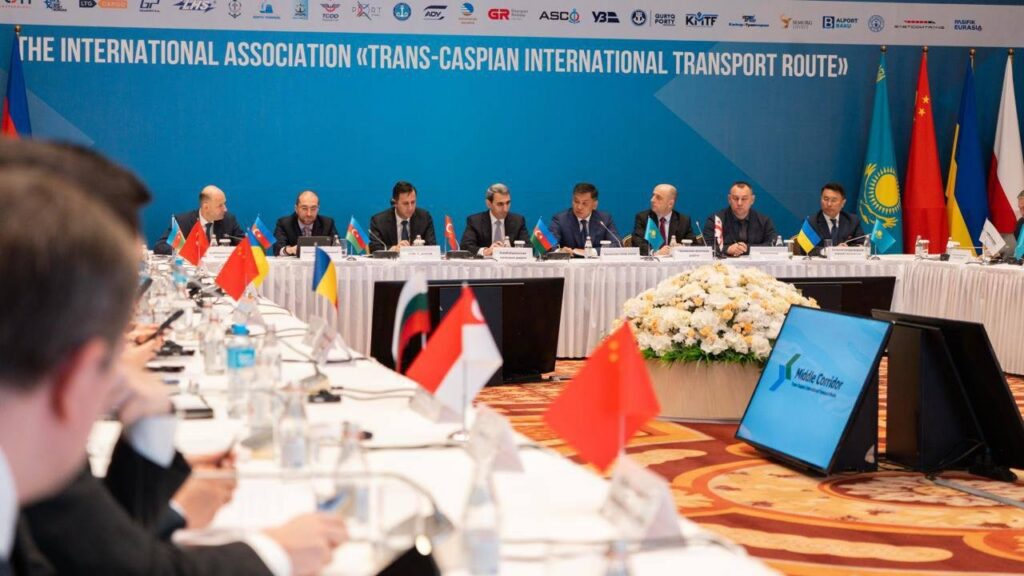
Kazakhstan is advancing the digital transformation of its maritime infrastructure as part of broader efforts to strengthen the Trans-Caspian International Transport Route (TITR), also known as the Middle Corridor. The Ministry of Transport is developing an electronic Maritime Single Window system designed to replace paper-based documentation with digital data exchange for vessel entry and exit procedures at the country’s seaports. The initiative is included in the Roadmap for the Digitalization of Kazakhstan’s Transport Industry for 2025-2027. According to the ministry, the project is being implemented with support from the German Society for International Cooperation (GIZ). An international tender has already been held to select experts responsible for preparing the system’s technical specifications. In February, working meetings were held with stakeholders in Aktau and Kuryk, Kazakhstan’s two largest ports on the Caspian Sea. Discussions focused on port digitalization, simplifying administrative procedures, and reducing vessel processing times through the introduction of the Maritime Single Window. The project is viewed as a key component in the further development of the TITR, which connects China with Europe via Central Asia and the South Caucasus. By streamlining port operations and reducing bureaucratic delays, Kazakhstan aims to enhance the route’s competitiveness and reliability. Kazakhstan’s maritime transport sector has recorded steady growth in recent years. In 2025, maritime cargo volumes reached 8 million tons, a 7% increase compared to 2024. Container traffic through Kazakh seaports rose by 29% to 90,637 TEUs, while cargo volumes transported along the TITR increased by 36%. Infrastructure development has accompanied this growth. In 2025, construction of a container hub at the port of Aktau was completed, a dry cargo vessel was launched on the Kuryk-Baku route, and two new ferries were acquired. Overall transit cargo traffic through Kazakhstan reached 36.9 million tons in 2025, up 6.6% year on year, driven by the integrated development of road, rail, air, and maritime transport. Under the country’s comprehensive maritime infrastructure development plan for 2024-2028, Kazakhstan intends to establish a major transport and logistics cluster based on the ports of Aktau and Kuryk. The plan includes the expansion of container handling capacity, development of cargo terminals and international shipping logistics, and a reduction in administrative barriers. By 2028, total cargo throughput at the ports is expected to increase by 50%, while container handling volumes are projected to triple. To ensure year-round navigation and maintain competitiveness amid changing environmental and logistical conditions in the Caspian region, Kazakhstan has also prioritized dredging works, including the deepening of the ports of Aktau and Kuryk.

Ten Years On, Kazakhstan’s Digital Experiment Moves Closer to Citizens

On a snowy afternoon in Taldykorgan, a group of university students reacts with excitement at the mention of the words “smart city.” “Finally!” one of them says, but they struggle to define what it actually means. Artificial intelligence? Cameras? Faster internet? It doesn’t really matter. For them, the concept signals something simple: progress. That expectation has accompanied Kazakhstan’s digital strategy for nearly a decade. When the government adopted the “Digital Kazakhstan” program in 2017, the goal was to modernize public administration and infrastructure through data. Astana and Almaty were the first testing grounds. But the real challenge began elsewhere. To scale the model nationally, authorities turned to medium-sized towns and small urban centers, places where infrastructure gaps were sometimes more visible than innovation. In some regions, electricity supply remains unstable. In others, sidewalks, heating networks, or waste management systems require urgent upgrades. Aqkol: The Laboratory Aqkol, a town of around 13,000-14,000 residents located 100 kilometers north of Astana, became the country’s first official pilot in 2018. The project, developed in partnership with Kazakhtelecom JSC, Tengri Lab, and the Eurasian Group, aimed to create a “conceptual model” of an intelligent city. Around 3,000 sensors and 150 cameras were installed to monitor everything from traffic flows to air quality. In theory, Aqkol became a data-driven microcosm. In practice, the transformation was uneven. [caption id="attachment_43867" align="aligncenter" width="2560"] During winter, some residents of Aqkol contend with poor street lighting and snow-covered roads; image: TCA, Manon Madec.[/caption] At first glance, Aqkol does not immediately appear transformed. On the main avenue, two heated bus stops operate through the winter. Nearby, smart benches equipped with Wi-Fi and charging ports stand mostly unused. A seventy-year-old resident waiting for his bus acknowledges that “the city has become more comfortable.” [caption id="attachment_43864" align="aligncenter" width="2560"] In Aqkol, residents are waiting for more “smart” bus stops; image: TCA, Manon Madec.[/caption] Yet a few streets away, there are no sidewalks and limited street lighting. “Children walk home from school in the dark,” says Nadejda, a resident in her thirties. Zeinolla, a taxi driver native from Aqkol, questions whether the investment reached the entire town. To understand the project, one has to step inside the Smart Aqkol control room. In a small office, screens display live environmental and security data. Air quality is measured every ten minutes. During winter evenings, coal-burning households generate visible emission peaks on the graphs. “With these systems, we see exactly when pollution increases,” explains Asylbek Baiboranov, deputy director of the Smart Akmola regional program. “We can identify patterns and respond faster.” On one of the large LED screens, a woman’s portrait appears alongside a live video feed of her entering what looks like a post office. The system matches faces in real time. “The surveillance cameras are equipped with facial recognition technology,” Baiboranov explains. Since their installation, recorded offences have fallen by roughly 20%, according to him. Taldykorgan: more security, more environmental considerations Taldykorgan already has an extensive camera network. Ameer, a student, supports further expansion. A smart city,...

Kazakhstan to Launch AI Fund Backed by National Bank

Kazakhstan will establish a dedicated Artificial Intelligence Fund to finance digital and educational initiatives, Deputy Prime Minister and Minister of Artificial Intelligence and Digital Development Zhaslan Madiev announced at an expanded government meeting. According to Madiev, the fund will be capitalized using resources from the National Bank, with the government currently finalizing its financial and organizational structure. The fund is expected to serve as the main vehicle for identifying and supporting priority AI and digitalization projects, as well as educational programs. Madiev cited international precedents, noting that leading technological nations allocate between 4% and 6% of GDP to digital development and artificial intelligence over three years. Based on ministry projections, such investments could yield a multiplier effect of 5 to 1, with the potential to contribute up to 1.5% of GDP annually in additional economic growth. One of the fund’s key focuses will be integrating AI solutions into Kazakhstan’s public and quasi-public sectors. Simultaneously, the country is pursuing international tech partnerships. With presidential backing, Kazakhstan has approved the creation of a joint venture with Chinese artificial intelligence firm 01.AI. Scheduled to launch in March, the venture will operate the National Artificial Intelligence Platform and focus on developing AI agents to enhance public sector decision-making. 01.AI is a startup founded by former Google China CEO Kai-Fu Lee. The company is best known for its open-source language model Yi-34B, positioned as an alternative to ChatGPT. At the meeting, President Kassym-Jomart Tokayev emphasized that AI is a foundational pillar of Kazakhstan’s emerging economic model. Anticipated benefits include increased labor productivity, growth in export-oriented industries, higher production of high value-added goods, and deeper integration into global digital networks. However, Tokayev also cautioned against using insufficient digitalization as a scapegoat for systemic inefficiencies. “Technology should not serve as an excuse for management shortcomings,” he noted. As previously reported by The Times of Central Asia, Kazakhstan joined OpenAI’s “Education for Countries” initiative, aimed at integrating AI tools into national education systems.

Kazakhstan Moves to Regulate Chinese Medicine Clinics

Amanzhol Altai, a deputy of the Mazhilis, has submitted a formal request to the Ministry of Health proposing tighter oversight of centers operating under labels such as “Eastern medicine,” “Chinese medicine,” “acupuncture,” and “manual therapy.” The central proposal is the creation of an open digital register of such institutions, particularly those involving foreign specialists. According to the deputy, he regularly receives complaints from citizens about the provision of medical services without proper licenses or verified qualifications, the performance of invasive procedures in violation of sanitary standards, the use of unregistered medicines, and misleading advertising that promises to “cure” serious illnesses. Altai also said that some centers operate for only short periods before changing their names or addresses in order to evade oversight. Of particular concern, he noted, are cases in which foreign nationals without confirmed medical education present themselves as doctors. “We are talking about citizens of the People's Republic of China who present themselves as qualified specialists, see patients for several months, and then close the center and leave the country,” the deputy said. In his view, such practices pose a direct threat to patients’ life and health and undermine trust in the healthcare system. At the same time, some services offered under the branding of “traditional Chinese medicine” are classified as medical activities under Kazakh law and therefore require licensing, certified qualifications, and compliance with established regulatory standards. In this context, Altai proposes not only establishing a digital register of these organizations but also issuing official legal clarifications on the status of such services, strengthening interagency control over the circulation of unregistered medicines, and tightening oversight of online advertising for these centers. The Times of Central Asia previously reported on the risks of drug shortages in Kazakhstan amid proposed changes to tax policy.