• KGS/USD = 0.01144 0%
  • KZT/USD = 0.00216 0%
  • TJS/USD = 0.10659 0%
  • UZS/USD = 0.00008 0%
  • TMT/USD = 0.28530 0%
  • KGS/USD = 0.01144 0%
  • KZT/USD = 0.00216 0%
  • TJS/USD = 0.10659 0%
  • UZS/USD = 0.00008 0%
  • TMT/USD = 0.28530 0%
  • KGS/USD = 0.01144 0%
  • KZT/USD = 0.00216 0%
  • TJS/USD = 0.10659 0%
  • UZS/USD = 0.00008 0%
  • TMT/USD = 0.28530 0%
  • KGS/USD = 0.01144 0%
  • KZT/USD = 0.00216 0%
  • TJS/USD = 0.10659 0%
  • UZS/USD = 0.00008 0%
  • TMT/USD = 0.28530 0%
  • KGS/USD = 0.01144 0%
  • KZT/USD = 0.00216 0%
  • TJS/USD = 0.10659 0%
  • UZS/USD = 0.00008 0%
  • TMT/USD = 0.28530 0%
  • KGS/USD = 0.01144 0%
  • KZT/USD = 0.00216 0%
  • TJS/USD = 0.10659 0%
  • UZS/USD = 0.00008 0%
  • TMT/USD = 0.28530 0%
  • KGS/USD = 0.01144 0%
  • KZT/USD = 0.00216 0%
  • TJS/USD = 0.10659 0%
  • UZS/USD = 0.00008 0%
  • TMT/USD = 0.28530 0%
  • KGS/USD = 0.01144 0%
  • KZT/USD = 0.00216 0%
  • TJS/USD = 0.10659 0%
  • UZS/USD = 0.00008 0%
  • TMT/USD = 0.28530 0%

Viewing results 1 - 6 of 33

Kazakhstan-EU Cooperation Focuses on Critical Raw Materials and Regional Connectivity

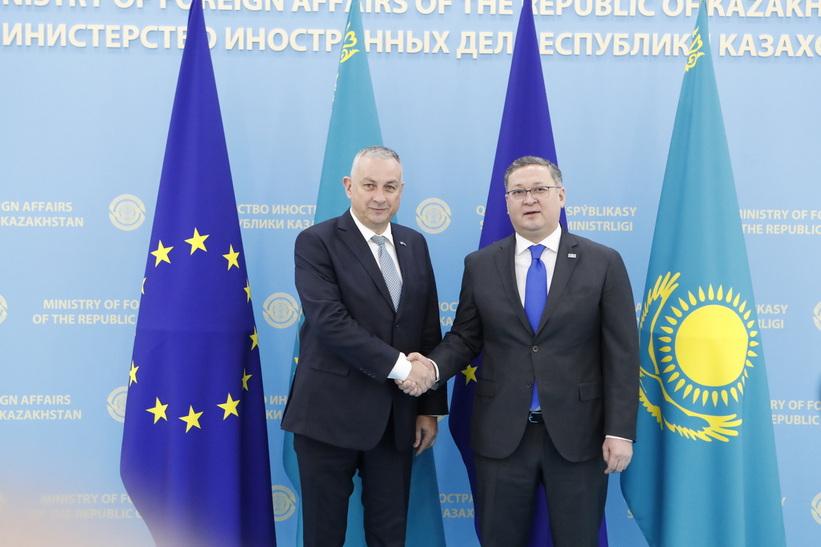
On March 13, European Commissioner for International Partnerships Jozef Síkela visited Kazakhstan and held negotiations with Deputy Prime Minister and Minister of Foreign Affairs Murat Nurtleu. As a result of the visit, the European Union and Kazakhstan have taken steps to strengthen their partnership, signing key agreements to support sustainable economic growth and foster regional connectivity, according to the EU Delegation to Kazakhstan. Investments in Transport and Renewable Energy During the visit, Commissioner Síkela and Kazakh officials oversaw the signing of a €200 million framework loan agreement between the European Investment Bank (EIB) and the Development Bank of Kazakhstan (DBK). This loan, backed by an €18 million EU guarantee, will finance investments in sustainable transport and renewable energy. The initiative aligns with the EU’s Global Gateway strategy, particularly its programs on the Trans-Caspian Transport Corridor and the Team Europe Initiative on Water, Energy, and Climate Change. Síkela underscored the EU’s commitment to strengthening economic ties with Kazakhstan through sustainable investments. “This financing agreement will boost connectivity, enhance renewable energy infrastructure, and further integrate Kazakhstan into the Trans-Caspian Corridor, a key component of the Global Gateway strategy,” he stated. Critical Raw Materials Cooperation The visit also marked the signing of a €3 million contract to enhance cooperation between the EU and Central Asia in the critical raw materials (CRM) sector. The agreement, implemented by the European Bank for Reconstruction and Development (EBRD), will support the identification of joint projects and promote international best practices for sustainable and responsible supply chains. Síkela highlighted the importance of the agreement, stating: “The EU and Kazakhstan are natural partners. Europe needs reliable access to critical raw materials, which are essential for modernizing our economy. We are committed to advancing mutually beneficial cooperation with Kazakhstan on their extraction and development. This partnership will support all Central Asian countries, strengthen Kazakhstan’s industrial capacity, create new opportunities for Kazakh businesses, drive innovation, and generate high-quality jobs.” Kazakhstan-EU Trade and Investments Foreign Minister Nurtleu reaffirmed Kazakhstan’s commitment to expanding its partnership with the EU. “Astana and Brussels have built a strong political dialogue, established dynamic cooperation between executive bodies, and fostered productive cultural and humanitarian ties between our peoples,” he said. According to the Kazakh Foreign Ministry, the EU is Kazakhstan’s primary trade and investment partner. In 2024, bilateral trade between Kazakhstan and the EU totaled $49.7 billion, with Kazakhstan’s exports reaching $38.6 billion and imports totaling $11.1 billion. From 2005 to October 2024, the total foreign direct investment (FDI) inflow from EU countries reached $200.7 billion, accounting for 47.8% of Kazakhstan’s total FDI inflows ($419.5 billion).

Visit by EU’s Sikela Strengthens Global Gateway Partnership with Turkmenistan

On March 12, European Commissioner for International Partnerships Jozef Síkela visited Turkmenistan, as part of the European Union’s work to expand cooperation under the Global Gateway strategy. The visit focused on transport connectivity, renewable energy, and trade facilitation, aiming to integrate Turkmenistan into regional and global economic networks, according to the EU Delegation to Turkmenistan. Global Gateway and the Trans-Caspian Transport Corridor The Global Gateway strategy is the EU’s initiative to bridge global investment gaps by promoting sustainable connectivity in digital, energy, and transport sectors, while strengthening education and research systems. The initiative seeks to mobilize €300 billion in public and private investments between 2021 and 2027, fostering sustainable growth and resilient partnerships worldwide. A key topic during Síkela’s meetings with Turkmenistan’s President Serdar Berdimuhamedov and Foreign Minister Rashid Meredov was the Trans-Caspian Transport Corridor, a strategic route enhancing connectivity between Central Asia and Europe. Síkela reaffirmed the EU’s support for Turkmenistan’s role in this corridor, emphasizing its potential to create faster, more secure trade routes. “We see Turkmenistan as a key partner for building stronger connections between Europe and Central Asia. By working together under the Global Gateway, especially through the Trans-Caspian Transport Corridor, we are creating faster, more secure trade routes that will open new opportunities for businesses, attract investments, and create jobs. Our joint efforts aim to cut trade times between Europe and Asia to only 15 days, while helping Turkmenistan become an important hub for commerce between Asia and Europe.” According to the Turkmen Foreign Ministry, Berdimuhamedov highlighted the Turkmenbashi Port as a vital transit hub on the Caspian coast, offering a direct link to the Black Sea, Europe, the Middle East, South Asia, and the Asia-Pacific region. While in Turkmenistan, Síkela visited the Turkmenbashi Port, where he met with Mammethan Chakyev, Director General of the Agency for Transport and Communications under the Cabinet of Ministers. He reaffirmed the EU’s commitment to supporting infrastructure modernization and regulatory alignment to international standards. Energy and Climate Cooperation As part of the visit, two key initiatives were launched under the EU-Turkmenistan bilateral cooperation facility: A €6 million project, implemented by the International Trade Centre (ITC), will support Turkmenistan’s accession to the World Trade Organization (WTO) and promote economic modernization. A €4.5 million initiative, implemented by GIZ, aims to advance renewable energy development, reduce methane emissions, and improve energy efficiency. Síkela also welcomed Turkmenistan’s accession to the Global Methane Pledge, stressing the importance of emissions reduction and sustainable energy solutions for fostering a greener economy. The EU’s technical and financial assistance will further support Turkmenistan’s efforts to align with international trade and environmental standards.

Eduards Stiprais Appointed New EU Special Representative for Central Asia

The Council of the European Union has appointed Eduards Stiprais as the new EU Special Representative for Central Asia. Stiprais will assume his duties on March 1, 2025, with an initial two-year mandate, succeeding Terhi Hakala. According to the European Council, Stiprais will be responsible for promoting EU-Central Asia relations based on shared values, strengthening regional stability and cooperation, and supporting democracy, the rule of law, good governance, and human rights. A seasoned Latvian diplomat, Stiprais previously served as Latvia’s Permanent Representative to the EU and as Deputy State Secretary - Political Director at the Latvian Ministry of Foreign Affairs. From 2016 to 2020, he was Head of the EU Delegation to Uzbekistan and has also served as Latvia’s ambassador to the United Kingdom and France. The European Council recently announced that the first-ever EU-Central Asia summit will be held in Uzbekistan on April 3-4. The summit will be attended by European Council President António Costa, European Commission President Ursula von der Leyen, and the presidents of Kazakhstan, Kyrgyzstan, Tajikistan, Turkmenistan, and Uzbekistan. As EU-Central Asia relations gain strategic significance, the upcoming summit presents a key opportunity for the EU to deepen its engagement in the region. The European Council stated that discussions will focus on enhancing cooperation in transport and digital connectivity, critical raw materials, economic and security collaboration, and energy transition. The EU adopted a new Strategy on Central Asia in 2019. The EU remains Central Asia’s second-largest trading partner and the leading investor, accounting for over 40% of foreign investment in the region.

Criminal Charges Against MEP Maria Arena Spark Renewed Debate on Central Asia Influence-for-Hire

In the latest chapter of a slow-burning story, on January 18, 2025, Antonio Panzeri’s successor as head of the European Union’s Subcommittee on Human Rights (DROI), Maria Arena, was charged with participating in a criminal organization concerning the Qatargate scandal. As far back as December 2022, shocking revelations had exposed collaboration between Panzeri, EU officials, and certain NGOs. This alliance turned their human rights advocacy into a self-serving commercial enterprise, yielding them €2.6 million and their clients favorable motions and resolutions in the European Parliament. The roles of Arena and Panzeri in commercializing their office by curating human rights targets and taking protective measures for monetary exchange warrant closer scrutiny. After leaving DROI, Panzeri continued to operate behind the scenes, having “almost 400 telephone calls” in ten months with Arena. As reported by Politico, her ties to the NGOs Fight Impunity (FI) and No Peace Without Justice (NPWJ) raised concerns about transparency and influence within DROI, especially as key figures from these NGOs faced corruption and money laundering charges in the EU’s Qatargate scandal. Arena’s leadership has also been criticized for allowing unbalanced hearings that favored Qatar’s interests while sidelining its critics. The scope of corruption extends beyond Qatar, with both Morocco and Mauritania mentioned as attempting to influence European Parliament decisions through bribery. All three countries — Qatar, Morocco, and Mauritania — deny any involvement. Germane to Central Asia, Maria Arena reportedly penned a letter to the Ambassador of Kazakhstan in Brussels calling for the release from prison of Karim Massimov, the former head of Kazakh intelligence who was sentenced to long-term imprisonment in his homeland for high treason, attempted coup and abuse of power. Journalists’ investigations have documented Massimov’s alleged links to major corruption, and he was closely associated with the authoritative regime of former President Nazarbayev. Arena’s push coincides with social media postings on 8 November 2022 by FI and NPWJ calling for Massimov’s release. Francesco Giorgi, an ex-parliamentary staffer at Fight Impunity and Panzeri aide who admitted partial guilt in the Qatargate bribery scandal, retweeted the post. A broader investigation suggests further malfeasance similar to Qatargate, in which Panzeri, Arena, and other EU officials collaborated with Mukhtar Ablyazov, a known criminal with judgments against him exceeding $4.8 billion dollars in the U.S. and British courts. Ablyazov is facing potential deportation from France following his evasion of a 22-month UK prison sentence for contempt of court. Despite this high-profile conviction in the UK, under DROI’s leadership, a faction of European politicians, including prominent names from the S&D including Panzeri and Maria Arena, along with their legislative partner Renew Europe, continued to align themselves with Ablyazov. An analysis of Ablyazov's supporters in the European Parliament, PACE, and national legislatures reveals a discernible pattern. During his time in Strasbourg, Ablyazov met with Panzeri – a figure labeled by The Spectator as one of Ablyazov’s “most diligent lawyers and active supporters.” Alongside Ablyazov was his daughter, Madina, who is married to Ilyas Khrapunov - found by a federal judge in...

Central Asia’s Pivotal Role in the Global Energy Transition

The United States and Europe are driving a global shift from fossil fuels to renewable energy, though progress has been slow. Central Asia’s oil, gas, uranium, and green hydrogen resources are expected to remain vital for Europe and global energy security for years to come. Within Central Asia, a shift to cleaner natural gas and nuclear energy is anticipated to replace coal-fired power, reducing environmental harm. Europe’s push for electrification has also renewed focus on nuclear energy, increasing the strategic and commercial value of Central Asia’s uranium deposits. On December 16, 2024, The Times of Central Asia, in cooperation with the Central Asia-Caucasus Institute and the American Foreign Policy Council, hosted a Burgut Expert Talk titled, "Central Asia in the Energy Transition". The event featured presentations by Dr. Svante Cornell and Dr. Brenda Shaffer, who outlined their takes on the topic. The discussion focused on Central Asia’s significant role in the global energy landscape, particularly in light of the push for renewable energy and Europe's efforts to diversify its energy sources. Challenging the notion of a true "energy transition," Shaffer argued that despite substantial investment in renewable energy, fossil fuels remain dominant. Shaffer pointed out that traditional biomass burning continues to be a major energy source in developing countries, posing significant health risks. Highlighting the fact that renewables often rely on a baseload of fossil fuels, Shaffer noted that this makes complete reliance on renewables impractical, especially in regions with harsh winters, such as Central Asia. Dr. Shaffer further emphasized that European policies, including the reluctance to finance fossil fuel projects and the instability of U.S. LNG exports, serve to hinder diversification efforts. Stressing the need for affordable and accessible energy solutions - particularly for developing countries - to address the issue of indoor pollution caused by traditional biomass burning, she argued that natural gas can serve as a bridge fuel, offering a cleaner alternative to traditional methods. Dr. Cornell focused on the rising importance of Central Asia as a major uranium producer, supplying a crucial element for nuclear energy, which is gaining renewed interest as a low-carbon energy source. Cornell highlighted the dependence of the EU on uranium imports and the potential for Central Asia, particularly Kazakhstan, to play a pivotal role in supplying this demand. Outlining the geopolitical dynamics surrounding uranium, Cornell noted the involvement of France, Russia, and China in Central Asia's uranium sector, emphasizing the importance of Central Asian states maintaining a balance in their foreign relations and partnering with various countries to ensure their independence in the uranium market. Drawing parallels to the oil and gas diplomacy of the 1990s - when Central Asian countries strategically engaged with multiple actors to safeguard their interests - Cornell advocated for the development of a robust domestic nuclear industry in Central Asia, enabling the region to move beyond raw material production and gain greater control over the value chain. Cornell also stressed the need for Western powers to actively engage in the region's nuclear sector, supporting the development...

Turkmenistan to Boost Gas Exports to Neighbor Uzbekistan

Uzbekistan has agreed to purchase more natural gas from Turkmenistan, though the amount of additional gas and the price remain unclear. Uzbek President Shavkat Mirziyoyev spoke by phone with the chairman of Turkmenistan’s Halk Maslahaty (People’s Council) and leader of the country Gurbanguly Berdimuhamedov on December 5 to discuss the deal. According to Turkmen state news, Berdimuhamedov “agreed to the increase” of Turkmen gas to Uzbekistan, and it would not be surprising if Berdimuhamedov was quietly dancing in celebration on the other end of the line.   Anxious to Sell Turkmenistan has the fourth largest gas reserves in the world, some 17.5 trillion cubic meters, at least. To put that in perspective, the 27 countries of the European Union, combined, used 350 billion cubic meters of gas in 2022, meaning Turkmenistan has enough gas to meet all the EU’s gas needs, at current levels, for 50 years. Unfortunately, more than 33 years after becoming independent, Turkmenistan still does not have many customers for its gas. There is China, which buys the most Turkmen gas, some 35 billion cubic meters (bcm), Uzbekistan, which in recent years has been purchasing 1.5-2 bcm annually from Turkmenistan, and Azerbaijan, which gets 1-1.5 bcm of Turkmen gas via a swap arrangement involving Iran. Turkmenistan’s only successful recent export deal is with Iraq for 10 bcm, which involves a swap arrangement with Iran that will require maintenance work and repairs on Turkmenistan’s and Iran’s pipelines. Turkmenistan just lost Russia as a customer after the contract for Russia to purchase up to 5.5 bcm of Turkmen gas expired at the end of June 2024. The expiration of the agreement with Russia meant Turkmenistan lost its second biggest buyer, but that might now turn out to be good news for Uzbekistan.   Anxious to Buy The jump in the number of people and accompanying expansion of service infrastructure have combined with Uzbekistan’s gross failure to increase domestic gas output to make Uzbekistan a net gas importer. In late January 2023, Uzbek media reported the country produced some 51.7 bcm of gas in 2022 and said plans called for increasing that to 56.3 bcm in 2023. Instead, gas production fell to 46.7 bcm in 2023, and it is set to decrease further in 2024. Uzbekistan signed its first contract for Turkmen gas in December 2022. That deal was for 1.5 bcm annually, but in August 2023, the two countries agreed to boost that to 2 bcm. However, that was not enough to fill Uzbekistan’s growing gas consumption needs. In June 2023, Uzbekistan signed a two-year agreement to import up to 2.8 bcm of gas from Russia, but by March 2024, reports showed Uzbekistan looking to increase Russian gas imports to 11 bcm starting in 2026. It looks like some of the 5.5 bcm Turkmenistan was until recently selling to Russia will instead be sent to Uzbekistan, so for Turkmenistan, the gas deal with Uzbekistan only recovers some of the revenue lost with the expiration of the contract with Russia....