• KGS/USD = 0.01144 0%
  • KZT/USD = 0.00216 0%
  • TJS/USD = 0.10663 0%
  • UZS/USD = 0.00008 0%
  • TMT/USD = 0.28530 0%
  • KGS/USD = 0.01144 0%
  • KZT/USD = 0.00216 0%
  • TJS/USD = 0.10663 0%
  • UZS/USD = 0.00008 0%
  • TMT/USD = 0.28530 0%
  • KGS/USD = 0.01144 0%
  • KZT/USD = 0.00216 0%
  • TJS/USD = 0.10663 0%
  • UZS/USD = 0.00008 0%
  • TMT/USD = 0.28530 0%
  • KGS/USD = 0.01144 0%
  • KZT/USD = 0.00216 0%
  • TJS/USD = 0.10663 0%
  • UZS/USD = 0.00008 0%
  • TMT/USD = 0.28530 0%
  • KGS/USD = 0.01144 0%
  • KZT/USD = 0.00216 0%
  • TJS/USD = 0.10663 0%
  • UZS/USD = 0.00008 0%
  • TMT/USD = 0.28530 0%
  • KGS/USD = 0.01144 0%
  • KZT/USD = 0.00216 0%
  • TJS/USD = 0.10663 0%
  • UZS/USD = 0.00008 0%
  • TMT/USD = 0.28530 0%
  • KGS/USD = 0.01144 0%
  • KZT/USD = 0.00216 0%
  • TJS/USD = 0.10663 0%
  • UZS/USD = 0.00008 0%
  • TMT/USD = 0.28530 0%
  • KGS/USD = 0.01144 0%
  • KZT/USD = 0.00216 0%
  • TJS/USD = 0.10663 0%
  • UZS/USD = 0.00008 0%
  • TMT/USD = 0.28530 0%

Viewing results 1 - 6 of 28

What’s Holding Back Kazakhstan’s Air Transport Market?

Kazakhstan’s aviation industry has posted steady growth in recent years. Over the past four years, passenger and cargo traffic have risen by more than 36% and 23% respectively, with an actively expanding route network. The state’s aviation development strategy prioritizes infrastructure upgrades, improved safety standards, and expanded international cooperation. Yet, despite these advances, several systemic barriers continue to prevent Kazakhstan from realizing its potential as a Central Asian aviation hub. These challenges were discussed at the New Silk Way International Transport and Logistics Business Forum and the annual TransLogistica Kazakhstan 2025 exhibition. Experts agree that Kazakhstan’s air transport market ranks among the fastest-growing globally, driven in part by geopolitical shifts that have boosted the volume of Chinese and European transit flights through its airspace. Industry Trends and Infrastructure Expansion A major airport modernization effort is underway, targeting key cities such as Astana, Almaty, Aktobe, Shymkent, and Karaganda. Renovations have already been completed in Aktau, Pavlodar, and Balkhash, while new terminals have opened in Almaty, Kyzylorda, and Shymkent. New airports are under construction in Kenderli, Zaisan, Katon-Karagai, and Arkalyk. Total investment in infrastructure has exceeded $2.9 billion. According to the Civil Aviation Committee, in 2025, Kazakh airlines transported a record 15 million passengers and 171,000 tons of cargo. Transit flights accounted for 414 million aircraft-kilometers. Deputy Chairman Sarsen Zharylgasov has stated that the country now operates 56 domestic routes, up 9% year-on-year, and maintains air links with 30 countries. International Routes and Regional Competition In 2025, 33 new international routes were launched, connecting Kazakhstan to cities including Budapest, Munich, Cairo, Shanghai, Phuket, and Delhi. Currently, 140 international routes operate under the Open Skies policy, which has applied to 15 airports since 2019. Looking ahead to 2026, new routes are planned to major global hubs, such as Singapore, Tokyo, Rome, Vienna, and New York. The long-anticipated direct U.S. flight hinges on a successful completion of the FAA's CAT-1 audit, following Kazakhstan’s passage of the preliminary technical assessment in August 2024. The 2022 air transport agreement between the U.S. and Kazakhstan remains a key step toward this goal. Air Astana plans to operate the route using a Boeing 787 Dreamliner, though delivery has been delayed to Q2 2026 due to production backlogs. Meanwhile, Uzbekistan is ramping up its own ambitions. During President Shavkat Mirziyoyev’s 2025 visit to the US, Tashkent signed a deal with Boeing for 22 Dreamliners. Analysts suggest this could intensify regional competition and enhance Uzbekistan’s appeal as a transit hub. Airport Bottlenecks and Tariff Issues Despite progress in large cities, many regional airports remain hampered by chronic underinvestment and outdated tariff policies. According to Zharylgasov, tariffs at several airports have not been updated in over two decades. “We are working to completely deregulate tariffs, but the Agency for the Protection and Development of Competition does not yet support us,” he noted. Eliminating state control over airport tariffs could introduce market-based pricing, attract investors, and improve profitability, particularly for regional hubs. Digitalization Drives Efficiency Digital transformation is another key priority. Kazakhstan...

Multimodal Transport: What Makes Modern Logistics Flexible and Efficient?

Kazakhstan has set itself the task of developing the country's transport and transit potential. The national railway network operator, as well as the country’s main freight and passenger rail carrier, is now engaged in organizing multimodal transportation that combines rail, maritime, air, and road transport, along with providing logistics services at international cargo hubs. In August, it was announced that KTZ Express JSC, a subsidiary of KTZ JSC, had been established as Kazakhstan's first national air freight carrier, and that modern sea vessels were being built to develop the domestic fleet. We spoke with Damir Kozhakhmetov, CEO of JSC “KTZ Express,” about the prospects for developing aviation and maritime competencies within the framework of a multimodal operator. - Mr. Kozhakhmetov, could you tell us about your company’s plans for creating a national cargo airline under JSC “KTZ Express”? - First, I would note that establishing a national cargo airline means building a modern, competitive freight carrier. The project is coordinated by the Samruk-Kazyna Sovereign Wealth Fund, while our company is designated as the lead implementer. This effort will allow Kazakhstan to strengthen its position as a key transit hub of Eurasia and deepen integration into global transport chains. In terms of goals, the priority is to ensure Kazakhstan has stable access to international markets. The new carrier will not only handle transit cargo but also open new opportunities for businesses, especially where delivery speed is critical. Aviation, in particular, offers capabilities that no other mode of transport can match. As you know, the global air cargo market is growing rapidly. On the one hand, this is driven by the expansion of e-commerce; on the other, by rising transit flows between China and Europe. Kazakhstan’s unique geographic location gives us an advantage, and our task is to turn that into concrete, competitive services. The process of building the airline is structured in stages, and we have already started practical implementation. Research results confirm strong potential on routes between China and Europe, the Middle East and Central Asia, and in transit shipments via Kazakhstan. These routes will form the backbone of a sustainable network and the company’s long-term growth, aligned with current market trends, competition, and projected demand. In parallel, we have begun organizational structuring, regulatory compliance, and the development of manuals and documentation required to obtain an Air Operator Certificate (AOC). These documents are essential for launching any airline, as they confirm that the carrier has the necessary structure, staff, aircraft, and procedures that meet aviation law and safety standards. To ensure the project is built on solid ground and delivers real impact, we are engaging international consultants and leading industry experts. At the first stage, we plan to launch regular flights and establish a reliable route network. Priority will, of course, be given to the China-Europe corridor, which is one of the fastest-growing segments with strong and stable demand. At the next stage, the fleet will expand, and operations will extend to Southeast Asia, North America, the Middle East, and Africa. We...

Kazakhstan and China Pilot Driverless Cargo Transport Project

Kazakhstan and China have  launched a pioneering pilot project called “Smart Customs,” which will enable the use of driverless vehicles to transport cargo across their shared border. The program is currently being tested at the Bakhty (Kazakhstan) and Pokitu (China) border checkpoints. Its main goal is to streamline customs procedures using high-tech solutions, with autonomous trucks as the project’s central feature. These unmanned vehicles are designed to cross the border automatically, removing the need for human drivers. The initiative was formalized during a working meeting between Zhandos Duisembiev, Chairman of Kazakhstan’s State Revenue Committee, and Zhixianwei, Party Secretary of the Chinese city of Tacheng in the Xinjiang Uyghur Autonomous Region. The two sides signed a cooperation agreement confirming their commitment to harmonize efforts, share expertise, and support digital innovation in logistics. The Smart Customs system incorporates several advanced technologies: A unified electronic declaration system recognized by both countries Fully digitized documentation and data processing Continuous, unmanned cargo movement across the border Automated navigation and operational control These innovations are expected to reduce border processing times, lower transportation costs, and improve operational transparency. The project also aims to support the development of logistics infrastructure along the border. Key objectives of the initiative include: Expanding annual cargo capacity to 10 million tons Establishing logistics hubs to relieve pressure on current infrastructure Creating employment opportunities and attracting investment Increasing exports of Kazakhstani agricultural products, including grain, oilseeds, meat, and processed goods According to Kazakhstan’s Ministry of Finance, the initiative is intended to strengthen the country’s position as a regional transit hub and to deepen trade relations with China. Kazakhstan has previously faced criticism over delays in customs inspections. A study by the German Society for International Cooperation (GIZ) in late 2024 found Kazakhstan had the slowest inspection times among Central Asian countries, averaging 2 hours and 26 minutes per cargo inspection. In comparison, Turkmenistan averaged 50 minutes, Uzbekistan 1 hour and 25 minutes, Kyrgyzstan 1 hour and 28 minutes, and Tajikistan 1 hour and 50 minutes. The rollout of Smart Customs is expected to significantly improve these statistics and help Kazakhstan match the efficiency of regional leaders in border processing. Autonomous cross-border freight transport has also been explored by Russia and China. Previous plans aimed to launch driverless cargo operations across the new Blagoveshchensk–Heihe Bridge, although that  project has yet to materialize.

Kazakhstan, Hungary, and China Establish Cargo Terminal in Budapest

Kazakhstan Temir Zholy (KTZ, Kazakhstan’s national railway company), L.A.C. Holding (Hungary), and Xi'an Free Trade Port Construction and Operation Co., Ltd (China) have signed a memorandum to establish a joint inter-modal cargo terminal in Budapest. The document was signed on November 20 as part of the state visit of Kazakhstan's President Kassym-Jomart Tokayev to Hungary. The planned terminal will leverage the strategic location of the Hungarian capital in the heart of Europe and its developed transport network for multimodal transportation across the continent. The terminal will have a capacity of 230,000 TEU annually and will increase the number of container trains between China and Europe, including transit along the Trans-Caspian International Transport Route (TITR). The new terminal is expected to reduce delivery times and transportation costs. KTZ continues to expand its terminal network along key transport corridors to strengthen Kazakhstan's position as a key transit hub in Eurasia. On November 12, Kazakhstan, Azerbaijan, and China signed an agreement to establish an inter-modal cargo terminal in the Port of Alat in Baku, Azerbaijan. Commenting on the signed Memorandum at a press briefing in Budapest, Tokayev said this initiative will strengthen trade and transport ties between the participating countries. “New opportunities are opening up for the development of infrastructure, logistics, and international trade. Eighty-five percent of land transit shipments between Asia and Europe pass through Kazakhstan. In the near future, the volume of cargo transportation along this route will reach 10 million tons,” Tokayev said.

Kazakhstan, Azerbaijan and China Establish Joint Cargo Terminal in Baku

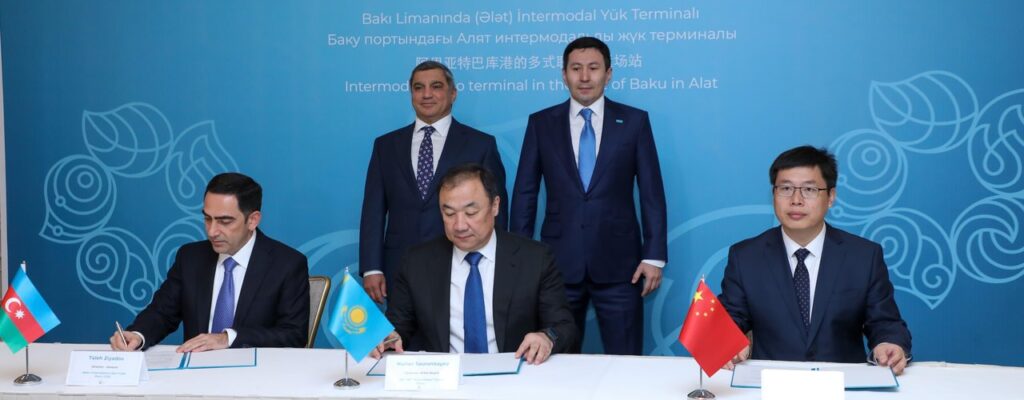
Azerbaijan, China, and Kazakhstan have signed an agreement to establish an intermodal cargo terminal in the Port of Alat in Baku, the Azerbaijani capital. The agreement was signed in Baku on November 12 by SK-AIH Investment Fund Ltd (Samruk-Kazyna, Azerbaijan Investment Holding), Kazakhstan Temir Zholy (Kazakhstan’s national railway company), Baku International Sea Trade Port (Azerbaijan), and Xi'an Free Trade Port Construction and Operation Co., Ltd (China). The project was made possible through Azerbaijan’s provision of a land plot, operational berths, and terminal facilities at the Port of Alat. This new terminal is expected to increase container train traffic between China and Europe along the Trans-Caspian International Transport Route (TITR), also known as the Middle Corridor, reducing delivery times, transportation costs, and transshipment time. The terminal will feature a universal cargo yard, a covered warehouse complex spanning 5,000 square meters, and a container yard with a capacity of over 1,000 containers. Kazakhstan and China plan to increase the volume of cargo transported along the TITR to 600 container trains per year by 2025–2026, with targets of 1,000 container trains in 2027 and 2,000 by 2029, according to Kazakhstan’s Ministry of Transport. In 2023, transit volumes between China and Europe through Kazakhstan reached 2.76 million tons—a 65% increase from 1.7 million tons in 2022. The TITR connects China and Europe via Central Asia and the Caucasus, bypassing Russia, offering a strategic link between the two regions.

Kazakhstan and China to Double Trade, Increase Cargo Transportation

On November 4, Kazakhstan’s Prime Minister Olzhas Bektenov arrived in Shanghai and held talks with his Chinese counterpart China Li Qiang. They discussed strengthening trade, investment, transport and logistics cooperation, agriculture, energy, and tourism. Kazakhstan and China aim to double bilateral trade turnover from last year’s historic high of $41 billion. In January-September 2024, Kazakh-Chinese trade totaled $33 billion. Bektenov stressed that Kazakhstan is ready to increase exports to China of 180 high-value-added commodity items worth $1.6 billion. Bilateral agricultural trade increased by 5.8% from January to September 2024, reflecting China’s growing demand for Kazakhstani organic and environmentally-friendly agricultural products. The sides discussed expanding the export of Kazakh grain, crops, and livestock products. Regarding the transport and logistics sector, the Kazakh and Chinese prime ministers noted that over 80% of land cargo transportation from China to Europe today passes through Kazakhstan. Therefore, Kazakhstan is interested in deepening cooperation within China’s Belt and Road Initiative framework. Bektenov noted that this globally important project, together with the Trans-Caspian International Transport Route (the Middle Corridor), running through the territory of Kazakhstan, can unlock the potential of the North-South and East-West corridors. In January-September 2024, the traffic volume along the Middle Corridor exceeded the previous year's figures by 23% and amounted to 3.4 million tons. This figure is expected to increase to 10 million tons annually by 2030. Bektenov also attended the Kazakh-Chinese investment roundtable in Shanghai, which resulted in the signing of commercial agreements with Chinese companies totaling $2.5 billion, including on energy projects and localized automotive production. Addressing the forum, Bektenov said: "Kazakhstan and China have huge potential for implementing joint investment projects. Together, we can open new horizons for interaction and increase the effectiveness of cooperation. To this end, we should actively work to expand transit opportunities, strengthen industrial cooperation, and build ties between our business communities."