• KGS/USD = 0.01143 -0%
  • KZT/USD = 0.00198 -0%
  • TJS/USD = 0.10899 0.93%
  • UZS/USD = 0.00008 0%
  • TMT/USD = 0.28490 -0.28%
  • KGS/USD = 0.01143 -0%
  • KZT/USD = 0.00198 -0%
  • TJS/USD = 0.10899 0.93%
  • UZS/USD = 0.00008 0%
  • TMT/USD = 0.28490 -0.28%
  • KGS/USD = 0.01143 -0%
  • KZT/USD = 0.00198 -0%
  • TJS/USD = 0.10899 0.93%
  • UZS/USD = 0.00008 0%
  • TMT/USD = 0.28490 -0.28%
  • KGS/USD = 0.01143 -0%
  • KZT/USD = 0.00198 -0%
  • TJS/USD = 0.10899 0.93%
  • UZS/USD = 0.00008 0%
  • TMT/USD = 0.28490 -0.28%
  • KGS/USD = 0.01143 -0%
  • KZT/USD = 0.00198 -0%
  • TJS/USD = 0.10899 0.93%
  • UZS/USD = 0.00008 0%
  • TMT/USD = 0.28490 -0.28%
  • KGS/USD = 0.01143 -0%
  • KZT/USD = 0.00198 -0%
  • TJS/USD = 0.10899 0.93%
  • UZS/USD = 0.00008 0%
  • TMT/USD = 0.28490 -0.28%
  • KGS/USD = 0.01143 -0%
  • KZT/USD = 0.00198 -0%
  • TJS/USD = 0.10899 0.93%
  • UZS/USD = 0.00008 0%
  • TMT/USD = 0.28490 -0.28%
  • KGS/USD = 0.01143 -0%
  • KZT/USD = 0.00198 -0%
  • TJS/USD = 0.10899 0.93%
  • UZS/USD = 0.00008 0%
  • TMT/USD = 0.28490 -0.28%
06 December 2025

Viewing results 1 - 6 of 8

Tokayev Proposes Employing Top Foreign Graduates in Kazakhstan

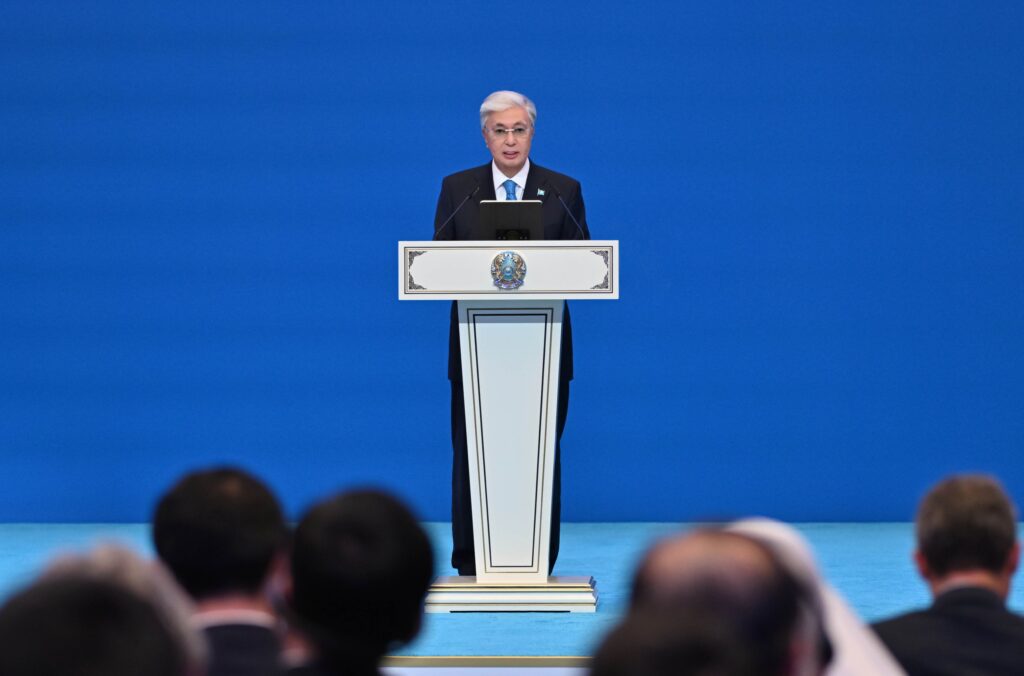
President Kassym-Jomart Tokayev has proposed launching a program to employ the most talented foreign graduates of Kazakh universities, allowing them to begin their professional careers within the country. He announced the initiative during the Strategic Partners Forum, Kazakhstan - Territory of Academic Education. According to Tokayev, over 31,000 foreign students are currently studying at Kazakh universities, a national record. The government aims to increase this figure to 100,000 by 2029 through visa liberalization and improved learning conditions. The employment program will enable top-performing international graduates to stay in Kazakhstan, contributing to the national economy. Simultaneously, the country plans to expand the number of foreign university branches in Kazakhstan, with a particular focus on technical disciplines. “The opening of branches of foreign universities is fully in line with our goal of developing engineering and IT education,” Tokayev said. Kazakhstan currently hosts three Lu Ban workshops, which serve as centers for applied engineering training. Special emphasis is being placed on preparing skilled personnel for the nuclear energy sector. “Our task is to ensure a direct link between education and science and the real sector of the economy. There are already successful examples: the partnership between Kozybayev University and the University of Arizona has led to the development of a technology to convert sulfur into innovative polymers. This is a vital project for our country, which has significant sulfur reserves. It will spur growth in the chemical industry and contribute to solving environmental challenges,” Tokayev noted. Since 2019, Kazakhstan has tripled its investment in education and science. Five Kazakh universities have been included in the Times Higher Education global rankings, and higher education institutions now enjoy greater autonomy. Tokayev emphasized that investment in education is an investment in Kazakhstan’s future. He said the country sees the demographic potential of Central Asia and neighboring regions as an opportunity to grow its higher education sector and attract international students. “Kazakhstan has set itself the ambitious goal of becoming part of the global knowledge market. To this end, we have partnered with 40 leading universities worldwide and opened 33 foreign university branches. Many of these institutions offer courses in English, Russian, and Chinese. Multilingualism is the key to openness and competitiveness for both universities and nations,” he said. To help foreign students better understand local culture, all foreign university branches are required to offer mandatory courses in the Kazakh language and the history of Kazakhstan. Tokayev also named digital state development and the integration of artificial intelligence (AI) technologies among the country's top priorities. He noted that by 2030, AI is projected to contribute over $15 trillion to global GDP, and Kazakhstan intends to play an active role in this transformation. “Since the beginning of the year, we have launched the AI-Sana program, completed by more than 540,000 students. Courses on artificial intelligence have become mandatory in all schools and universities. An AI university is currently in development,” Tokayev said. He cited agreements reached with OpenAI during his September visit to the United States, under which...

From Astana to the World: Kazakhstan Expands Academic Frontier

Kazakhstan is rapidly establishing itself as a regional center for higher education, attracting students from around the world. The number of branches of foreign universities operating in the country is steadily increasing, complemented by a growing domestic academic base, especially in fields such as artificial intelligence. Today, Kazakhstan is viewed as a viable regional alternative to Russia, which has long been considered a destination for affordable, high-quality education. Expanding Options for Students In June, the Ministry of Science and Higher Education of the Republic of Kazakhstan unveiled a map of foreign university branches operating in the country. The government is positioning Kazakhstan as a leading academic hub in Central Asia by enhancing international cooperation and expanding opportunities for students. Partnerships have already been established with 39 foreign universities. Currently, 23 branches of institutions from the UK, Italy, China, Russia, the U.S., France, and South Korea operate in Kazakhstan. [caption id="attachment_36320" align="aligncenter" width="1201"] Map of foreign university partnerships; image: Ministry of Science and Higher Education of Kazakhstan.[/caption] Seven more branches are expected to open in the 2025-2026 academic year, namely Coventry University, the Moscow State Institute of International Relations (MGIMO) in Astana, Gazi University in Shymkent, Woosong University in Turkestan, Anhalt University in Almaty, Politecnico della Marche in Taldykorgan, and Dong Eui University in Kostanay. A standout example of this strategy arrived in early September: Notably, on September 3, Cardiff University opened its first campus outside the UK in Astana. It is also the first member of the prestigious Russell Group to begin operations in Kazakhstan. The Russell Group comprises 24 leading UK universities responsible for two-thirds of all research grants and contract funding in the UK, and 56% of doctoral degrees awarded. Cardiff University Kazakhstan is now accepting students for four-year bachelor’s programs in computer science, business management, civil engineering, and geology and mineral exploration. Kazakhstan has witnessed a surge in the establishment of foreign university branches since 2021. These include the Peking University of Languages and Culture at Astana International University, and the National Research Nuclear University MEPhI (Russia) at Al-Farabi Kazakh National University. Additional branches include the University of Lorraine (France) at the Kazakh National Pedagogical University named after Abai, and the University of Anhalt (Germany) at the Almaty University of Power Engineering and Telecommunications named after Gumarbek Daukeev. Other notable branches include the University of Hong Kong at Satpayev University in Almaty, Berlin Technical University in Aktau, De Montfort University (UK) in Almaty, and Queen’s University Belfast (Ireland) at Narxoz University, among others. These branches offer programs in mining, water resource management, and mineral exploration and extraction, along with biotechnology, electrical engineering, energy, mechatronics, logistics, chemical technology, robotics, and related disciplines. In 2023, Korkyt Ata University in Kyzylorda launched an Institute of Artificial Intelligence, in partnership with Seoul National University of Science and Technology. It currently offers programs in computer science, cybersecurity, software development, and information systems. An Ambitious Vision Observers note that Kazakhstan’s education drive is unfolding amid growing global competition for international students. Neighboring Uzbekistan...

Learning Across Borders: Education at the Heart of Central Asia–Japan Relations

For more than three decades, Japan has cultivated a distinctive partnership with the countries of Central Asia, one rooted not in geopolitics or grand strategy alone, but in human connection. Education has emerged as one of the strongest pillars of this relationship, as young people from Uzbekistan, Kyrgyzstan, Kazakhstan, Tajikistan, and beyond increasingly look to Japan for academic training, language study, and professional development. Tokyo’s support for scholarships, university exchanges, and Japanese language programs reflects a long-term vision: to invest in people-to-people ties that strengthen mutual understanding and prepare a new generation of leaders across the region. The Times of Central Asia spoke with Central Asian students at the International University of Japan to gauge their experiences. Ilyos from Uzbekistan: "As an international student, I found Japan to be a country of fascinating contrasts - deeply rooted in tradition, yet highly modern. I was struck by the coexistence of fast-paced, bustling cities and quiet, remote towns, each offering a very different atmosphere and way of life. "I chose Japan because I’d previously studied in South Korea at the undergraduate level. That experience made me curious about Japan, as I expected certain similarities but also wanted to explore the differences. I thought that if Japan were similar to Korea, the adjustment would be smooth, and if it offered something new, it would be an even greater opportunity to broaden my perspective and prepare for my career. "I’ve been truly impressed by how consistently Japanese people follow rules, respect social order, and demonstrate a high level of etiquette in everyday interactions. This has left a strong impression on me and has shaped the way I think about discipline, respect, and community values." Farrukh from Tajikistan: "I first visited Japan back in 2019. At that time, it was a business trip, and I spent a month here. I’d been thinking about studying in Japan for a long time, but I finally had the opportunity last year when the JICE JDS Scholarship in my home country was announced. "In the time I’ve been here, I’ve never felt I was treated differently from other people, even locals. There have been minor instances when Japanese people acted very strictly, but I guess that’s how they usually are. In terms of cultural differences, one thing I noticed was how hard they work; there is a lack of work-life balance." Azmat from Uzbekistan: "Most of my colleagues from work got their Master’s degrees in Japan, and we have some agreements between the Japanese government and our organization about studying here. My ex-director, my current deputy director, and the head of division are graduates of Japanese universities. So, listening to their stories, I ended up studying in Japan. "I find the people of Japan to be very polite and patient. The way they treat us as foreigners is really good. Of course, there are some difficulties - Japan is a country of rules - but they’re minor." As Central Asia deepens its educational links with Japan, the stories of...

From Kazakhstan to Arizona: First Student Cohort Marks Nation’s Education Hub Ambitions

On August 23, 2025, 29 students from Kozybayev University in Petropavlovsk arrived at the University of Arizona. Their journey marks the start of a dual-degree program that allows Kazakh students to spend a semester in the U.S. while completing the rest of their studies at home. Graduates will receive two diplomas, one from each institution. The program, launched under President Kassym-Jomart Tokayev’s directive, is Kazakhstan’s first large-scale partnership with a U.S. university. Fully funded by the state, it covers tuition, housing, visas, and travel expenses. Courses are offered in biotechnology, information systems, and inclusive education - fields aligned with Kazakhstan’s development priorities. Part of a Broader Strategy This initiative is not just about Kozybayev University. It is part of a broader government strategy to internationalize higher education and transform Kazakhstan into an academic hub for Central Asia. In 2022, Tokayev set a goal of opening five foreign university branches by 2025. Since then, partnerships have multiplied: De Montfort University (UK) in Almaty, MEPhI and Gubkin University (Russia) in Almaty and Atyrau, and the University of Arizona in Petropavlovsk. Others are in development, including Heriot-Watt University (Scotland), SeoulTech (South Korea), and Tianjin University (China). These ventures come with incentives. The government treats foreign universities as “strategic investors,” offering land, tax breaks, and simplified bureaucracy. In return, Kazakhstan gains access to advanced curricula and English-language teaching, while local universities benefit from joint research and faculty exchanges. Building Domestic Capacity Kozybayev University has expanded rapidly to accommodate the Arizona program: a new academic laboratory, dormitories, and upgraded infrastructure are in place. The university is also hosting students from 16 countries, including a hundred from Türkiye. This signals a shift - Petropavlovsk, once peripheral in academic terms, is now a point of attraction for international students. The government’s long-term aim is to convert more domestic universities into research-intensive institutions. By embedding foreign collaborations into the national strategy, Kazakhstan hopes to ensure lasting benefits rather than temporary prestige projects. Rising Student Mobility Kazakhstan’s pivot to become an education destination reflects changing regional dynamics. More than 31,000 foreign students now study in Kazakhstan, including over 12,000 from India in medical programs. This is a sharp rise from a few years ago and a reversal of the trend where most Kazakh students went abroad, often to Russia. The Ministry of Science and Higher Education is actively promoting the country under the “Study in Kazakhstan” campaign, targeting markets like Pakistan, China, and Azerbaijan. For many students, Kazakhstan offers lower costs than the West and the chance to earn dual degrees with reputable foreign institutions. For many international students, Kazakhstan is becoming an appealing study destination. Tuition fees are comparatively low - ranging from US $1,500 to $5,000 per year - while monthly living costs are in the U.S. $550–$750 range, encompassing accommodation, food, transport, and essentials. These financial benefits, along with government scholarships, English-taught programs, and dual-degree opportunities, make Kazakhstan an increasingly attractive option. Lessons from Abroad Kazakhstan’s ambition echoes strategies pursued by the UAE and Singapore. Dubai, for example,...

From Uzbekistan to St. Petersburg: An International Student’s Journey Through Challenges and Change

Five years ago, Dilshot moved from Uzbekistan to St. Petersburg to pursue higher education. Like many international students, he faced challenges adapting, cultural differences, and other unexpected difficulties. The Times of Central Asia spoke with Dilshot to learn how his life in Russia has unfolded, what obstacles he encountered, and why his future in the city has taken an unexpected turn. TCA: Why did you choose to study in St. Petersburg? What factors influenced your decision? Dilshot: After finishing school in Uzbekistan, I decided to continue my education in Russia, specifically in St. Petersburg. First of all, I believed that Russia provided high-quality education, especially in IT, where it is ahead of other CIS countries. Additionally, at that time there was no war, and I never expected the situation to take such a turn. The pandemic also played a role. Since entrance exams were conducted online, it became easier to apply. Moreover, Russian universities offered many state-funded places, and I was fortunate enough to receive a scholarship. While Uzbekistan has good universities, particularly in Tashkent, tuition fees were high, and I couldn't find a suitable program in my field. Moving to a new city and country was exciting and I was full of hope, but the reality turned out to be more complicated. TCA: How would you describe the atmosphere at the university and among students? Dilshot: The university had a relatively open and multicultural environment, which helped with adaptation. Many students were supportive, regardless of nationality. However, stereotypes still existed. Occasionally, I heard remarks like, "What are you doing here? Go work at a construction site." Kazakh students were often mistaken for Chinese without people even bothering to ask about their nationality. For students from CIS countries who spoke Russian, adaptation was easier. Professors and students generally considered us as “their own”, though with some reservations. However, foreign students, particularly from China, faced a different attitude. Some professors showed impatience if a student struggled to express themselves in Russian. In dormitories, tensions arose; Chinese students were sometimes mocked over minor disputes, whereas CIS students were treated with more understanding. TCA: Did you experience prejudice from your professors? Dilshot: Some professors viewed me through the lens of stereotypes, making me feel isolated. While I didn’t face direct discrimination, there were moments when my knowledge was questioned, or my achievements were met with unnecessary surprise. One instance stands out: a lecturer made a point of noting where students were from. I happened to excel in his subject, but I still don’t understand why he felt the need to keep track of our nationalities. On a few occasions, I received high grades with remarks like, “Wow, you speak Russian so well!” Of course, I wasn’t going to complain about good grades, but it made me feel uncomfortable as if my achievements were being measured against lower expectations. TCA: Did participating in student activities help you integrate? Dilshot: Yes, I got involved in student projects and activities early on. This helped break down...

Uzbekistan Ranked Fifth for Number of Students Studying Abroad

According to Statista, based on UNESCO data, Uzbekistan ranked fifth globally in terms of the number of students studying abroad in 2021. Chinese and Indian students top the list. The number of Chinese students studying abroad was one million, and Indian students, 508,000. Vietnam, Germany and Uzbekistan are next on the list, with 137,000 students from Vietnam, 126,000 from Germany, 110,000 from Uzbekistan, 106,000 from France, 103,000 from the U.S., and 99,000 from Syria studying abroad. The U.S. has become the main country receiving foreign students, enrolling 833,000 in 2021, with Britain in second place with 601,000. The figures are part of the World Migration Report 2024. UNESCO has reported that international students numbered 2.2 million in 2001, and this had increased to 6.39 million by 2021.